
Millennial Marketing Statistics UK Businesses Can Actually Use
Table of Contents
Millennial marketing statistics get quoted a lot and verified rarely. Most of the figures circulating online trace back to US surveys from 2017 to 2020, repackaged each year with a fresh date in the title. This guide takes a narrower, more honest approach: every number here is attributed to a named source, the scope (global, UK, US) is stated plainly, and where the data is thin or contested, it says so. The aim is to give marketing managers and business owners in Northern Ireland, Ireland, and the UK figures they can put in front of a client without getting caught out.
One point up front. Millennials are not a single homogenous market. Born between 1981 and 1996, they are aged roughly 30 to 45 in 2026 (Pew Research Center definition), which means their behaviour now splits hard along lines of income, region, life stage, and whether they are buying for themselves or signing off a corporate budget.
Who Millennials Are in 2026
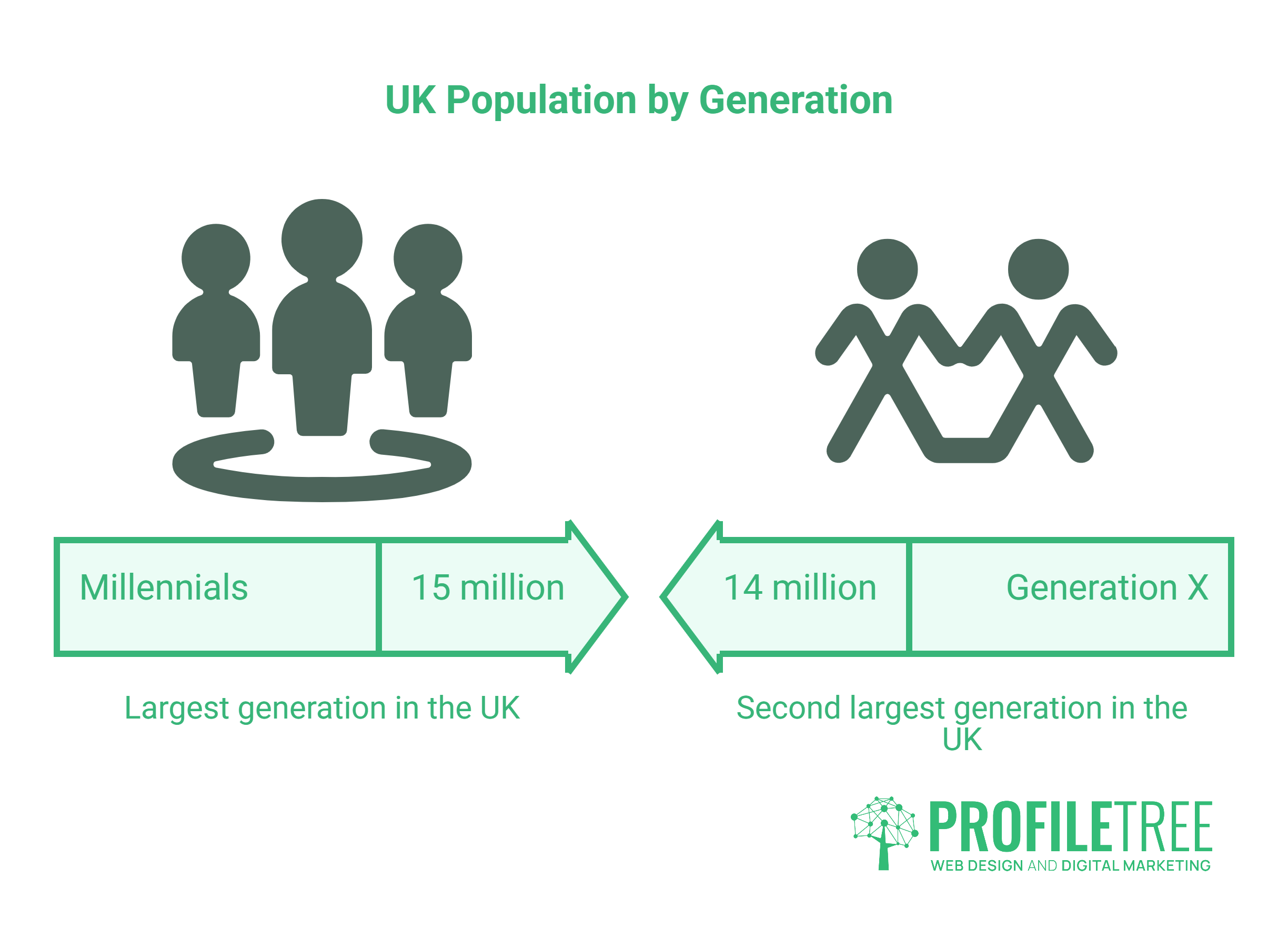
Millennials are the largest generation in the UK. As of 2024 there were over 15 million of them, ahead of Generation X at around 14 million, according to Office for National Statistics estimates published via Statista. They overtook the Baby Boomer generation as the UK’s largest cohort in 2019.
Definitions matter here, because they change the headline number. The House of Commons Library, using a narrower age band, has put the UK figure closer to 14.4 million. The cohort is more urban and more ethnically diverse than older groups, and it carries the marks of entering the workforce around the 2008 financial crisis: stagnant real wages and lower home ownership than previous generations at the same age. The same House of Commons research found that a majority of millennial-headed households were renting rather than owning, a reversal of the pattern twenty years earlier.
For UK and Irish marketers, that economic backdrop matters more than any single demographic stat. A generation carrying student debt and high housing costs behaves differently to the free-spending stereotype the older statistics implied. If you want help turning audience research into a coherent plan, our digital strategy service is built around exactly this kind of segmentation work.
Spending Power: What the Data Actually Shows
The most-quoted global figure is around $2.5 trillion in annual millennial income or spending power, a number originally calculated by YPulse and widely circulated through Visual Capitalist. It is worth treating with care. The original YPulse calculation was US-focused, and different sources put the figure anywhere from $2.5 trillion to $4 trillion depending on whether they measure income or total spend.
Where there is broader agreement: millennials are projected to keep growing as a spending force. Analysis cited by Khoros puts collective millennial income on track to exceed $4 trillion by 2030, and NielsenIQ projects that millennials will overtake Gen X as the highest-spending generation globally by the early-to-mid 2030s. So the direction of travel is clear even where the exact figure is not.
On financial behaviour, the verifiable signals point to caution rather than abandon. Around 46% of millennials report not feeling financially secure, second only to Gen Z (The Robin Report), and roughly 1 in 5 millennials planned to use Buy Now, Pay Later services in 2024 (ESW, cited via Khoros). That combination, real spending power tempered by financial anxiety, is the practical takeaway for any UK brand pricing or positioning a product for this group.
Social Media and Digital Discovery
This is the area where the original article carried the most unsourced claims, so it is worth being plain: many of the precise percentages you see quoted about millennial platform use cannot be traced to a primary source. What can be said with confidence is that millennials were the first generation to come of age alongside mainstream internet access, and social platforms now sit firmly inside their research and discovery habits.
If you are running social activity aimed at this group, the practical questions are which platforms, how often, and what the path to a sale looks like. Those answers differ by sector and audience, which is why a templated posting schedule rarely works. Our social media marketing service starts from the conversion path rather than the posting calendar.
Video deserves a specific mention because it is the highest-engagement format across most channels, and it is one of the few areas where production quality and distribution strategy are genuinely separable problems. A polished video that nobody sees is a common, expensive mistake.
For the strategy side of that, from filming through to ranking and distribution, our video marketing service treats production as one part of a broader plan. And if blog, social, and email content all need to pull in the same direction, our content marketing service covers the connective work.
The B2B Millennial Buyer
Here is the gap most millennial marketing content misses. The oldest millennials are now in their mid-forties, which puts a large share of them on B2B buying committees, in management, and in budget-holding roles. Treating the entire cohort as retail consumers is increasingly out of date.
B2B millennials tend to favour self-directed research: ungated information, transparent pricing, and peer reviews over cold outreach. For a UK or Irish business selling to this buyer, that shifts the emphasis towards search visibility and genuinely useful content rather than interruptive advertising. Strong search engine optimisation and a well-built website do more of the selling than they used to. If your site is the first thing a millennial decision-maker checks, our website design and website development services exist to make that first impression count.
There is also a growing AI dimension. Millennials increasingly use conversational AI tools during product research, which changes what “being found” means. Our work on AI for marketing looks at how that affects discovery, and our digital training helps teams build the skills to keep up rather than outsourcing them permanently.
As Ciaran Connolly, founder of ProfileTree, puts it: The biggest mistake we see with millennial marketing is treating a 44-year-old finance director and a 30-year-old first-time buyer as the same person. They grew up with the same technology, but their budgets, their pressures, and their buying decisions have almost nothing in common.
How to Market to Millennials in Practice
The data points in one direction: segment first, then build. A campaign aimed at a 30-year-old renter and a 44-year-old budget holder cannot be the same campaign, even though both grew up with the same technology. Start by deciding which slice of the cohort you are actually selling to, then work backwards from their life stage and pressures.
A few principles hold up across most of the verified picture. Lead with usefulness rather than interruption, because this is a generation that researches before it buys and trusts peer reviews over polished advertising. Be transparent on price, particularly given the financial caution the data shows. And make the path from discovery to purchase short, since friction is where intent quietly leaks away.
Channel choice follows from the audience, not the other way round. For B2C activity, social discovery and video tend to carry the most weight; for B2B millennials, search visibility and genuinely useful content do more of the selling than outreach does. Either way, the work sits inside a wider plan rather than a single channel, which is what our digital strategy service is built to set up. If your team would rather develop these skills in-house, our digital training covers the practical side.
One caution worth stating plainly: price sensitivity can override stated values. A millennial may say they prefer sustainable or local brands and still choose the cheaper option under cost-of-living pressure. Treat ethical positioning as a genuine commitment that earns trust over time, not a shortcut to a sale.
Conclusion
The honest version of millennial marketing statistics is smaller and more cautious than the usual listicle, but it is also more useful. The cohort is large, financially squeezed, increasingly senior in business, and split across very different life stages. For brands across Northern Ireland, Ireland, and the UK, the opportunity is in segmenting properly rather than chasing a single trillion-dollar headline.
Frequently Asked Questions
How many millennials are there in the UK?
Over 15 million as of 2024, making them the UK’s largest generation, according to ONS estimates published via Statista. Narrower age-band definitions, such as the House of Commons Library’s, put the figure closer to 14.4 million.
How much time do millennials spend on social media?
Reliable, current per-generation figures for the UK are harder to pin to a single primary source than most articles admit, so treat any precise daily-minutes claim with caution. What is clear is that social platforms are a core part of how millennials research and discover brands, which matters more for planning than an exact average.
How much spending power do millennials have?
Global estimates range from around $2.5 trillion to $4 trillion in annual income or spend, depending on the source and what is being measured (YPulse via Visual Capitalist; Khoros). Most analysts agree the figure is rising, with NielsenIQ projecting millennials to become the top-spending generation globally in the early-to-mid 2030s.
What is the difference between marketing to millennials and Gen Z?
Millennials (aged 30 to 45 in 2026) are further into careers, family life, and in many cases B2B buying roles, while Gen Z is earlier in the workforce. The practical difference is life stage and budget rather than a simple platform split.
Are millennials good B2B buyers to target?
Increasingly so. Older millennials now hold management and budget-holding roles, and they favour self-serve research, transparent pricing, and peer reviews over cold outreach, which rewards strong search visibility and useful content.