
AI-Driven Quality Assurance: A Strategic Guide
Table of Contents
Most businesses treat quality assurance as a final checkpoint: a manual review at the end of a process. That approach is expensive, slow, and increasingly out of step with how modern operations run. AI-driven quality assurance changes the model entirely, moving quality control from a reactive gate into a continuous, predictive system embedded throughout production and service delivery.
The shift matters for UK and Irish businesses right now. Regulatory pressure is rising, customer tolerance for defects is falling, and the cost of recalls and service failures is higher than ever. At ProfileTree, we’ve worked with businesses across Northern Ireland, Ireland, and the UK to assess where artificial intelligence quality assurance genuinely delivers, and where it doesn’t. This guide gives you the strategic framework, not just the tool list.
You’ll find that the strongest returns from AI quality assurance don’t come from replacing QA teams. They come from giving those teams better tools, better data, and the capacity to focus on the judgment calls that machines can’t make.
Traditional QA vs AI-Driven Quality Assurance
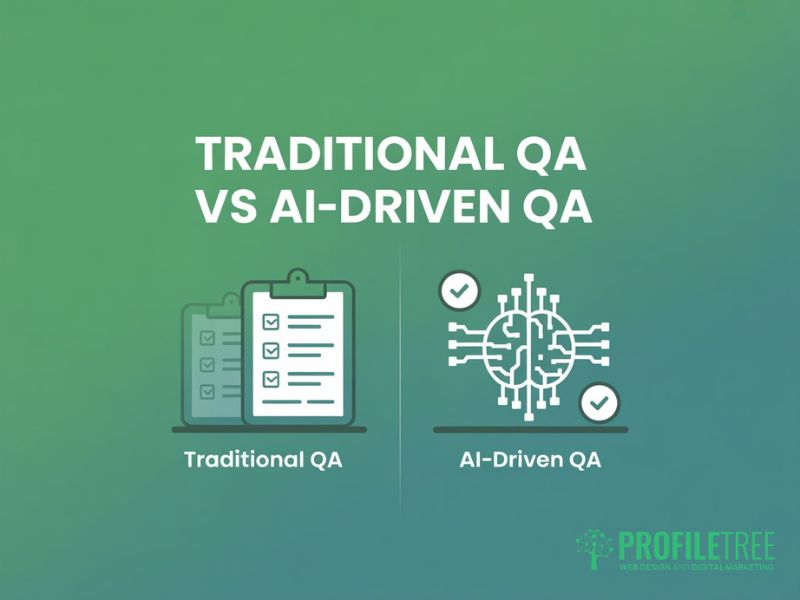
Understanding the gap between conventional testing and AI-driven quality assurance is the starting point for any credible business case. The differences aren’t just technical: they affect cost structures, team roles, and your ability to scale without adding headcount.
The Cost Reality for UK Businesses
For a 50-person development team running a traditional approach to ai in quality assurance, the annual cost breaks down roughly like this: manual testing staff runs from £180,000 to £250,000; tooling and licences add £15,000 to £30,000; infrastructure and maintenance add a further £10,000 to £20,000. Bug fixing and rework (consistently the most underestimated line item) typically adds £50,000 to £100,000. Total: between £255,000 and £400,000 per year.
Augmenting that same team with ai tools for quality assurance changes the structure considerably. AI platform licensing runs from £60,000 to £120,000; reduced manual testing headcount drops the staffing line to £120,000 to £180,000; training and implementation costs £15,000 to £25,000; ongoing maintenance adds £5,000 to £10,000. Total: £200,000 to £335,000, giving a first-year saving of £55,000 to £65,000. Year-two savings typically reach £80,000 to £120,000 as the system matures. Three-year ROI lands between 180% and 250%.
| Factor | Traditional QA | AI-Driven QA | Business Impact |
|---|---|---|---|
| Bug detection speed | Hours to days | Minutes | 40-60% faster release cycles |
| Test coverage | Defined cases only | Adaptive, edge-case aware | 40% improvement in coverage |
| Predictive capability | None | Flags issues before they occur | Reduces rework by 30-40% |
| Cost of human error | High (consistent risk) | Reduced via automation | 60-80% reduction in manual effort |
| Scalability | Linear (more testers) | Exponential (more data) | No added headcount to scale |
Why the “Replace QA Teams” Framing Is Wrong
The most persistent misconception in the market is that ai qa is about eliminating QA professionals. In practice, the opposite is true for most UK businesses. AI handles scale: running thousands of regression tests overnight, flagging visual regressions, and monitoring production data for anomalies. QA engineers handle nuance: interpreting edge cases, setting test strategy, and making judgment calls on acceptable risk thresholds.
The role shifts from manual tester to AI orchestrator. Plans that skip the upskilling budget consistently underperform against their ROI projections.
AI Technologies Reshaping Quality Assurance
Three capabilities within artificial intelligence quality assurance are driving the most measurable improvements across software, manufacturing, and service businesses. Each has distinct implementation requirements and payback timelines. Understanding which one fits your situation first is more valuable than trying to deploy all three at once.
Machine Learning for Predictive Quality Management
Machine learning models analyse historical test data, production outputs, and failure patterns to predict where quality issues are most likely to emerge. In software, this means prioritising which test cases to run based on recent code changes, a technique called risk-based test prioritisation. In manufacturing, it means flagging equipment performance trends before they cause defective output.
The practical value of ai in quality assurance at this level is resource concentration. Rather than running every test every time, ML-driven ai qa runs the tests that matter most, given what the system knows about current risk. Teams using this approach typically report a 70% reduction in test maintenance overhead and 50% faster identification of critical failures.
Computer Vision for Physical Product Inspection
For businesses manufacturing physical products, computer vision, one of the most widely deployed ai tools for quality assurance in industrial settings, now achieves defect detection accuracy above 99.5%, operating continuously without fatigue. Systems from manufacturers including Cognex, Keyence, and Omron deploy multi-camera setups that inspect surface quality, dimensional tolerance, and assembly completeness in real time.
The payback period on vision-based inspection systems typically runs between eight and twelve months, measured against reduced scrap rates and recall costs. Manufacturing clients working with ai-driven quality assurance have reported a 30% reduction in scrap rates and a 25% decrease in customer complaints within the first year.
Natural Language Processing for Test Case Generation
NLP enables QA teams to generate test cases directly from requirements documents written in plain English. Rather than manually translating a product specification into test scripts, the ai tools for quality assurance read the requirements and generate coverage automatically. This reduces the gap between what was specified and what was tested, which is a common source of defects that surface only in production.
NLP-based test generation is particularly useful in regulatory environments where test traceability is required. Every test case links back to a specific requirement, creating an audit trail that supports compliance documentation. It’s one of the reasons artificial intelligence quality assurance is gaining ground fastest in regulated sectors like healthcare and financial services.
AI QA Implementation Framework
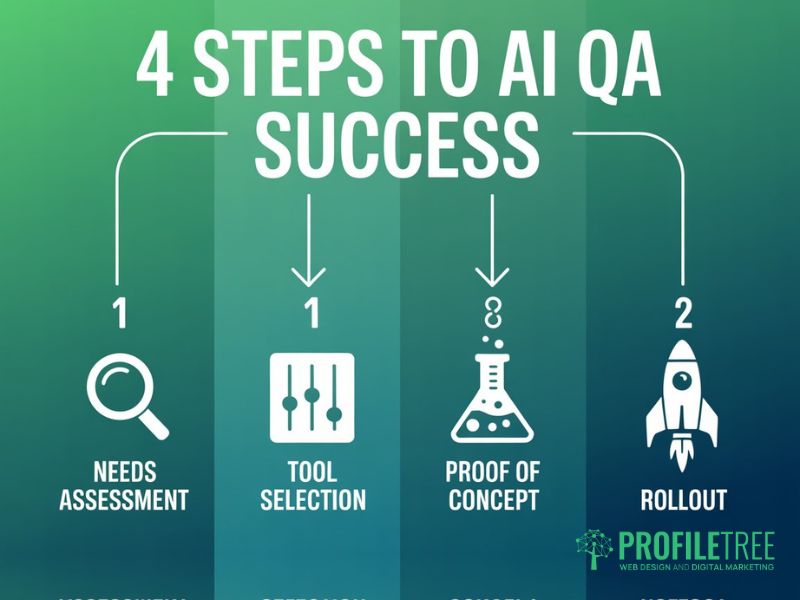
Successful AI-driven quality assurance follows a structured maturity model. Businesses that jump straight to enterprise-wide deployment without completing the early phases consistently overspend and underperform against their projections. The framework below reflects what actually works across the implementations we’ve seen.
Step 1: Needs Assessment
Before evaluating any platform, map your current quality process. Identify the highest-cost failure points: where defects escape to customers, where manual testing creates bottlenecks, and where compliance requires documented test evidence. This assessment determines which ai in quality assurance capability delivers the fastest payback.
Key questions at this stage: What’s your current test execution time? What percentage of defects are caught before release? Which testing types consume the most manual hours?
Step 2: Tool Selection Against Requirements
AI qa platforms divide into two broad categories: software testing tools designed for development teams, and industrial quality systems designed for manufacturing and physical product inspection. Mixing these categories is a common procurement mistake that adds cost without adding capability.
For software development teams, weight AI capability at 40%, cost at 25%, support quality at 20%, and strategic fit at 15%. For manufacturing environments, integration with existing PLCs and production monitoring systems matters more than CI/CD compatibility. Get this distinction right before comparing ai tools for quality assurance vendors.
Step 3: Proof of Concept on Non-Critical Systems
The most reliable implementation approach starts with a contained proof of concept on a system that’s important enough to generate meaningful data but not so critical that a failure causes serious disruption. Set specific success criteria before the POC begins: test execution time, defect detection rate, and integration stability. Hold the vendor accountable to those metrics.
Most POCs run for two to four weeks. Build parallel traditional testing during this period, so you have a direct comparison baseline. The businesses that get the strongest outcomes here are those that involve QA engineers directly in the evaluation, rather than running it as a pure procurement exercise.
Step 4: Phased Rollout with Upskilling
Following a successful POC, phase the rollout across test types rather than across teams. Start with regression testing and visual validation, then add risk-based prioritisation once the suite is stable. Reserve exploratory testing and subjective quality judgements for human engineers.
Allocate upskilling budget from day one. QA engineers moving to AI-orchestrated roles need training in prompt engineering, model interpretation, and alert threshold-setting. Teams that skip this see their AI-driven quality assurance systems degrade as models drift without skilled oversight.
Navigating UK and EU Regulatory Requirements
AI-driven quality assurance in regulated industries carries compliance obligations that go well beyond standard software implementation. UK and EU frameworks are converging on common requirements for AI systems used in quality-critical applications, and the penalties for non-compliance are substantial enough to affect the business case for deployment.
UK AI Regulation and the White Paper Framework
The UK Government’s AI Regulation White Paper places responsibility on sector regulators to apply five principles: safety; transparency and explainability; fairness; accountability; and contestability. For artificial intelligence quality assurance systems, explainability is the most demanding requirement. You’ll need to document why the AI flagged a defect, not simply that it did so.
The full framework is available via the UK Government AI Regulation White Paper. For EU market access, the EU AI Act official text sets out the high-risk classification criteria in full.
For healthcare and life sciences businesses in Northern Ireland and the UK, this intersects with MHRA requirements for AI-as-a-medical-device classification. Any ai qa system used in the production of regulated medical products needs a documented validation pathway before deployment.
EU AI Act Implications for Quality Systems
Businesses operating in or selling into EU markets need to assess where their ai-driven quality assurance systems fall within the EU AI Act’s risk classification. Manufacturing quality control systems that directly influence product safety (automotive components, medical devices, food safety monitoring) are likely to fall within the high-risk category, triggering requirements for conformity assessments, technical documentation, and human oversight mechanisms.
The practical implication is that audit trail functionality isn’t optional for high-risk classifications. Every automated quality decision needs to be logged, attributable, and reviewable. This should be a hard technical requirement in any vendor evaluation for AI in quality assurance, not an afterthought in the procurement process.
Data Quality and AI Explainability in Practice
The most cited challenge in AI-driven quality assurance is data quality. If training data contains systematic biases, the AI learns to reproduce them. Diverse, representative datasets are a prerequisite for reliable quality systems. Explainability tools (model visualisation, feature importance analysis, SHAP values) are now standard in enterprise platforms; include an explicit explainability requirement in any vendor evaluation.
ProfileTree’s AI transformation services include regulatory readiness assessments for businesses planning AI quality system deployments. We map your specific sector obligations before any platform evaluation begins.
AI-Driven Quality Assurance Across Industries
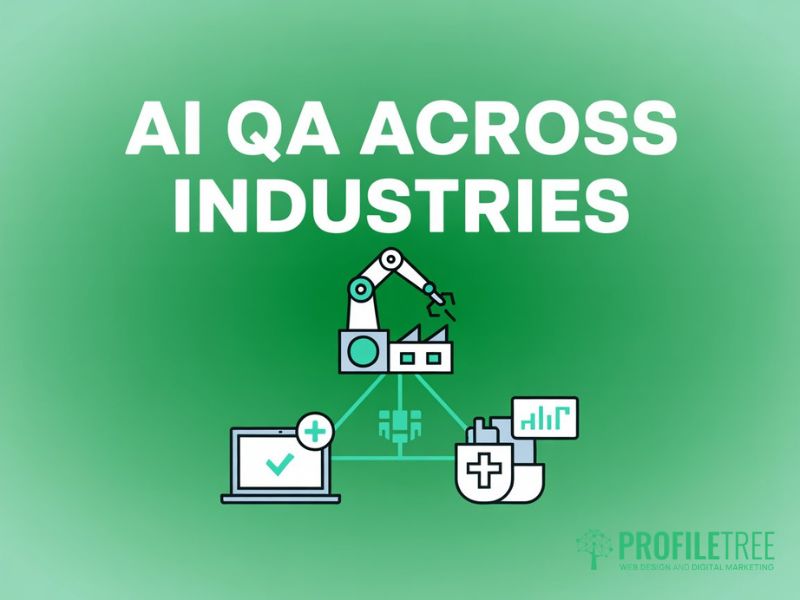
The practical application of AI-driven quality assurance varies considerably by sector. What works in software development looks quite different from what works in manufacturing, healthcare, or financial services. Understanding the sector-specific context before committing to a platform is time well spent.
Software Development and DevOps Environments
For development teams operating CI/CD pipelines, artificial intelligence quality assurance delivers value through self-healing test automation, intelligent test prioritisation, and visual regression detection. Self-healing tests adapt to application changes automatically: when a UI element moves, the test updates its locator rather than failing. This single capability eliminates a large proportion of test maintenance work.
It’s worth noting that ai qa platforms vary considerably in coding expertise required. No-code options like Testim and Mabl suit teams without dedicated automation engineers, while enterprise platforms like Sauce Labs need specialist skills to deliver their full value.
Teams building or rebuilding their web platforms can benefit from integrating QA considerations from the start. ProfileTree’s web development services include performance and quality standards built into the delivery process, reducing the testing overhead after launch.
Manufacturing and Industrial Quality Control
In manufacturing, AI in quality assurance centres on two applications: computer vision for physical inspection and predictive maintenance for equipment quality. Where defect detection is currently manual, computer vision increases inspection speed by 300% to 500%, moves coverage to 100%, and exceeds human inspection accuracy at speed.
Predictive maintenance systems monitor equipment metrics to catch degradation before it affects output. A CNC machine producing components at tolerance boundaries is already a quality risk before it produces a defective part. The AI spots the trend and triggers maintenance first. That’s the core value of ai tools for quality assurance in industrial settings.
Healthcare and Regulated Industries
Healthcare AI-driven quality assurance operates under the most stringent regulatory constraints of any sector, with clinical trial data management, medical device testing, and diagnostic system validation each carrying distinct compliance obligations. The common thread is traceability: every quality decision must be documentable, and the human oversight requirement is written explicitly into both UK and EU frameworks.
For healthcare organisations in Northern Ireland, artificial intelligence quality assurance systems need to be assessed against both UK MHRA requirements and EU market access frameworks, particularly where medical devices are involved.
Choosing AI Tools for Quality Assurance
The market for ai tools for quality assurance has grown rapidly, and the range of platforms now available makes vendor selection genuinely complex. The following framework cuts through the noise by focusing on what actually differentiates outcomes rather than feature lists.
Evaluation Criteria That Matter
Most procurement processes overweight features and underweight integration complexity and maintenance burden. A platform with a full feature set that takes six months to integrate and needs a dedicated administrator rarely delivers its projected ROI from ai in quality assurance.
Weigh your evaluation criteria honestly against your team’s capacity. A no-code platform may deliver better outcomes for a team without dedicated test automation expertise than a technically superior platform that requires specialist skills you don’t currently have. Conversely, if you’ve got an experienced automation team, constrained no-code platforms will frustrate them quickly.
If your quality challenges are closely linked to how your website or digital products perform, ProfileTree’s search engine optimisation services include technical performance audits that identify quality-related issues affecting both user experience and search visibility.
Total Cost of Ownership
Published licensing costs rarely reflect the true cost of AI quality assurance implementation. Factor in integration development time (typically one to two weeks for straightforward CI/CD integrations, up to three to six months for complex enterprise environments), training costs, data preparation, and the internal resource cost of managing the proof of concept.
Ask vendors specifically about data storage and egress costs at scale, pricing model changes at higher test volumes, and how pricing changes as you expand scope. These questions separate vendors who’ve done serious enterprise implementations from those who haven’t.
Next Steps: AI-Driven Quality Assurance for Your Business
AI-driven quality assurance isn’t a single product decision. It’s a strategic commitment to embedding quality throughout your operations, not inspecting for it at the end.
If you’re assessing where AI fits within your operations, ProfileTree’s digital strategy services include structured AI readiness assessments for businesses across Northern Ireland, Ireland, and the UK.
For businesses at the training stage, building internal capability to manage and maintain AI tools for quality assurance, our AI training programmes cover both strategic AI literacy for leadership teams and hands-on technical training for operations staff. ProfileTree has delivered AI training to over 1,000 businesses since 2011, with a 5-star rating from more than 450 verified client reviews.
FAQs
1. Can AI quality assurance replace manual testing entirely?
No, and businesses that plan for full replacement consistently run into problems. AI qa handles scale, consistency, and pattern recognition far better than humans. Human QA engineers handle ambiguity, subjective quality judgements, and strategic test design far better than current AI systems can. The sustainable model is augmented quality assurance: AI runs the high-volume, rule-based testing; humans set strategy, interpret edge cases, and manage the AI system itself.
2. How long does AI-driven quality assurance implementation take?
Simple setups (a self-healing regression suite for a single web application) typically reach production within two to four weeks. Medium-complexity implementations covering multiple test types and environments take one to three months. Enterprise deployments spanning legacy systems, manufacturing integration, and compliance documentation take three to six months. Most teams see tangible benefits within the first month of the initial deployment scope, regardless of the full project timeline.
3. What is the biggest challenge in implementing AI in quality assurance?
Data quality is consistently the most cited challenge, ahead of technical integration and budget. Artificial intelligence quality assurance systems learn from historical test data and production outputs. If that data contains systematic gaps (no test coverage for certain user journeys, or manufacturing data from a single production line), the AI learns those gaps alongside the patterns. Investing in data audit and preparation before platform selection makes a measurable difference to outcome quality.
4. Is AI quality assurance compliant with UK GDPR?
It can be, provided the implementation is designed with data minimisation and purpose limitation in mind. AI qa systems processing personal data (customer interaction data used in CX quality monitoring, for example) require a lawful basis for that processing. Most enterprise platforms include data anonymisation and access control features that support GDPR compliance. Review your vendor’s data processing agreement before any deployment that touches personal data.
5. Which industries benefit most from AI tools for quality assurance?
Software development teams in CI/CD environments, manufacturers producing high-volume precision components, healthcare organisations managing clinical data quality, and financial services firms with regulatory reporting obligations all see strong returns. The common factor is high testing volume combined with a clear cost for defect escape; industries where manual testing at the required scale is either cost-prohibitive or practically impossible given throughput requirements.