
Ad Blockers and Digital Advertising: What SMEs Need to Know
Table of Contents
Ad blockers are now installed on more than 700 million devices worldwide. For businesses that rely on display advertising to reach customers, that number matters. But the more useful question is not how to work around ad blockers; it is what the widespread adoption of them tells you about how people want to be reached in 2026, and what to do instead.
This guide is written for business owners and marketing managers in the UK and Ireland who want a clear picture of why ad blockers exist, how they affect digital advertising, and which alternatives actually work for SMEs with limited budgets and realistic timelines.
What Ad Blockers Are and Why People Use Them
An ad blocker is a browser extension or network-level tool that prevents advertising content from loading on a webpage. The most widely used extensions (uBlock Origin Lite, AdGuard, and Ghostery) work by filtering page requests against lists of known advertising domains and tracking scripts, stopping ads before they render rather than hiding them after the fact.
Users install ad blockers for three main reasons: to speed up page loading, to stop intrusive ad formats such as autoplay video and pop-ups, and to limit the amount of tracking data collected about their browsing behaviour. In the UK, privacy concerns have grown significantly since the implementation of GDPR and the more recent UK Data Use and Access Act, which gives users clearer rights over what code runs on their devices.
For advertisers, the practical consequence is that a portion of your display ad budget is generating zero impressions with a meaningful segment of your potential audience. The size of that segment varies by industry and audience demographics, but it is consistently higher among 18 to 35-year-olds and technology-literate users, often the same people businesses most want to reach.
The Technical Shift: Manifest V3
Chrome’s move to Manifest V3 (the updated framework governing browser extensions) has reduced the effectiveness of some older ad blockers. Extensions can no longer intercept and modify network requests in real time as they once could. This has affected tools like the legacy version of uBlock Origin, though developers have responded with Manifest V3-compatible alternatives. The practical effect for advertisers is that ad blocker usage has not declined; it has simply shifted to newer tools.
How Ad Blockers Affect Digital Marketing Performance
When a user has an ad blocker active, display adverts, pre-roll video ads, and retargeting pixels do not load. Analytics platforms may also record inaccurate data because some ad blockers strip tracking parameters from URLs or block the scripts that fire conversion events. This means campaigns running on cost-per-impression or cost-per-click models can show artificially clean performance data while actually underperforming.
For SMEs running Google Display Network or Meta advertising campaigns, this creates a genuine measurement problem. If a meaningful percentage of your audience uses ad blockers, your reach figures are overstated, and your cost-per-acquisition calculations may be wrong.
The response to this is not to find increasingly sophisticated ways to circumvent privacy tools. That approach tends to damage brand credibility and can put businesses in conflict with PECR (Privacy and Electronic Communications Regulations), which governs how tracking technologies are deployed on UK websites. The more durable response is to build marketing channels that do not depend on interruptive advertising in the first place.
Content Marketing as the Ad-Blocker-Proof Channel
Organic search traffic generated through well-structured content is completely unaffected by ad blockers. A user who finds your website through a Google search result and reads a detailed, useful article has chosen to engage with you; no impression needs to be served, and no pixel needs to fire.
Content marketing works by creating pages that answer the specific questions your target customers are searching for, at the moment they are searching for them. A solicitor’s practice in Belfast that publishes a thorough guide to residential conveyancing in Northern Ireland will attract people actively researching the process. A furniture retailer that covers topics like “how to measure a room for a fitted wardrobe” reaches buyers in the consideration phase. Neither of those interactions can be blocked.
The challenge for most SMEs is not understanding the principle; it is executing consistently enough to build ranking authority. That means publishing regularly, building internal links between related articles, earning external coverage, and keeping content accurate and genuinely useful. ProfileTree’s content marketing service covers the strategy, production, and optimisation, working with businesses across Northern Ireland, Ireland, and the UK to build content programmes that compound in value over time rather than stopping when a budget runs out.
Video Marketing: Engagement That Bypasses the Block
Video content published on YouTube and social platforms is not served through the same ad network infrastructure that ad blockers target. When a viewer watches a video you have published on your YouTube channel, they have opted in to that content. No ad impression is involved, and no blocker can prevent that view.
This distinction matters because video is increasingly where purchase decisions are made. Product demonstrations, how-to content, customer testimonials, and behind-the-scenes content about how a business operates all perform well on YouTube, and a well-produced video on a product or service page can significantly increase the time visitors spend on a page and the rate at which they enquire.
For SMEs considering video for the first time, the practical starting point is identifying the three or four questions your sales team answers most often. Each of those answers is a video. A Northern Ireland roofing company might cover “how to spot early signs of roof damage,” “the difference between repair and replacement,” and “what to expect during a roof replacement.” None of that content costs money to maintain; each piece builds credibility with people who are already interested in the topic, and none of it is affected by any browser extension.
Short-form video content on Instagram Reels and TikTok follows the same principle: organic reach through formats that users actively choose to watch. ProfileTree’s video production team works with businesses to plan, shoot, and edit this kind of content in Belfast and remotely across the UK and Ireland.
Native Advertising: The Format Ad Blockers Struggle With
Native advertising refers to paid content that takes the form of the platform it appears on, rather than a banner or interruptive ad unit. Sponsored articles on publishers’ websites, promoted posts in social feeds, and paid placements in newsletters are all forms of native advertising.
Because native formats are often served as editorial content rather than through third-party ad scripts, some, though not all, native placements are less likely to be caught by browser-level ad blockers. More importantly, they tend to generate higher engagement because they match the format users came to the platform to consume.
The key to native advertising working for an SME is that the content has to be genuinely useful. A sponsored guide to choosing business software, written for an audience of SME owners, will perform. A thinly veiled product pitch dressed up as an article will not, regardless of where it is placed.
| Channel | Affected by Ad Blockers? | Notes |
|---|---|---|
| Google Display Network | Yes | Browser-level blockers prevent rendering |
| Meta social ads | Partially | In-feed placement reduces blocking; some extensions still intercept |
| YouTube pre-roll ads | Yes | Pre-roll is ad network traffic; blocked by extensions |
| YouTube channel content | No | Organic content chosen by the viewer |
| Sponsored articles (native) | Partially | Depends on how the content is served |
| Organic search (SEO) | No | No ad impression involved |
| Email marketing | No | Delivered directly to inbox |
| Content marketing | No | Delivered directly to the inbox |
Personalisation and Targeting: Working With What You Can Measure
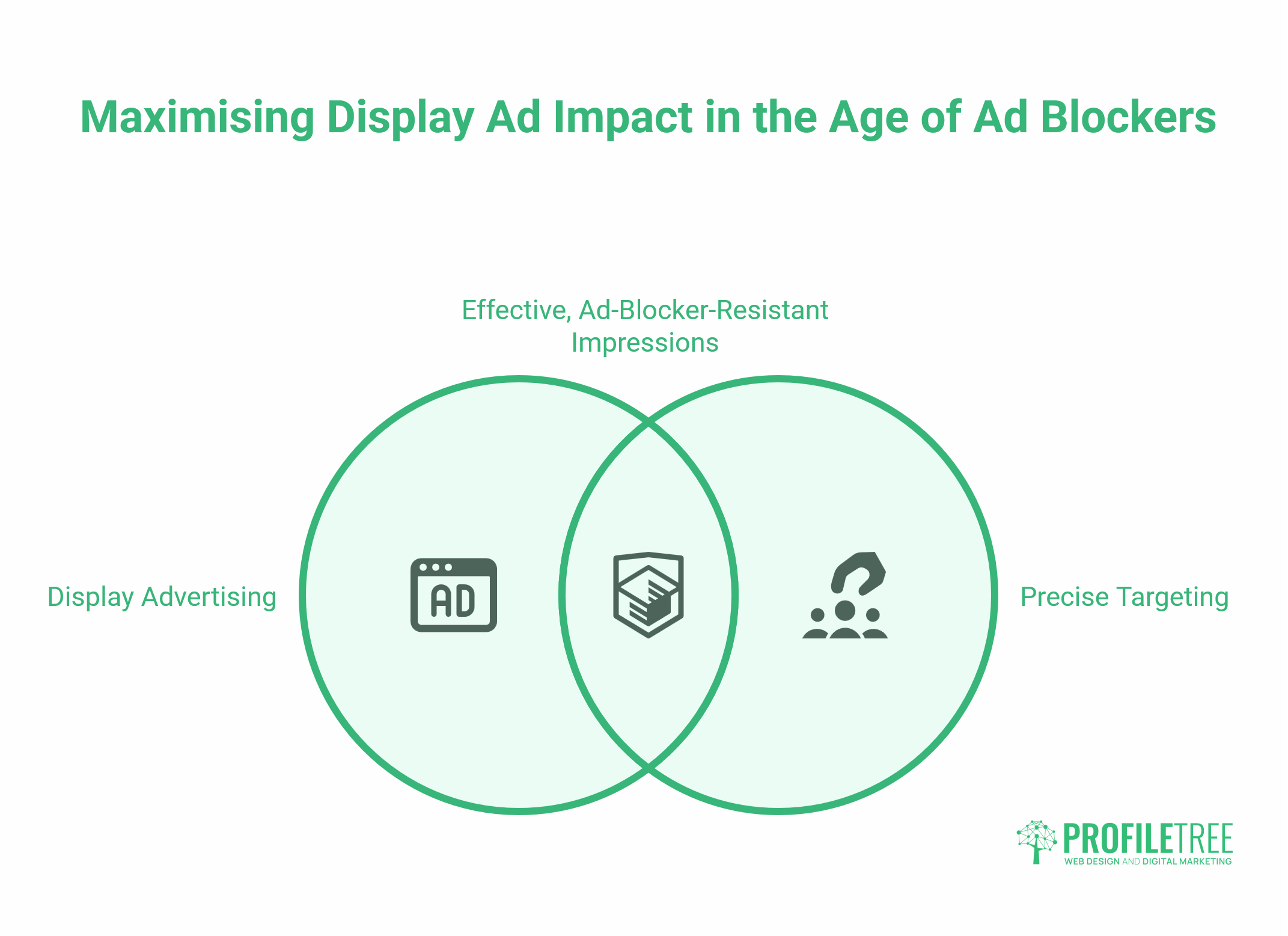
Where display advertising remains part of the mix, the response to ad blocker usage is not to spend more; it is to target more precisely so that the impressions that do deliver are reaching the right people.
First-party data is the foundation of this. An email list built from genuine opt-ins, a CRM populated with customer purchase history, or a loyalty programme with behavioural data gives you targeting inputs that do not depend on third-party tracking cookies, which are also being phased out across major browsers.
Behavioural targeting on your own website (showing different content or offers based on which pages a user has visited) also uses first-party data and is not disrupted by ad blockers in the same way that external retargeting pixels are. A user who has visited your pricing page three times in a week is a warm lead; surfacing a relevant offer or a prompt to book a consultation on their next visit costs nothing in media spend.
AI-driven marketing tools are increasingly practical for SMEs here. Platforms that use machine learning to identify the characteristics of your highest-value customers and find similar audiences in ad platforms can significantly improve the return on whatever display budget you do run. ProfileTree’s AI implementation service helps identify which AI tools are actually worth deploying for a business of your size, rather than adopting technology for its own sake.
Subscription Models and Direct Revenue Channels
For publishers and media businesses specifically, ad blockers create a direct revenue problem. The response that has worked most reliably is a combination of a paywall for premium content and an appeal to readers to whitelist the site in exchange for an ad-light experience.
The broader lesson for SMEs is that building direct relationships with customers, through email newsletters, membership programmes, or loyalty schemes, creates a channel that no browser extension can interrupt. A customer who has given you their email address and opted in to hear from you is reachable regardless of what advertising tools they use.
This is where an honest assessment of your marketing mix matters. If most of your customer acquisition currently runs through paid display, you have a single-channel dependency that is increasingly fragile. Adding organic search, email, and video as complementary channels does not mean abandoning paid advertising; it means not being entirely dependent on it.
Ethical Advertising and User Trust
The growth in ad blocker adoption is, at its core, a signal about user experience. People block ads because too many are intrusive, slow, deceptive, or irrelevant. The businesses that respond to that signal by improving the quality of their advertising, rather than finding new ways to force-serve ads people do not want, tend to build stronger brands.
Transparent data practices matter here. Being clear about what data you collect, how you use it, and giving users genuine control over their preferences is both a legal requirement under UK GDPR and PECR and a practical trust signal. Users who trust a website are more likely to whitelist it in their ad blocker settings.
Ethical and legal issues in digital marketing are a topic ProfileTree covers in depth, including the specific obligations businesses operating in Northern Ireland and the Republic of Ireland face under both UK and EU regulatory frameworks.
Measuring What Actually Works
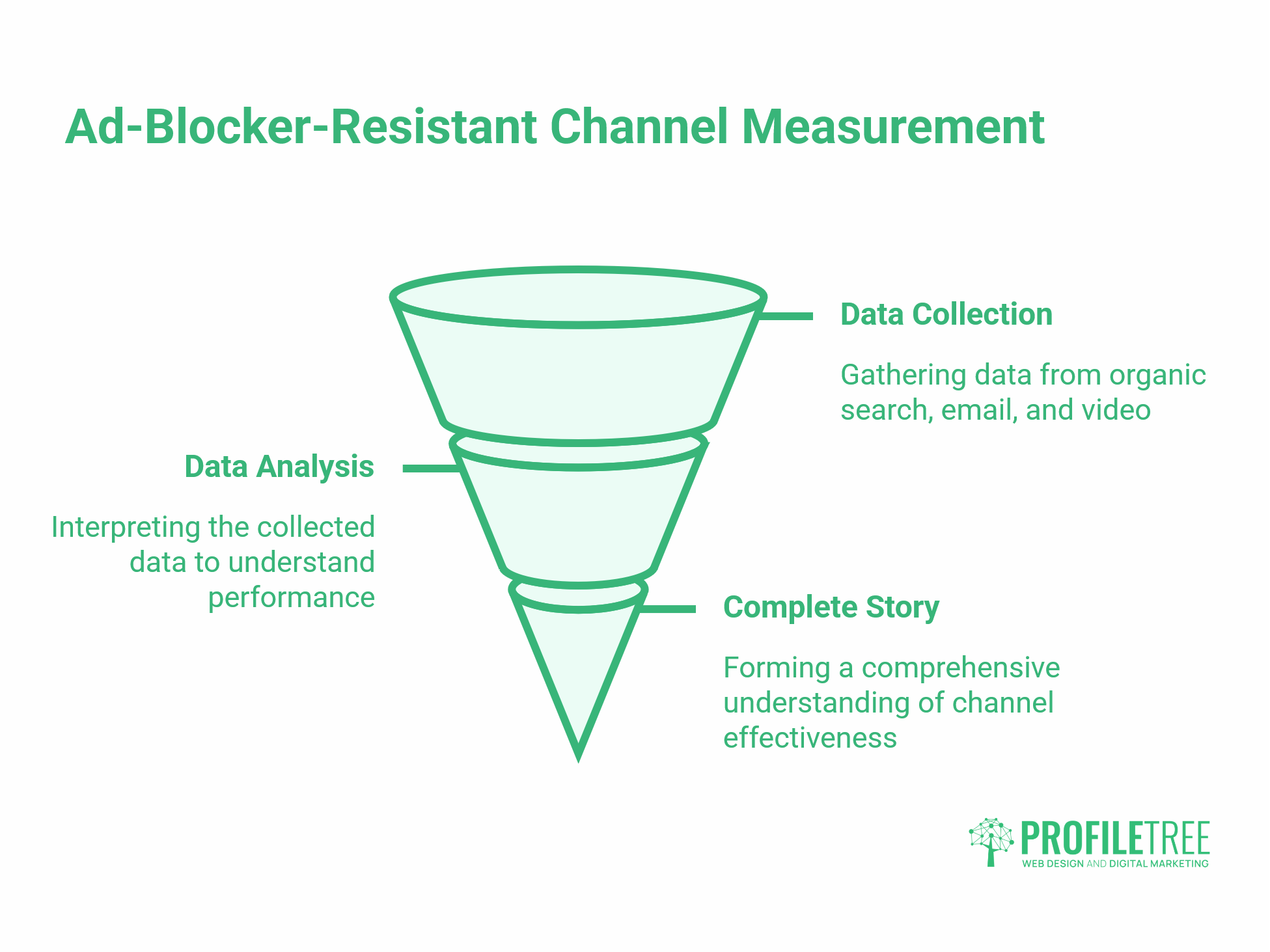
Shifting toward ad-blocker-resistant channels only works if you can demonstrate they deliver. The measurement challenge is real: organic search, email, and video do not produce the same clean impression-to-conversion dashboards that paid campaigns do. But they do produce data, and that data tells a more complete story when you know where to look.
For organic search, the primary metrics are keyword rankings, organic sessions, and goal completions attributed to organic traffic. Google Search Console shows which queries are driving impressions and clicks to specific pages, and tracking those over time reveals whether your content programme is building authority or stalling. A page that moves from position 14 to position 6 for a commercial query is generating measurably more qualified traffic, even if revenue attribution takes longer to appear.
Email marketing performance is straightforward to track: open rates, click-through rates, and the downstream behaviour of people who click. The metric that matters most for SMEs is not the open rate; it is whether email-attributed sessions convert at a higher rate than cold traffic, which they almost always do for businesses with a genuinely useful list.
Video is slower to connect to commercial outcomes, but watch time, subscriber growth, and traffic referred from YouTube to your website are all trackable in YouTube Studio and Google Analytics. The leading indicator to watch is whether video content drives search queries for your brand name, signalling that viewers are moving from passive watching to active consideration.
Where display advertising remains part of the mix, server-side tracking and first-party data collection give you more reliable performance data than client-side pixels, which are increasingly blocked or stripped. This requires a modest technical investment but significantly improves the accuracy of cost-per-acquisition calculations, making it easier to justify reallocating budget toward channels that compound.
Building a Digital Marketing Strategy That Does Not Depend on Interruption
The most useful reframe for any SME thinking about ad blockers is this: the problem is not the technology, it is the dependency. Businesses that have built marketing programmes around content, organic search, email, video, and direct customer relationships are largely unaffected by the growth of ad blockers. Businesses that have built everything around display advertising are exposed.
A digital marketing strategy that accounts for this reality will audit your current channel mix, identify where you are over-dependent on paid reach, and build a plan to diversify into channels that compound over time. That is not a quick fix; building meaningful authority in content and SEO takes months. But it is the kind of work that changes what your marketing costs three years from now.
For businesses in Northern Ireland, Ireland, and the UK that want support with that kind of strategic review, ProfileTree’s digital marketing team offers consultation across the full channel mix, from content and SEO to video production, AI tool selection, and digital training for in-house teams.
Conclusion
Ad blockers are not going away. Their growth reflects a genuine shift in how people expect to be treated online, and the businesses that adapt by building marketing channels that earn attention rather than interrupt it are better positioned for the long term. Content, SEO, email, and video do not depend on an impression being served or a pixel firing; they work because they give people something worth reading, watching, or sharing. If you want to review how your current mix holds up, get in touch with ProfileTree’s digital marketing team to start the conversation.
FAQs
Why do so many people use ad blockers?
The main reasons are intrusive ad formats, slow page load times, and concerns about tracking. Users who have had repeated negative experiences with advertising install blockers to reclaim control of their browsing experience.
Do ad blockers affect my Google Analytics data?
Yes, to a degree. Some ad blockers block analytics scripts, meaning sessions from those users may not be recorded. First-party analytics solutions and server-side tracking are more resilient than standard client-side scripts.
Are ad blockers legal in the UK?
Yes. Under UK law, users have the right to control what code executes on their device. Some website terms of service prohibit users from using blockers, but this is not legally enforceable in most cases.
What is the most effective alternative to display advertising for SMEs?
Organic search through content marketing and SEO consistently delivers the highest return over a 2- to 3-year horizon. Email marketing to an opted-in list is the second-most reliable way to re-engage existing customers and warm prospects.
How does Manifest V3 affect ad blockers in Chrome?
Chrome’s Manifest V3 framework restricted how extensions intercept network requests, weakening some older ad blockers. Developers have largely adapted with compatible versions, so ad blocking remains widespread; the tools have simply updated.
Can content marketing genuinely replace paid advertising for a small business?
For most SMEs, content marketing supplements rather than fully replaces paid advertising in the short term. Businesses that publish consistently for 12 to 18 months typically find that paid spend can be reduced while total enquiry volume stays flat or grows.