
AI Competency Framework: Essential Skills for the Modern Workforce
Table of Contents
Most organisations now buy AI software faster than they can train people to use it. An AI Competency Framework closes that gap by defining the exact knowledge, skills and behaviours your workforce needs to use artificial intelligence safely, ethically and productively. Without one, you end up with shadow AI, data leaks, biased outputs and very little measurable return on a growing software bill.
At ProfileTree, we’ve delivered AI training for SMEs across Northern Ireland, Ireland and the UK through our Future Business Academy programme, and the same pattern keeps appearing. Marketing teams paste client data into public language models. HR shortlists candidates using tools nobody has audited. Finance staff trust generative outputs they cannot verify. The fix is structural, not motivational. A clear framework gives every department a shared baseline, role-specific expectations and a way to measure progress.
This guide sets out a practical approach mid-sized businesses can actually implement, including a four-tier skills matrix, role-specific competencies, an assessment approach for hiring and appraisals, and the regulatory considerations that come with UK and EU operations.
Why You Need an AI Competency Framework
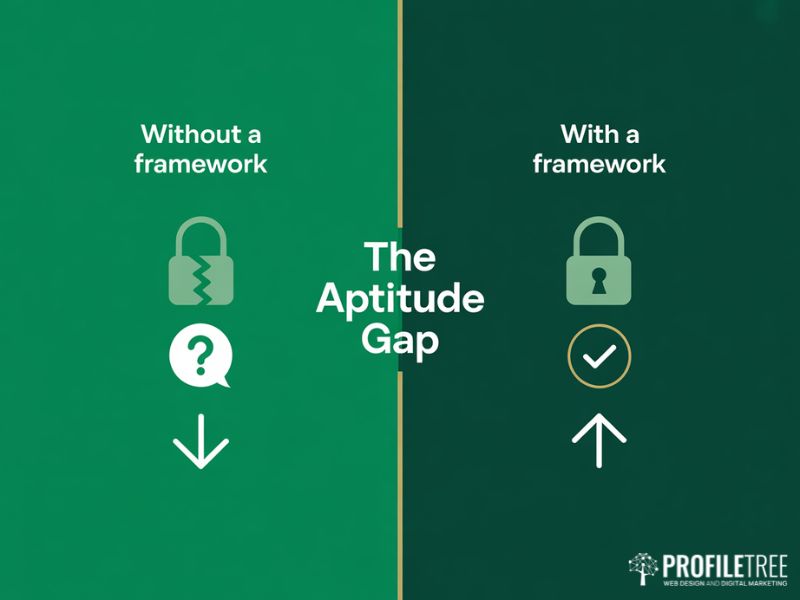
An AI Competency Framework is a structured model that defines the knowledge, technical skills and cognitive behaviours required to use AI effectively at every level of an organisation. It moves AI use from individual experimentation to organisational capability. The point is not to make everyone an expert; it’s to make sure nobody is operating blind.
Right now, most teams have what we’d call an aptitude gap. People are using AI on an ad hoc basis with no shared standards. A marketing executive might draft client proposals in ChatGPT while a finance manager uploads sensitive spreadsheets to a free language model to analyse trends. Both are technically “using AI”. Neither is operating within any defined competency. Our survey of AI adoption among UK SMEs shows this gap is the rule rather than the exception.
A working AI Competency Framework resolves this in four ways. It sets a baseline of AI literacy that every employee meets, regardless of role. It clarifies which advanced AI competencies belong to technical teams versus general staff. It builds in the legal and ethical guardrails required under UK GDPR and the EU AI Act. And it gives line managers a measurable rubric for hiring, appraisals and promotion decisions. The productivity gains we see come not from buying better tools but from teaching people how to use the ones they already have responsibly.
The 4-Tier AI Skills Matri
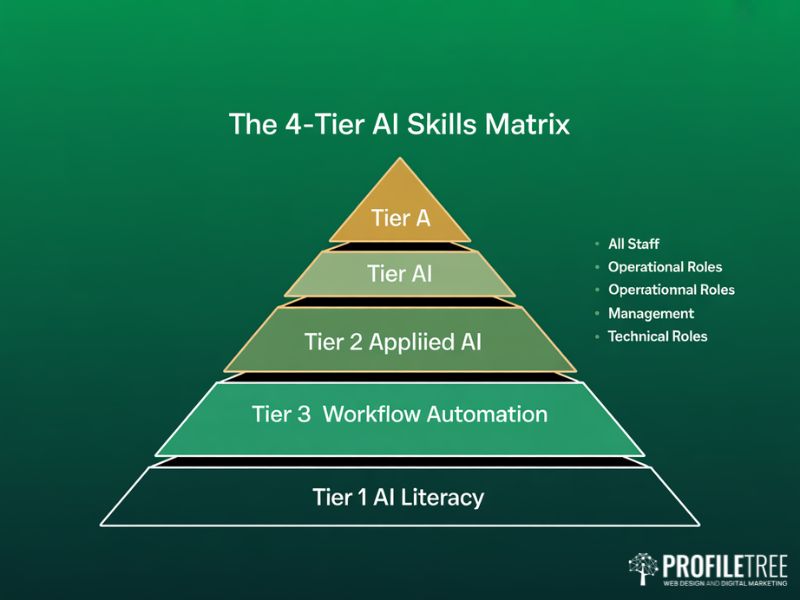
AI upskilling cannot follow a single curriculum. The skills a financial controller needs are different from those a software engineer needs, and treating them the same wastes time on both sides. To make implementation realistic, we recommend organising your AI Competency Framework into a four-tier matrix that maps competencies to roles. Each tier builds on the one below it. Everyone needs Tier 1. Most operational staff need Tiers 1 and 2. Managers need 1 to 3. Technical specialists work in Tier 4 but still need foundations from the lower tiers.
Tier 1: AI Literacy and Security (All Staff)
This is the non-negotiable baseline of any AI Competency Framework. Every member of staff, from the receptionist to the CEO, should clear Tier 1 before being given access to any generative AI tool. The focus here is risk awareness and ethical judgement, not technical capability.
Core competencies at this tier include:
- Conceptual understanding: Knowing the difference between predictive AI, generative AI and rule-based automation, and recognising what each is suited to.
- Data security and privacy: Understanding that public language models may train on user inputs, and demonstrating the ability to anonymise client data, financial records or personally identifiable information before any AI interaction.
- Algorithmic bias awareness: Recognising that AI outputs are shaped by training data and can systematically disadvantage certain groups, particularly in recruitment, lending and content moderation.
- Source verification: Understanding that generative AI produces plausible but unverified content, and treating every output as a draft requiring human review.
In practice, Tier 1 takes a couple of hours of structured digital training followed by a short assessment. Most AI incidents we see in client businesses stem from staff who never had this baseline conversation.
Tier 2: Applied AI and Prompt Engineering (Operational Roles)
Tier 2 targets the people who use AI as a daily working tool: marketing, HR, finance, customer service, content production and administration. The shift here is from passive understanding to active, structured use.
Core competencies include:
- Structured prompt engineering: Moving beyond simple queries to multi-shot prompting that includes context, tone constraints, format requirements and output structure. Our guide to prompt engineering best practices covers the core techniques.
- Output validation: The ability to verify AI-generated facts, identify hallucinations and refine outputs to match brand guidelines or factual sources. This is the single most important skill at Tier 2.
- Tool-agnostic adaptability: Applying underlying logic across multiple platforms rather than relying on the interface of a single tool. Models will keep changing; the principles will not.
- Workflow integration: Knowing where AI genuinely accelerates a task and where it slows you down. Not every job is a candidate for AI assistance.
For operational teams, this is where ProfileTree’s AI training programmes deliver the most measurable impact. Marketing teams move from generating drafts to producing publish-ready copy supported by sound content marketing principles. HR teams move from screening hundreds of CVs by hand to building structured shortlists with auditable criteria.
Tier 3: Workflow Automation and Integration (Management)
Tier 3 targets operations directors, department heads, project managers and senior business owners. Managers don’t need to build AI models; they need to redesign workflows around them, measure the impact and lead their teams through change.
Core competencies include:
- Process redesign: Mapping departmental workflows, identifying repetitive bottlenecks and integrating AI tools where they remove friction without creating compliance exposure. This is where a coherent digital strategy makes the difference between scattered automation and meaningful productivity gains.
- ROI measurement: Tracking productivity gains, time saved and quality improvements against software licensing costs, training investment and integration time.
- Change management: Coaching team members through AI-related anxiety, addressing fears about job displacement honestly and building a culture where staff are rewarded for finding better ways of working.
- Vendor selection: Evaluating AI tools against business requirements rather than marketing claims. The work involved in choosing how to integrate AI into existing business processes usually sits with this group.
Managers who clear Tier 3 are the people who actually deliver the productivity gains promised when the software was purchased. Without them, AI investment stays as shelfware.
Tier 4: AI Development and Architecture (Technical Roles)
Tier 4 applies to a small subset of staff: developers, data scientists, machine learning engineers and technical architects. Most SMEs won’t build AI from scratch, but anyone customising AI systems, fine-tuning models or building custom integrations needs Tier 4 capability.
Core competencies include machine learning fundamentals (supervised, unsupervised and reinforcement learning, model selection and evaluation metrics), practical fluency in Python and libraries such as TensorFlow or PyTorch, data engineering for reliable pipelines and bias-aware datasets, and system architecture skills to integrate AI features cleanly into existing systems through professional website development, with appropriate logging, fallback behaviour and monitoring for model drift.
For most ProfileTree clients, Tier 4 capability is brought in through partnership rather than built in-house. The point of the framework is knowing when you genuinely need this tier and when off-the-shelf tools in Tier 2 will do the job, alongside the work of building an AI-ready infrastructure that supports both routes.
Output Validation and AI Ethics
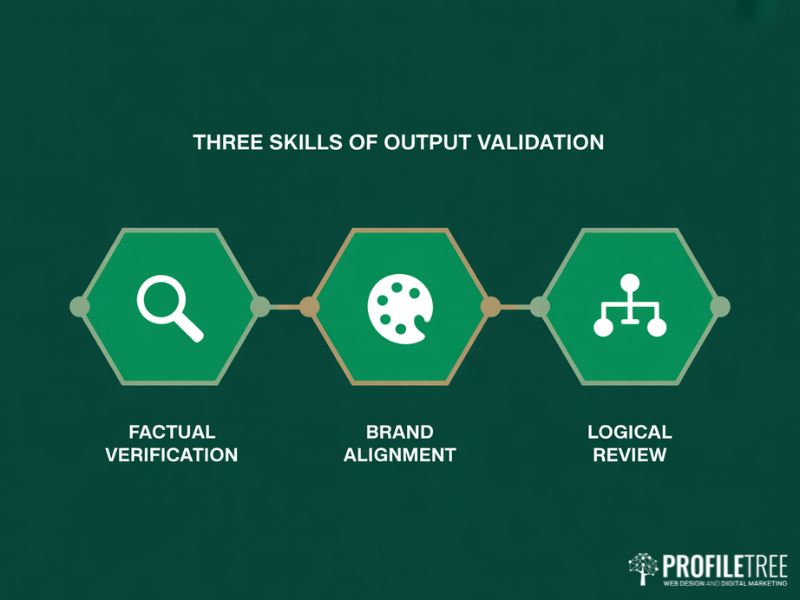
The single most underrated competency in any AI Competency Framework is the ability to validate what AI produces. Generative models produce confident, well-structured outputs that sound authoritative whether the content is accurate or fabricated. Treating every output as a draft is what separates teams that benefit from AI from teams that quietly accumulate errors.
Output validation breaks down into three skills. Factual verification means cross-checking claims, statistics and citations against primary sources before they go anywhere external. Brand alignment means editing tone, terminology and emphasis until the content actually sounds like your business; this is also where understanding AI content detection signals helps teams produce work that reads like your business and not a model. Logical review means catching the subtle errors that only appear on careful reading: contradictions between paragraphs, plausible but wrong reasoning, recommendations that ignore your specific context.
The ethics dimension sits alongside this. Staff should know when to disclose AI assistance, when to refuse to use AI for a particular task, and when human judgement must override an automated recommendation. As Ciaran Connolly, founder of ProfileTree, puts it: “The teams that get the most from AI are the ones that treat it as a junior colleague whose work always needs reviewing, not as a senior expert whose output can be trusted on sight.”
This is also where human-in-the-loop workflows matter. For any high-stakes decision, content with legal exposure, customer-facing communication or anything affecting hiring, finance or compliance, the framework should require explicit human sign-off.
Role-Specific AI Competencies
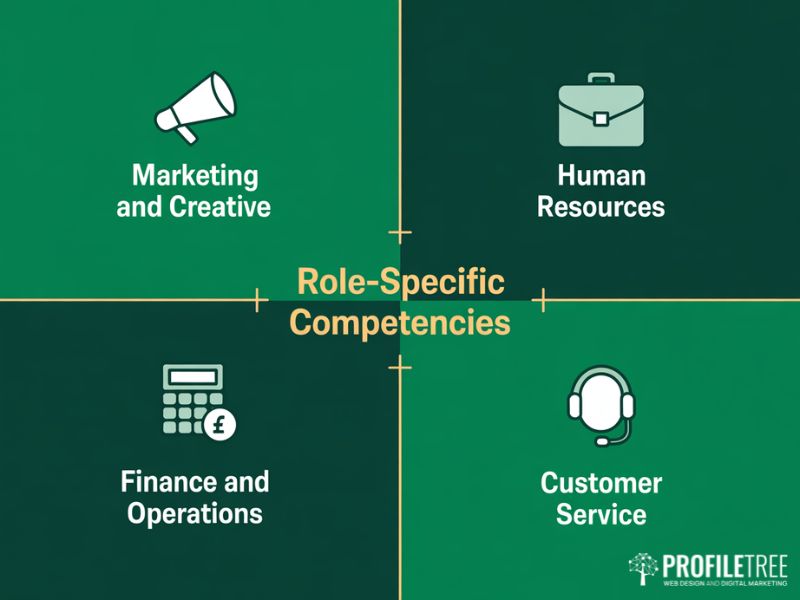
The four-tier matrix gives you the structure of an AI Competency Framework. The next step is mapping specific competencies to specific roles. Generic training fails because a finance manager and a marketing executive use AI for entirely different things, and grouping them in the same workshop wastes time on both sides.
Marketing and Creative Teams
Marketing teams use AI primarily for content production, research and campaign analysis. Competencies for these roles should prioritise advanced prompt engineering for long-form content, brand-voice editing skills, and the ability to verify research outputs against original sources. Critically, staff need to understand how AI-generated content fits within Google’s E-E-A-T guidelines, which is where solid SEO services and content writing standards intersect, requiring named authorship and original perspective. Teams producing visual content should also build the same competencies into video marketing workflows, where AI accelerates scripting and editing but cannot replace editorial judgement.
Human Resources and Recruitment
HR has the highest bias risk of any department using AI. The AI Competency Framework here should focus on understanding how AI screening tools can disadvantage protected groups, the legal exposure under UK Equality Act 2010 and EU AI Act high-risk classifications, and the practical skills to keep human review at every stage of a hiring decision.
Finance and Operations
Finance teams need strong data security competencies above almost anything else. Training for finance should emphasise data anonymisation before any AI interaction, structured prompting for analysis tasks, the verification skills to catch arithmetic errors and logical inconsistencies that language models routinely produce in numerical work, and clear boundaries around any AI marketing automation that touches customer financial data.
Customer Service and Support
Customer service AI use is mostly about response generation and triage. Training should cover tone matching for brand consistency, escalation criteria for issues AI shouldn’t handle, clear policies on disclosing AI assistance to customers, and proper governance around any AI chatbot deployments handling first-line enquiries.
Assessing Your Team’s AI Maturity
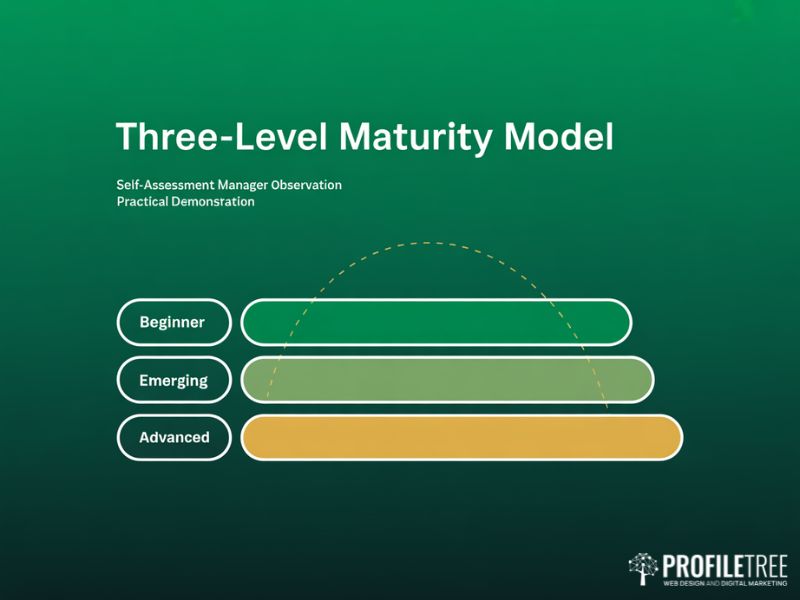
A framework without measurement is just a document. The point of an AI Competency Framework is to give managers an objective way to assess where their team currently sits, where the gaps are and what training will close them. We use a simple three-level maturity model in client work: Beginner, Emerging and Advanced. The assessment combines self-assessment, manager observation and practical demonstration.
Practical Assessment Methods
Formative assessment happens throughout learning. Short quizzes, hands-on prompt exercises and structured peer review give continuous signal on where staff are progressing and where they’re stuck. These work best when tied to real business tasks rather than abstract examples.
Summative assessment happens at intervals: end of training, performance reviews, role transitions. This includes structured testing against the framework tiers, presentation of completed AI-assisted work and discussion of judgement calls the staff member has made.
For hiring, we recommend three additions to your interview process. First, a practical prompt engineering exercise relevant to the role. Second, a validation task where the candidate is given a flawed AI output and asked to identify the issues. Third, an ethics scenario where the candidate explains how they’d handle a borderline case.
Sample Assessment Rubric
For Tier 1 AI literacy, a competent staff member should demonstrate the following on a five-point scale:
- Explains the difference between generative and predictive AI in their own words.
- Identifies which categories of company data must never be entered into a public AI tool.
- Recognises at least three forms of algorithmic bias and gives a relevant business example of each.
- States the correct internal escalation route for AI-related security or ethics concerns.
- Articulates the conditions under which human review is mandatory before publication or action.
This rubric scales up through the tiers. For Tier 2, you’d add prompt engineering quality, output validation accuracy and workflow integration judgement. For Tier 3, change management, ROI measurement and vendor evaluation.
UK and EU Compliance Considerations
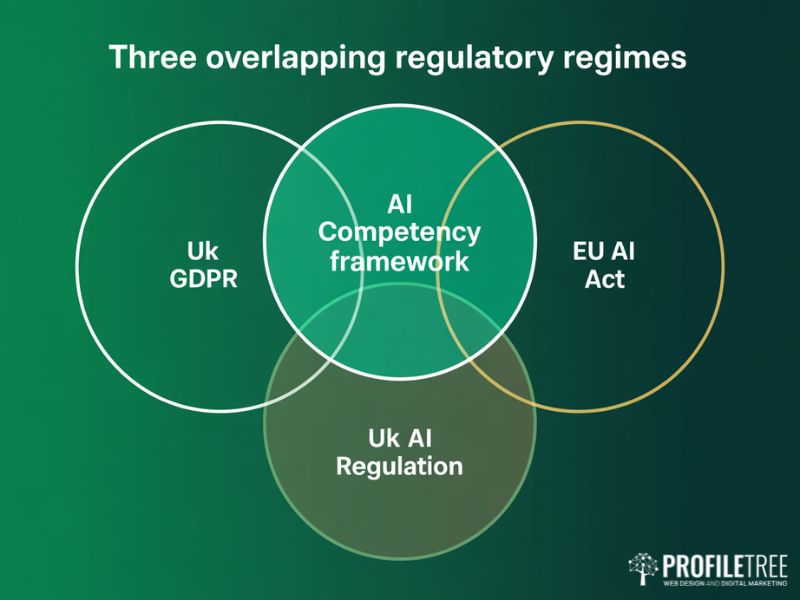
Compliance is not a footnote to your AI Competency Framework; it’s a structural part of it. UK and Irish businesses operate under three overlapping regimes: UK GDPR, the EU AI Act (which affects any business serving EU customers) and the UK government’s pro-innovation regulatory approach to AI. Staff competence in this area is no longer optional, and the Information Commissioner’s Office guidance on AI and data protection sets the operating standard.
UK GDPR requirements that intersect with AI include lawful basis for processing personal data through AI tools, transparency obligations when AI affects a data subject, and the right to human review for automated decision-making with significant effects. Any framework deployed in the UK should explicitly cover these.
The EU AI Act, fully applicable from 2 August 2026 for general-purpose AI obligations and earlier provisions already in force, classifies AI systems by risk. High-risk systems used in employment, education, essential services and law enforcement carry substantial documentation, testing and human oversight requirements. Any UK business operating in the EU needs staff who understand which classifications apply to their use cases.
Practical implications include mandatory training on data anonymisation before AI use, a documented register of AI tools in use with their risk classification, clear policies on prohibited uses and a designated person responsible for AI governance. For most SMEs this can sit alongside existing data protection responsibilities.
Implementing Your AI Competency Framework
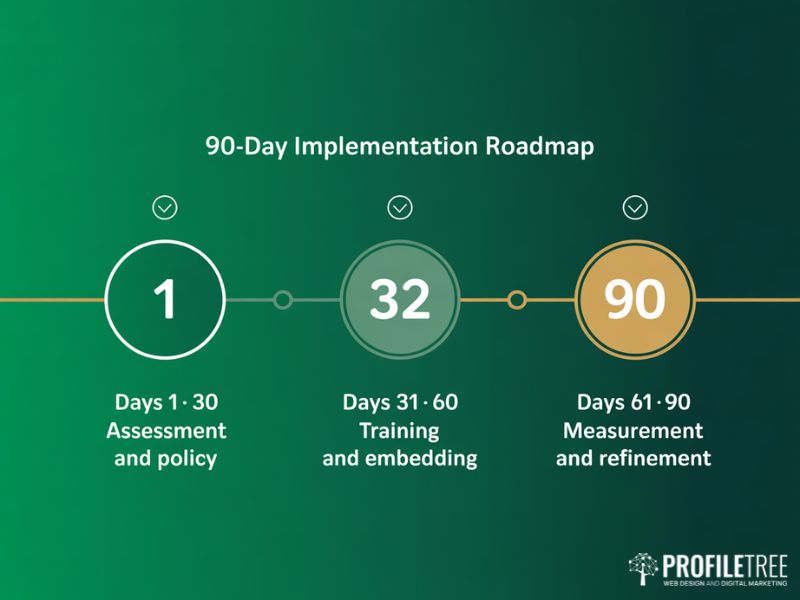
The AI Competency Framework only works if it gets implemented in practice, which is where most organisations stall. The pattern we recommend with our SME clients takes around 90 days from start to operational baseline.
The first 30 days focus on assessment and policy. You map current AI use across departments, audit what tools are already deployed (including the unofficial ones), draft an AI use policy that names approved tools and prohibited categories, and complete a baseline competency assessment for all staff using a Tier 1 rubric.
The next 30 days focus on training and embedding. You roll out Tier 1 training to every member of staff, deliver Tier 2 training to operational teams and Tier 3 training to managers, and document the workflows where AI is approved with the verification steps required for each. This is also when you set up the governance roles: who owns the policy, who reviews incidents and who signs off new tools.
The final 30 days focus on measurement and refinement. You run formal competency assessments, identify where the framework needs role-specific expansion, capture early ROI evidence and tighten the policy where gaps have appeared.
For organisations that want help building this internally, ProfileTree delivers structured digital and AI training programmes for businesses across the UK and Ireland, including bespoke framework development, in-person and remote training delivery, and ongoing assessment support. Our analysis of SMEs successfully implementing AI solutions covers the patterns that separate the businesses that get measurable returns from those that stall.
Building an AI-Ready Organisation
A working AI Competency Framework is the difference between AI as expense and AI as capability. It defines what people need to know, structures how they learn it, gives managers an honest way to measure progress and embeds the compliance and ethical guardrails that protect the business from the predictable risks of AI deployment.
The gap is not closing on its own. Every quarter that passes without a structured approach widens the distance between what the technology can do and what the workforce can use it for. The businesses that move first with a clear AI Competency Framework are the ones that will compound capability over time.
If your organisation is at the point of needing this, ProfileTree delivers structured AI training and competency framework development for businesses across Northern Ireland, Ireland and the UK. From baseline literacy training through to bespoke role-specific competency design, our work is grounded in what actually changes performance rather than what looks impressive on a slide.
FAQs
What is an AI Competency Framework?
A structured model defining the knowledge, skills and behaviours staff need to use AI effectively in their role. It covers baseline literacy, applied skills, governance and technical capability.
Who needs AI competency training?
Anyone with access to AI tools needs Tier 1 literacy training. Operational users need Tier 2. Managers need Tier 3. Technical staff need Tier 4. Rarely is the answer “just the tech team”.
How long does AI competency training take?
Tier 1 takes two to four hours. Tier 2 takes one to three days depending on role. Tier 3 runs across a month. Full organisational rollout takes around 90 days.
How does the framework relate to the EU AI Act?
The EU AI Act sets legal requirements; the AI Competency Framework operationalises them at the workforce level by defining who is competent to operate which categories of AI system.
What’s the difference between AI literacy and AI competency?
Literacy is general awareness of what AI is and the risks. Competency is specific, role-mapped skill measured against a rubric. Literacy is for everyone; competency is mapped to the job.
Can a small business implement an AI Competency Framework?
Yes. A 50-person business can implement a working framework in 90 days using the four-tier model, a written policy, baseline training and a simple assessment rubric.
How do we measure the ROI of AI competency training?
Track time saved on specific tasks, output quality against a rubric, reduction in AI-related incidents and time-to-competence for new staff. Most organisations see measurable returns within a quarter.