
Technology and Advertising: Smarter Marketing for SMEs
Table of Contents
Technology and advertising have always influenced each other, but the pace and depth of that relationship has shifted sharply over the last decade. For SMEs across Northern Ireland, Ireland, and the UK, the change is no longer abstract. Decisions about where to advertise, how to reach the right audience, and how to measure results are now inseparable from decisions about which technology to use and how to use it well.
This guide breaks down what the convergence of technology and advertising actually means for a business with a realistic budget and a marketing team without the resources of a global consultancy. It covers the tools that matter, the approaches that work at SME scale, the privacy considerations specific to UK and Irish markets, and how to build a practical plan that connects your content, your SEO, and your paid activity into a coherent whole.
Beyond the Buzzwords: What the Convergence of Technology and Advertising Means for SMEs
The phrase “technology and advertising” can sound like a topic for enterprise boardrooms, and the consultancy reports that dominate search results do little to challenge that impression. Those frameworks are written for organisations with dedicated transformation budgets and specialist teams to run them. They are less useful for a manufacturing business in Antrim or a professional services firm in Cork trying to work out whether their Google Ads spend is reaching the right people.
At its core, the convergence of technology and advertising refers to the shift from broad, intuition-led campaigns to targeted, data-informed activity that can be measured, adjusted, and scaled. That shift is not limited to enterprise brands. The same tools that allow a global retailer to serve personalised ads across millions of devices are available, in scaled-down and affordable forms, to businesses running marketing on a fraction of that budget.
The Difference Between Digital Upgrading and True Transformation
Upgrading means switching from a print ad to a Facebook campaign. Transformation means building a system where your content, search visibility, paid advertising, and data all work from the same foundation and inform each other continuously.
Most SMEs are somewhere between the two. They have digital activities in place, but they operate in silos. The SEO is handled separately from the paid ads, which are handled separately from the content, which has no clear relationship with what the sales team says is actually converting. Bringing technology and advertising together properly means connecting those silos so that data from one feeds into the decisions of the other.
The Core Pillars of Tech-Driven Advertising for SMEs
An effective technology and advertising strategy for an SME does not require every tool on the market. It requires the right tools applied consistently across four areas: data, targeting, content, and measurement.
AI-Powered Personalisation Without the Enterprise Price Tag
Artificial intelligence is now embedded in most of the advertising platforms SMEs already use. Google’s Performance Max campaigns, Meta’s Advantage+ targeting, and LinkedIn’s predictive audience tools all use machine learning to optimise ad delivery without requiring the advertiser to manually manage audience segments.
The practical implication is that SMEs can access a level of personalisation that was genuinely out of reach five years ago. A Belfast accountancy firm can run campaigns that serve different creatives to business owners at the growth stage versus those approaching their year-end filing, based on behaviour signals the platform identifies automatically.
What AI cannot do is compensate for poor creative, weak landing pages, or unclear offers. The technology serves the strategy; it does not replace it. As Ciaran Connolly, founder of ProfileTree, puts it: “The SMEs we work with that get the most from AI-powered advertising are the ones who have already done the groundwork on their messaging and their content. The technology accelerates what’s working. It doesn’t fix what isn’t.”
ProfileTree’s AI implementation services are built around helping SMEs assess where AI tools will deliver genuine return before committing budget or internal resources.
Programmatic Advertising for Local and Regional Markets
Programmatic advertising, the automated buying and placement of digital ads based on audience and context data, is no longer reserved for brands with dedicated AdTech teams. Display network buying through Google, social retargeting, and YouTube pre-roll advertising are all programmatic in practice, even if they are accessed through familiar self-serve interfaces.
For regional SMEs, the most useful application is the combination of geographic and behavioural targeting. A Northern Ireland builder’s merchant does not need national reach; it needs to appear in front of procurement managers, site supervisors, and domestic renovators within a defined radius when they are actively researching. Programmatic tools make that kind of targeting straightforward and cost-effective.
First-Party Data Strategy Under UK and Irish Privacy Rules
Third-party cookies are on the way out. Browser restrictions, regulatory pressure, and changing platform policies have made it clear that advertising built on borrowed data is increasingly unreliable. The response for SMEs is to invest in first-party data: information collected directly from your own audience with their knowledge and consent.
First-party data includes your email list, CRM records, website analytics, and contact forms that feed your sales pipeline. When this data is structured properly, it can be used to build custom audiences in advertising platforms, to personalise email sequences, and to identify the content topics that generate the most qualified interest.
This is directly relevant to UK GDPR and the Irish Data Protection Commission’s guidance on consent-based marketing. Businesses that build compliant first-party data practices are not just protecting themselves from regulatory risk. They are building a more accurate and durable targeting foundation than anything that relies on third-party tracking. ProfileTree’s guide to the ethics and legalities of digital marketing covers the compliance requirements in detail.
Why Regional SMEs Often Struggle with Marketing Transformation
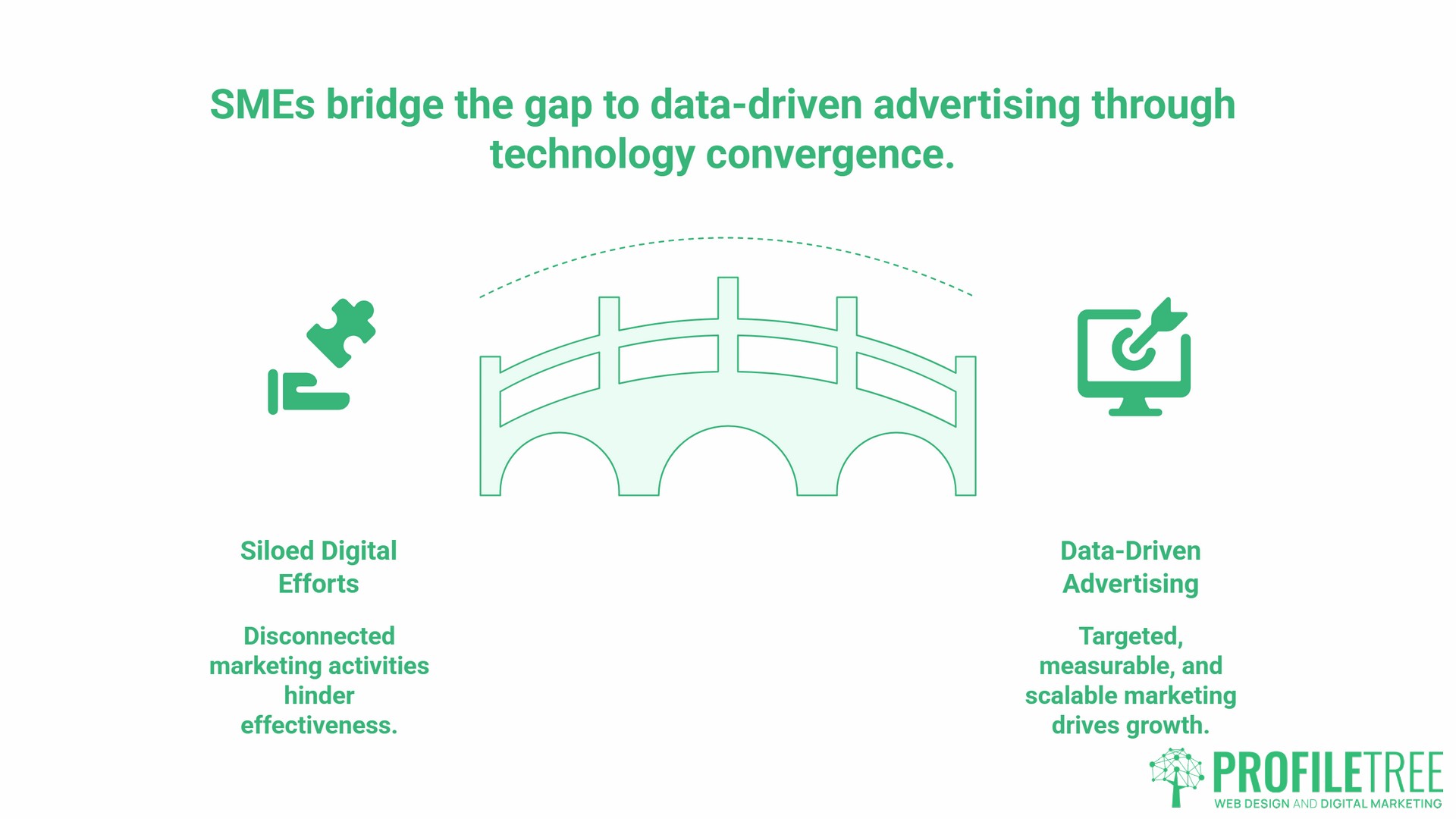
The talent and technology gap in advertising is real, and it affects businesses in Belfast, Derry, and Manchester differently from those in London or Dublin’s multinational corridor. Agency access is more limited, internal marketing teams are smaller, and the volume of conflicting information about which tools to prioritise makes it difficult to make confident decisions.
The most common failure mode is not a lack of investment in technology. It is an investment in technology without a content and SEO foundation to support it. Paid advertising drives traffic to pages that give visitors no reason to act. AI tools generate content that lacks the specificity and local knowledge that SME audiences respond to. Automation is applied to processes that were not working in the first place.
Identifying the Tech Debt in Your Current Marketing Stack
Tech debt in marketing refers to the accumulated cost of decisions made for short-term convenience rather than long-term coherence. For most SMEs, it looks like this: a website built on a platform that does not support good SEO; analytics set up incorrectly so the data cannot be trusted; ad accounts with no clear attribution model, so it is impossible to tell which activity is generating return; email lists that have never been segmented.
A useful starting audit covers ten questions:
- Does your website load in under three seconds on mobile?
- Are your Google Analytics goals tracking actual conversions, not just page views?
- Do your ad campaigns link to dedicated landing pages or to your homepage?
- Can you identify which marketing channel drove your last ten enquiries?
- Is your email list segmented by product interest, lifecycle stage, or buying behaviour?
- Do you have a content calendar that connects to your SEO keyword targets?
- Are your ad creative assets refreshed at least quarterly?
- Is your CRM connected to your advertising platforms for audience matching?
- Do you have a defined process for capturing and acting on website visitor data?
- Can you report marketing ROI to the business in a format that connects to revenue?
The more no answers you have, the stronger the case for consolidation before expansion. Adding more technology to a fragmented stack only makes it worse.
The Practical Delivery Layer: Content and SEO as the Engine of Tech-Driven Advertising
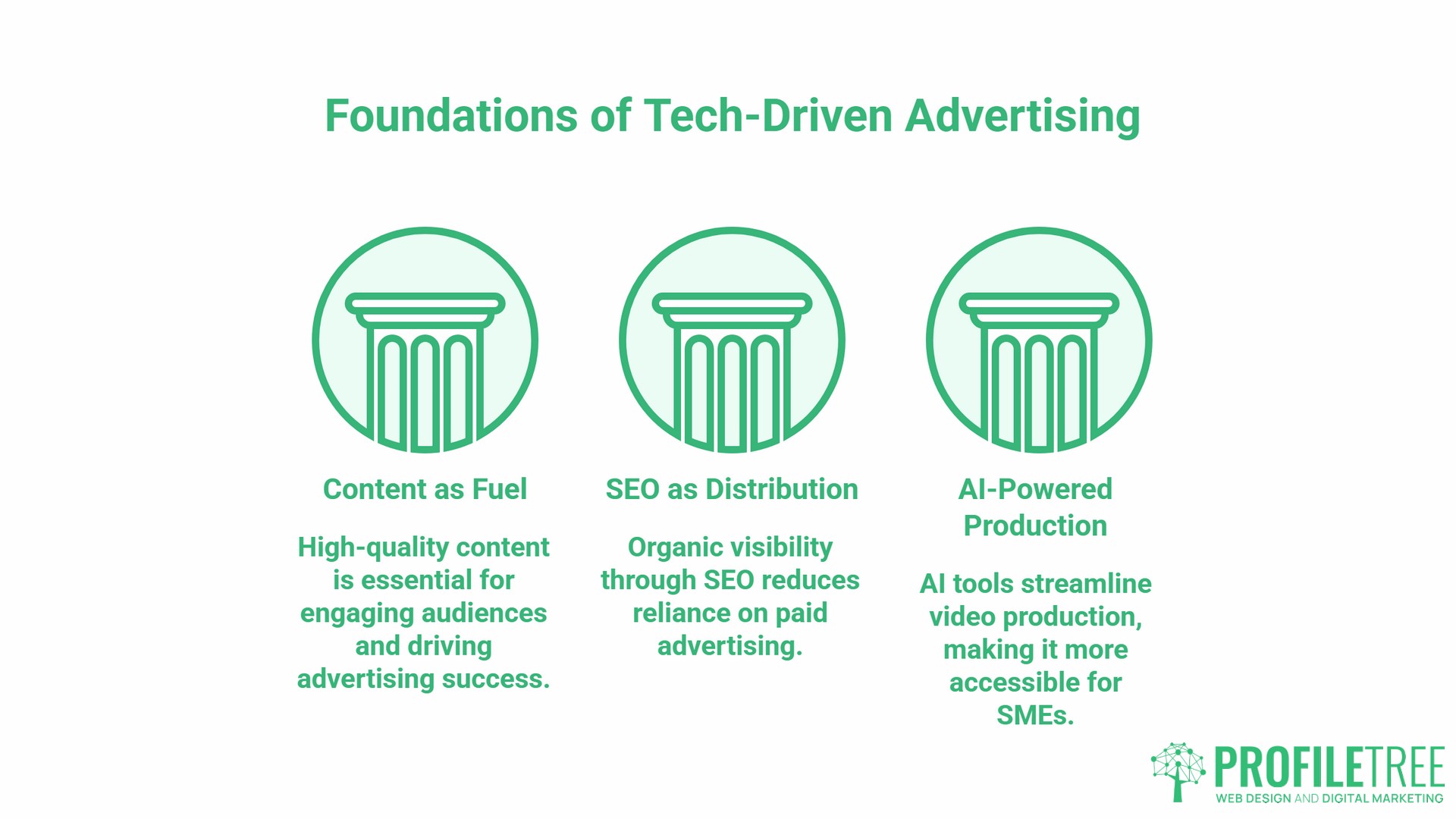
The relationship between technology and advertising is often discussed as if the technology is the primary driver. In practice, for SMEs, content is the fuel and SEO is the distribution mechanism. Neither paid technology nor AI personalisation delivers a sustainable return without them.
Search engine optimisation builds organic visibility, reducing dependence on paid spend. When a business ranks well for the terms its customers use when actively looking for what it offers, every pound spent on paid activity goes further because it supplements rather than substitutes for organic traffic. Businesses that rely entirely on paid advertising are renting their audience. Businesses with strong SEO foundations own a growing share of it.
Digital marketing strategy works most effectively when SEO and paid advertising are planned together from the start, with shared keyword data, aligned messaging, and a content plan that serves both channels.
Using AI to Scale Video and Content Production
Video is the highest-engagement format across every major advertising platform. YouTube, Meta, LinkedIn, and TikTok all weigh video content more heavily in their distribution algorithms. For SMEs, the barriers have traditionally been production costs and consistency.
AI tools have meaningfully lowered that barrier. Script generation, automated transcription, caption production, and thumbnail creation can all be handled with AI assistance, reducing the time and cost of producing video content at a volume that supports regular advertising activity. The strategic layer still requires human judgement: knowing what topics to cover, what tone suits the audience, and which calls to action land. But the production layer is more accessible than ever.
ProfileTree’s video marketing services are built around helping SMEs produce content at a volume and quality that supports both organic reach and paid distribution, with a strategy that connects the two.
Measuring What Matters: ROI in a Tech-Driven Advertising Model
The promise of technology and advertising is measurability. Unlike print or broadcast, digital advertising can, in principle, attribute every conversion to a specific channel, campaign, or piece of creative. In practice, attribution is more complicated, particularly as cross-device behaviour and privacy restrictions reduce the completeness of tracking data.
The most practical approach for SMEs is to work with a small number of clearly defined metrics that connect to business outcomes rather than platform vanity metrics. Click-through rate and impression share tell you about the mechanics of a campaign. Revenue per lead, cost per acquisition, and customer lifetime value tell you whether the advertising is actually working.
| Metric | What it measures | Why it matters |
|---|---|---|
| Cost per acquisition | Total ad spend divided by conversions | Tells you whether the channel is profitable |
| Revenue per lead | Average deal value multiplied by close rate | Puts lead quality in commercial terms |
| Organic share of voice | Your site’s visibility versus competitors for target keywords | Measures SEO progress independently of paid |
| Return on ad spend (ROAS) | Revenue generated per pound of ad spend | The primary paid advertising efficiency metric |
| Content conversion rate | Leads generated by organic content | Measures whether SEO investment is converting |
A 12-Month Transformation Roadmap for Marketing Managers
The following phased approach is designed for an SME marketing team moving from fragmented activity to a coherent technology and advertising strategy. It assumes a modest budget and an internal team of one to three people, with external support for specialist tasks.
Phase 1: Audit and Foundation (Months 1 to 3)
Audit your current tech stack against the ten questions above. Fix the most damaging gaps: GA4 setup, landing page quality, and basic SEO structure. Define your primary audience segments and the keywords they use at each stage of the buying journey. Set your baseline metrics.
Phase 2: Content and SEO Build (Months 4 to 8)
Produce a rolling programme of content that targets the keywords identified in Phase 1. Prioritise topics that have both search volume and commercial intent. Build internal linking between related articles and service pages. Set up email capture and begin segmenting your list. This phase builds the organic foundation that reduces your cost per acquisition in the next phase.
ProfileTree’s digital training programmes are designed to build this capability in-house, so your team can sustain the content programme independently.
Phase 3: Paid Amplification and Automation (Months 9 to 12)
As organic traffic grows and first-party data accumulates, paid advertising becomes far more efficient. Use your email list and website visitor data to build custom audiences. Run retargeting campaigns against people who have already engaged with your content. Test AI-optimised campaign types against manually managed campaigns and shift budget toward what the data supports. Review your attribution model and refine your reporting so the next planning cycle starts from a reliable evidence base.
ProfileTree is a Belfast-based digital agency providing web design, SEO, content marketing, video production, and AI implementation services to SMEs across Northern Ireland, Ireland, and the UK. If you are reviewing your approach to technology and advertising and want a practical assessment of where to start, get in touch with the ProfileTree team.
Frequently Asked Questions
What is the difference between marketing transformation and digital transformation?
Digital transformation refers to the adoption of digital technology across an entire business, covering operations, customer service, finance, and more. Marketing transformation is a subset of that: it specifically addresses how digital tools change how a business plans, executes, and measures its marketing and advertising activities. For an SME, marketing transformation is usually the more practical starting point because the scope is defined and the return is more directly measurable.
What are the four pillars of marketing transformation for SMEs?
For SMEs, the four practical pillars are strategy (a clear plan that connects marketing activity to commercial goals), data (a first-party data foundation that supports targeting and measurement), technology (the right tools applied consistently, not the most tools), and content (the material that powers both organic and paid channels). Technology and advertising strategies that ignore any of these four tend to underperform.
How much does marketing transformation cost for a UK business?
The more useful question is how the existing budget can be reallocated rather than how much new investment is required. Most SMEs already spend on advertising, website maintenance, and content production, but without a plan that connects those activities. Consolidating spend around a coherent strategy typically delivers better return from the same total budget before any new investment is considered.
How is AI changing advertising for SMEs?
AI is changing three things at the SME level: the speed of content production, the precision of audience targeting, and the efficiency of campaign optimisation. Tools that previously required specialist skills or significant budget are now accessible through standard advertising platforms. The constraint is no longer access to the technology; it is having a clear enough strategy to direct it. ProfileTree’s detailed look at AI implementation for SMEs provides a grounded assessment of where the return is most predictable.
Does UK GDPR make technology and advertising harder?
It makes some tactics harder and others more valuable. What gets harder is anything built on data you did not collect yourself, since third-party audience buying and cross-site tracking are being squeezed by regulation and browser policy at the same time. What gets more valuable is the email list, the CRM, and the enquiry form, because that data has consent attached and does not disappear when a browser policy changes. The practical answer for most SMEs is that GDPR compliance and good targeting are now the same project rather than competing ones.
What role does video play in technology-led advertising?
Video is the primary high-engagement format across every major advertising platform, and AI tools have made it much more accessible for SMEs to produce consistently. For technology and advertising strategy to work at scale, video needs to be part of the content plan: it supports organic reach, improves ad quality scores, and gives retargeting campaigns better material to work with.