
Conversational Marketing Examples for UK and Irish SMEs
Table of Contents
A conversational marketing campaign is a chat flow on one chosen page that opens with a qualifying question and sends each visitor to the step that suits them, usually a booked call or a member of the team. The conversational marketing examples below are campaign designs ProfileTree uses when planning chat for SMEs across the UK and Ireland.
What a Conversational Marketing Campaign Looks Like in Practice
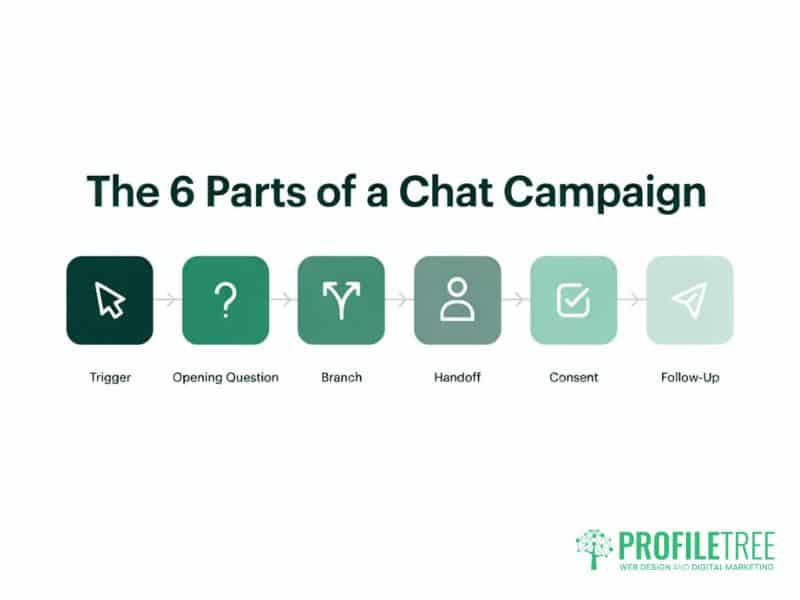
Every chat campaign that produces enquiries has the same six working parts, whatever the sector or the software. If one part is missing, the campaign tends to fail at that point, so it is worth checking each example in this article against the table before you copy it. This six-part anatomy is how ProfileTree’s AI chatbot service plans each campaign before any platform is chosen.
| Part | What it decides | A weak version | A working version |
|---|---|---|---|
| Trigger | Which page and which moment opens the chat | A widget that pops up on every page after three seconds | A prompt on the pricing page after the visitor has scrolled past the price table |
| Opening question | What the visitor is asked first | “Hi, how can we help?” | “Are you pricing this for a team of under ten or more?” |
| Qualifying branch | How answers split visitors into groups | One path for everyone | Separate paths for ready buyers and for researchers |
| Human handoff | When a person takes over | Only when the visitor types “agent” | On frustration, a complaint, a high-value answer or a question outside the script |
| Capture with consent | What data is collected and on what basis | Name and email taken, marketing sent later | A clear statement of use and a separate, unticked choice for marketing |
| Follow-up | What happens after the chat ends | The transcript sits in an inbox | The lead and answers pass to the CRM (customer relationship management system) with a named owner |
The opening question deserves the most care. A visitor who answers a specific question has told you something useful, whereas a general greeting invites a general reply or none at all. The examples that follow each start with a question the visitor can answer in a word or a tap.
The term “zero-party data” appears often in this area. It means information a visitor chooses to give you in the conversation, such as company size or timescale, as distinct from data inferred from their browsing. It is the most useful thing chat produces, and it is only useful if the follow-up step sends it somewhere a person will act on it.
B2B Example: Qualifying Visitors on a Pricing Page
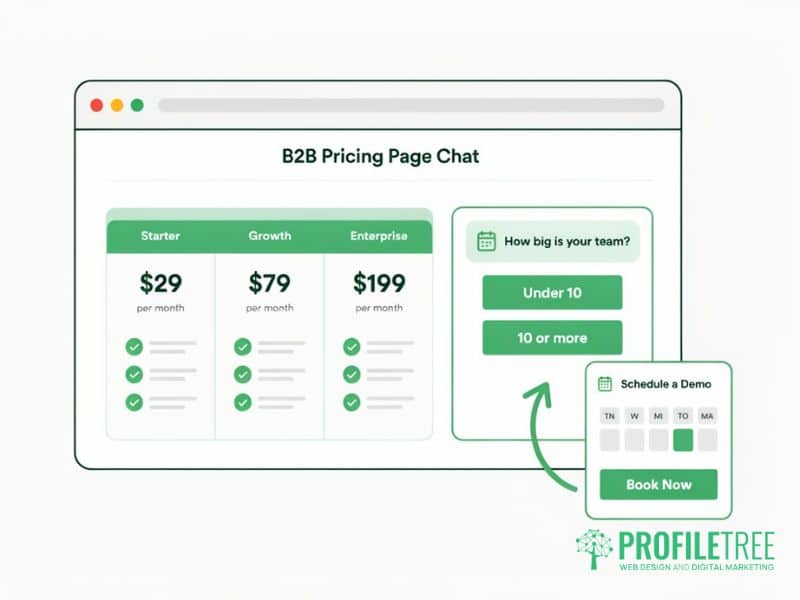
The pricing page is where a B2B chat campaign earns its keep, because the people reading it are already weighing a purchase. The aim is to separate the visitor who wants a call this week from the one who is gathering figures for a budget meeting next quarter, and to give each of them something worth having.
A design that works for a software or services firm selling to other businesses runs like this. The trigger is a prompt that appears once someone has spent time on the price table, worded around the decision they are making. The first thing the chat asks about is team size or how many users there will be, because that answer usually decides which package fits. Visitors in the larger band are offered a calendar link to book a call with a named person, while smaller teams are shown the package that suits them with an offer of a short comparison guide in exchange for an email address.
The handoff rule matters most here. If the visitor asks about a contract term, a discount, or an integration that the script does not cover, a person should pick up the conversation during working hours, with the earlier answers already on screen so the visitor does not repeat themselves. Outside working hours, the chat should say plainly when someone will reply. For the cost and build time of this kind of setup, see what an SME chatbot costs and how long it takes.
Before building anything, it is worth agreeing what counts as a qualified lead. If sales and marketing disagree on that, the chat will route people to the wrong place, however well the flow is written. We start every chat project with that agreement for this reason.
Professional Services Example: Capturing Out-of-Hours Enquiries
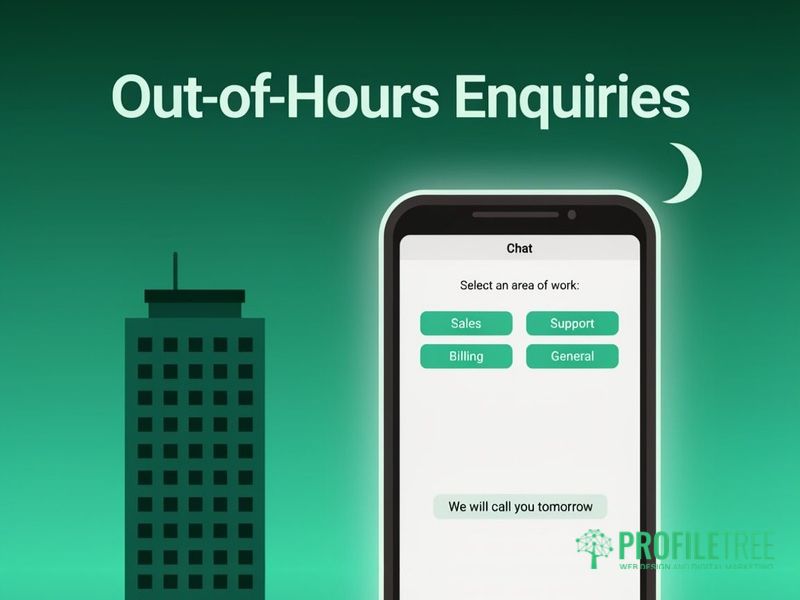
For accountants, solicitors, surveyors and consultants, the best chat campaign is often the simplest one. Many people research a professional problem in the evening, when the office is closed, and a contact form at that hour feels like posting a letter. A short chat that takes the enquiry and promises a call back the next working day turns that visit into a conversation the firm can follow up.
The design is deliberately limited. The trigger is the service page for each area of work, and the chat first asks which kind of help the visitor needs, offered as buttons. The chat then asks for a name, a phone number or email address, a preferred time for a call, and a sentence about the problem. It confirms when the firm will call and ends there, with no attempt to answer the question itself.
Keeping the chat this limited protects the firm, because a bot that answers a professional question risks giving something that reads as advice without any of the checks that advice requires. The callback model keeps the expert judgement with the person qualified to give it, and the chat does only what it is good at.
A Regulated Firm That Gives No Advice in Chat
Firms regulated by a body such as the Financial Conduct Authority or the Solicitors Regulation Authority need one extra layer of design. The chat should state at the start that it books appointments and does not give advice, and the script should be reviewed by whoever is responsible for compliance in the firm before it goes live. Any answer the bot gives about products or fees should match the approved wording on the website word for word.
The handoff in this example works the other way round from the B2B case. Questions that drift towards personal circumstances should end the automated part of the chat and offer a call with an adviser, because that is where a regulated conversation belongs. This is a design principle and not legal guidance, so the firm’s own compliance owner has the final say.
Retail Example: Answering Questions Before Checkout
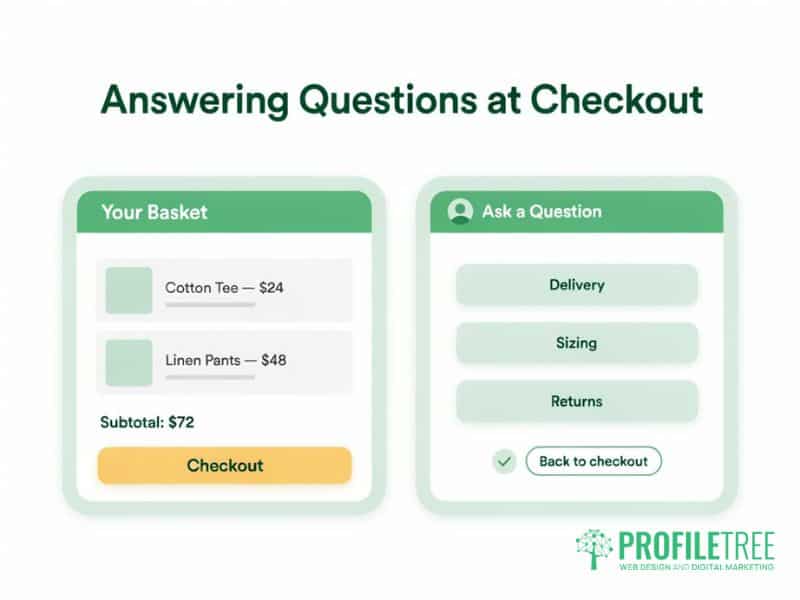
In online retail, chat earns its place by removing the doubt that stops someone from paying. The questions buyers ask at that stage are predictable: delivery dates, sizing, returns, and whether a product works with something they already own. A chat that answers those from approved content, at the point of hesitation, does more for sales than a general help widget.
The trigger in this design is the basket or checkout page, once someone pauses before paying. The chat opens by offering the common worries as buttons, each leading to a short answer and a link back to the checkout. Anything outside those answers goes to a person or, outside staffed hours, to a promise of a reply by a set time.
Some retailers move the conversation to WhatsApp, which suits buyers who would prefer to continue on their phone. Our guide to WhatsApp Business features covers what the business app offers for this. Moving the chat to a messaging app also moves it into the rules on electronic marketing, which the next section covers.
Building Consent Into Every Chat Flow
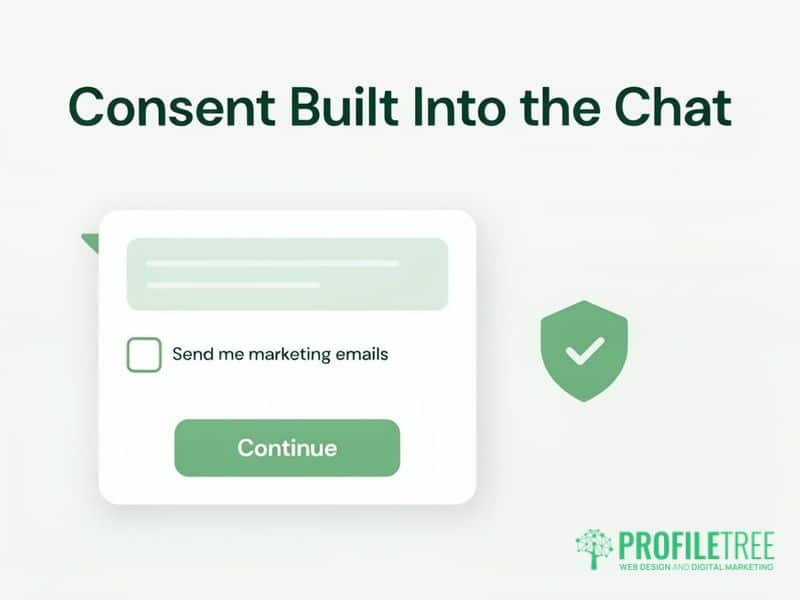
A chat that collects a name and contact details is processing personal data, so UK GDPR (the UK version of the General Data Protection Regulation) applies, and the business needs a lawful basis for each use it makes of that data. Sending marketing afterwards is a separate use from answering the enquiry. Under the Privacy and Electronic Communications Regulations (PECR), which govern marketing by email and text message in the UK, that marketing normally needs the person’s consent unless a narrow exception applies.
The exception most businesses rely on is the soft opt-in. It covers existing customers, or people who were in talks about buying, who receive marketing about similar products and who were given a simple way to refuse at the point of collection and in every message afterwards. A first-time chat visitor who has not bought anything usually falls outside it, which is why the chat itself is the right place to ask. The ICO’s guidance on direct marketing and electronic communications sets out the conditions in full.
In practice, consent built into the chat looks like this. Before asking for contact details, the chat says what they will be used for. Marketing is offered as a separate choice that the visitor has to select themselves, because a pre-selected option does not count as consent under UK GDPR. The follow-up message then repeats how to opt out.
For readers in the Republic of Ireland, the equivalent rules sit in the GDPR and Ireland’s ePrivacy Regulations of 2011. The Data Protection Commission publishes an FAQ on consent for electronic direct marketing that covers the existing-customer exception. A business selling into both markets should design its chat for the stricter reading and keep one flow for both.
Two other checks belong in the build. The first is where the chat platform stores data, which you should confirm with the provider in writing for your account. The second is how long transcripts are kept, which should match the retention period in your privacy notice. For the wording that sits beside the consent choice, the advice on consent wording on web forms applies equally to a chat window.
Measuring Whether a Chat Campaign Is Working
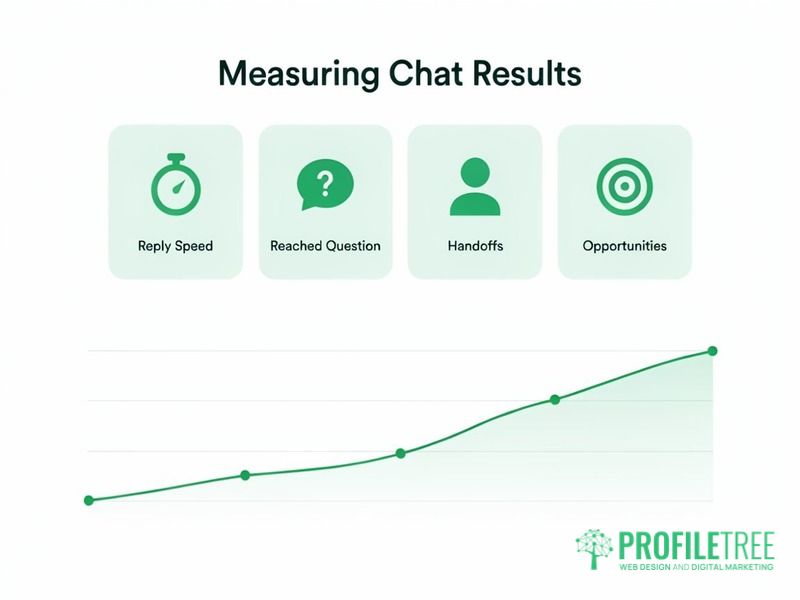
The measure that matters is how many chats turn into sales conversations, and the number of chats opened tells you very little on its own. Before launch, decide what counts as qualified and record it in the CRM as a stage, so that every chat can be traced to an outcome.
Four measures cover most campaigns. Speed to a first useful reply shows whether visitors are getting an answer while they still care. The share of chats that reach the qualifying question shows whether the opening works. Handoffs to a person show whether the script covers the real questions, because a high rate usually means the bot is being asked things it cannot answer. Finally, how many qualified leads become opportunities shows whether the campaign is producing business or only conversations.
Published figures on chat performance vary widely, and most come from software vendors, so treat any benchmark with care. Our article on conversational marketing statistics that hold up sets out which figures survive a check. Your own numbers after a few months on one page will tell you more than any industry average.
Review each campaign monthly against these measures, change one part of the anatomy at a time, and keep a note of what changed. A different opening question on the same page for a month is a fair test, whereas changing several parts at once leaves you unable to say which change made the difference.
“The businesses getting results from AI chatbots are the ones that put a chat flow on one page that matters to them and measured what changed. The ones that switched on a bot across the whole website and hoped for the best are usually back where they started six months later. ProfileTree’s AI chatbot work for SMEs in Northern Ireland follows the first approach, because it is the only one we have seen work.” Ciaran Connolly, founder of ProfileTree.
Getting Your First Chat Campaign Live
Start with one page where visitors are close to a decision, write the opening question and the handoff rules before choosing software, and agree what counts as a qualified lead with whoever follows them up. Run it for a few months, measure it against the outcomes above, and then decide whether to extend it to a second page. If your current approach to chat is a widget on every page, our guide to conversational marketing strategy covers the planning that sits above individual campaigns.
ProfileTree is a Belfast web design and digital marketing agency, founded in 2011 and based at the McSweeney Centre, and it designs and connects chat campaigns for businesses across the UK and Ireland. To talk through chat for your own website, see how our AI chatbot service works and what is included; pricing is quoted on request.
FAQs
1. What is an example of conversational marketing?
A common example is a chat prompt on a pricing page that asks the visitor how many people the product is for. It then offers a call booking to larger buyers and a guide to smaller ones. The campaign works because the first question splits visitors by need, so each one is offered a next step that fits. The same pattern suits evening enquiry capture for professional firms and pre-checkout questions in retail.
2. Is a chatbot the same as conversational marketing?
A chatbot is one part of conversational marketing and not the whole of it. The chatbot is software that runs a conversation, while conversational marketing is the plan for which conversations to have on which pages and what each one should lead to. Many campaigns use a chatbot for the opening and qualifying steps and a person for the rest. A chatbot added without that plan is usually a help widget and rarely produces leads.
3. Do chat campaigns need consent under UK GDPR?
Answering the enquiry a visitor started does not need marketing consent, because it is what they asked for. Sending them marketing afterwards usually does, under PECR, unless the soft opt-in for existing customers applies. The safe design asks for marketing consent as a separate, unticked choice inside the chat and explains how to opt out.
4. Can a small business run a chat campaign without a developer?
Yes. For a simple design such as capturing evening enquiries, most chat platforms can be set up through their own settings. The harder work is writing the questions, the answers, and the handoff rules, and connecting the chat to wherever leads are followed up. A developer becomes useful when the chat needs to read from a booking system or write leads straight into a CRM.
5. What should a chatbot never do on a regulated website?
It should never give anything that could read as personal advice, and it should never quote prices or product terms that differ from the approved wording on the site. A chatbot on a regulated firm’s website should say at the start that it books appointments and does not advise. Questions about personal circumstances should pass to a qualified person.