
Project Pricing Fixed Time: Choosing Your Model
Table of Contents
Two pricing models dominate quotes for web design, development and marketing work: fixed price and time and materials. Get the choice wrong, and a budget can spiral, a supplier can end up delivering at a loss, or a project can stall while both sides argue over what was actually agreed.
For SMEs across Northern Ireland, Ireland and the UK, this decision carries more weight than most business owners expect before they sign anything. It determines who holds the financial risk if requirements shift, how closely you need to stay involved once work starts, and whether IR35 status becomes a factor in how the contract gets written.
This guide sets out how fixed price and time and materials contracts work, where UK rules on IR35 and VAT matter, and how to pick the model that actually suits your project rather than the one that simply sounds safest. We’ll refer to this throughout as a project pricing fixed time decision: one choice, made at the start, that shapes budget certainty, IR35 exposure, and how much control you keep once work begins.
Most disputes between clients and suppliers trace back to this decision rather than to poor delivery. A well-run project on the wrong pricing model still causes friction, because the contract was never built to handle the way the work actually unfolded. Getting this right at the brief stage saves far more time than any amount of renegotiation once work is underway.
Understanding the Two Pricing Models
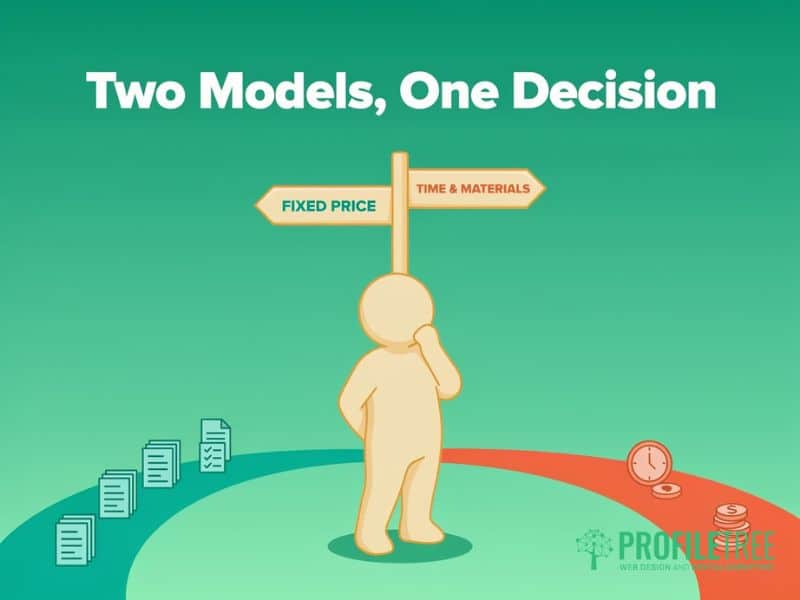
Every project pricing fixed time decision starts with the same fork: are you buying a defined output, or paying for effort as it happens? Fixed price and time and materials sit at opposite ends of the same trade-off, cost certainty against flexibility. Neither model is better in the abstract; each suits a different type of project. Most comparisons of project pricing models boil down to this single fork; many extra factors get layered on top.
Both models can apply to the same type of work. A website build can be quoted at a fixed price or run as time and materials; what changes is how settled the requirements are and how much say you want during delivery. Confusing the model with the service itself is a common mistake, and it’s usually what leads businesses to pick the wrong one.
What Is a Fixed Price Contract?
A fixed price contract sets the total cost of a project before work begins. You agree on a specification, a supplier quotes a single figure, and that figure stays the same regardless of how many hours the work actually takes. Any unexpected complexity becomes the supplier’s problem to absorb, not an extra invoice for you.
This works well when the brief is genuinely settled. A website built with a defined page count, a fixed set of integrations and an agreed number of revision rounds is a natural fit for a fixed price. It’s less suited to work where the output depends on what you learn as you go, because there’s no built-in mechanism for handling scope that grows mid-project without triggering a formal change request.
What Is a Time and Materials Model?
A time and materials contract, often shortened to T&M, charges for the actual hours worked plus any materials or third-party costs. Time and material pricing works on a simple principle: the supplier tracks time, adds a markup, usually between 15% and 35%, to cover project management and margin, then invoices weekly or monthly as the project runs.
Time and materials suits projects where the scope isn’t fully known at the outset. An SEO retainer that adjusts month to month based on performance, an AI implementation project shaped by what the business actually needs rather than a fixed brief, or a build where features get tested and refined in stages, all fit this model naturally. The trade-off is cost predictability. Without a ceiling, a T&M contract can run past the client’s original budget if scope expands or timelines slip, which is why an engaged, responsive client matters more here than under a fixed price.
Fixed Price vs Time and Materials Compared
The two models differ across several dimensions beyond cost alone, and the table below sets out how a project pricing fixed time decision plays out across cost, risk and control, so you can see where each of these project pricing models wins depending on what you actually need from the arrangement.
| Factor | Fixed Price | Time and Materials |
|---|---|---|
| Cost certainty | High | Low to moderate |
| Scope flexibility | Low | High |
| Risk holder | Supplier | Client |
| Best suited to | Well-defined briefs | Evolving or exploratory work |
| Client involvement | Low during delivery | High throughout |
| Change request process | Formal, often costly | Built in |
Read the table as a starting filter rather than a final answer. A project can score “well-defined” on requirements but still needs the flexibility of time and materials if the delivery timeline is long enough that priorities are likely to shift before the work finishes. Use it to narrow the decision, then work through the risk and IR35 considerations below before committing either way.
Risk Allocation: Who Carries the Cost of Delay
Risk allocation is often what actually decides a project pricing fixed time question, more than which option simply sounds cheaper upfront. Every pricing model answers one question differently: if something goes wrong, who pays for it? Understanding where the risk actually sits changes how you negotiate a fixed price or time and materials agreement, not just which one you pick.
Under a fixed price contract, the supplier carries the risk of underestimating the work. If a project takes twice as long as quoted, that cost sits with the agency, not the client, which is why suppliers often build a risk premium of 20 to 30% into fixed quotes to protect their margin against the unknowns. Learning how to manage fixed price projects well starts with recognising this risk premium for what it is, rather than assuming the lowest quote is automatically the safest one.
Under time and materials, the client carries more of the risk, because hours worked translate directly into cost. This isn’t necessarily worse. It reflects the actual effort involved rather than a supplier’s best guess dressed up as certainty, and it removes the incentive for a supplier to cut corners to protect a fixed margin. This is one of the clearest arguments for time and material pricing on genuinely uncertain projects: cost follows effort rather than a guess made before anyone has actually started the work.
“Clients often assume a cheap fixed price bid is the safer option,” says Ciaran Connolly, founder of ProfileTree. “In practice, an unrealistically low fixed quote is one of the biggest warning signs. Something has to give: quality, scope, or an expensive change request further down the line.”
The real question isn’t which model removes risk, because neither does. It’s which party is better placed to manage the specific risk on your project: a supplier absorbing the unknowns of a well-scoped build, or a client staying closely involved in an evolving one.
The Hybrid Option: Capped Time and Materials

For many businesses, capped T&M is what actually resolves a project-pricing fixed-time decision, combining the flexibility of one model with the ceiling of the other. It’s best understood as a variant t&m pricing model rather than a separate contract type altogether. A capped T&M arrangement, sometimes called a “not to exceed” contract, gives you both, and it’s the option that most general guides to fixed-price and time-and-materials leave out entirely.
A capped T&M contract works exactly like a standard time-and-materials agreement, with hourly tracking and monthly invoicing, except that the total cost cannot exceed an agreed ceiling without formal client sign-off. If the work finishes under the cap, you pay only for the hours used. If it looks likely to exceed the cap, the supplier has to flag this before continuing rather than simply carrying on and invoicing you afterwards.
This model suits projects with a rough idea of scope but genuine uncertainty about the finer details: a website rebuild where the page count is known but the content migration effort isn’t, or a phased digital strategy engagement where an initial discovery phase informs what the delivery phase will actually need. Many agencies structure projects this way by default, quoting discovery as a fixed price and moving to T&M, capped or otherwise, once the scope is properly understood.
The main thing to get right in a capped T&M agreement is the reporting cadence. If hours are tracked and shared regularly against the cap, disputes about what’s been spent are rare. If reporting is vague or infrequent, a capped contract offers little more protection than an uncapped one.
UK Considerations: IR35, VAT and Contract Structure
A project pricing fixed time decision in the UK carries an extra layer that many general guides skip entirely: how the contract structure interacts with IR35 and VAT.
IR35 legislation looks at whether a contractor is genuinely operating as an independent business or effectively working as a disguised employee. Two of the tests HMRC applies, substitution and control, are generally easier to satisfy under a fixed price, output-based contract. You’re paying for a defined deliverable, not a person’s time under your day-to-day direction, and that’s the structure IR35 is designed to distinguish from disguised employment.
Time and materials contracts sit closer to the line, particularly where a supplier’s team works to your schedule and under your direction for an extended period. This doesn’t make T&M non-compliant. It means the contract terms need to be written carefully, with clear language around the supplier’s right to substitute staff and their control over how the work gets delivered, rather than just how many hours it takes.
VAT treatment also differs slightly in practice. Fixed price projects are usually invoiced against agreed milestones, with each one a separate VAT point. T&M invoices are typically monthly, so VAT falls due more frequently across the project’s life. Neither model changes whether VAT applies, but it does change your cash flow planning, particularly for businesses managing VAT quarterly.
None of this is legal advice, and any business with genuine IR35 exposure should get a contract reviewed by a qualified adviser before signing. But knowing the right questions to ask, about substitution rights, control, and invoicing structure, puts you in a stronger position going into that conversation, whichever pricing model you’re weighing up.
Businesses that report VAT quarterly tend to prefer the milestone structure of fixed price, because each payment lands as a discrete, forecastable VAT point rather than a rolling monthly charge. This is a genuine, practical reason some SMEs approach fixed price and time and materials decisions differently, depending on their own accounting cycle, not just the nature of the project itself. It’s worth raising with your accountant alongside the IR35 question, particularly if you’re weighing up a longer engagement where the invoicing pattern will run for several quarters.
Choosing the Right Model for Your Project
The right model for a fixed price or time and materials decision depends on how well-defined your project actually is, not on which option sounds more reassuring on paper. These four questions cover most of what decides a project’s pricing fixed time choice.
Requirement Clarity and Scope Stability
If you can document every page, feature and integration without ambiguity, a fixed price is viable. If the project is exploratory, or the output depends on what you learn once work starts, time and materials protect both sides better. This is really the heart of how to manage fixed price projects successfully: a short, paid discovery phase, often scoped through a defined website development brief, is the most reliable way to turn an unclear idea into something that can genuinely support a fixed quote.
Budget Predictability vs Flexibility
A fixed price gives you a hard ceiling, but only if the brief behind it was genuinely locked down. A poorly scoped fixed price project can still run over budget once change requests start accumulating, and change requests worth 10 to 20% of the original project value are common enough that most suppliers build a formal process for handling them. Time and material pricing makes this trade-off explicit rather than hidden behind a single quoted figure, which suits businesses that would rather see the real cost of changes, and VAT, as they happen, including those running an ongoing digital marketing programme where activity shifts month to month.
Client Involvement and Decision-Making
Time and materials ask more of you as the client. It works best when someone on your side can review progress regularly, give feedback quickly and make decisions without long delays, because a slow decision-maker extends the timeline and the invoice together. Fixed price needs far less day-to-day involvement once the brief is signed off, which suits businesses with limited capacity to manage a supplier closely.
This is also where the working relationship matters as much as the contract itself. One ProfileTree client, working through a digital transformation via our digital training programme, said the process “was easy”, specifically because the team “went above and beyond to accommodate” a genuinely difficult schedule, rather than expecting the client to fit around fixed meeting slots. That kind of flexibility tends to matter more under time and materials, where ongoing input shapes the outcome.
Duration, Delivery Style and Technology Risk
Short, well-understood projects with little technical uncertainty suit a fixed price: a defined website build, a single campaign asset, a scoped set of training sessions. Longer engagements, iterative software development, or work involving newer technology where the approach itself is still being tested, suit a t&m pricing model far better than a fixed quote guessed at before the technology has actually been tested, because nobody, supplier included, can accurately estimate hours for a problem that hasn’t been solved before.
Managing Your Chosen Pricing Model
Whichever way your project pricing fixed time decision goes, the contract type matters less than how it’s managed day to day. How to manage fixed price projects well and how to manage a t&m pricing model well come down to the same handful of habits, even though the mechanics of each contract differ, and this holds true across most project pricing models, not just these two.
Clear documentation of requirements before work starts reduces disputes under either model, and a formal change request process, even a simple one, gives both sides a shared reference point when something needs to shift. Under time and materials, specifically, visible time-tracking tied to documented work is what keeps regular progress reviews useful rather than becoming a source of friction.
Naming a single decision-maker on the client side, someone with the authority to approve changes without escalating every request, speeds up delivery under either model. This matters particularly for web design projects, where small decisions, a colour, a layout choice, a page structure, accumulate quickly and stall a project if everyone needs sign-off from multiple people.
Project management software that makes time-tracking visible to both sides removes most of the disagreement that otherwise builds up around time and materials invoices. When the client can see what was worked on and when, questions about hours become straightforward rather than adversarial.
The same discipline pays off under a fixed price, too, even without hourly invoicing. A shared task board that shows what’s been completed against the original specification gives both sides an early warning if a change request is drifting the project away from what was originally agreed, well before it becomes a dispute about the final invoice. Whichever model governs the contract, a written scope, a single decision-maker, and shared visibility into progress do more for a smooth delivery than the contract type ever will.
Neither fixed price nor time and materials is the “correct” default. The models exist because projects genuinely differ, and the businesses that get the best outcomes are the ones that match the contract to the brief rather than the brief to whatever pricing model they’ve used before. If your requirements are locked down, a fixed price protects your budget. If they’re still forming, time and materials, capped or otherwise, protect the outcome. In the end, a project pricing fixed time decision comes down to one thing: get the scope conversation right first, and the pricing model tends to follow naturally.
FAQs
1. What does T&M mean in project pricing?
T&M stands for time and materials. It’s a contract model where you pay for the actual hours worked and resources used, rather than agreeing on a single fixed sum upfront.
2. Is a fixed price or time and materials better for software development?
It depends on the brief. A clearly scoped MVP or prototype can work well as fixed price, but most iterative software development suits time and materials better because the effort involved tends to change as testing reveals what’s actually needed.
3. What is a “not to exceed” clause?
It’s the ceiling written into a capped time and materials contract. The supplier can’t bill beyond that figure without formal client approval, even if the actual hours worked would otherwise justify it.
4. How does IR35 affect the choice between fixed price and time and materials?
Fixed price, output-based contracts are generally easier to structure outside IR35 because they focus on a deliverable rather than a person’s time under your direction. Time and materials contracts can still sit outside IR35, but the terms need clearer language around substitution and control, and any business with genuine exposure should get this reviewed by a qualified adviser.
5. Why do fixed price projects go over budget?
Usually, because the brief wasn’t as clearly defined as it looked when the contract was signed. The other common cause is the client introducing changes during delivery that fall outside the original scope, which triggers the formal change request process rather than being absorbed for free.