
Outsourcing Training: Pros, Cons and When It Makes Sense
Table of Contents
Outsourcing training means contracting external providers to design or deliver employee development programmes. It can reduce costs and give smaller businesses access to specialist expertise, but it also carries risks around quality control and cultural fit. The right choice depends on the type of training, how often it runs, and what internal capacity your business already has.
Deciding whether to outsource staff training is rarely straightforward. The cost savings look appealing on paper, but businesses that rush the decision often end up with programmes that feel disconnected from how their teams actually work. The wrong provider can waste both budget and time.
This guide looks at the genuine advantages and disadvantages of outsourcing training, along with the scenarios where it makes practical sense for SMEs. It also covers what to watch for when selecting a provider and how to protect your business if you commit to an external arrangement.
If you’re also looking at how digital skills fit into your staff development plans, there is a separate section below on bridging outsourced training with digital training courses and the other digital capabilities your team needs to grow.
What Is Outsourcing Training?
Outsourcing training means contracting a third party to take on some or all of your organisation’s learning and development function. That could mean a provider designing a bespoke programme, an external trainer delivering sessions your team has planned, or a platform managing your e-learning infrastructure entirely.
The scope varies considerably. Some businesses outsource a single compliance module once a year. Others hand over their entire onboarding process to a specialist firm. The distinction matters because the risks and benefits are very different at each end of that spectrum.
What Typically Gets Outsourced
The most commonly outsourced training categories in UK SMEs include compliance and regulatory training (health and safety, GDPR, financial services requirements), technical and software skills, leadership and management development, and onboarding for new starters. Niche or fast-moving subjects, such as cybersecurity or AI tools, are also frequently handled externally because the internal expertise simply doesn’t exist yet.
What Usually Stays In-House
Culture-specific content, company process training, and anything touching sensitive internal knowledge tends to stay internal. The same is true of training that needs to be updated constantly to reflect live operational changes. External providers struggle to keep up with that pace unless you have a very tight service level agreement in place.
Pros of Outsourcing Training
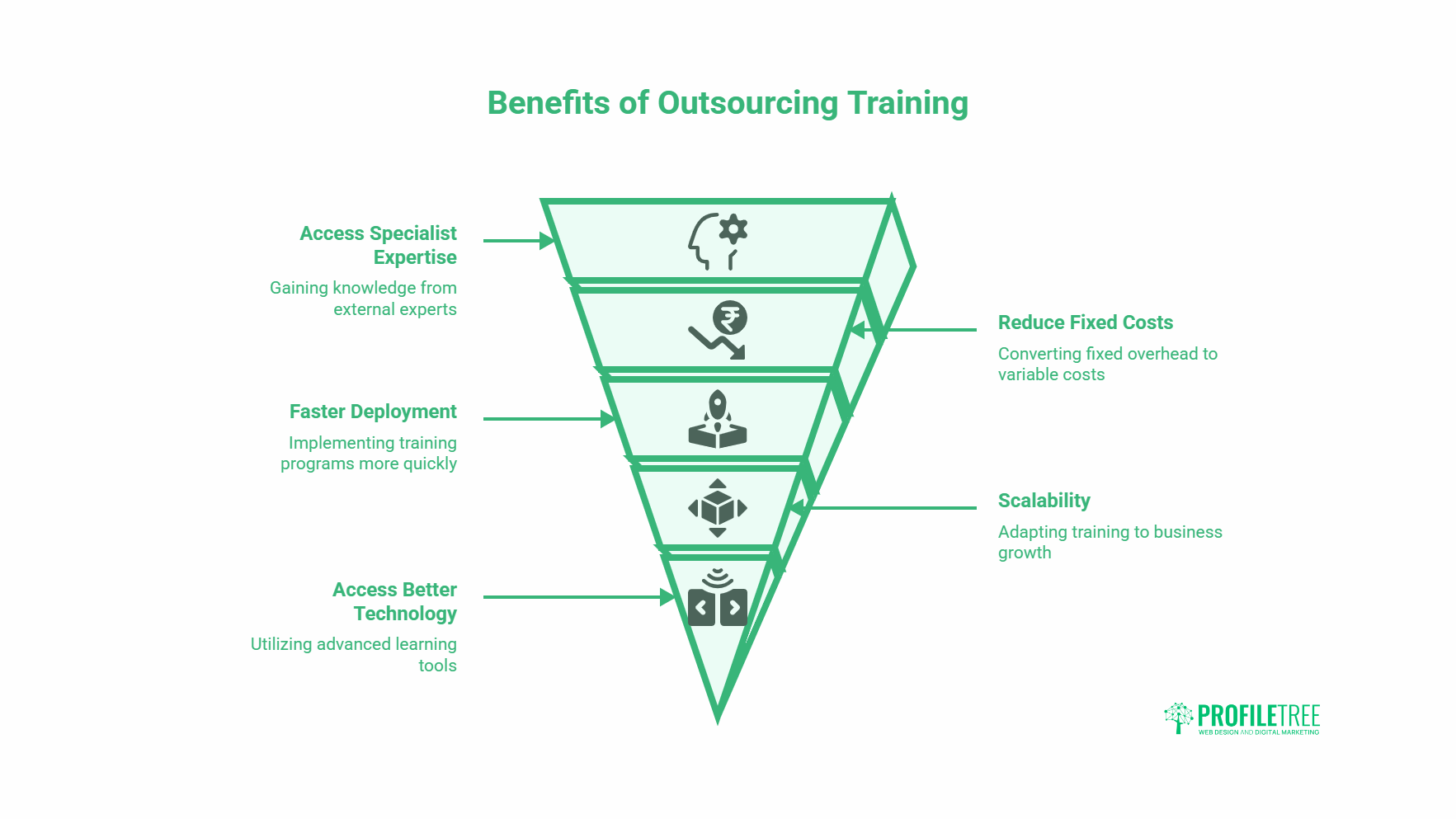
For many SMEs, the case for outsourcing training rests on three practical realities: no in-house L&D team, no budget for one, and a need to get people trained quickly. These are legitimate reasons. But the benefits go further than cost alone.
Access to Specialist Expertise
A good external provider has delivered the same type of training to dozens of organisations. They know what works, what wastes time, and where most teams struggle. That accumulated knowledge is difficult and expensive to replicate internally, especially for technical subjects or regulated industries where the content changes frequently.
For businesses that need staff trained on specific platforms, data tools, or emerging technologies, this is probably the strongest argument for going external. AI training for businesses, for example, is an area where the practical knowledge gap between what internal staff know and what they need to know is still very wide.
Reduced Fixed Costs
Running an internal training function requires dedicated staff, content production, platform licences, and ongoing maintenance. For most SMEs, that fixed overhead is hard to justify. Outsourcing converts that fixed cost into a variable one: you pay for what you need, when you need it.
The CIPD’s annual learning and skills at work report consistently shows that SMEs invest proportionally less in training than larger organisations, largely because the fixed cost of an internal L&D function is harder to absorb at lower headcount.
The savings are most obvious for training that only runs occasionally. A one-day leadership workshop delivered twice a year externally will almost always cost less than employing someone to develop and deliver it internally. The calculation shifts when training is frequent, standardised, and scalable.
Faster Deployment
Building a training programme from scratch takes time. Writing content, testing materials, training the trainer, booking rooms or configuring platforms: a reasonably complex internal programme can take months to get to first delivery. A specialist provider with ready-made frameworks can often cut that to weeks.
For urgent needs such as a compliance deadline, a new product launch, or a rapid recruitment drive this speed advantage is difficult to ignore.
Scalability Without Headcount
When your business grows quickly, training demand can spike in a way that would overwhelm a small internal team. External providers can absorb that variation without you having to hire. This is particularly relevant for businesses with seasonal patterns or those going through acquisitions and restructuring.
Access to Better Technology
A specialist training company may have access to learning management systems, simulation tools, or interactive content platforms that would be prohibitively expensive to licence independently. Businesses that want modern, trackable e-learning without the capital investment often find outsourcing to be the more practical route.
Cons of Outsourcing Training
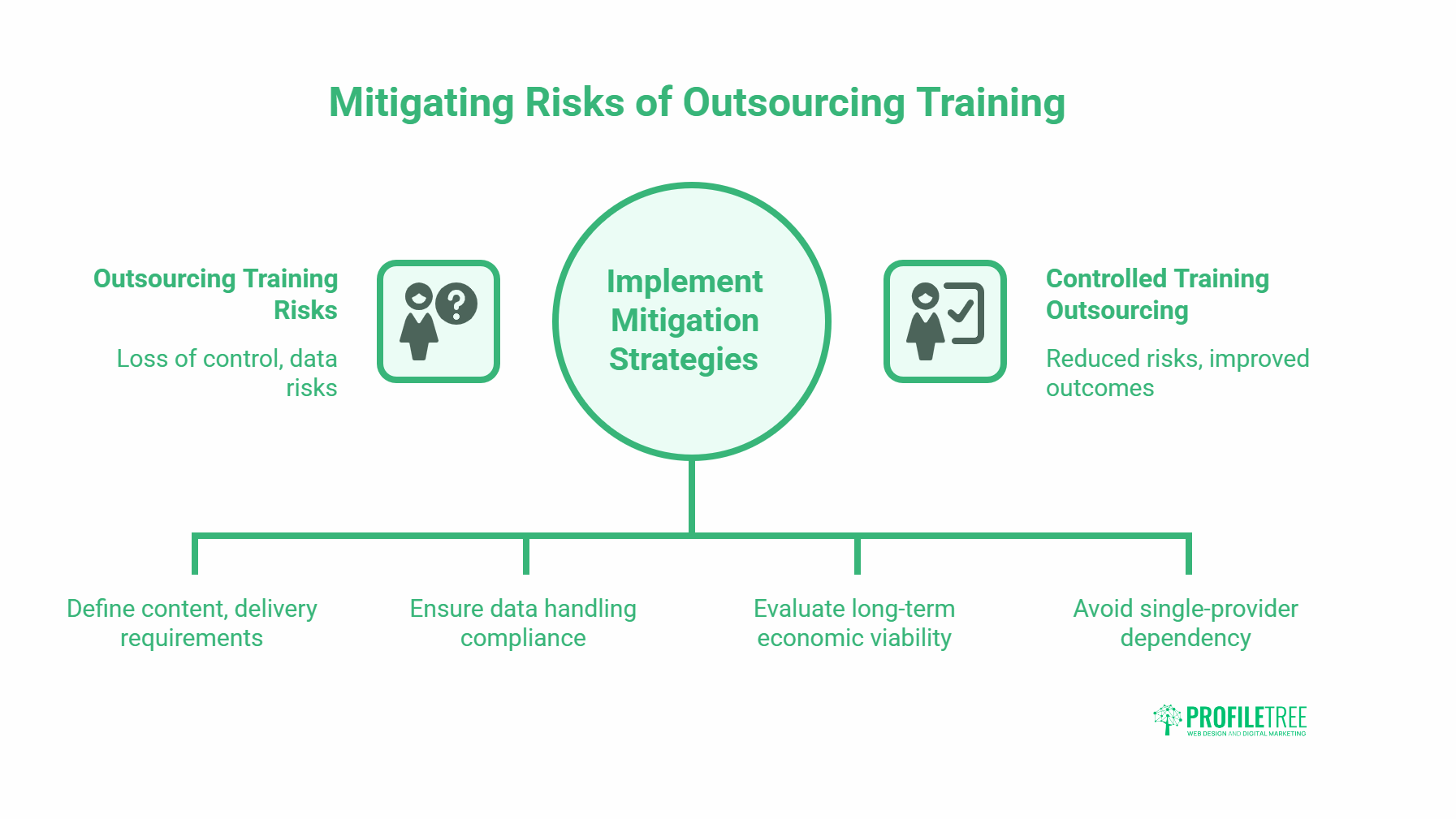
The risks of outsourcing training are real, and they are not always obvious until after a contract is signed. The most common problems are not about provider quality in isolation; they are about fit, control, and the long-term cost of dependency.
Loss of Control Over Content and Delivery
When you outsource training, you hand over a degree of control over what your people learn and how. Generic modules may not reflect your company’s actual processes, culture, or standards. In regulated industries, that gap between standard content and your specific requirements can create compliance problems rather than solve them.
The solution is a tight specification up front. Providers who resist customisation, or charge heavily for it, are a warning sign.
Confidentiality and Data Risks
Training often involves sharing internal process information, organisational structure, performance data, or customer-related content with a third party. Without strong contractual protections and clear data processing agreements that meet UK GDPR requirements, this creates exposure.
This is especially relevant for businesses in regulated sectors such as financial services, healthcare, or legal. Before signing any outsourcing arrangement, a legal review of data handling provisions is not optional.
Long-Term Cost Can Exceed In-House
For training that runs frequently and at scale, the per-head cost of external provision adds up fast. A business that outsources its standard onboarding programme will pay a per-head fee indefinitely. At some volume, building that capability internally becomes the more economical choice. Running the numbers over a three-year horizon is worth doing before committing.
Dependency and Transition Risk
Once your organisation’s training rhythm is built around an external provider, switching is disruptive. If that provider exits the market, raises prices significantly, or loses the team members who understand your account, the impact lands directly on your people. Avoiding single-provider dependency matters, particularly for training that’s operationally critical.
Cultural Misalignment
Training that doesn’t reflect how a company actually behaves is counterproductive. An external provider working from a brief has a limited understanding of your team’s real day-to-day context. This is hardest to fix in soft-skills training, management development, and anything tied to values or ways of working. The better providers invest time upfront to understand the organisation; the less experienced ones don’t.
When to Outsource (and When Not To)
The decision is rarely all or nothing. Most SMEs that handle training well use a blended approach: internal delivery for the content only they can teach, external provision for the rest.
Outsourcing Makes Sense When…
You need specialist knowledge your team doesn’t have. Technical, regulatory, or fast-evolving subjects such as data analytics, cybersecurity, or digital skills fall into this category. Paying for expertise here is more cost-effective than trying to build it from scratch.
You need to move quickly. If there’s a compliance deadline or a new system going live, an external provider with a ready-built programme can deploy faster than any internal development process.
Training volumes are low and variable. If you need a particular programme only occasionally, the fixed cost of developing and maintaining it internally is hard to justify.
You’re trying to introduce genuinely new capabilities. Bringing in an external expert to build something new, then transferring knowledge to internal staff, is a reasonable model for capability development.
Keeping It In-House Works Better When…
The training is deeply tied to your internal culture or proprietary processes. No external provider will understand your operational context as well as your own people.
Training is high-frequency and standardised. If you’re onboarding 50 people a quarter with the same programme, building that internally will be more cost-effective within a year or two.
You need complete control over content and iteration. Training that needs to change quickly in response to operational shifts is difficult to keep accurate through an external provider.
Digital Skills Training: A Common Gap for SMEs
One area where outsourcing consistently makes sense for SMEs is digital skills. Most businesses do not have the internal expertise to train staff on SEO, content strategy, social media, or AI tools. ProfileTree’s digital training services are designed specifically for this gap: practical, business-focused programmes that upskill teams without requiring them to become technical specialists.
As Ciaran Connolly, founder of ProfileTree, puts it: “The businesses that get real results from digital training aren’t the ones who send staff on a one-day course and expect transformation. They’re the ones who pick two or three specific skills gaps, train the team properly on those, and then build the habit of applying them. That’s how you get a genuine return from any training investment.”
For structured delivery beyond ad hoc in-house sessions, ProfileTree’s sister training brand, Future Business Academy, runs dedicated programmes for SME teams building AI and digital skills.
For businesses exploring how AI tools might fit into their operations, the starting point is usually a structured review of where the genuine capability gap sits. AI transformation support can help map that before committing to any training programme.
Practical Questions Before You Commit
Before signing an outsourcing contract, work through these questions. How often will this training run? What’s the three-year cost compared to building internally? What data will the provider access, and how is it protected? What happens if the provider relationship ends? Can content be customised, and at what cost? Who owns the materials created during the engagement?
If your answers to those questions are uncertain, the due diligence phase hasn’t finished yet.
How to Evaluate a Training Provider
The quality of outsourced training varies more than most buyers expect before they go through the process once. Credentials and case studies matter, but so do the less visible factors: how a provider handles customisation requests, whether they ask good questions upfront, and what their process looks like when things don’t go to plan.
What to Check Before Signing
Request a sample module or a pilot session before committing to a full contract. Any credible provider should be comfortable with this. If they’re not, that’s informative.
Check references from organisations of comparable size and sector. Training that works well in a 500-person enterprise may not translate to a 20-person SME. Ask specifically about customisation, responsiveness, and how the provider handled problems.
Review the data handling provisions carefully. The provider should be able to clearly articulate how participant data is stored, processed, and deleted, and that process should comply with UK GDPR. Vague answers here are a red flag.
Getting the Most from an External Provider
The businesses that get the best results from outsourced training treat the provider as a partner rather than a vendor. That means investing time upfront in briefing them properly, being available to answer questions during development, and giving honest feedback during pilot delivery.
It also means measuring outcomes, not just completion rates. Whether training actually changes behaviour or improves performance is the relevant test. Providers who can’t help you measure that outcome are delivering activity without evidence it worked..
If you’re thinking about how training fits within a wider digital growth plan, ProfileTree’s digital strategy services can help you connect the skills-development piece to your broader business goals. The same applies if you’re reviewing how your marketing capabilities stack up: digital marketing services can complement internal upskilling with external delivery in the areas your team isn’t ready to handle alone yet.
Making the Outsourcing Decision Work
Outsourcing training works well when the expertise doesn’t exist internally, the need is time-sensitive, or the training is too specialised to build and maintain in-house. It carries real risks when organisations lose sight of content quality, cultural fit, and long-term cost. The businesses that manage it well treat external provision as a targeted tool, not a blanket solution. Know what you’re outsourcing and why, and build the measurement into the contract from day one.
Frequently Asked Questions
These are the questions SME owners ask most often when weighing up whether to bring training in-house or bring in outside help.
What types of training are best suited to outsourcing?
Technical and specialist subjects where internal expertise doesn’t exist, compliance and regulatory training with fixed content requirements, onboarding programmes for businesses that hire in irregular volumes, and new capability areas where the organisation is starting from scratch. These are the categories where external providers add the most consistent value.
How much does outsourcing training cost for a small business?
Costs vary widely depending on format, frequency, and customisation level. A one-day in-person workshop from a specialist provider typically ranges from £500 to £2,500, depending on group size and subject matter. E-learning platform licences for a small team might run from £50 to £200 per user per year. Bespoke programme development adds to this significantly. Any quoted price should be compared against the cost of developing equivalent capability internally over a two-to-three-year period.
What are the main risks of outsourcing training?
The most significant risks are loss of control over content quality and cultural fit, confidentiality exposure if data handling isn’t properly contracted, long-term cost escalation when training volumes grow, and operational dependency on a single provider. Each of these can be managed through careful contracting and provider selection, but they need to be addressed before the relationship starts, not after.
Can small businesses benefit from outsourcing training, or is it mainly for larger organisations?
Small businesses often benefit more from outsourcing training than larger ones, precisely because they lack internal L&D capacity. The fixed cost of building and maintaining training infrastructure is harder to justify at low headcount. For specialist or compliance training in particular, external provision is usually the more practical and cost-effective route for SMEs.
How do I measure the return on investment from outsourced training?
Start by defining what behaviour or outcome the training is meant to produce before it runs. Completion rates and satisfaction scores are the easiest things to measure but the least useful. More meaningful metrics include whether the relevant skill or knowledge is being applied on the job three months after delivery, whether any measurable performance indicator has shifted, and whether the problem that prompted the training in the first place has actually been resolved.
Should I outsource digital skills training or develop it in-house?
For most SMEs, outsourcing digital skills training is the more practical starting point. The subject matter moves quickly, internal expertise is usually limited, and the gap between what staff currently know and what modern business requires is typically significant. That said, the goal should be building internal capability over time so the business depends less on external delivery as it grows. A good programme transfers knowledge to the team rather than just delivering it to them.