
Choosing the Best Programming Language for an E-commerce Website
Table of Contents
The best programming language for an e-commerce website depends on your project size, budget, CMS, and whether you need a mobile app. JavaScript suits interactive storefronts, PHP fits WordPress and WooCommerce builds, Python handles data-heavy and AI-driven stores, and Java or C# suit large enterprise platforms. For most SMEs, the platform and developer matter more than the language itself.
Building an online shop sounds like a technical decision, but the language question is really a business one. Pick something with a small developer pool, and you pay more to maintain it. Pick something mismatched to your CMS, and you fight the tooling for years. For owners in Belfast, across Northern Ireland, and the wider UK, the practical aim is a store that loads fast, handles payments safely, and can grow without a rebuild.
“Most SME owners ask which language is best, when the better question is which build will still serve them in three years,” says Ciaran Connolly, founder of ProfileTree. “Get the platform and the developer right, and the language usually answers itself.”
This guide compares the main options, sets out the factors that should drive the call, covers the strengths and weaknesses of each language, and explains when it pays to bring in professional help rather than build the store yourself.s and weaknesses of each language, and explains when it pays to bring in professional help rather than build the store yourself.
Why Your E-commerce Language Choice Matters
The programming language sets the ceiling on performance, security, and how cheaply you can scale. It influences how well your store talks to UK payment gateways, plugs into shipping providers like Royal Mail, and meets UK and EU data rules. Because most UK SME stores end up on WooCommerce, ProfileTree’s WordPress development services treat the platform decision as the starting point, and let the language follow from it.
A well-supported language with local developer availability lowers your long-term cost more than any single feature does. It also shapes maintenance. A store built in a niche language with few local developers becomes expensive to update, and risky if your original builder moves on.
A mainstream stack with a wide developer pool means you can change supplier without a rebuild, add features without bespoke tooling, and keep development costs predictable as the catalogue grows. A store is a multi-year asset, so the cheapest line of code to write is rarely the cheapest one to maintain.
There is a second reason the choice matters, and it gets overlooked. Language and framework decisions determine what your team can do without calling a developer. On a WooCommerce store, a marketing manager can add a product, change a price, or publish a landing page unassisted. On a custom Node or Django build, the same tasks may need a ticket and a deployment. That difference does not show up in the build quote. It shows up every week afterwards.
Factors To Consider Before You Choose
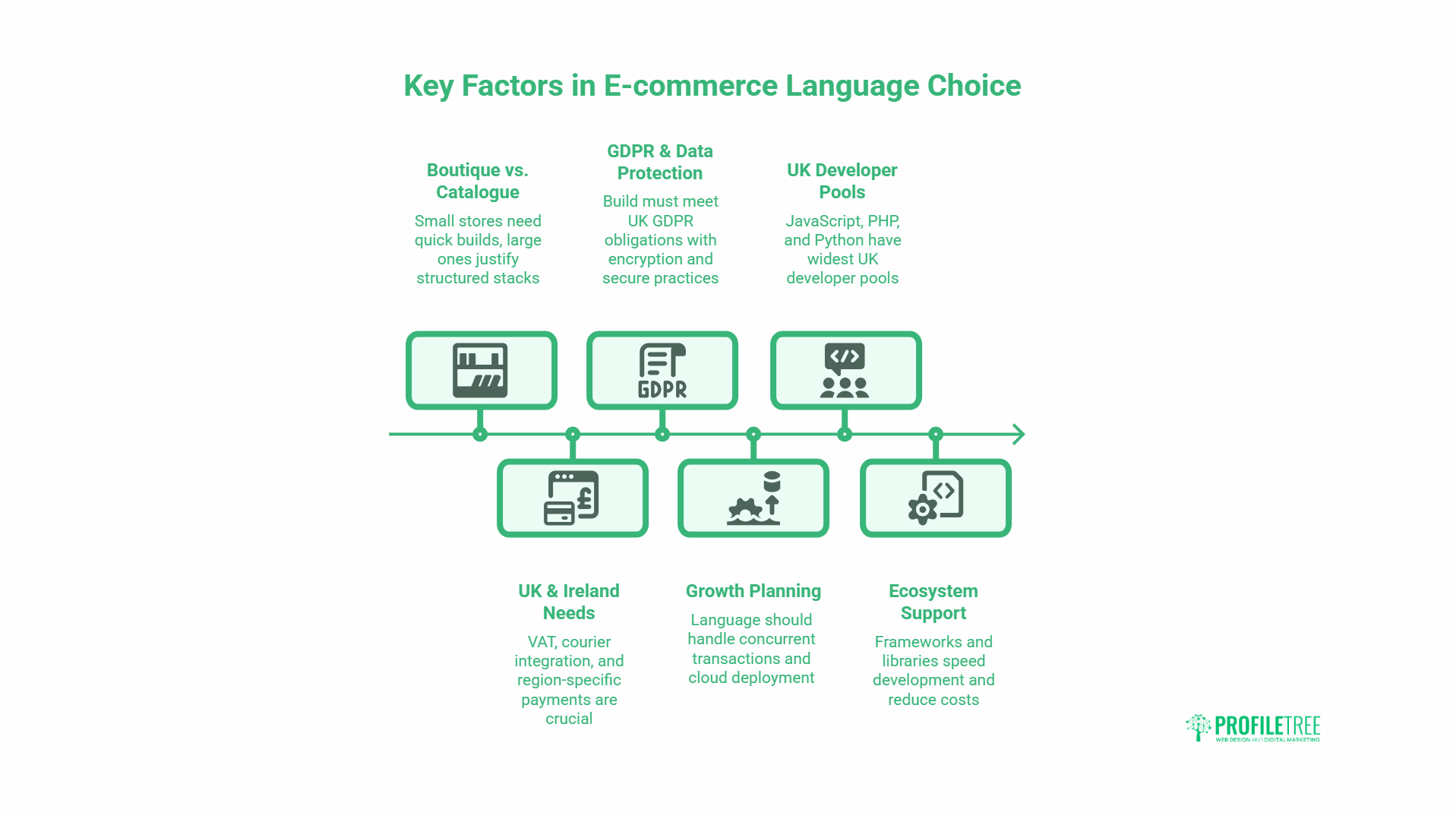
Before comparing languages, weigh the factors that actually decide the outcome. Get these right, and the language often picks itself.
Project Size And Complexity
A small boutique shop has very different needs from a catalogue running tens of thousands of products with AI recommendations and multiple third-party integrations. Smaller stores favour quick, well-supported builds; larger ones justify a heavier, more structured stack.
Complexity is rarely about product count alone. A shop with 40 products, three delivery zones, trade pricing for wholesale customers, and a stock feed from an accounting system is a harder build than a 4,000-product catalogue with one flat shipping rate. Map the rules, not the SKUs.
Local Market Requirements
Businesses selling into the UK and Ireland often need VAT handling, Royal Mail or local courier integration, and region-specific payment options. Languages and frameworks with strong plugin support for these save build time and reduce custom work.
Cross-border selling adds a layer that catches out Northern Ireland businesses in particular. A store shipping to both Great Britain and the Republic of Ireland may need dual currency display, different VAT treatment by destination, and customs documentation on some orders. PHP and JavaScript both have mature, maintained packages for this. In a less common language, it becomes custom work you pay for twice: once to build, once to keep current as the rules shift.
Security And Compliance
E-commerce handles card data and personal details, so the build must meet UK GDPR obligations. Choose languages with well-maintained encryption and data-protection libraries, and check that your developer follows current security practices. The Information Commissioner’s Office publishes UK GDPR guidance for organisations, worth reviewing before launch.
Ask one specific question of any developer: how quickly do security patches reach the live site, and who is responsible for applying them? Mainstream languages get patched fast because a large user base finds problems early. That advantage only reaches your store if somebody is actually installing the updates.
Performance And Scalability
Even a small store should plan for growth. Look at how the language handles concurrent transactions and how easily it deploys to the cloud. Good WordPress hosting and a sensible architecture often deliver more real-world speed than the language alone.
Most SME stores never hit a language-level performance limit. They hit an unoptimised image, a bloated theme, a plugin running a database query on every page load, or a shared server under strain. Diagnose those before rewriting anything.
Developer Availability
The widest UK developer pools sit around JavaScript, PHP, and Python. A mainstream language keeps hiring and ongoing support affordable, which matters far more over a site’s lifetime than a marginal performance edge.
Test this before you commit. Search for the language plus your city or region on a jobs board and see how many results come back. If the answer is a handful, you have found your maintenance risk.
Frameworks, Libraries, And Community
Most languages ship with frameworks that speed e-commerce work: Django for Python, Spring for Java, and Laravel for PHP. A deep library selection for payments, analytics, and authentication cuts costs and shortens timelines.
Check that the specific packages you need are actively maintained, not just that they exist. An abandoned payment integration with no commits in two years is a liability, whatever language it is written in.
Top Programming Languages For E-commerce Websites
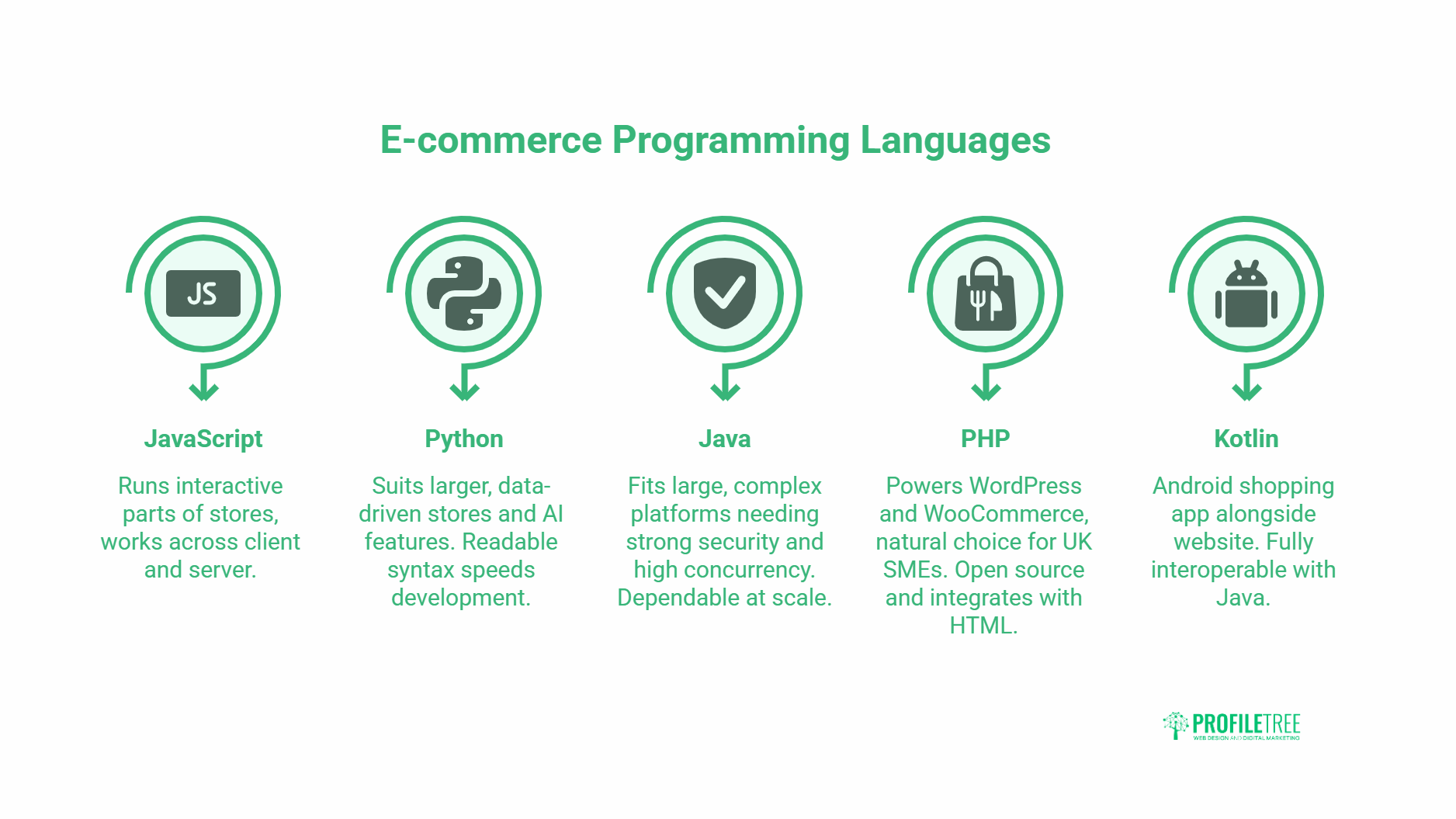
Eight languages cover almost every SME e-commerce build. Each has a clear sweet spot, and the right choice usually follows from your platform and your team rather than from any ranking of languages. According to W3Techs usage data, a handful of these account for the overwhelming majority of live websites.
JavaScript
JavaScript runs the interactive parts of most stores: live search, cart updates, filters, and chat widgets. It works across client and server, which keeps a single team productive. W3Techs reports it appears on the large majority of websites, so documentation and developer supply are strong. Frameworks like React and Node.js extend it to full store builds.
Advantages: Huge library selection, strong community support, and one language across front and back end.
Disadvantages: Its flexibility allows messy, hard-to-maintain code, and behaviour can vary across older browsers.
TypeScript
TypeScript is JavaScript with a type system layered on top, and it compiles down to plain JavaScript. For store builds of any size, type checking catches a class of mistakes before they reach a customer: a price handled as text, a missing field in a checkout payload, a cart total that quietly becomes undefined. Most current React and Node projects are written in it by default, so treat it as the sensible way to write JavaScript rather than as a separate choice.
Advantages: Catches errors at build time, makes larger codebases easier to hand over, and works with every JavaScript library.
Disadvantages: Adds a build step and a learning curve for developers used to plain JavaScript, with little benefit on very small projects.
Python
Python suits larger, data-driven stores and anything leaning on AI features such as recommendations or smart search. Its readable syntax speeds development, and its library support is wide, with Django a popular framework for full builds. For stores planning analytics or machine-learning features, that breadth of library support is the main draw.
Advantages: Simple, readable, secure, and rich in libraries for fast development.
Disadvantages: Slower execution than Java or C#, and rarely the first pick for mobile builds.
Java
Java fits large, complex platforms that need strong security and high concurrency, meaning many simultaneous transactions are handled cleanly. Its object-oriented structure and mature libraries make it dependable at scale, and it integrates well with other languages in a larger stack.
Advantages: Strong multithreading, wide open-source library support, and proven reliability for big stores.
Disadvantages: Steeper learning curve and verbose code that can lengthen build times.
PHP
PHP powers WordPress and, by extension, WooCommerce, so it is the natural choice for the many UK SMEs running shops on that stack. It is open source, integrates tightly with HTML, and has a deep plugin selection for payments and shipping. W3Techs reports it as the server-side language behind around three-quarters of sites whose back end is known.
Advantages: Open-source, cross-platform, huge plugin library, and the foundation of WordPress.
Disadvantages: Performance can dip under very heavy traffic, which is where caching and hosting do most of the work.
Ruby
Ruby matters to e-commerce mainly through Ruby on Rails, the framework on which Shopify is built. If you sell through Shopify, you are running on Ruby, whether you ever see a line of it, and app or theme customisation work on that platform draws on Ruby and Liquid. Rails also supports self-hosted store frameworks such as Solidus for teams that want full control without starting from scratch.
Advantages: Fast to build with, clean conventions, and the language behind one of the largest hosted store platforms.
Disadvantages: A smaller UK developer pool than PHP or JavaScript, and fewer local agencies with deep Rails experience.
Kotlin
Kotlin is worth considering when an Android shopping app sits alongside the website. It is fully interoperable with Java, and Google names it as its preferred language for Android development. Its concise syntax and strong type system catch errors early, which means fewer runtime faults that could cost sales.
Advantages: Clean syntax, less boilerplate, and access to existing Java libraries.
Disadvantages: A newer language with a smaller community and fewer ready-made resources; load times can lag older options.
C#
C# (C Sharp) is the Microsoft-backed option, built for stores running on the .NET platform. It offers strong typing, automatic memory management, and scales well for enterprise builds. It works well in back-end development and integrates cleanly with other Microsoft systems as a store grows.
Advantages: Strong typing, automatic garbage collection, and enterprise-grade scalability.
Disadvantages: Slower execution than lighter setups and tied to the .NET stack, which does not suit every project.
When To Use Each Programming Language
The right choice depends on your platform and goals. Use this as a quick decision guide.
| If You Want To… | Consider | Why |
|---|---|---|
| Build a highly interactive storefront | JavaScript (React) | Best for client-side interactions and live, on-page updates |
| Run a WordPress or WooCommerce shop | PHP | PHP underpins WordPress, so it is a natural fit |
| Build a large, data-heavy or AI-driven store | Python | Readable, library-rich, strong for analytics and AI |
| Run a high-security enterprise platform | Java | Structured, secure, handles heavy concurrency |
| Customise a Shopify store or theme | Ruby | Shopify runs on Ruby on Rails, with Liquid for templates |
| Keep a larger JavaScript codebase maintainable | TypeScript | Type checking catches checkout and pricing bugs early |
| Launch an Android app alongside the site | Kotlin | Interoperable with Java, Google’s Android choice |
| Build on the Microsoft .NET platform | C# | Designed for .NET, scales for enterprise |
For most SMEs, the honest answer is this: choose the platform first, then let the language follow. If you want a WordPress shop, you are choosing PHP and WooCommerce. If you want a Microsoft-based enterprise build, you are choosing C# and .NET. The language is downstream of the platform decision, not the other way round.
One pattern worth knowing about, because agencies increasingly propose it: a headless build, where a JavaScript or TypeScript front end sits on top of WooCommerce or Shopify, handling the data. It can produce a very fast storefront. It also doubles the number of things that can break, needs a developer for changes that a standard theme would let your team make, and costs more to run. For a shop with genuine scale or an unusual customer journey, that trade may be worth it. For a first store, it rarely is.
What A Language Choice Costs You Over Five Years
The language never appears as a line on an invoice, but it drives three costs that do: what the build costs, what ongoing support costs, and how likely you are to pay for a rebuild. Judging a stack on the build quote alone is how businesses end up spending more over five years than they would have on a dearer initial build.
| Cost Area | What Drives It | Where The Language Matters |
|---|---|---|
| Initial build | Catalogue size, custom rules, integrations, design scope | Mainstream stacks reuse existing packages instead of building from scratch |
| Hosting and maintenance | Traffic, security monitoring, backups, update cadence | Common stacks have standardised, competitively priced managed hosting |
| Changes and new features | Developer day rates and how many hours each change takes | Wide developer supply keeps rates competitive and coverage available |
| Rebuild risk | Whether a new supplier can take the site on as it stands | Niche stacks often force a rebuild rather than a handover |
ProfileTree’s published guidance on e-commerce web design packages puts a template-based starter build in the range of up to £1,500, a freelance custom build between £1,500 and £5,000, a full agency build with UX and SEO work between £5,000 and £12,000, and complex multi-region or heavily integrated projects from £12,000 upwards. Those tiers reflect scope rather than language, which is precisely the point: the same WooCommerce store can sit in any of them depending on how much of it is bespoke.
Running costs follow a similar pattern. Managed WordPress hosting with daily backups, security monitoring, and uptime alerts starts from £40 per month plus VAT at ProfileTree, with a plugin update service available from £80 per month plus VAT. A store on a mainstream stack can be quoted from a rate card like that. A store on something unusual gets a bespoke quote because fewer providers can support it.
The cost that hurts most is the one nobody budgets for. If your original developer becomes unavailable and no local agency will take the code on, the choice is an expensive discovery exercise or a rebuild. That risk is a direct function of how many people near you speak the language your store is built in.
How To Choose, And When To Hire A Developer
Choosing a language is really about matching the build to the business. A clear digital strategy answers most of the technical questions before any code is written, because it sets the catalogue size, the budget, the growth plan, and the features that matter.
When A Platform Build Is Enough
If you are selling a modest catalogue with standard payments and shipping, a WooCommerce or similar platform build covers it without custom coding. You get a working store faster and at lower cost, and the maintenance burden stays manageable. Most first-time online sellers fit here.
A platform built also gives you something a custom project cannot: the option to change your mind cheaply. Six months of real orders will teach you more about what your store needs than any specification written beforehand, and it is far less painful to add custom development to a working WooCommerce shop than to unpick a bespoke build that guessed wrong.
When To Bring In A Developer
Custom checkout flows, complex integrations, high traffic, or AI features are the signals to hire. At that point, the build choices interact with search performance and conversion, so it helps to align development with SEO from the start rather than retrofitting it later.
Two more triggers are worth watching for. The first is staff time: if somebody spends hours each week copying orders between your shop and another system, that is a paid integration waiting to happen. The second is a workaround that has become permanent, such as a manual discount applied by hand on every trade order. Both have a measurable cost you can weigh against a developer’s quote.
Questions To Ask Before You Commit To A Stack
Put these to any developer or agency before signing. The answers tell you more than a technology comparison will.
- Which language and framework will the store be built in, and why that one for this project?
- How many other developers in Northern Ireland, Ireland, or the UK could pick this codebase up?
- Which parts can your team change without a developer, and which will always need one?
- Who applies security and platform updates after launch, and how often?
- Do you own the code and design assets outright at handover?
- What would it cost to add trade pricing, a second currency, or a stock feed in 12 months?
- Is the hosting standard for this stack, or does it need something specialised?
How An Agency Approaches The Decision
A practical agency process starts with the business goal, not the tech. It maps your catalogue size, payment and shipping needs, compliance requirements, and growth plans, then recommends a platform and language combination that a local team can support long term, where personalisation or automated support is in scope, that can extend to AI chatbots built on the same stack, so the store and its features share one maintainable codebase.
Making The Decision In Practice
The same approach avoids two common SME mistakes. The first is over-engineering: choosing an enterprise stack like Java or C# for a shop that a WooCommerce build would serve at a fraction of the cost. The second is under-planning: launching on a quick template, then finding that custom checkout rules, marketplace integrations, or cross-border VAT need development work that the original build cannot support.
A short discovery conversation usually surfaces which camp you are in before any code is written, which is cheaper than finding out after launch. The video below walks through how an e-commerce build comes together in practice, from platform choice through to launch, which puts the language decision in its proper context.
FAQs
What Is The Best Programming Language For An E-commerce Website?
There is no single best language. The right choice depends on your platform, budget, and whether you need a mobile app or AI features.
Which Languages Are Most Common For E-commerce Sites?
PHP, JavaScript, Python, Java, and C# are the most widely used. PHP is especially common because it powers WordPress and WooCommerce.
Do I Need To Know Multiple Programming Languages To Build A Store?
No. One language suited to your chosen platform is enough. Many owners use a platform like WooCommerce and write no code at all.
Can I Use WordPress Instead Of Learning To Code?
Yes. WordPress with WooCommerce and ready-made themes lets you run a store without writing code yourself.
Does The Language Affect E-commerce SEO?
Indirectly. Page speed, clean markup, and a well-built platform affect SEO more than the language name. Good hosting and structure matter most.
Which Language Is Best For A Mobile E-commerce App?
Kotlin is a strong choice for Android, since it is Google’s preferred Android language and works with existing Java code.