
Ecommerce Web Design Packages: How to Choose the Right Build for Your Business
Table of Contents
Ecommerce web design packages range from around £800 for a template-based starter build to £25,000 or more for a fully custom agency build, and the gap between those figures is mostly about what is included rather than profit margin. A starter package covers a preconfigured store on an existing platform with your branding applied.
A custom build adds bespoke user experience design, structured data, fulfilment integrations, and a build process tailored to your specific product catalogue. The platform you choose, whether that’s WooCommerce, Shopify or another hosted option, affects long-term flexibility more than it affects upfront cost. Most quotes also omit payment processing fees, apps, product photography, and fulfilment software, which is where the real cost of running the store usually shows up.
If you’re comparing two ecommerce web design packages and the prices don’t seem to line up with what you’re being told you’ll get, the rest of this guide breaks down what each tier should include, how the platforms compare, what to ask before signing, and where the hidden costs sit.
Package Tiers: What You Actually Get at Each Price Point
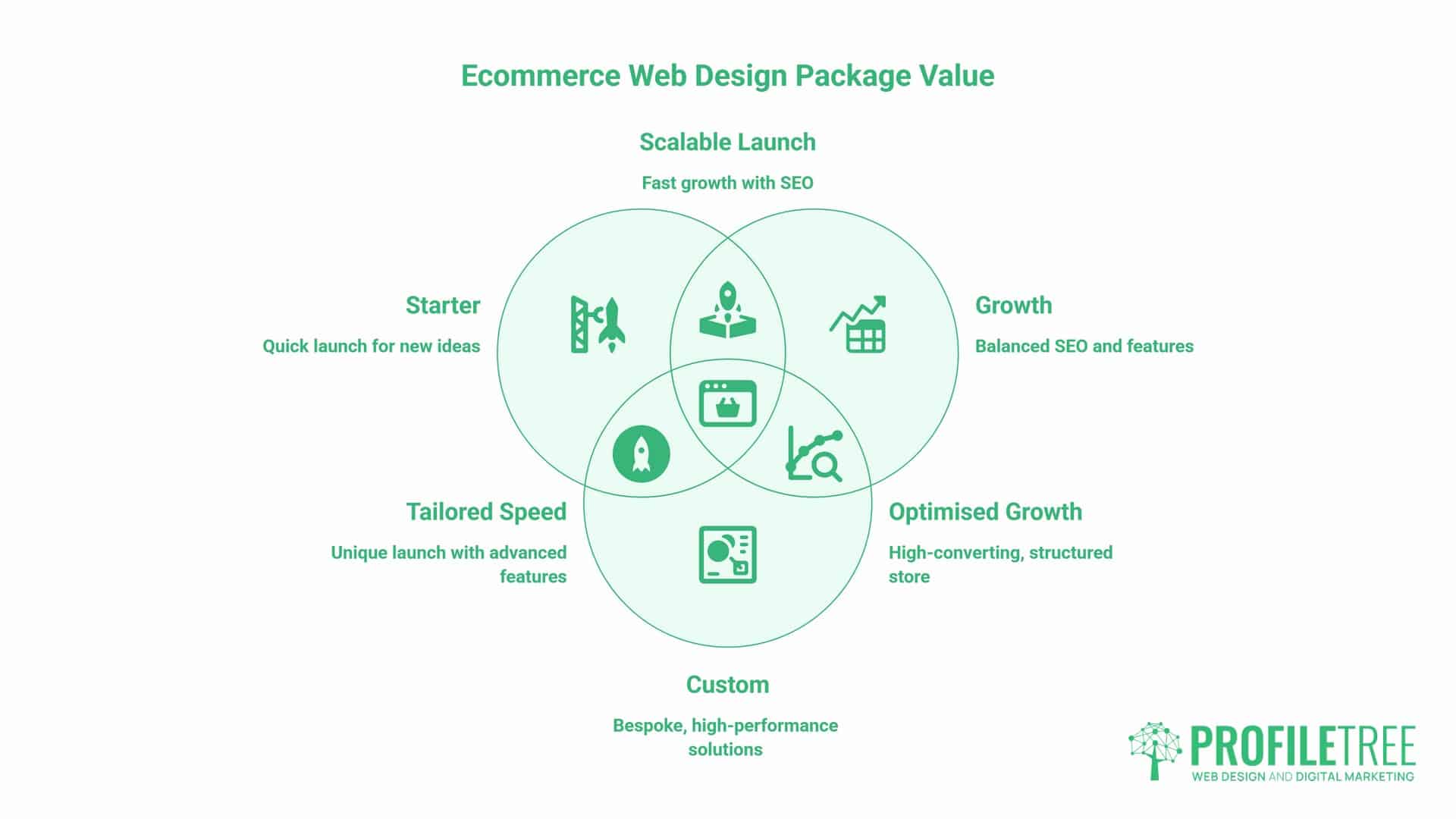
The word “package” gets used loosely across the industry, so two ecommerce web design packages with similar headline prices can cover very different amounts of work. The table below sets out what’s typical at each tier for UK and Irish SMEs.
| Tier | Typical price (GBP) | What’s usually included |
|---|---|---|
| Starter | £800–£2,500 | Template theme, logo and colour application, up to 20 product pages, standard payment gateway, no custom SEO configuration |
| Growth | £2,500–£8,000 | Semi-custom design, larger product catalogue, basic technical SEO, one payment and one fulfilment integration, CMS training |
| Custom | £8,000–£25,000+ | Bespoke UX design, unlimited product structure, structured data for products and reviews, multiple integrations, ongoing SEO strategy, dedicated project management |
A starter package suits a business testing a product idea with a small catalogue and no immediate SEO ambitions. You’re paying for speed to launch, not for the store to rank on its own; organic visibility usually has to be built afterwards, separately, once the product idea has proven itself.
A growth package fits a business with an established product range that wants the store to start ranking and converting properly, rather than just existing online. This tier is where most SMEs land, because it covers enough technical SEO and catalogue structure to compete without the cost of a fully bespoke build.
A custom build is for businesses treating ecommerce as a primary revenue channel, where the cost of getting the structure wrong (poor URLs, missing schema, a checkout that leaks sales at the final step) is higher over time than the cost of paying for it to be built properly from the outset. This is also the tier where ongoing SEO strategy tends to be priced in rather than treated as a separate retainer, because the two are harder to separate once the catalogue reaches a few hundred products.
None of these tiers automatically includes ongoing running costs, and this is where a lot of first-time buyers get caught out. A starter tier with a £1,000 build price and a £1,500 annual template licence fee is not necessarily cheaper over two years than a £6,000 growth build that ranks, converts, and doesn’t need constant developer intervention to keep running. Ask what happens after handover before comparing headline prices on any set of ecommerce web design packages.
If you already have a site and are adding ecommerce functionality to it rather than starting fresh, this is a scoping conversation for our website development team rather than a fixed package, since the cost depends on what your current platform can and can’t support.
“The businesses that struggle with ecommerce usually aren’t struggling because they picked the wrong platform,” says Ciaran Connolly, founder of ProfileTree. “They’re struggling because nobody costed the catalogue structure, the fulfilment integration and the ongoing SEO work before the build started. Those three things decide whether the site pays for itself.”
WooCommerce or a Hosted Platform: How to Decide
Neither WooCommerce nor a hosted platform such as Shopify is the better choice in isolation. The right one depends on catalogue size, technical resource and how much control you need over search visibility, not on which platform is more fashionable this year.
WooCommerce runs on WordPress and gives full control over URL structure, canonical tags and page templates, which matters if organic search is central to your acquisition strategy. Because the underlying site is WordPress, it also sits naturally alongside a content strategy: blog content, buying guides and comparison pages can share the same database, internal linking structure and analytics setup as the store itself. The trade-off is maintenance. Hosting, plugin updates and security need active management, which is why most SMEs running WooCommerce pair it with agency-managed website development and hosting support rather than handling it in-house.
Shopify is hosted, so security, uptime and platform updates are handled for you, which suits businesses without in-house technical resource. Checkout is fast to set up, and the app ecosystem covers most common needs (subscriptions, reviews, loyalty programmes) without custom development. The trade-off is SEO flexibility: canonical control, URL structure and schema markup all have platform-level constraints that a developer cannot fully work around, however good they are.
BigCommerce sits between the two. It has stronger native SEO features than Shopify, including better URL control and built-in structured data, with a lower technical maintenance burden than WooCommerce. It’s worth considering for larger catalogues or businesses planning to sell across multiple regions or currencies from a single build.
If your catalogue is under 20 products, your technical resource is limited and speed to launch matters more than long-term SEO control, a hosted platform is usually the more practical starting point for your ecommerce web design package. If organic search is a primary acquisition channel and your catalogue is likely to grow beyond a few hundred products, WooCommerce’s flexibility tends to pay off over the long term, provided hosting and maintenance are handled properly from day one.
How to Compare Ecommerce Web Design Packages Before You Sign
Ask five questions before comparing any set of quotes, because the headline price rarely tells you what you’re actually buying — the same five questions apply whether you’re comparing ecommerce builds or general website costs.
- Is SEO configuration included in the build, or treated as an add-on billed later? A quote that’s £1,000 cheaper but excludes basic SEO setup usually costs more once you pay to have it retrofitted after launch.
- Who handles hosting and security once the site is live, and what does that cost month to month? A build price without mention of ongoing hosting is incomplete, not cheaper.
- What happens if something breaks after handover? A freelancer working alone has a different risk profile to an agency with a support team, and that difference matters more once the store is processing real orders.
- Are the design assets, code and product data owned outright by your business, or licensed through the platform provider? This affects what happens if you ever want to move suppliers.
- Does the package include training on the content management system, or will every future product update need to go through the developer? For a business adding products regularly, this alone can be worth more than a lower headline price.
Suppliers who answer all five clearly, without hedging, are usually pricing the work honestly. Suppliers who deflect one or two of these are usually leaving something out of the number they’ve quoted you.
The Hidden Costs Most Quotes Leave Out
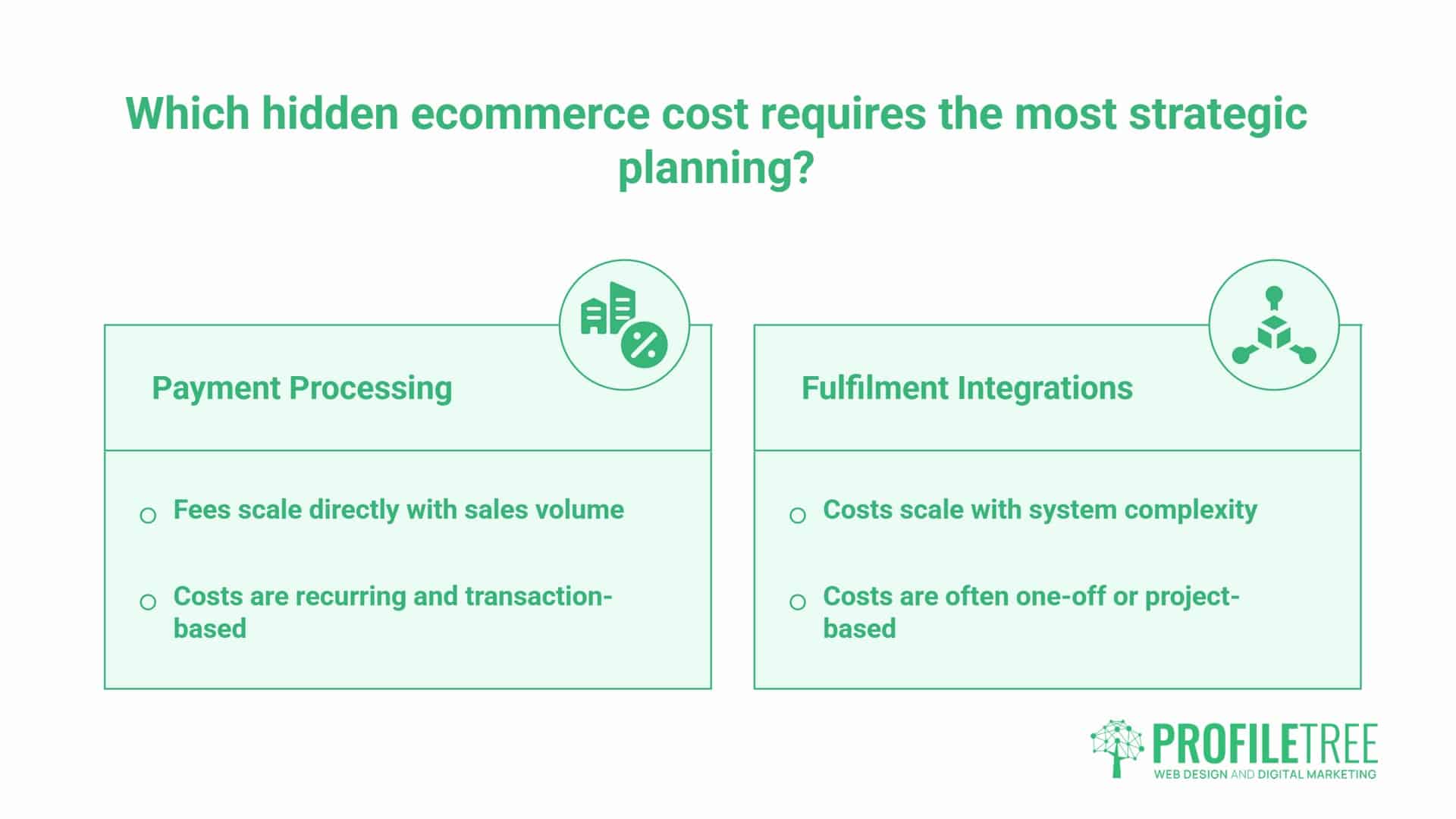
A build quote rarely covers everything you’ll spend in year one running the store. Five costs catch most first-time ecommerce owners off guard, and none of them is unusual or avoidable; they’re simply left off the headline figure most ecommerce web design packages are sold on.
- Payment processing fees. These are charged per transaction, not per month, so they scale with sales rather than showing up as a fixed line item in a build quote. Stripe’s standard UK rate is 1.5% plus 20p per domestic card transaction, with higher rates for non-UK cards. On £20,000 of monthly sales at an average order value of £40, that works out to roughly £400 a month in processing fees alone, before any currency conversion or dispute charges are added.
- Apps and plugins. Most stores end up adding paid apps for things the base platform doesn’t handle well out of the box: abandoned cart recovery, subscription billing, advanced shipping rules, loyalty programmes. Budget £20–£100 a month once the store is live, and more if you’re running several apps at once.
- Product photography. A template build rarely includes photography, and stock images hurt both conversion and how AI search tools evaluate the page, since generic imagery gives them nothing distinctive to extract or describe. A single-day photography shoot for a small catalogue typically runs £300–£800, more if you need lifestyle shots or short video alongside stills.
- Fulfilment integrations. Connecting the store to a courier, warehouse, or stock management platform is usually quoted separately from the build itself, and costs scale with the number of systems that need to talk to each other. A single courier integration might be a few hundred pounds; a full warehouse management connection can run into the thousands, particularly if it needs to sync with an existing accounting system.
- Copywriting for product pages. Templates don’t write product descriptions, and a catalogue of 50 or 100 products with thin, duplicated copy performs poorly for both search and AI visibility. Budgeting for this properly, rather than writing rushed copy the week before launch, is one of the more overlooked costs in most ecommerce web design packages.
Extra costs at checkout are also the single biggest reason customers abandon a purchase after adding items to a cart. Baymard Institute’s meta-analysis of checkout research puts the average cart abandonment rate at 70.22%, and 48% of that abandonment is due to shipping, tax, or other charges appearing unexpectedly at the final step. Showing delivery costs early in the customer journey, rather than only at checkout, is one of the cheapest fixes available, and it isn’t something a build quote will flag for you unprompted.
If your annual turnover is likely to pass £90,000, you’ll also need to register for VAT with HMRC within 30 days of crossing that threshold. This isn’t a web design cost, but it changes your pricing and margin calculations, so it’s worth factoring into the budget before launch rather than after your first strong month of sales.
Delivery Timelines by Package Tier
The timeline is usually driven by how quickly you can supply product data, copy, and images, not by how fast the developer can work; this holds true across every tier of ecommerce web design packages.
A starter build typically takes 2–4 weeks from brief to launch, mostly limited by how quickly template customisation and payment setup can be completed rather than by any technical complexity. A growth build usually runs for 6–10 weeks, with most of that time spent on catalogue structure, semi-custom design, and integration testing rather than on the visual design itself. A custom build with multiple integrations, a large catalogue or multi-region functionality typically takes 12–20 weeks, and the biggest variable at that end of the scale is how much of the product data and imagery is ready before development starts, not the number of features being built.
If you’re supplying product data as it comes in rather than all at once, expect the timeline to stretch regardless of which tier you’re on. Agencies quoting a fixed timeline without asking about your data readiness are usually building in slack you’ll end up needing anyway, so it’s worth raising this directly during the quoting stage rather than after the contract is signed.
Choosing between these ecommerce web design packages comes down to what the store needs to do in year one, not which price looks most affordable on the quote. A template build is a reasonable way to test a low-risk product idea with a small catalogue. A growth or custom build makes sense once ecommerce is a serious revenue channel, because the SEO, UX and integration work built in from the start is expensive to retrofit later. Whichever tier fits, get a full breakdown of what’s included, what’s charged separately, and what happens after handover before you sign anything.
FAQs
How much does an ecommerce website cost in the UK?
Costs range from around £800 for a basic template build to £25,000 or more for a fully custom agency build with multiple integrations. Most SMEs commissioning a professionally built WooCommerce or Shopify store from a specialist agency should budget between £2,500 and £8,000 for a growth-tier build, with the final figure depending on catalogue size and the number of integrations required.
I keep getting quotes with wildly different prices for what sounds like the same website. Why is that happening?
It’s almost always because the quotes cover different amounts of work, not because one supplier is charging more for the same thing. A £1,200 quote and a £7,000 quote might both say “custom Shopify store,” but one includes structured data, SEO configuration and fulfilment integration, and the other doesn’t. Ask each supplier to list exactly what’s in scope before comparing the numbers.
What’s the difference between a template ecommerce package and a custom one?
A template package applies your branding to an existing theme with a fixed structure, which is fast and inexpensive but limits how far you can customise navigation, checkout flow or page layout. A custom package builds the structure around your specific catalogue and customer journey, which costs more upfront but tends to convert better and needs less retrofitting as the business grows.
Is WooCommerce better than Shopify for a small business?
Neither is universally better; it depends on catalogue size and technical resource. WooCommerce gives more control over URL structure and SEO, but needs active maintenance. Shopify handles hosting, security and updates for you but has more constraints on SEO customisation. A business with fewer than 20 products and limited technical support is usually better suited to Shopify; a business planning to scale beyond a few hundred products, with organic search as a priority, is usually better suited to WooCommerce.
What hidden costs should I budget for beyond the build price?
The five most commonly missed costs are payment processing fees (typically 1.5% plus 20p per transaction in the UK), paid apps for features the base platform doesn’t cover, product photography, fulfilment integrations connecting the store to couriers or stock systems, and copywriting for product pages. None of these usually appear in the initial build quote.
How long does it take to build an ecommerce website?
A straightforward starter build takes 2–4 weeks. A growth-tier build with semi-custom design and integrations typically takes 6–10 weeks. A custom build with a large catalogue or multiple integrations can take 12–20 weeks. The pace is usually set by how quickly product data, copy and images are supplied, not by development speed alone.
Can you just tell me which platform to pick without all the caveats?
If pushed to choose without more detail: Shopify for a catalogue under 20 products with no in-house technical support, WooCommerce for anything larger where organic search matters. That said, the caveats exist because getting this wrong is expensive to undo later, so it’s worth the extra five minutes of thinking before committing to either.
Do I need to budget for product photography separately, or is it included in the build?
It’s almost never included. Template and even most custom builds assume you’re supplying your own product images. A single-day shoot for a small catalogue typically costs £300–£800. Skipping this and using supplier stock images tends to hurt conversion rates and makes product pages less useful for AI search tools that increasingly pull product details directly from the page.