
MySpace in 2026: A Complete Guide to the Platform’s Current State
Table of Contents
The story of MySpace is one of spectacular ascent and dramatic decline. Once the world’s most visited website, the platform now exists as a digital time capsule—a repository of early internet culture that many users have forgotten they contributed to. For business owners considering social media strategies, MySpace serves as a cautionary tale about platform dependence and the importance of owning your digital presence.
This guide examines MySpace’s current state in 2026, explores what remains functional, and provides practical guidance for those seeking to recover old content or understand the platform’s role in modern digital marketing.
Platform Status Today
MySpace continues to operate, albeit in a vastly diminished capacity compared to its peak in the mid-2000s. The platform attracts approximately 6 million unique visitors monthly—a fraction of its former 100 million active users. These visitors typically fall into three categories: digital archaeologists seeking nostalgic content, musicians maintaining legacy profiles, and users attempting to recover old photographs and media.
The current iteration bears little resemblance to the highly customisable profiles that defined the original platform. The famous HTML and CSS editing capabilities have been removed entirely, replaced by a standardised interface that prioritises music streaming functionality over social networking features.
What Works, What’s Broken, and What’s Dormant
Understanding which MySpace features remain operational is essential before attempting to access old accounts or content. Based on testing conducted in January 2026 across multiple browsers and devices, here’s the current functionality breakdown:
Fully Functional:
- Basic account login (though often requiring multiple password reset attempts)
- Direct messaging between users
- Music streaming for content uploaded after 2015
- Profile viewing and basic navigation
Partially Functional:
- Photo viewing (depends on when the content was uploaded and whether it survived platform migrations)
- Profile updates and editing
- Search functionality (inconsistent results, particularly for older profiles)
Non-Functional:
- HTML/CSS profile customisation
- Most pre-2015 music uploads
- Legacy photo albums have not been migrated to “Mixes”
- Group features and community forums
- Bulletin board system
The platform’s infrastructure shows clear signs of minimal maintenance. Page load times are inconsistent, features time out without warning, and the mobile experience is notably inferior compared to modern social platforms. For business owners evaluating social media platforms for marketing purposes, these technical limitations make MySpace unsuitable for active business promotion.
“The digital marketing landscape has transformed beyond recognition since MySpace’s heyday,” notes Ciaran Connolly, Director of ProfileTree. “Modern businesses need platforms that offer robust analytics, reliable uptime, and active user bases. MySpace’s current state demonstrates why we advocate for clients to maintain control of their core web presence rather than relying solely on third-party platforms.”
The 2019 Data Loss Event
Any discussion of MySpace’s current functionality must address the catastrophic data loss event of 2019. During a server migration, the platform lost approximately 50 million songs and 12 years’ worth of music and photos uploaded between 2003 and 2015. This wasn’t a temporary glitch—the data was permanently deleted.
The incident represents one of the most significant losses of cultural data in internet history. Unsigned artists who used MySpace as their primary distribution platform lost their early recordings. Users lost irreplaceable photographs from weddings, holidays, and significant life events. For many, these files existed nowhere else.
From a digital strategy perspective, this disaster reinforces critical lessons about data ownership and backup protocols. ProfileTree’s approach to website development and digital asset management prioritises client control and multiple backup systems. When we build websites for SMEs across Northern Ireland and the UK, we implement robust backup procedures and maintain clients’ data independently of any single platform.
Account Recovery Guide
Many users visiting MySpace in 2025 are attempting to recover old content or delete accounts they’ve long forgotten. The recovery process presents multiple challenges, particularly for those who no longer have access to the email addresses they used 15 to 20 years ago.
Accessing Your Account with Original Credentials
If you still have access to your original email address and can remember your username, the login process remains relatively straightforward:
- Navigate to myspace.com
- Click the login option (typically found in the upper right corner)
- Enter your username or email address and password
- Complete any security verification required
The system frequently prompts password resets even for correct credentials—this appears to be a security measure rather than an error. Allow up to 10 minutes for password reset emails to arrive, and check spam folders thoroughly.
Once logged in, immediately verify what content remains accessible. Navigate to your profile and check photo albums (now called “Mixes”) and any music uploads. If thumbnails appear grey or broken, the underlying files are likely lost in the 2019 deletion event.
Recovering Accounts Without Original Email Access
The recovery process becomes significantly more complex without access to your original email address. MySpace maintains a manual verification system, though response times are notably slow:
Step 1: Locate Your Profile URL Search for your old username using the site’s search function or through search engines using the query: “site:myspace.com [your username]”. Note the exact URL of your profile.
Step 2: Submit a Manual Recovery Request. Access the MySpace Help Centre and submit a “Declaration of Ownership” request. You’ll need to provide:
- Your profile URL
- The email address you believe was associated with the account
- Alternative contact information
- Any identifying information from your profile (bio details, friend connections, posted content)
Step 3: Provide Identity Verification. For accounts with significant concerns about unauthorised access, MySpace may request photographic proof. This involves holding a paper displaying “MySpace Recovery [Current Date]” alongside your face, which they’ll compare against profile photos.
Response times for manual recovery requests averaged 14-22 days for UK-based queries in late 2025. The system is clearly under-resourced, and some requests receive no response at all.
What to Do If Your Content Is Gone
If you’ve successfully accessed your account but find your photos and music missing, your options are limited. The 2019 data loss was permanent—no backup exists from which to restore content. However, several alternative recovery methods may yield results:
Internet Archive Wayback Machine: Check whether the Internet Archive captured snapshots of your profile. While this won’t recover full-resolution images or audio files, it may preserve lower-quality versions or at least confirm what content existed.
Connected Accounts: If you connected MySpace to other platforms (Facebook, Twitter) during the integration period, some content may have been cross-posted and remains accessible on those services.
Third-Party Applications: Applications like RockYou and Photobucket, which integrated with MySpace, may retain copies of uploaded content. Check whether you can still access these services with your old credentials.
Personal Backups: Search old computers, external hard drives, and cloud storage accounts for original files you may have uploaded to MySpace. Many users retained copies of their “Top 8” profile photos or music files even after uploading them to the service.
From a professional web development perspective, this recovery process illustrates why ProfileTree emphasises proper data management in all our client projects. When we develop websites for businesses in Belfast and across Northern Ireland, we implement automated backup systems and maintain multiple restore points to ensure data security. Our clients aren’t dependent on a single platform’s reliability; they retain control of their digital assets.
Privacy and Security Considerations
The security implications of maintaining a 15-20-year-old social media account extend beyond simple nostalgia. Old MySpace accounts represent potential privacy and security vulnerabilities that many users haven’t considered.
The Password Reuse Problem
In the mid-2000s, password security practices were far less rigorous than today’s standards. Many MySpace users employed simple passwords or reused the same credentials across multiple sites. If you used the same password for MySpace that you used for email, banking, or other services—and haven’t changed it—you’re potentially vulnerable.
MySpace itself suffered data breaches. In 2016, credentials for 360 million MySpace accounts were reportedly leaked and sold on dark web marketplaces. If you used MySpace credentials anywhere else and haven’t changed those passwords, your other accounts may be compromised.
Immediate Actions:
- Change passwords on any accounts where you reused your MySpace credentials
- Run your email addresses through “Have I Been Pwned” (haveibeenpwned.com) to identify known breaches
- Enable two-factor authentication on all active accounts
- Consider changing your email address if your MySpace-era email was compromised
What Information Remains Public
Even dormant MySpace profiles may contain information you no longer want publicly accessible:
- Full names and birthdates
- Location information (schools, cities, workplaces)
- Email addresses (often visible to logged-in users)
- Friend connections reveal personal networks
- Photos and comments from your teenage years
- Music preferences and personal interests
For professionals and business owners, these legacy profiles can present reputation management challenges. A prospective client searching your name might discover a MySpace profile containing outdated information or content that doesn’t align with your current professional image.
ProfileTree’s digital marketing services include reputation management and online presence auditing. When we work with business owners across the UK, we conduct comprehensive searches to identify legacy accounts and outdated information that might impact their professional brand.
GDPR and Data Rights
UK users have specific rights regarding personal data under GDPR (UK GDPR post-Brexit). These rights apply to MySpace despite it being owned by a US entity. You can exercise your right to:
Access: Request a copy of all personal data MySpace holds about you. Rectification: Correct inaccurate or incomplete information. Erasure: Request complete deletion of your account and associated data. Restriction: Limit how your data is processed
To exercise these rights, submit a formal request through the MySpace Help Centre. Reference your GDPR rights explicitly and provide your profile URL, along with any associated email addresses. MySpace must respond within one month under UK GDPR requirements, though in practice, response times may be longer.
For complete account deletion, be aware that:
- Deletion is permanent and irreversible
- All content, connections, and messages will be removed
- Your username may remain reserved (unavailable for new registrations)
- Cached versions may persist in search engines temporarily
If MySpace fails to respond to GDPR requests within 30 days, UK users can file complaints with the Information Commissioner’s Office (ICO). However, pursuing this for a legacy social media account may not be practical unless there are significant privacy concerns.
Musicians and Content Creators
Despite its decline as a general social network, MySpace attempted to maintain relevance as a music-focused platform. The question for musicians and content creators in 2026 is whether any value remains.
Current Music Functionality
The modern MySpace interface prioritises music streaming, with features including:
- Artist profile creation with bio and imagery
- Music upload capabilities (post-2015 content)
- Basic streaming functionality
- Limited analytics and engagement metrics
However, these features pale in comparison to dedicated music platforms like Spotify, SoundCloud, Bandcamp, or even YouTube. The active user base is minimal, discovery mechanisms are virtually non-existent, and integration with modern music distribution systems is lacking.
The UK Independent Music Perspective
For UK-based independent musicians, MySpace’s relevance has primarily come to an end. The platform that launched careers for Arctic Monkeys, Lily Allen, and Kate Nash no longer serves as a viable discovery or promotion tool. Modern music marketing requires presence on platforms where audiences actively engage.
ProfileTree collaborates with content creators and small businesses to develop video production, YouTube strategies, and content marketing campaigns. When advising musicians on digital strategy, we focus on platforms with active, engaged audiences:
Essential Platforms for UK Musicians:
- Spotify and Apple Music for streaming distribution
- YouTube for video content and long-form engagement
- Instagram and TikTok for short-form content and audience building
- Bandcamp for direct sales and fan support
- SoundCloud for works-in-progress and collaboration
MySpace might serve as a nostalgic archive of early work, but no musician should rely on it for audience development or revenue generation in 2026.
Content Creation Lessons from MySpace’s Decline
MySpace’s trajectory offers valuable lessons for content creators and business owners developing digital strategies:
Platform Dependency Risk: Building your audience exclusively on third-party platforms means you’re vulnerable to algorithm changes, policy shifts, or platform decline. MySpace musicians who didn’t maintain email lists or independent websites lost their entire audience when the platform declined to support them.
Content Ownership: The 2019 data loss demonstrated the importance of maintaining original files and backups. Never treat any platform as your sole content repository.
Multi-Platform Strategy: Successful modern content creators maintain presence across multiple platforms, with a core hub (typically a website) they control directly.
These principles inform ProfileTree’s approach to digital marketing and content strategy. When we develop websites and digital techniques for SMEs across Northern Ireland, we prioritise owned media (your website and email list) over rented media (social platforms). Social media serves as a traffic and engagement channel, but your core digital presence should be platform-independent.
MySpace vs Modern Social Alternatives
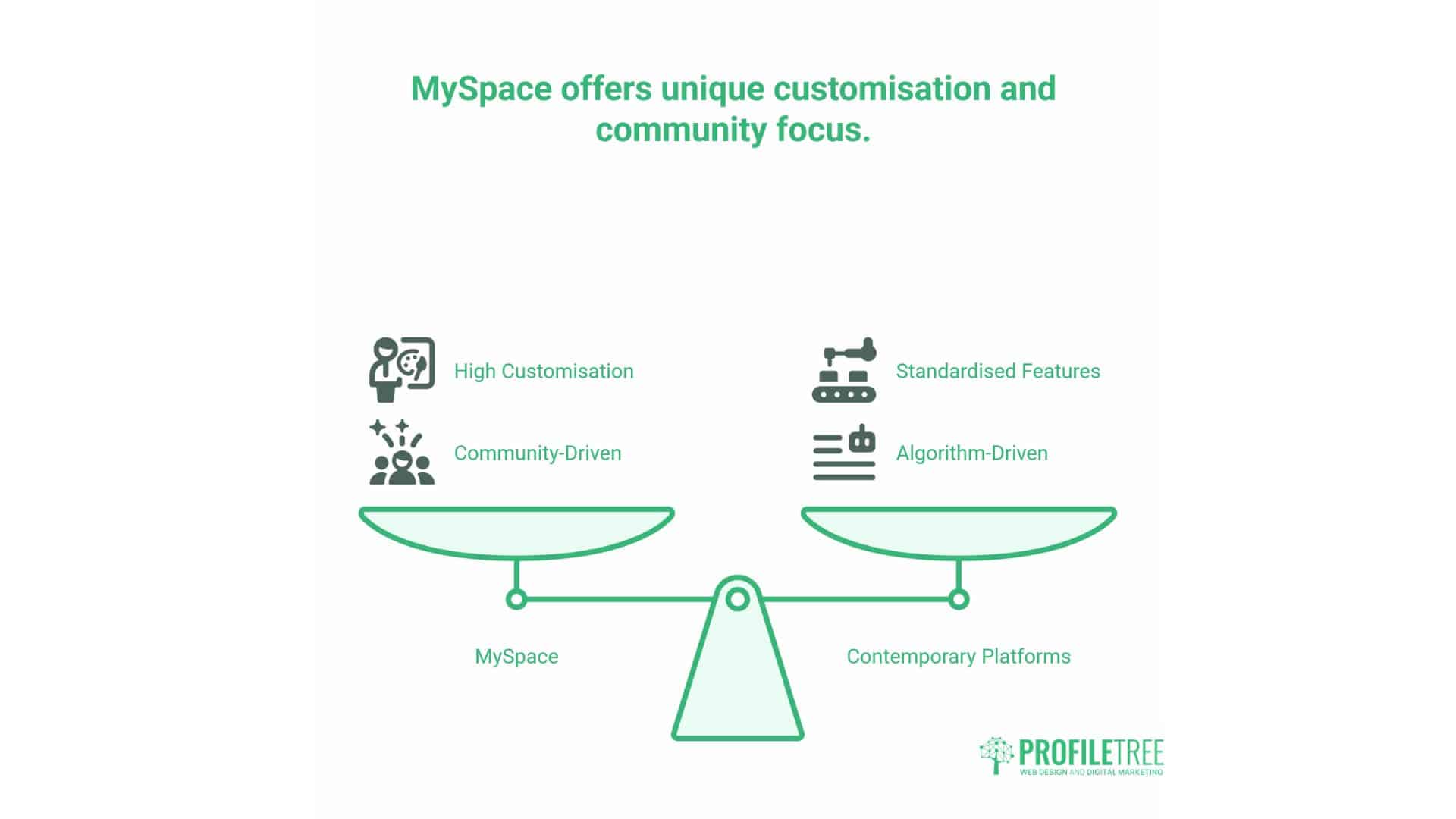
Understanding how MySpace compares to both modern mainstream platforms and nostalgic alternatives helps contextualise its current relevance.
MySpace vs Contemporary Platforms
The gap between MySpace and modern social platforms reflects 20 years of technological and user experience evolution:
User Experience: Modern platforms offer responsive design, instant loading, mobile-optimised interfaces, and intuitive navigation. MySpace’s interface feels dated, loads slowly, and provides a poor mobile experience.
Engagement Features: Contemporary platforms offer features such as stories, reels, live streaming, group video calls, advanced messaging, and sophisticated engagement tools. MySpace offers basic messaging and status updates.
Business Tools: Platforms like Facebook, Instagram, and LinkedIn provide comprehensive business profiles, advertising systems, analytics, and e-commerce integration. MySpace offers none of these.
Active Communities: Modern platforms maintain active, engaged user bases. MySpace is essentially dormant, with minimal real-time interaction.
For business owners evaluating where to invest time and resources, MySpace offers no practical value for marketing, customer engagement, or brand building in 2026.
MySpace vs SpaceHey
SpaceHey represents an interesting alternative—a platform explicitly designed to recreate the classic MySpace experience for nostalgic users. Launched in 2020, it features:
- Fully customisable HTML/CSS profiles
- Classic MySpace aesthetic and functionality
- A “Top 8” friends feature
- Blog functionality
- Forums and groups
SpaceHey attracts users seeking the creative freedom and aesthetic of early MySpace without the corporate overlay. However, its user base remains small (approximately 400,000 registered accounts as of 2025) and primarily consists of younger users who experience the MySpace-era design aesthetically rather than nostalgically.
Neither platform serves practical business purposes. However, SpaceHey demonstrates ongoing demand for customisable, user-controlled social spaces—a desire that contemporary platforms fail to satisfy.
The IndieWeb Movement
MySpace’s decline and the subsequent dominance of algorithmically-controlled platforms have sparked the IndieWeb movement—a community advocating for independent, user-owned web presence. This movement champions:
- Personal websites as primary online identity
- Cross-platform content syndication
- Open standards rather than proprietary platforms
- User control over data and presentation
ProfileTree’s web design philosophy aligns closely with IndieWeb principles. When we develop websites for clients in Belfast and across the UK, we create digital presences they own and control. Your website isn’t subject to algorithm changes, platform policies, or corporate decisions. It serves as your permanent digital home, with social media channels feeding traffic inward rather than trapping your audience elsewhere.
For business owners, this approach offers stability and control that platform-dependent strategies cannot match. Your website remains accessible, regardless of which social platforms rise or fall, and you maintain direct relationships with customers through email lists and your own databases.
Website Development and Digital Strategy Insights
MySpace’s trajectory offers instructive lessons for business owners seeking to develop their digital presence. The contrast between a platform-dependent strategy and an owned-media approach becomes starkly apparent when examining the platform’s collapse.
The Platform Dependency Problem
Businesses and individuals who built their entire online presence on MySpace lost everything when the platform declined. Musicians lost their fan bases, businesses lost their customer connections, and creators lost their audiences. This wasn’t a gradual transition where they could redirect followers elsewhere—it was a sudden collapse that left no viable migration path.
This pattern has repeated across digital marketing history. Businesses that relied entirely on organic Facebook reach suffered when algorithm changes significantly reduced their visibility. Publishers that built audiences on Medium struggled when the platform changed its revenue model. YouTube creators face ongoing concerns about demonetisation and algorithm changes.
ProfileTree’s approach to digital strategy addresses this vulnerability by establishing a client-owned core:
- Your Website as Central Hub: We develop websites that serve as your primary digital presence. This isn’t a supplementary “online brochure”; it’s a comprehensive platform for content, customer engagement, e-commerce, and lead generation.
- Multi-Channel Distribution: Social media, email marketing, and content distribution channels feed traffic to your owned properties rather than keeping audiences on third-party platforms.
- Data Ownership: Customer databases, email lists, and analytics data belong to you, not platform providers.
- Independent Analytics: Rather than relying solely on platform-provided metrics (which can be manipulated or removed), we implement comprehensive analytics you control.
This strategy proved prescient for clients who previously depended heavily on organic social reach. When algorithm changes reduced visibility, their core web presence and email audiences remained unaffected.
Building Resilient Digital Presence
Modern digital strategy requires resilience—the ability to withstand platform changes, algorithm updates, and shifting digital trends. Based on lessons from MySpace and subsequent platform evolutions, resilient strategies include:
- Owned Content Repository: Maintain original files, backups, and archives of all digital content. Never treat any platform as your sole content storage.
- Email List as Core Asset: Email remains the most reliable direct communication channel. Unlike social followers, email subscribers can be contacted regardless of changes to the platform.
- SEO-Optimised Website: Organic search traffic provides platform-independent access to your audience. ProfileTree’s SEO services focus on building sustainable search visibility for long-term traffic generation.
- Multi-Format Content: Develop content in various formats (written, video, audio) to adapt as consumption preferences shift.
- Regular Content Migration: Periodically export and archive your content from third-party platforms. Don’t wait for a platform to decline before preserving your work.
For SMEs across Belfast, Northern Ireland, and the UK, ProfileTree provides website development, WordPress hosting, and digital strategy services that implement these resilience principles. Our clients own their digital assets, control their customer relationships, and maintain stability as digital trends evolve.
AI and Digital Transformation Context

The evolution from MySpace to modern platforms parallels broader digital transformation in business operations. Understanding this context helps business owners make informed decisions about technology adoption and digital strategy.
From Manual Customisation to AI-Driven Personalisation
MySpace offered manual profile customisation—users hand-coded HTML and CSS to personalise their pages. Modern platforms use AI algorithms to personalise content feeds, recommendations, and advertising. This shift from user control to algorithm control represents a fundamental change in how digital platforms operate.
For businesses, understanding this evolution informs decisions about AI adoption. ProfileTree’s AI training and implementation services help SMEs across Northern Ireland and the UK adopt AI strategically:
- AI for Efficiency, Not Replacement: We help businesses identify tasks where AI enhances efficiency (such as content generation, data analysis, and customer service automation), while maintaining human oversight for strategy and relationship management.
- Data-Driven Decision Making: Modern platforms collect extensive user data to train algorithms. Businesses can apply similar data-driven approaches to understand customer behaviour and optimise operations.
- Accessibility and Inclusivity: AI tools can enhance website accessibility, provide translation services, and create more inclusive digital experiences, capabilities that were previously impossible in the MySpace era.
- Automation of Repetitive Tasks: Unlike MySpace’s manual updates and content posting, modern systems automate scheduling, posting, and performance tracking.
The businesses that thrive in modern digital environments combine owned infrastructure (websites, databases) with strategic platform usage and appropriate AI adoption. This balanced approach provides stability while allowing innovation and adaptation.
Digital Training for Modern Marketing
MySpace’s early users learned HTML and CSS out of necessity—it was required to customise profiles. While that specific skill has limited application today, the underlying principle remains relevant: businesses must invest in digital literacy to compete effectively.
ProfileTree’s digital marketing training and workshops help organisations develop capability across:
- SEO Fundamentals: Understanding how search engines work and how to optimise content for discovery.
- Content Strategy: Developing systematic approaches to content creation, distribution, and performance measurement.
- AI Basics: Demystifying AI capabilities and limitations to inform strategic adoption decisions.
- Website Management: Empowering teams to manage WordPress sites, update content, and maintain security.
- Video Production: Creating professional video content for YouTube, social media, and website embedding.
These skills provide resilience and adaptability. Businesses with internal digital capability can respond quickly to changes, test new approaches, and reduce dependence on agencies or platforms for basic operations.
The 2026 Verdict: Should You Use MySpace?
After examining MySpace’s current functionality, security implications, and competitive positioning, we can provide clear guidance for different use cases.
For Personal Nostalgia
If your goal is to recover old photos, music, or access nostalgic content, MySpace may be worth attempting to access—with appropriate expectations. Recognise that much content from 2003-2015 is permanently lost, security implications exist for old accounts, and the process may be frustrating and time-consuming.
Recommended Actions:
- Attempt login with original credentials
- Change your password immediately upon access
- Download any recovered content to personal storage
- Consider deleting the account after content recovery
- Update passwords on any accounts where you reused MySpace credentials
For Musicians and Content Creators
MySpace offers no practical value for audience building, content distribution, or career development in 2026. Dedicate your time and resources to platforms with active, engaged audiences.
Alternative Platforms:
- Spotify, Apple Music, and streaming services for music distribution
- YouTube for video content and long-form engagement
- Instagram and TikTok for visual content and audience interaction
- Bandcamp for direct sales and fan support
If you wish to maintain a MySpace profile as an archive of early work, that’s reasonable—but don’t expect it to generate meaningful engagement or opportunities.
For Business Marketing and Brand Building
MySpace is no longer suitable for business purposes in 2026. The platform lacks active users, functional business tools, analytics capabilities, and integration with modern marketing systems. Any resources invested in MySpace represent a wasted opportunity.
Focus Instead on:
- A professionally developed website as your digital hub
- SEO strategy for organic search visibility
- Active social platforms where your target audience engages
- Email marketing for direct customer communication
- Video content for YouTube and social media
ProfileTree specialises in developing comprehensive digital strategies for SMEs across Belfast, Northern Ireland, Ireland, and the UK. Our services (web design, WordPress development, SEO, content marketing, video production, and AI implementation) create a sustainable digital presence that generates leads and supports business growth.
For Digital Marketing Education
MySpace’s rise and fall provide valuable case studies for understanding platform dynamics, user experience evolution, and digital strategy fundamentals. The lessons learned from MySpace’s trajectory inform modern digital marketing practices and strategic planning.
Business owners and marketing professionals can extract practical insights by studying what went wrong, why users abandoned the platform, and how competitors successfully captured its audience. These lessons remain relevant for evaluating new platforms, making technology adoption decisions, and developing resilient digital strategies.
Future Outlook: What Happens Next?
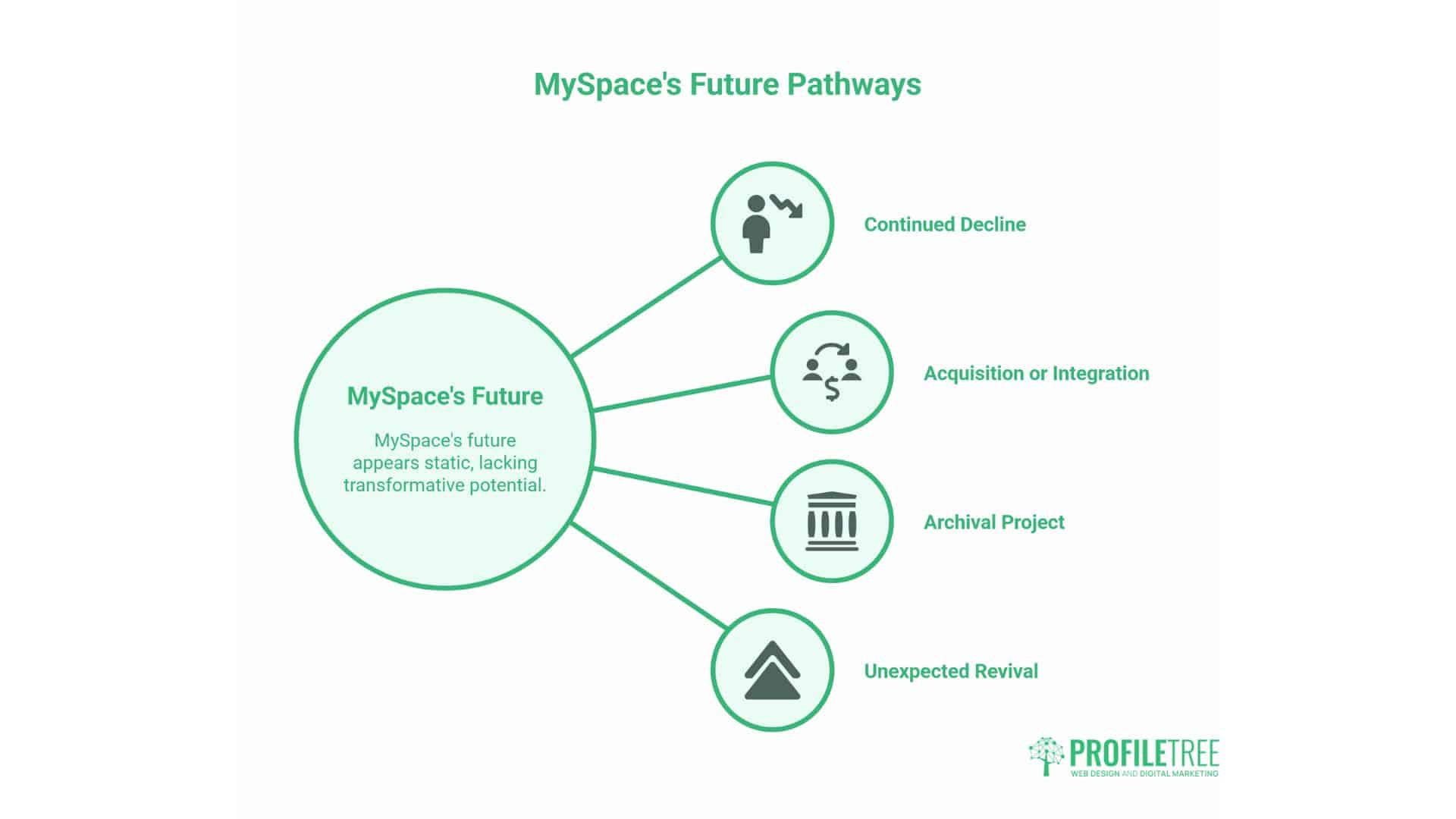
MySpace’s future appears static rather than transformative. The platform lacks the necessary resources, user base, and strategic vision to regain relevance in the competitive social media landscape. Several scenarios are plausible for the next 3-5 years.
Scenario 1: Continued Decline
The most likely trajectory involves a gradual decline leading to an eventual shutdown. As maintenance costs exceed minimal revenue and remaining users continue to depart, the economic case for maintaining the platform weakens. A quiet shutdown with minimal notice would mirror how many legacy platforms end their operations.
This would represent the final chapter in MySpace’s story—a platform that revolutionised social media, ultimately fading into digital history.
Scenario 2: Acquisition or Integration
A technology company or media organisation might acquire MySpace for its brand recognition, domain authority, or as a nostalgic IP asset. This could result in either transformation into something entirely new (effectively ending MySpace as it currently exists) or integration into a larger platform ecosystem.
Given the costs involved in platform maintenance and the limited user base, this scenario seems unlikely unless brand value justifies acquisition costs.
Scenario 3: Archival Project
MySpace could transition into a pure archival project—a read-only repository of early internet culture. Similar to the Internet Archive, it might receive funding as a historical preservation effort rather than operating as a commercial entity.
This would acknowledge MySpace’s cultural significance while accepting its irrelevance as an active platform. Users could access historical content without the pretence of ongoing social networking functionality.
Scenario 4: Unexpected Revival
While unlikely, dramatic changes in social media preferences could theoretically create space for alternative platforms. Growing concerns about algorithm control, data privacy, and platform monopolisation might drive users toward alternatives offering greater control and customisation.
However, any such movement would more likely coalesce around newer platforms (like SpaceHey or Mastodon) than resurrect MySpace specifically.
What This Means for Digital Strategy
Regardless of MySpace’s specific future, the platform’s trajectory reinforces fundamental principles for business digital strategy:
- Own Your Core Infrastructure: Maintain direct control of your website, customer database, and communication channels.
- Diversify Platform Presence: Engage audiences across multiple platforms rather than depending on any single channel.
- Maintain Content Archives: Regular backups and content exports protect against platform changes or closures.
- Prioritise Sustainable Approaches: Focus on strategies with long-term viability rather than chasing temporary platform trends.
- Invest in Fundamentals: SEO, email marketing, and quality content creation provide value regardless of platform shifts.
ProfileTree applies these principles when developing digital strategies for clients across the UK. We build foundations that withstand market changes while remaining flexible enough to adopt emerging opportunities.
Taking Action: Your Next Steps
Whether you’re recovering nostalgic content, building a business digital presence, or developing a marketing strategy, clear next steps will help you move forward effectively.
If You’re Accessing MySpace for Personal Reasons
- Attempt Account Access: Try logging in with your original credentials at myspace.com
- Secure Your Account: Change your password immediately and update any accounts where you reused those credentials.
- Export Content: Download any photos, music, or content that remains accessible
- Consider Deletion: If you’ve recovered desired content, delete the account to eliminate security vulnerabilities.
- Update Other Accounts: Change passwords on email, banking, or other services where you may have reused MySpace credentials.
If You’re a Business Owner Developing a Digital Strategy
- Audit Current Presence: Review where your business currently has online presence and evaluate each channel’s effectiveness
- Prioritise Website Development: If you lack a professional website, this should be your first investment. Contact ProfileTree to discuss web design and development tailored to your business needs.
- Implement SEO Strategy: Work with specialists to develop sustainable organic search visibility.
- Build an Email List: Establish direct communication channels that are independent of platform algorithms.
- Create Content Strategy: Develop systematic approaches to content creation across written, video, and visual formats.
- Consider AI Adoption: Explore how AI tools can improve efficiency in your operations, marketing, or customer service
If You’re Evaluating Digital Marketing Services
ProfileTree offers comprehensive digital services for SMEs across Belfast, Northern Ireland, Ireland, and the UK:
- Web Design and Development: User-focused websites built on WordPress, optimised for ranking, traffic, leads, and sales
- SEO Services: Local and regional optimisation to improve search visibility and attract qualified traffic
- Content Marketing: Strategic content creation, including writing, video production, and animation
- AI Training and Implementation: Practical AI adoption for SMEs, including training workshops and integration support
- Digital Marketing Training: Workshops and consultancy helping teams develop capability across SEO, content strategy, and digital fundamentals
- Video Production: Professional video content for marketing, training, and social media
We focus on sustainable, measurable strategies that deliver tangible business results, rather than relying on vanity metrics or fleeting trends.
Conclusion
MySpace exists as a digital relic—a reminder of early social media’s possibilities and limitations. For most users and businesses, it offers no practical value beyond potential content recovery or historical interest. The platform that once dominated online social interaction now serves primarily as a cautionary tale about platform dependency and the importance of owning digital assets.
The lessons from MySpace’s trajectory remain highly relevant for modern business strategy. Platform-dependent approaches create vulnerability, owned infrastructure provides stability, and balanced digital presence combines both owned and rented media effectively.
For business owners across Belfast, Northern Ireland, and the UK, developing a resilient digital presence starts with professional website development, strategic SEO implementation, and systematic content marketing. ProfileTree’s expertise in web design, digital training, and AI implementation enables SMEs to build foundations that support long-term growth, regardless of platform shifts or market changes.
Whether you’re recovering memories from MySpace’s archives or building a modern digital presence, understanding this evolution informs better decisions about where to invest time, resources, and strategic focus.
FAQs
Can I still access my old MySpace account?
Yes, MySpace still exists, and you can attempt to log in using your original credentials. However, many accounts require password resets, and the process can be complicated if you no longer have access to your original email address.
Is my MySpace data still safe and private?
Old MySpace accounts present potential security vulnerabilities, particularly if you reused passwords on other services. The platform suffered a data breach in 2016, affecting 360 million accounts. Change your password immediately if you access an old account, and update credentials on any other services where you used the same password.
What happened to my old photos and music on MySpace?
MySpace suffered a catastrophic data loss in 2019 during a server migration. Approximately 50 million songs and 12 years’ worth of content (2003-2015) were permanently deleted. If your content was uploaded during this period and wasn’t migrated to “Mixes” during platform updates, it’s likely gone forever.
Should musicians use MySpace for promotion in 2026?
No. MySpace offers no practical value for music promotion, audience building, or career development in 2026. Focus instead on platforms like Spotify, YouTube, Instagram, TikTok, and Bandcamp, where active and engaged audiences exist.