
What Is a Podcast? Types, Formats and How They Work
Table of Contents
A podcast is an on-demand audio series made up of episodes focused on a specific topic, theme, or story. Listeners subscribe through apps like Spotify or Apple Podcasts and tune in whenever it suits them. Formats range from solo monologues and interviews to scripted fiction and repurposed radio content. Podcasting has grown into one of the most accessible content channels for both individual creators and businesses looking to build an audience, and rising demand for video podcasts is an area where our video production team increasingly gets involved.
How Podcasts Work
Understanding the mechanics behind podcasting helps both listeners and businesses get more from the medium. At its core, a podcast is an audio file distributed through an RSS feed, which pushes new episodes automatically to every platform and listener app where the show is listed.
What Is an RSS Feed in Podcasting?
RSS stands for Really Simple Syndication. When a podcaster publishes a new episode, their hosting platform generates an updated RSS feed. That feed signals every connected directory, including Spotify, Apple Podcasts, and Amazon Music, that new content is available. Listeners who have subscribed receive the episode automatically, without needing to check back manually.
The RSS feed is what separates podcasting from standard audio streaming. It gives creators ownership of their distribution and means a podcast can appear across dozens of platforms from a single upload.
What Is a Podcast Hosting Platform?
A podcast hosting platform stores the audio files and generates the RSS feed. Most hosting services offer a dashboard for uploading episodes, writing show notes, and tracking listener analytics. Some platforms are free with limited storage; paid plans typically offer more bandwidth, better analytics, and monetisation tools.
Popular options include Buzzsprout, Podbean, Libsyn, and Anchor (now Spotify for Podcasters). The choice of platform depends on episode frequency, file size, and whether the podcaster needs detailed audience data.
What Is a Podcast Directory?
A podcast directory is an app or platform where listeners discover and play podcasts. The most widely used directories include:
- Apple Podcasts — the largest single directory by catalogue size
- Spotify — the most-used platform globally by listening hours
- Amazon Music / Audible
- Google Podcasts (now migrated to YouTube Music)
- Overcast and Pocket Casts — popular with dedicated listeners who prefer a cleaner interface
Submitting a podcast to multiple directories increases discoverability without any additional production effort; the same RSS feed serves all of them.
Equipment Required to Start a Podcast
The barrier to entry is low. Three things are all that is needed to produce a listenable podcast: a device to record on (laptop, phone, or desktop), a microphone, and recording software.
A USB condenser microphone at the entry level costs between £30 and £100 and eliminates most background noise. Recording software such as Audacity (free) or Adobe Audition handles both capturing and editing audio. For podcasters moving into video podcasting, a basic webcam or DSLR adds the visual layer without dramatically increasing the production cost.
Investing in better equipment matters once the show has an audience. At the start, audio clarity is more important than production polish.
7 Types of Podcasts
Podcast formats shape the listener experience as much as the topic itself. Understanding the different types helps both creators and businesses choose the right approach for their goals.
Interview Podcasts
The interview format is the most common in podcasting. A host brings on one or more guests per episode to discuss their expertise, experiences, or perspectives. The audience benefit is variety: each episode offers a different voice and a different story.
- Advantages: Guests bring their own audiences, naturally expanding reach. Each episode requires less original content from the host. Varied perspectives prevent the show from feeling repetitive.
- Considerations: Interview logistics take time. Scheduling guests, preparing questions, and managing technical issues on remote recordings all add to production time.
- Examples: The Joe Rogan Experience, F1: Beyond the Grid with Tom Clarkson, The Laughs of Your Life with Doireann Garrihy.
Solo or Monologue Podcasts
Solo podcasts feature a single host speaking directly to the audience. They work well when the host has genuine expertise, a strong point of view, or a natural storytelling ability. The format is the most direct and often the most personal.
- Advantages: Minimal scheduling and coordination. No technical issues from guest connections. The host has complete editorial control.
- Considerations: Sustaining listener interest without a second voice is harder. The host carries the entire energy of each episode, which requires more preparation to avoid rambling.
- Examples: The Sarah Silverman Podcast, Have You Heard George’s Podcast, Inner Monologue with Olivia Neill.
Narrative Non-Fiction Podcasts
Non-fiction narrative podcasts tell real stories, often in a documentary style. Episodes may be standalone or serialised across a season. True crime is the most popular sub-genre, but narrative non-fiction extends to history, journalism, and investigative reporting.
- Advantages: Serialised storytelling drives binge listening and strong subscriber retention. The format suits in-depth reporting on a single subject.
- Considerations: Research and production are significantly more involved than conversational formats. The host needs strong storytelling skills to hold the listener through long-form episodes.
- Examples: Your Own Backyard, Chameleon: Hollywood Con Queen, The Making of a Detective.
Fictional Storytelling Podcasts
Scripted fiction podcasts function like audio dramas: full casts, sound design, original scores, and written storylines. The format requires the most production effort but creates a genuinely immersive experience.
- Advantages: High creative freedom. A strong storyline with cliffhangers keeps listeners committed across seasons.
- Considerations: Sound design and acting take the production complexity well beyond a microphone-and-laptop setup. These are effectively radio plays with a digital distribution channel.
- Examples: Edith!, The Amelia Project, Passenger List (BBC Audio Drama Award winner 2020 and 2022).
Open Conversation Podcasts
This format involves two or more hosts discussing topics without a formal script or interview structure. Chemistry between the hosts is the central appeal. The best shows in this format feel like listening to a compelling conversation between people you find interesting.
- Advantages: Low prep time and easy to produce consistently. Authenticity is the selling point: audiences value the unfiltered dynamic.
- Considerations: Without recognisable hosts, building an audience is slower. Poor chemistry between presenters is difficult to hide.
- Examples: My Therapist Ghosted Me (Vogue Williams and Joanne McNally), The 2 Johnnies Podcast, Red Table Talk.
Educational Podcasts
Educational podcasts teach specific skills or subjects in an audio format. They range from language learning to economics to science communication. The best examples prioritise clarity and structure: each episode has a defined learning objective and delivers it efficiently.
- Advantages: If the host has genuine subject-matter expertise, research time is reduced. The format has strong replayability: listeners return to episodes as reference material.
- Considerations: The quality bar for educational content is high. An audience that comes to learn will disengage quickly if the information is shallow or poorly organised.
- Examples: The David McWilliams Podcast, The Happiness Lab with Dr Laurie Santos, Duolingo’s language learning podcasts.
Repurposed Content Podcasts
Repurposed podcasts reformat existing content, typically from television, radio, or live events, for audio distribution. News organisations, broadcasters, and event producers use this format to reach listeners who prefer audio consumption.
- Advantages: Content already exists, reducing production demands. The format extends the lifespan of content that would otherwise have a single broadcast window.
- Considerations: If the content relies on visuals or was designed for a different medium, the audio experience can feel incomplete. Adapting, rather than simply re-uploading, is usually necessary.
- Examples: The Daily Show with Trevor Noah: Ears Edition, TED Radio Hour, The Ian Dempsey Breakfast Show.
Podcast Genres Explained
A podcast genre describes the subject area or theme of the show, separate from its format. Format is how the podcast is structured; genre is what it is about. Most podcast directories organise their libraries by genre, making this an important consideration for discoverability.
Common podcast genres include:
- Comedy
- True Crime
- Sports
- News and Politics
- Arts and Entertainment
- Health and Wellness
- Music
- Society and Culture
- Business and Technology
- Education
- Games and Hobbies
A podcast can combine format and genre freely. An educational podcast about true crime, or a fictional storytelling series set in the sports world, both fit within established genre categories while using different formats.
Are Podcasts Free to Listen To?
The vast majority of podcasts are free to access. Listeners can browse, subscribe, and listen through any major directory without paying anything. Revenue for free podcasts typically comes from advertising, sponsorship, or audience support platforms such as Patreon.
Some podcasters offer premium tiers with bonus content, early access, or ad-free listening for paying subscribers. This is common among shows with large, engaged audiences who want a closer relationship with the creators.
The free-to-access model has driven adoption. A listener can follow twenty different shows across five different genres at no cost, which is very different from the subscription economics of video streaming.
Can You Get Paid for Podcasting?
Podcasting can generate income through several routes. The main ones are:
- Advertising and sponsorship: Brands pay to have products or services mentioned within episodes. Rates are typically calculated per thousand downloads (CPM). Shows with a defined, engaged niche command higher rates than general-interest shows with larger but less targeted audiences.
- Listener support: Platforms such as Patreon and Buy Me a Coffee allow audiences to make monthly contributions or one-off payments. Podcasters often offer bonus episodes, early access, or community access in return.
- Premium content: Some shows place certain episodes or back-catalogue content behind a paywall while keeping new releases free.
- Affiliate marketing: Hosts recommend products and include a tracked link or discount code. Commission is earned on resulting purchases.
- Live events and merchandise: Established shows extend into live recordings, meet-and-greets, and branded products.
Most podcasters do not earn a significant income in the first year. Building an audience takes time, and monetisation tends to follow once a show has a defined audience and a consistent publishing schedule.
Podcasts for Business
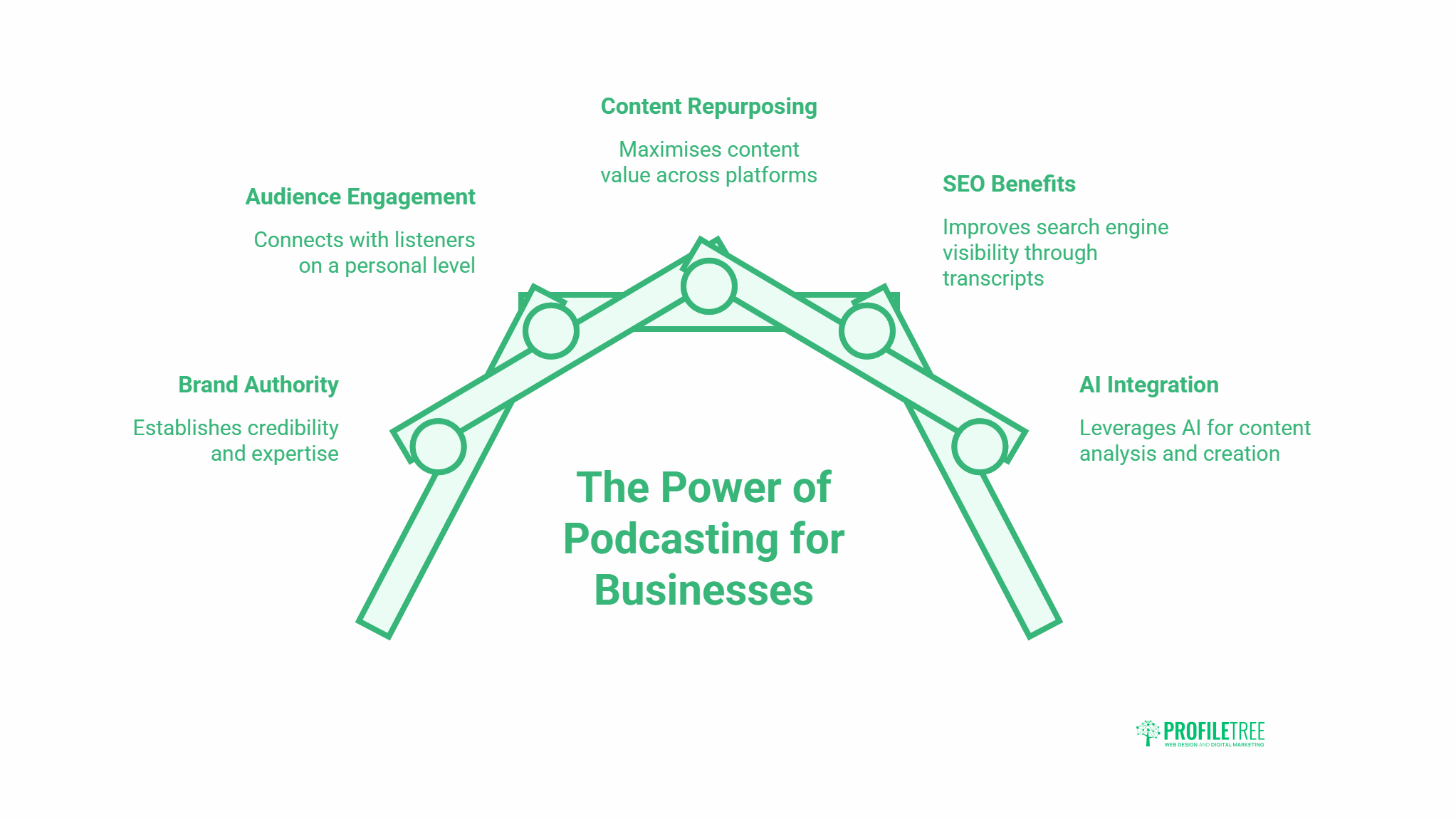
Podcasting has moved well beyond hobby broadcasting. Businesses across sectors now use it as a structured content channel, both for building brand authority and for reaching audiences who prefer audio over reading.
Why Businesses Use Podcasting
Audio content fits naturally into a commute, gym session, or domestic task. It creates a different kind of audience relationship than a blog post or social media update: longer listening sessions, lower distraction, and a more personal tone. A business podcast positions the company or its people as credible voices on a subject, over time and across many episodes.
From a content marketing perspective, a podcast episode can be repurposed into blog posts, short clips for social media marketing, email newsletter content, and transcripts for SEO. One recording session can feed multiple content formats, making it an efficient production investment.
Ciaran Connolly, founder of ProfileTree, notes that many SMEs overlook podcasting as a brand-building tool, assuming it requires expensive studio equipment. In practice, a well-edited, consistently published podcast recorded on a decent USB microphone can outperform far more expensive content in terms of audience trust and recall.
How Podcasting Fits a Content Marketing Strategy
A podcast works best when it is part of a broader content marketing strategy. Treated as a standalone output, it rarely builds the same momentum. An episode on a relevant industry topic can drive organic search traffic through an accompanying blog post, build the company’s authority in a specific niche, and give the sales team shareable content that demonstrates expertise.
Businesses starting out should define their audience before their topic. A podcast aimed at SME owners in Northern Ireland, covering practical digital marketing questions, will find an audience more quickly than a general marketing podcast trying to compete with established international shows.
Integrating Podcast Content With Digital Marketing
A podcast strategy that connects with digital marketing services creates a compounding content effect. Each episode builds the brand’s entity signals, particularly when accompanied by a structured show notes page with internal links to relevant service pages. Audio content cited in AI systems (Perplexity, ChatGPT, Bing AI) is increasingly including podcast transcripts and show notes pages in responses, making the written content layer around a podcast episode as important as the audio itself.
For businesses considering how AI transformation affects content strategy, a podcast can also serve as a primary data source: episode transcripts trained into a custom AI model give businesses a documented body of expert knowledge in their own voice. AI transformation services are increasingly covering this use case.
Web Presence and Podcast Discoverability
A podcast without a web presence is limited in its reach. A dedicated podcast page on your website, with episode show notes, transcripts, and embedded audio, serves both listener convenience and search engine visibility. This also makes the podcast content part of your overall web design and development strategy: the page structure, schema markup (PodcastEpisode, PodcastSeries), and internal linking all contribute to how well the podcast content performs in search.
For podcasters publishing video versions of episodes to YouTube, the same fundamentals covered in ProfileTree’s guide to ranking YouTube videos for maximum visibility apply directly.
Frequently Asked Questions
These are the questions people ask most often when they’re new to podcasting or thinking about starting one for a business.
What is a podcast in simple terms?
A podcast is an audio show made up of individual episodes, available to listen to on demand through apps like Spotify or Apple Podcasts. Listeners subscribe to shows they like and receive new episodes automatically. Topics can cover anything: news, comedy, true crime, business, education, or sport.
How is a podcast different from radio?
Radio broadcasts live at a scheduled time; you either tune in or miss it. A podcast is recorded in advance and available whenever the listener chooses. Podcasts also have no geographic broadcast limit; a show produced in Belfast can be listened to in Tokyo the same day it is published.
What are the main types of podcasts?
The seven main formats are interview, solo or monologue, narrative non-fiction, fictional storytelling, open conversation, educational, and repurposed content. Most podcasts fit one primary format, though many blend elements from more than one.
What equipment do you need to start a podcast?
At a minimum: a smartphone or laptop, a USB microphone, and free recording software like Audacity. A pop filter reduces unwanted breath sounds. More advanced setups add audio interfaces, professional condenser microphones, and acoustic treatment for the recording space.
What is an RSS feed and why does it matter for podcasts?
An RSS feed is the technical backbone that distributes a podcast to every platform and directory simultaneously. When a new episode is published to the hosting platform, the RSS feed updates automatically, pushing the episode to Spotify, Apple Podcasts, and every other directory the show is registered on.
Can a business benefit from having a podcast?
Yes. A podcast builds brand authority, creates a content library that can be repurposed across formats, and reaches audiences who prefer audio over reading. It works best as part of a wider content marketing strategy where episodes are supported by written show notes, social clips, and internal links to relevant service pages.
How long should a podcast episode be?
Episode length varies by format and audience. Interview podcasts typically run between 45 and 90 minutes. Educational podcasts are often shorter, between 15 and 30 minutes, to match the attention span of someone learning on the go. The right length is whatever fully covers the topic without padding — listener retention data from most hosting platforms shows significant drop-off after the halfway point in poorly paced episodes.