
Tourism Marketing Strategies: The Definitive UK & Ireland Guide
Table of Contents
Tourism marketing strategies determine whether UK and Ireland businesses generate bookings or just impressions. Strong search visibility means little if visitors have no clear, compelling reason to act, and that gap is a strategy problem, not a traffic problem. Attracting visitors is only half the equation. Giving them a clear, compelling reason to book is what separates growing operators from stagnant ones.
This guide covers the full spectrum of tourism marketing, from foundational principles to the practical tactics UK and Irish SMEs can act on today. Whether you run a boutique hotel in Belfast, a tour operator in Galway, or a regional destination marketing organisation, the frameworks here are designed for real-world application.
The sections below cover the tourism marketing mix, digital channels that drive bookings, the connected destination model, AI applications for time-poor operators, and how to measure what actually matters.
What Is Tourism Marketing?
Tourism marketing covers every strategy a business in the travel and hospitality sector uses to attract visitors, generate bookings, and build long-term brand loyalty. It applies to hotels, tour operators, attractions, restaurants, destination marketing organisations, and the broader hospitality supply chain.
What sets tourism marketing apart from general marketing is the nature of the product being sold: an experience that cannot be sampled before purchase, delivered largely through human interaction, and subject to factors entirely outside the operator’s control. This creates both a challenge and an opportunity for marketers willing to invest in understanding their audience.
Tourism Marketing vs General Marketing
The core difference lies in the marketing mix. Tourism services are perishable. An unsold hotel room tonight cannot be recovered tomorrow. They are also deeply personal, with every customer arriving with different expectations, budgets, and motivations.
Country-level branding adds another layer. Nations compete for visitor share just as businesses compete for customers. France, Spain, and the United States consistently top global tourism revenue rankings because their brand stories are consistent, credible, and backed by decades of coordinated marketing investment. For regional operators in Northern Ireland and Ireland, aligning with national destination bodies like Tourism Ireland and Fáilte Ireland provides reach that individual businesses cannot achieve alone.
Why Brand Consistency Matters at Every Level
From a national destination to a single guesthouse, the same principle applies: the brand promise must be clear, specific, and delivered at every touchpoint. Tourists share experiences widely, through both word of mouth and online reviews, making a single disappointing stay far more costly than the lost booking itself.
For businesses across Northern Ireland’s cities, consistent brand positioning at the local level complements national tourism campaigns and helps build the kind of repeat visitor numbers that sustain year-round revenue.
The table below shows how tourism marketing differs from conventional product marketing across four dimensions:
| Dimension | Conventional Product Marketing | Tourism Marketing |
|---|---|---|
| Product | Physical, returnable, testable | Experiential, perishable, untestable pre-purchase |
| Purchase cycle | Often immediate or short | Weeks to months of research before booking |
| Trust signals | Product specs, warranties, returns | Reviews, UGC, editorial content, social proof |
| Seasonality | Moderate | High — pricing and volume fluctuate dramatically |
The Building Blocks of a Tourism Marketing Strategy
A functioning tourism marketing strategy rests on four decisions made before any campaign runs. First, define who you are trying to reach and what motivates them to travel. Second, identify the channels where those people make their decisions. Third, align your messaging to the emotional and functional benefits your offering delivers. Fourth, build the measurement framework that tells you whether the activity is working.
ProfileTree works with hospitality and tourism businesses across Northern Ireland, Ireland, and the UK to develop digital strategies that connect those four decisions into a coherent, measurable plan.
The Tourism Marketing Mix
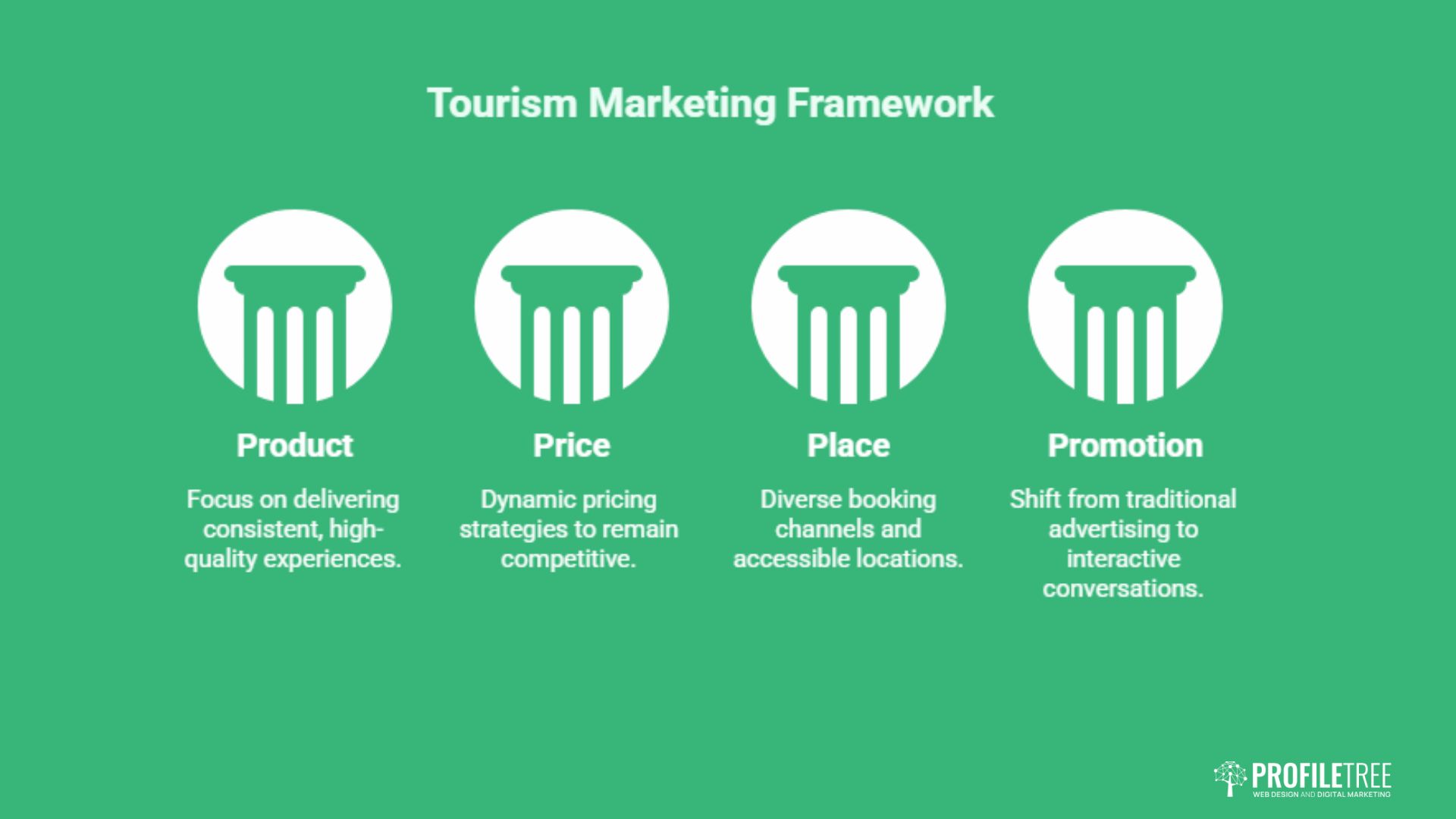
The traditional four Ps (product, price, place, and promotion) still provide a useful structure for tourism marketing planning, though the way each element operates has shifted considerably. Understanding how they interact in the current market is the prerequisite for investing in any individual tactic.
Product: Consistency Over Novelty
In most industries, product innovation drives competitive advantage. In tourism, the reverse is often true. Guests want reliability: the same comfortable room, the same quality of service, the same clear brand promise they experienced or heard about before. What differentiates a service is not constant change but the ability to deliver a familiar, high-quality experience while making each customer feel individually valued.
This is not to say that product development is irrelevant. The growth of experience tourism (culinary tours, adventure activities, cultural immersion, wellness retreats) reflects a genuine shift in traveller expectations. Visitors, particularly younger ones, increasingly prioritise experiences over amenities. Operators who can package unique, participatory activities alongside reliable service have a measurable advantage in the current market.
Price: Complex and Always Competitive
Tourism pricing is among the most complex in any industry. Most operators work across multiple strategies simultaneously: time-based pricing adjusts rates by season and proximity to the travel date; price discrimination offers different rates to different customer segments; value-based pricing commands a premium for genuinely differentiated experiences.
Airlines are the most visible example of demand-based pricing, but the logic applies equally to accommodation, tours, and attractions. For small operators without sophisticated revenue management tools, the most practical approach is to track competitor pricing regularly, set clear seasonal rate structures, and use scarcity signals (limited availability messaging) to encourage earlier booking decisions.
Place: Where and How People Book
The distribution picture for tourism has fragmented considerably. Travellers now book through OTAs (Booking.com, Expedia, Airbnb), directly via operator websites, through Google’s native booking integrations, via social commerce on Instagram and TikTok, and still occasionally through traditional travel agents for complex or long-haul itineraries.
For most UK and Irish operators, the priority should be reducing OTA dependency by driving direct bookings through strong website design and a smooth booking experience. Every direct booking saves the commission fee and gives the operator full ownership of the customer relationship. That relationship is the foundation of repeat visits and referrals.
Promotion: From Broadcast to Conversation
Promotional strategy in tourism is no longer primarily about reach. It is about relevance. Travellers research extensively before booking, moving between social media, search engines, review platforms, and peer recommendations across weeks or months. Effective promotion means being present and persuasive at each of these decision points, not just at the top of the funnel.
Paid search, organic content, influencer partnerships, email nurture sequences, and review management all play distinct roles across the customer journey. The operators who perform best are those who map their promotional activity to each stage of that journey rather than running disconnected campaigns.
Tourism Digital Channels
The digital channel mix for tourism has changed substantially over the past three years. Short-form video has emerged as the dominant awareness driver; local SEO has become essential for capturing high-intent searches; and email marketing remains the most cost-effective retention tool available to independent operators. Each channel requires a different approach and serves a different stage of the booking journey.
Local SEO and the Map Pack
For most tourism businesses, the highest-converting traffic comes from location-based searches: “things to do near me”, “hotels in [city]”, “tours in [destination]”. These searches carry strong commercial intent because the person searching has already decided to visit; they are choosing between options.
Appearing in the Google Maps local pack for these searches requires a fully optimised Google Business Profile, consistent NAP (name, address, phone) data across all directories, genuine customer reviews, and location-specific content on the website. A Belfast tour operator that ranks in the local pack for “Belfast food tours” will convert at a noticeably higher rate than one appearing on page two of organic results.
A common oversight among Northern Ireland tourism operators is neglecting Bing and Apple Maps for international visitors arriving from North America, where those platforms hold a higher market share. Consistent listings across all major platforms is a straightforward fix that many operators have not yet made. For detailed guidance on local search performance for hospitality businesses, see ProfileTree’s SEO services for Northern Ireland businesses.
Short-Form Video and the Endorphin Economy
TikTok, Instagram Reels, and YouTube Shorts have become the primary discovery channels for travel experiences, particularly among audiences under 40. The format suits tourism marketing naturally: a 30-second clip of a kayaking experience at dusk, a behind-the-scenes look at a working farm, or a walking tour of a historic city centre can convey in seconds what a paragraph of text cannot.
The key distinction between effective and ineffective tourism videos is authenticity. Travellers have developed a strong filter for over-produced, promotional content. Raw footage filmed on a smartphone, genuine customer reactions, and honest portrayals of what an experience actually involves consistently outperform polished advertising in organic reach and engagement.
ProfileTree’s video production team has worked with tourism and hospitality businesses across Northern Ireland to produce destination content that performs on both social platforms and the operator’s own website. Video content embedded on service pages reduces bounce rates and increases time on site, two signals that support organic rankings. Learn more about ProfileTree’s video marketing services for tourism businesses.
Social Media Marketing for Tourism Operators
Instagram and Facebook remain important platforms for tourism marketing, particularly for reaching the 35-to-65 age group that accounts for the majority of discretionary travel spend in the UK. Pinterest drives strong referral traffic for destination content, while LinkedIn is increasingly relevant for corporate travel and incentive tourism operators targeting business buyers.
The most effective social media strategies for tourism businesses combine three content types: aspirational imagery that builds desire, practical information that reduces booking friction, and social proof in the form of genuine customer content and reviews. User-generated content (where customers share their own photos and videos using a branded hashtag) is particularly valuable because it provides authentic endorsement at no production cost. A well-structured social media strategy makes this systematic rather than opportunistic.
Email Marketing as a Retention Engine
Email marketing consistently delivers the highest return on investment of any digital channel for tourism businesses, largely because it operates on a consented audience that has already expressed interest. The key to effective tourism email is segmentation: a first-time visitor to your destination needs different content from a repeat customer planning their third trip.
Behavioural triggers work particularly well in tourism. Someone who has browsed a specific tour type but not booked can receive a targeted follow-up with additional information, social proof, or a time-limited incentive. Someone who booked six months ago can receive a seasonal offer timed to the anniversary of their stay.
Content Marketing and Blogging
Long-form content remains one of the most durable organic traffic sources in tourism. Articles covering destination guides, activity comparisons, itinerary suggestions, and “how to choose” frameworks attract travellers at the research stage of their journey and, when well-structured, continue generating traffic for years.
The common mistake is writing content that is too generic to rank or too promotional to be genuinely useful. The articles that perform best answer specific questions with genuine depth: not “why visit Ireland” but “three-day itinerary for first-time visitors to the Causeway Coast”. Specificity signals expertise, earns links, and aligns with the longer, more precise queries that characterise how people actually search when planning a trip. ProfileTree’s content marketing services are built around this principle.
The Destination Framework
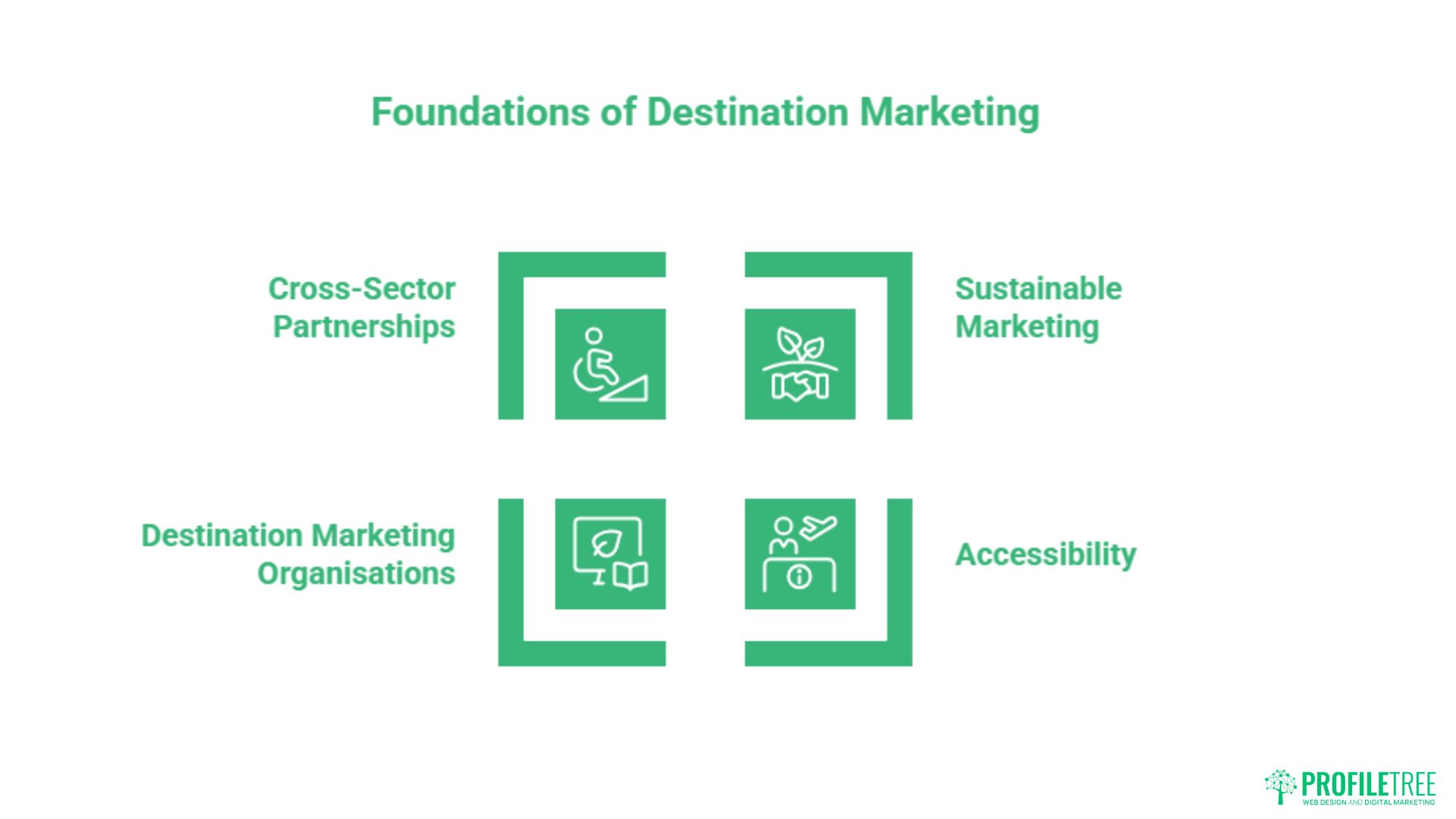
The most important strategic gap in UK and Irish tourism marketing is not digital capability; it is collaboration. Most operators market in isolation: the hotel promotes the hotel, the restaurant promotes the restaurant, the attraction promotes the attraction. The visitor, meanwhile, is making a single decision about a destination, not a series of disconnected decisions about individual businesses.
The Connected Destination Framework addresses this directly. It positions collaboration between accommodation providers, food and drink operators, activity providers, and transport links as the foundation of effective destination marketing. When these businesses work together, the combined proposition is far stronger than any individual offering.
Why Cross-Sector Partnerships Work
Ireland’s Wild Atlantic Way is one of the most cited examples of destination marketing done well, but its success is rooted not just in the branding but in the underlying network of businesses that deliver on the promise at every stop along the route. A traveller driving the route stays in local accommodation, eats in local restaurants, books local experiences, and buys from local producers. Each business benefits from the flow created by the whole.
For smaller regional destinations, replicating this model means identifying the natural clusters within a location and building joint packages, shared digital presence, and co-branded marketing assets. A hotel that partners with three local experience providers and two restaurants can offer a genuinely persuasive multi-day package that commands a higher price point and drives longer stays.
Working with Destination Marketing Organisations
Getting featured by a DMO (whether that is Tourism Ireland, VisitScotland, or a local council tourism body) is one of the most cost-effective ways for small operators to access national and international audiences. The challenge is that DMOs receive far more applications than they can feature and prioritise businesses that are digitally ready, review-rich, and easy to book.
Practical preparation for DMO features includes: a fully optimised website with clear booking functionality, a consistent and active Google Business Profile, a genuine base of recent reviews across multiple platforms, and professional photography that meets the quality standards DMOs apply when selecting images for their own channels.
Sustainable Marketing: Substance Over Signalling
Environmental messaging has become a standard fixture of tourism marketing, and travellers have become correspondingly sceptical of it. Research from Booking.com indicates that most travellers want to travel sustainably but struggle to find options they trust. Vague “eco-friendly” claims without supporting evidence are increasingly counterproductive, both because sophisticated travellers dismiss them and because regulatory scrutiny of green marketing claims is tightening across the UK.
The approach that works is specificity. “We source 90% of our menu ingredients from suppliers within 30 miles” is credible. “We are committed to sustainable tourism” is not. Operators who can document their practices (energy sources, waste management, local procurement, community partnerships) have a genuine differentiator. Those who cannot are better served by focusing their messaging on other strengths rather than making claims they cannot substantiate.
Accessibility as a Commercial Opportunity
Accessible tourism is consistently underserved across UK and Irish destinations, despite the commercial logic being straightforward. The UK’s disability market (sometimes called the “Purple Pound”) represents an estimated spending power of over £274 billion annually. Older travellers, the fastest-growing segment in domestic UK tourism, also have the highest discretionary income and the strongest preference for accessibility features.
Operators who invest in genuine accessibility (adapted facilities, clear accessibility information on their website, trained staff, and inclusive marketing imagery) access a customer segment that is actively underserved by the broader market. This is not a tick-box exercise but a genuine commercial opportunity that most operators have not yet captured.
AI Tools, Measurement, and the 2026 Tourism Operator’s Plan
Artificial intelligence is reshaping tourism marketing faster than most small operators have had time to adapt. The practical question for a time-poor hotel manager or tour operator is not whether AI matters (it clearly does), but which applications deliver real value without requiring a large technical investment or a new hire. The answer is narrower than the marketing press suggests.
Practical AI Applications for Small Tourism Operators
The most immediately useful AI tools for tourism businesses fall into three categories. Content generation tools can cut the time required to produce location descriptions, FAQ content, and email sequences, freeing up time for the aspects of marketing that require genuine local knowledge. Chatbot tools can handle routine booking enquiries, provide instant responses to frequently asked questions, and qualify leads outside business hours without additional staff cost.
Predictive analytics tools, now available at accessible price points through platforms like Google Analytics 4 and Hotjar, identify which pages and content types are most likely to lead to bookings, helping operators prioritise where to invest their marketing effort. ProfileTree’s AI marketing training programmes are specifically designed to make these tools accessible to non-technical teams.
The table below compares AI tools by use case and estimated time saving per week for a typical single-site tourism operator:
| AI Tool Category | Primary Use Case | Estimated Weekly Time Saving |
|---|---|---|
| Content generation | Descriptions, emails, social captions | 3–5 hours for operators publishing regularly |
| AI chatbot | Handling FAQs and out-of-hours enquiries | 2–4 hours in peak season |
| Predictive analytics | Identifying high-converting content and channels | 1–2 hours of manual reporting per week |
| Personalisation tools | Segmented email sequencing | 1–3 hours of manual segmentation work |
Personalisation Without Complexity
Full personalisation at scale requires infrastructure that most small operators do not have. A simplified version (segmenting email audiences by travel history, past booking type, or expressed preference) is achievable with standard email marketing platforms and delivers meaningful improvements in open rates and conversion. A couple who previously booked a coastal retreat does not need the same content as a solo traveller who booked a city walking tour. Treating them differently costs nothing once the segmentation is set up.
AI-powered chatbots on booking pages can go further, asking qualifying questions and actively recommending the most relevant package based on responses. For tour operators with a range of offerings, this kind of guided recommendation can meaningfully increase average booking value.
Measuring What Actually Matters
Tourism marketing ROI measurement is complicated by long decision cycles, multi-touch attribution, and the seasonal nature of the business. Most small operators default to measuring what is easy: social media followers, website sessions, rather than what is meaningful, cost per booking, customer lifetime value, and repeat visit rate.
The metrics worth tracking regularly are: booking conversion rate by channel (what percentage of website visitors from each source actually complete a booking), average booking value, and cost per acquisition. These three numbers, tracked consistently, tell you far more about the health of your marketing than any vanity metric.
Ciaran Connolly, founder of Belfast digital agency ProfileTree, puts it plainly: “Most tourism operators we work with are tracking reach when they should be tracking revenue. Once you connect your digital activity to actual booking data, even roughly, the decisions about where to invest become much clearer. The channels that look impressive on paper are rarely the ones filling rooms in March.”
The 2026 Plan for UK and Irish Tourism Operators
The businesses best positioned for the next two years are those that have built the fundamentals correctly: a fast, mobile-optimised website with genuine booking capability; a Google Business Profile that is actively maintained and rich with recent reviews; a content strategy that addresses the specific questions their target visitors are asking; and at least one digital channel managed with genuine consistency and quality.
Once those foundations are in place, the focus shifts to distribution efficiency (reducing OTA commission by driving more direct bookings), audience depth (building email and social audiences that can be activated for promotions and seasonal peaks), and incremental AI adoption, starting with the tools that save the most time per pound spent.
Conclusion
Effective tourism marketing in 2026 combines a clear brand promise, a presence in the channels where travellers actually make decisions, and the operational ability to deliver on what is advertised. UK and Irish operators have real advantages (authentic scenery, distinct cultural identities, and growing domestic demand), but realising those advantages requires more than good photography and a social media account.
The frameworks in this guide are designed to be applied in sequence: get the marketing mix right before scaling any single channel; build the destination network before running paid campaigns; measure bookings rather than impressions before drawing conclusions about what is working. If you are ready to build a tourism marketing strategy that converts visibility into bookings, get in touch with ProfileTree to discuss your next steps.
FAQs
What is the most effective tourism marketing strategy for UK and Irish operators in 2026?
Hyper-local SEO combined with short-form video content drives the strongest results for most UK and Irish operators. Local search captures high-intent visitors who have already decided on a destination; video builds the desire that gets them to that decision point. Together, they cover both the awareness and conversion stages of the booking journey. For operators with limited budgets, prioritising a fully optimised Google Business Profile before investing in paid advertising will typically deliver a better return.
How do tourism businesses attract more visitors on a limited budget?
Prioritise user-generated content, local partnerships, and organic search over paid advertising. Encouraging satisfied visitors to share their experiences and tag your business costs nothing and produces more credible content than anything you could create yourself. A well-maintained Google Business Profile and a genuine base of recent reviews will outperform a modest paid campaign for most small operators. Local cross-promotion with complementary businesses, sharing each other’s content and creating joint packages, extends reach at no media cost.
What are the 4 Ps of tourism marketing?
Product, price, place, and promotion. In tourism, a product means the full experience delivered to the visitor, including the intangibles of service, atmosphere, and staff interactions. Price covers the flexible, segment-based approaches common in hospitality. Place refers to the distribution channels through which customers book, from OTAs to direct website booking engines. Promotion covers all the communication activities used to generate awareness and drive bookings, from social media to email to editorial content.
How is AI changing tourism marketing strategies?
AI is most practically useful in three areas: content production (reducing the time required to write descriptions, emails, and FAQs), customer service (chatbots that handle routine enquiries around the clock), and analytics (identifying which content and channels are most likely to produce bookings). Predictive pricing and personalised itinerary recommendations are also emerging, though these require more sophisticated infrastructure than most small operators currently have.
What is a destination marketing strategy?
A destination marketing strategy is a coordinated plan to improve the image, visibility, and visitor numbers of a specific location. It typically involves a destination marketing organisation, such as Tourism Ireland or VisitBritain, working alongside local operators to present a unified, credible brand to target audiences in key source markets. For individual businesses, it means aligning your own marketing with the broader destination brand while differentiating your specific offering within it.