
Health and Beauty Franchise Business: A Practical UK Guide
Table of Contents
Starting a health and beauty franchise is one of the more structured ways to enter a sector that continues to grow despite economic pressure. You are buying into a proven model, an established brand, and a system that has already worked somewhere else. But the franchise model comes with real constraints, and the digital side of running a location-level business is an area most franchisors leave entirely to the franchisee.
This guide covers what health and beauty franchising entails in the UK and Ireland, what it costs, and how to build a local presence that goes beyond what the franchisor’s central marketing team provides.
What Is a Health and Beauty Franchise?
A health and beauty franchise is a licensing arrangement in which a brand owner (the franchisor) grants an individual or small group (the franchisee) the right to operate a business under their name, using their systems, products, and processes.
The franchisee pays an upfront fee for this right and ongoing royalties from revenue. In return, they receive a business model, brand identity, initial training, and access to supplier networks. The trade-off is clear: reduced creative freedom in exchange for a lower-risk route to business ownership.
In the UK, around 9% of all franchise businesses operate in the health and beauty sector, which spans hair salons, nail bars, spas, skin clinics, fitness studios, weight management services, laser treatment centres, and cosmetic procedure providers. The British Franchise Association (BFA) provides a self-regulatory framework for the sector; unlike the United States, where the Federal Trade Commission mandates a Franchise Disclosure Document (FDD), UK franchising operates primarily under contract law and BFA voluntary standards.
Understanding the British Franchise Association
The BFA is the primary trade body for franchising in the UK. It is not regulated by law, but membership carries weight. BFA-accredited franchisors must meet standards around financial disclosure, contract fairness, and training quality. When evaluating any UK health and beauty franchise opportunity, checking BFA membership is a reasonable first filter.
In Ireland, Franchise Ireland is the equivalent body. Northern Ireland businesses operate under UK franchise law, with an additional consideration: cross-border trading under the Windsor Framework may affect supply chains and VAT treatment for franchisees operating near the border.
Types of Health and Beauty Franchises
The sector covers a wide range of business models, each with different investment levels, staffing requirements, and digital marketing demands.
Hair salons are the most established franchise category in the UK health and beauty. Brands such as Regis and Rush Hair operate networks of franchised locations with standardised interior fit-outs, product lines, and pricing structures. A salon franchisee typically needs a high-footfall retail location and a skilled team, making staff recruitment and local visibility the two most pressing operational challenges.
Nail bars and beauty studios tend to require lower investment than full salons, with many operating successfully in shopping centre concessions or secondary high street locations. The appointment-driven model makes online booking and local search visibility especially important.
Fitness studios operate on either a membership or class-credit model. Brands such as Anytime Fitness and Snap Fitness offer territory-based franchise agreements. The digital challenge here is distinct: fitness franchisees compete not just with other local gyms but with national apps, which means content marketing and community-building carry more weight than in other health and beauty sub-sectors.
Med spas and laser clinics sit at the higher investment end, often requiring clinical staff and regulatory compliance with the Care Quality Commission (CQC) in England, or equivalent bodies in Scotland, Wales, and Northern Ireland. Sk:n Clinics is among the best-known UK franchise networks in this space. Marketing for these businesses must navigate ASA/CAP Code rules around the advertising of cosmetic procedures.
Weight management services such as Slimming World and WW (formerly Weight Watchers) operate a hybrid model: part franchise, part licensed consultant structure. They are among the most accessible entry points in terms of upfront cost, but margins depend heavily on local client retention.
What Does It Actually Cost?
Costs vary significantly by sector, brand, and location. The figures below represent publicly available ranges for UK franchises and should be treated as planning benchmarks, not precise quotes. Always request full financial disclosure from any franchisor before committing.
| Franchise Type | Typical Franchise Fee | Estimated Total Setup Cost |
|---|---|---|
| Hair salon (mid-market) | £15,000 – £30,000 | £60,000 – £120,000 |
| Med spa/laser clinic | £10,000 – £25,000 | £30,000 – £75,000 |
| Fitness studio | £20,000 – £40,000 | £80,000 – £200,000 |
| Med spa / laser clinic | £30,000 – £100,000+ | £100,000 – £300,000+ |
| Weight management (consultant model) | £1,000 – £5,000 | £3,000 – £10,000 |
Beyond the franchise fee, the highest costs are typically the fit-out, equipment, and the working capital needed to sustain operations before the business reaches break-even. Service-based health and beauty franchises in well-chosen locations commonly reach break-even within 18 to 30 months, though this depends on the brand, local competition, and how effectively the franchisee drives local awareness.
What ongoing costs should you plan for?
Royalty fees typically range from 5% to 12% of turnover, depending on the brand and what services the franchisor provides centrally. Many brands also charge a national marketing contribution (usually 1% to 3% of turnover), which funds brand-level advertising but rarely benefits individual locations in any direct or measurable way. The practical implication: franchisees who rely entirely on central marketing tend to underperform compared to those who invest in local digital presence independently.
Pros and Cons of the Franchise Model
No honest guide to franchising leads with only the benefits. Here is a straightforward comparison.
| Factor | Franchise | Independent Business |
|---|---|---|
| Brand recognition | Built-in from day one | Must be earned over time |
| Failure rate | Lower (BFA: ~5% in first 5 years) | Higher (est. ~20% in first year) |
| Creative control | Limited; franchisor-governed | Complete |
| Marketing support | Central campaigns; local effort required | All local effort |
| Initial investment | Franchise fee + setup | Setup only |
| Supplier costs | Resale within the franchise network | Negotiated independently |
| Exit options | Resale within franchise network | Open market |
The reduced failure rate is the most cited advantage of franchising, and it is grounded in data. The BFA’s periodic research has consistently found that franchise businesses have higher survival rates than independent startups in comparable sectors. The caveat is that the BFA’s data comes from its member franchisors, who have a commercial interest in positive reporting.
How to Choose a Health and Beauty Franchise
Start with the BFA directory. BFA-accredited franchisors have met the baseline transparency standards. Shortlist only those with full BFA membership and at least five years of franchise trading history.
Request the full franchise agreement before signing anything. UK franchise agreements are not regulated documents, which means their terms vary widely. Have a specialist franchise solicitor review the agreement. The British and Irish Franchise Solicitors Group maintains a directory of practitioners with relevant expertise.
Speak to existing franchisees — particularly those who have left the network. Franchisors will provide a list of current franchisees. Ask for a list of former franchisees, too. If the franchisor refuses, treat this as a significant red flag.
Assess the local market before committing to a territory. A territory may look viable on paper, but face specific local competition, demographic mismatches, or footfall patterns that undermine the projections. Walk the area. Check Google Maps for existing competitors. Look at what the nearest franchise location is doing digitally.
Ask the franchisor directly what local marketing support they provide. Most franchisors fund national brand campaigns. Very few provide meaningful support for local search, social media, or Google Business Profile management. If the answer is vague, budget for this independently.
The Digital Side of Running a Health and Beauty Franchise
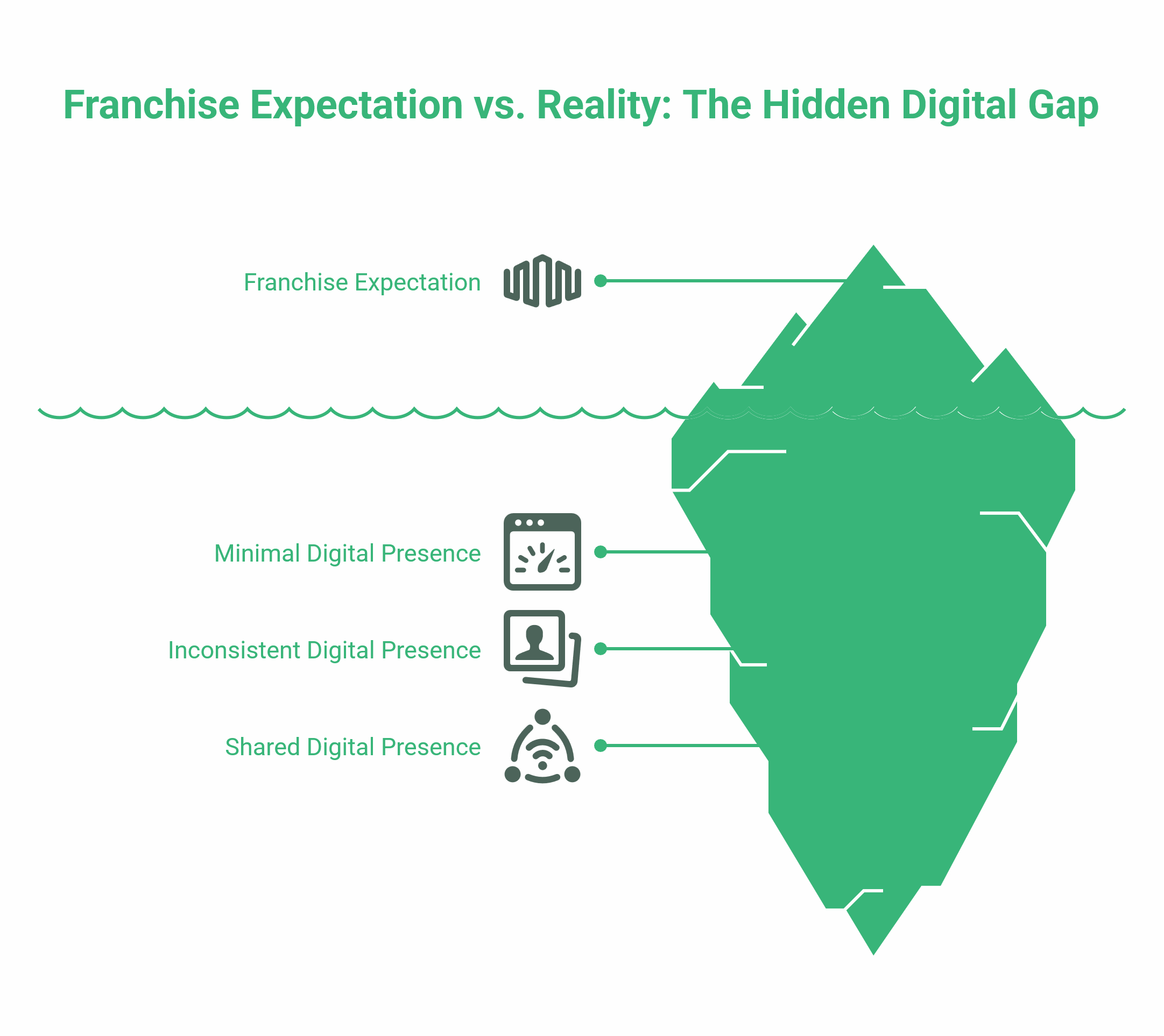
This is where the gap between franchise expectation and reality most commonly appears. A franchisee buys into a recognised brand but inherits a local digital presence that may be minimal, inconsistent, or shared across a network in ways that actively suppress individual location visibility.
The local SEO problem
Most health and beauty franchise networks have a primary domain that ranks for brand terms nationally. Individual locations may exist as subpages, subdirectories, or separate domains depending on the franchisor’s setup. In many cases, the franchisee’s location page competes with other franchise locations for local search terms because the franchisor has not differentiated content by territory.
Franchisees who want to rank for “hair salon Belfast” or “laser clinic Dublin” need location-specific content, a fully optimised Google Business Profile, and a consistent local citation profile. These are not provided by the franchisor. ProfileTree’s local SEO work for health and beauty businesses in Northern Ireland and Ireland has shown consistently that the combination of a well-structured location page, accurate NAP data, and an active Google Business Profile is more effective for local map pack rankings than any amount of central brand activity.
Website ownership and design
Some franchisors provide a template location page on their main domain. Others require franchisees to build and maintain their own separate website, within brand guidelines. If you own your location’s website, you have real control over how it performs in local search. If you do not, your digital fate is tied to decisions made centrally, often by people who do not know your specific market.
Franchisees who build their own location websites face a specific design challenge: the site must honour the franchisor’s brand guidelines (colours, fonts, logo usage, photography standards) while being locally differentiated enough to rank for area-specific queries. This is a genuine web design brief, not a template job. Getting the structure right from the outset — clean URL hierarchy, fast loading, mobile-first, and with schema markup for local business and service types — avoids the more expensive rebuild that many franchisees eventually face after a few years of poor search performance.
Content marketing for franchisees
The franchisor produces content about the brand. Nobody produces content about your specific location except you. A new hair salon franchise opening in Belfast on Lisburn Road faces different local competition, seasonal patterns, and a different client profile than one opening in Derry or Newry. Content that reflects this specificity performs better for local search and builds a more loyal local audience than syndicated brand content ever will.
Practical content that works well for health and beauty franchise locations: treatment explainers tailored to local terminology and pricing, staff profiles that build team recognition in the community, seasonal service guides (winter skin care, summer body treatments, and so on), and answers to the questions people actually ask in local search. Franchisees who maintain even a modest content calendar consistently outperform those relying entirely on the franchisor’s central activity.
Video and social content
The health and beauty sector is the most naturally visual category in UK franchising. Treatments, results, interiors, team personalities, and before-and-after transformations (within ASA/CAP Code limits) all translate directly into video content that builds local recognition and drives bookings.
YouTube, Instagram Reels, and TikTok are all legitimate traffic and booking channels for health and beauty businesses, and they are entirely within the franchisee’s control regardless of what the franchisor does nationally. A professionally produced salon or clinic tour video, combined with a consistent social content strategy, can generate more local enquiries than many paid advertising campaigns of the same budget.
Digital training for franchise staff
A recurring challenge for health and beauty franchise owners is that the people managing day-to-day social media and online booking are often therapists or stylists, not marketers. Franchisor training programmes cover service delivery; they rarely cover digital marketing. Practical digital training for staff — covering Google Business Profile management, social content creation, review responses, and basic analytics — equips franchise teams with the skills to maintain their own local presence without relying on external agencies for routine tasks.
How to Succeed as a Health and Beauty Franchise Owner
Follow the franchisor’s operational system precisely, particularly in the first 12 months. Deviating from a proven model before you understand it fully is one of the most common early-stage mistakes.
Invest in local digital presence from day one, not as an afterthought after year one. Your Google Business Profile, your location page, and your review volume all take time to build authority. Starting early matters.
Build a review strategy. Health and beauty businesses live and die by reputation, and in 2026, that reputation is largely formed online before the client walks through the door. Systemising review requests — whether through post-appointment text, email, or in-person prompts — is more effective than hoping satisfied clients review spontaneously.
Treat the national marketing contribution as a baseline, not a ceiling. If the franchisor’s contribution funds brand awareness nationally, your local spend should fund conversion locally. These are different activities, and both are necessary.
Conclusion
Health and beauty franchising offers a structured route into a sector with genuine consumer demand, but the model rewards those who go beyond the franchisor’s playbook. The brand, the systems, and the supplier relationships give you a head start. Building a local client base, a visible digital presence, and a reputation that stands independently of the national brand is your responsibility.
For franchise owners in Northern Ireland and Ireland, the opportunity is real. The market is underserved by the kind of localised digital strategy that makes individual locations stand out in local search, on Google Maps, and across social channels. That gap can be closed with the right approach to web design, local SEO, and content from day one.
FAQs
What is the British Franchise Association, and does it matter?
The BFA is the UK’s main voluntary self-regulatory body for franchising. BFA-accredited franchisors have met baseline standards around contract transparency and franchisee support. It is a reasonable first filter when comparing opportunities, not a guarantee of success.
How long before a health and beauty franchise becomes profitable?
Service-based health and beauty franchises in well-chosen locations typically reach break-even within 18 to 30 months. High-investment clinic and med spa formats can take longer. Site selection and local marketing activity from day one are the biggest variables.
Do I get my own website as a health and beauty franchise owner?
It depends on the franchisor. Some provide a location page on the main franchise domain; others permit or require a separate site within brand guidelines. If you own your website, you control your local SEO performance. If your location sits on a shared domain, visibility is largely outside your hands.
What are the ongoing costs beyond the initial franchise fee?
Royalty fees typically run from 5% to 12% of turnover, plus a national marketing contribution of 1% to 3%. Add rent, payroll, product inventory, insurance, and booking software. These ongoing obligations mean tight margins in the early years are common.
Is a health and beauty franchise a good investment?
It can be, but franchise does not mean low risk. You are reducing some risks (brand, systems, suppliers) while taking on others (royalty obligations, territory restrictions, dependence on the franchisor). The BFA’s data show lower early-stage failure rates than those of independent startups, but individual outcomes depend on site, market, and effort.
What marketing does the franchisor provide?
Most franchisors fund national brand campaigns. Local search, Google Business Profile management, and social content for individual locations are almost always the franchisee’s responsibility. Budget for this separately from the outset.
Ready to Take the Next Step?
If you are setting up a health and beauty franchise location in Northern Ireland, Ireland, or elsewhere in the UK and need support with your website, local SEO, or content strategy, talk to the ProfileTree team.