
Building Perceived Quality Through Strategic Digital Marketing
Table of Contents
What makes customers choose one product over another when technical specifications are nearly identical? The answer lies in perceived quality—the subjective evaluation that drives purchasing decisions more powerfully than objective product features ever could.
For businesses across Belfast, Northern Ireland, and the UK, understanding and shaping perceived quality represents a critical competitive advantage. At ProfileTree, we’ve witnessed how strategic digital marketing transforms customer perceptions, turning technically excellent products into market leaders. This guide examines the psychology behind perceived quality and provides actionable frameworks for enhancing your brand’s market position.
Understanding Perceived Quality in Modern Markets

Perceived quality differs fundamentally from actual product quality. Whilst actual quality refers to measurable specifications and verifiable performance standards, perceived quality exists entirely within the customer’s mind—shaped by experiences, associations, and carefully crafted brand signals.
Perception-Reality Gap
The disconnect between a product’s actual capabilities and customer perception creates the perception gap. Two scenarios emerge: when perceived quality exceeds actual quality, short-term gains risk long-term credibility damage. More commonly, excellent products languish because their perceived quality fails to match their genuine capabilities—a gap that strategic digital marketing must close.
Consider the audio equipment market. Two headphone models might share identical frequency response curves and build materials, yet the brand with professional product photography, seamless unboxing videos, and artist endorsements commands higher perceived quality and premium pricing. The technical specifications remain constant; the digital presentation creates the differentiation.
Key Dimensions of Perceived Quality
Customer perception forms around four fundamental dimensions that every digital marketing strategy must address:
- Performance: Does the product or service deliver effectively on its promises? Digital content must demonstrate capability through case studies, video demonstrations, and detailed technical documentation that builds confidence.
- Features: Are additional attributes valuable and well-implemented? Website design, content marketing, and SEO strategies should highlight meaningful differentiators rather than overwhelming visitors with unnecessary complexity.
- Reliability: Can customers depend on consistent delivery over time? This extends beyond product performance to encompass website uptime, customer service responsiveness, and content accuracy.
- Aesthetics: How do the product, packaging, and digital presence appear? Professional web design, high-quality video production, and cohesive branding create immediate impressions that influence perceived quality before customers engage with actual product features.
The Psychology Behind Brand Preference
People rely on mental shortcuts when evaluating products they cannot personally test. A professionally designed website signals credibility. Authentic customer reviews provide social proof. Authoritative blog content positions brands as industry experts. These digital signals accumulate to form overall quality perceptions that drive purchasing decisions.
“Digital marketing serves as the primary quality signal for most businesses,” notes Ciaran Connolly, Director of ProfileTree. “Your website’s performance, content authority, and visual presentation communicate more about your brand’s quality than any product specification sheet. We help businesses align their digital presence with their actual capabilities, closing perception gaps that cost them customers.”
Quality assessment remains inherently subjective despite objective performance metrics. Customer mood, personal preferences, and situational context all influence perception. This subjectivity creates opportunities through strategic content marketing, SEO, web design, and video production to craft experiences that position offerings favourably.
Business Impact Analysis
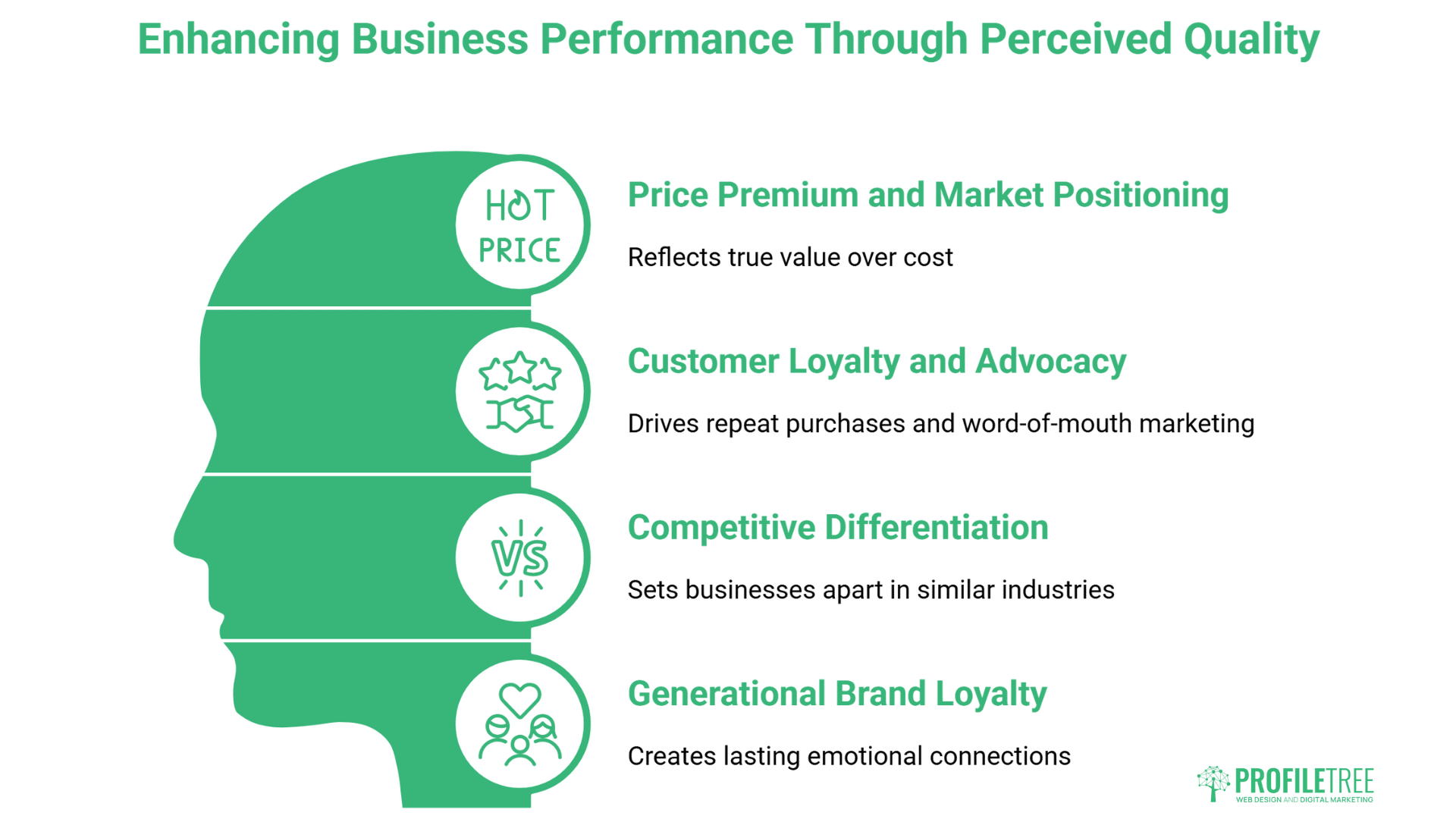
Understanding perceived quality matters because it directly influences business performance across multiple dimensions, creating tangible competitive advantages that translate to measurable financial outcomes.
Price Premium and Market Positioning
Customers willingly pay premium prices when they perceive products or services as high quality. Professional web design signals that businesses invest in quality across operations. Detailed case studies demonstrate expertise. Video testimonials provide authentic evidence of superior service delivery. These digital assets support pricing strategies that reflect true value rather than competing purely on cost.
Customer Loyalty and Advocacy
Perceived quality directly impacts satisfaction and loyalty. Customers who believe they receive high-quality products experience greater satisfaction, leading to repeat purchases and higher retention rates. For service-based businesses, perceived quality drives client retention more powerfully than contractual obligations.
High perceived quality generates word-of-mouth marketing that reduces promotional expenditure requirements. Satisfied customers recommend products to peers, creating organic growth channels. Apple exemplifies this dynamic—the brand’s high perceived quality reduces marketing costs relative to competitors, despite operating in identical market segments.
Competitive Differentiation
High perceived quality offers competitive advantages, particularly in industries where product offerings share similar features. Quality perception becomes the key differentiator. In digital marketing, agencies compete primarily on perceived expertise rather than service lists. Differentiation occurs through demonstrated thought leadership, comprehensive training programmes, and portfolios showcasing tangible client results.
Generational Brand Loyalty
Perceived quality creates multi-generational consumer relationships. When customers associate positive quality perceptions with brands, they often pass these preferences to subsequent generations. A parent who trusts a particular brand based on perceived quality often introduces that same brand to adult children—creating emotional connections that rational product comparisons rarely overcome.
Digital Marketing Framework for Perceived Quality
Creating and maintaining high perceived quality requires systematic approaches across all digital touchpoints. ProfileTree employs a comprehensive framework that addresses the interconnected elements shaping customer perceptions in digital environments.
Technical Foundation: Website Performance
Technical website performance creates immediate quality impressions before visitors consume any content. Page load speed, mobile responsiveness, security protocols, and intuitive navigation all signal professionalism.
Google’s Core Web Vitals now directly influence search rankings, aligning technical performance with visibility. Websites loading in under three seconds on mobile devices create positive first impressions, whilst those requiring five or more seconds generate frustration that undermines quality perception.
SEO as a Quality Signal
SEO extends beyond search rankings to serve as a quality indicator. Websites appearing prominently in search results benefit from implied endorsement—users trust that Google’s algorithms identify authoritative, high-quality sources. This borrowed credibility transfers to brand perception.
Local SEO for Northern Ireland businesses creates additional quality signals through Google Business Profile optimisation and location-specific content. When Belfast-based companies appear in map packs and local search results, they benefit from geographical relevance that enhances perceived local expertise.
Technical SEO elements—structured data, XML sitemaps, proper heading hierarchies, fast loading speeds—signal to both search engines and users that businesses maintain professional digital operations. These behind-the-scenes elements contribute to overall quality perception even when users never consciously notice them.
Content Marketing for Authority
Authoritative content builds perceived quality by demonstrating expertise, addressing customer questions comprehensively, and providing value beyond sales messaging. Well-researched blog posts, detailed guides, and industry analysis position businesses as thought leaders rather than mere product vendors.
Content marketing supports quality perception through multiple mechanisms:
- Educational guides demonstrate expertise whilst helping customers make informed decisions.
- Analysis of industry trends positions businesses as forward-thinking innovators and thought leaders. For ProfileTree, articles examining AI implementation for SMEs, digital training methodologies, and evolving SEO practices establish authority in the digital marketing space.
- Content addressing specific customer challenges demonstrates understanding, with case studies showing problem-solving, providing concrete evidence of quality delivery.
- Regular publishing schedules signal sustained expertise and commitment to audience value.
ProfileTree’s content marketing services help businesses develop strategic content calendars, create authoritative articles, and maintain publishing consistency that builds perceived expertise over time.
Video Production for Engagement and Trust
Video content creates emotional connections that text alone cannot achieve. Seeing real people, hearing authentic voices, and observing genuine interactions build trust more effectively than written descriptions. Video testimonials, product demonstrations, and behind-the-scenes content humanise businesses whilst showcasing capabilities.
High-quality video production signals investment in professional presentation—poor lighting and weak audio undermine quality perception, regardless of content value. Professional video production demonstrates that businesses take their market presence seriously, implying similar attention to detail in product development and service delivery.
For service-based businesses, video proves particularly valuable for explaining complex offerings, introducing team members, and documenting client success stories. ProfileTree’s video production services help businesses create professional content that enhances perceived quality whilst improving engagement across websites, social media, and YouTube channels.
Social Proof and Review Management
Customer reviews and testimonials provide authentic quality signals that marketing claims cannot replicate. Prospective customers trust peer experiences more than brand messaging, making review management critical to quality perception.
Businesses should actively encourage satisfied customers to share experiences across Google, industry-specific review platforms, and social media. Responding professionally to both positive and negative reviews demonstrates customer commitment and transparency. Review volume and recency matter as much as average ratings—businesses with dozens of recent reviews appear more actively engaged and trustworthy than those with a handful of outdated testimonials.
Design Consistency Across Channels
Visual consistency across websites, social media, email marketing, and all digital channels creates professional impressions that enhance quality perception. Inconsistent branding, varying colour schemes, and mismatched typography suggest disorganisation and lack of attention—qualities that transfer to product perception.
Professional brand guidelines govern logo usage, typography selection, colour palettes, image styles, and tone of voice. This consistency creates recognisable brand identities that customers associate with reliability and professionalism.
Web design serves as the foundation for digital brand presentation. Clean layouts, professional photography, carefully chosen colour schemes, and intuitive navigation create immediate quality impressions. ProfileTree’s design services create cohesive visual identities that communicate brand values whilst supporting optimal user experience.
AI-Driven Personalisation
AI-driven personalisation creates premium experiences that enhance perceived quality through relevant content recommendations, predictive search functionality, and adaptive user interfaces that respond to individual preferences.
For Northern Ireland SMEs, AI adoption represents a competitive differentiator that signals innovation. ProfileTree specialises in AI implementation for smaller businesses, making technologies previously available only to enterprises accessible to organisations of all sizes.
AI applications that enhance perceived quality include:
- Chatbots provide immediate response capabilities that create impressions of attentive customer service, even outside business hours. Well-designed chatbots handle routine enquiries whilst seamlessly escalating complex issues to human team members.
- E-commerce sites using AI to suggest relevant products based on browsing behaviour create shopping experiences that feel attentive and helpful rather than generic.
- Websites adapting content based on user behaviour provide relevant information proactively, reducing friction.
- Email campaigns responding to specific user actions create timely, relevant communications that feel personal rather than mass-distributed.
ProfileTree’s AI training programmes help businesses identify implementation opportunities, select appropriate tools, and integrate AI capabilities that enhance customer experience whilst improving operational efficiency.
Measurement Strategies
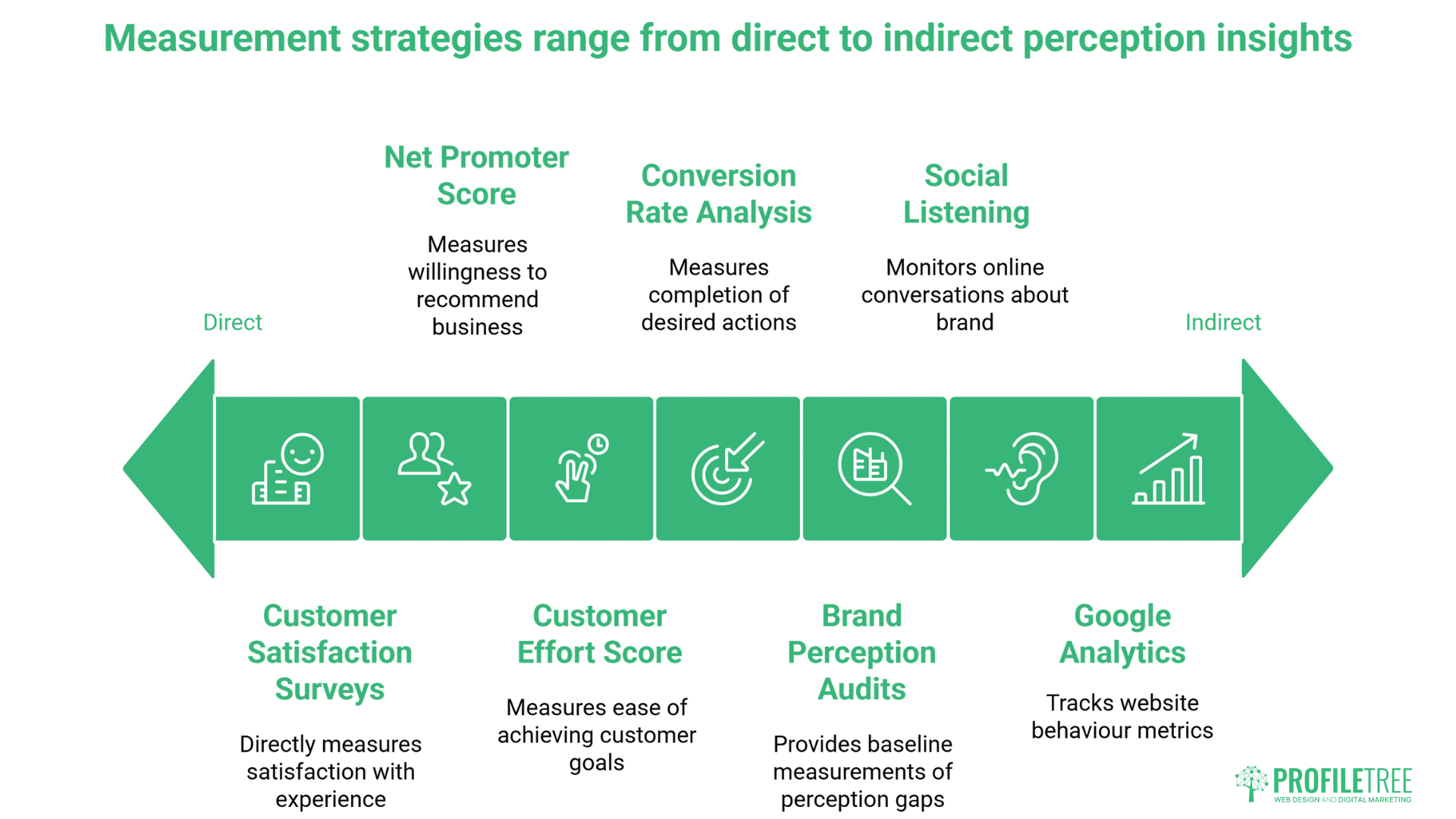
Improving perceived quality requires measurement frameworks that track perception changes over time, identify improvement opportunities, and quantify business impact.
Brand Perception Audits
Comprehensive brand perception audits provide baseline measurements and identify specific perception gaps requiring attention. These audits examine multiple dimensions:
- Digital presence assessment includes website performance analysis, SEO visibility evaluation, content quality review, social media engagement metrics, and online review analysis.
- Competitive benchmarking compares digital presence, content quality, review scores, and social engagement against key competitors, identifying relative strengths and weaknesses.
- Technical performance metrics, including website speed tests, mobile responsiveness checks, security assessments, and accessibility audits, measure technical factors that influence quality perception.
- Content quality evaluation assesses content depth, accuracy, comprehensiveness, and readability against industry standards.
ProfileTree conducts comprehensive digital audits for clients across Northern Ireland and the UK, providing detailed reports identifying specific actions to improve online presence and perceived quality.
Net Promoter Score (NPS) Implementation
Net Promoter Score measures customer willingness to recommend businesses to peers—a direct indicator of perceived quality. The simple question “How likely are you to recommend us to a friend or colleague?” with a 0-10 scoring provides actionable insights.
Customers rating 9-10 are “promoters” actively recommending the business. Those scoring 7-8 are “passive”—satisfied but unenthusiastic. Ratings 0-6 indicate “detractors” potentially sharing negative experiences. Regular NPS surveys after purchase or project completion provide ongoing quality feedback.
Customer Effort Score (CES) Tracking
The Customer Effort Score measures interaction ease—how much effort customers expend in achieving their goals when engaging with businesses. Lower effort correlates with higher satisfaction and better quality perception.
The question “How easy was it to handle your issue?” with a 1-7 scaling (very difficult to very easy) provides specific insights into friction points that require attention. High effort scores indicate process problems, unclear communication, or inadequate support—all of which undermine quality perception, regardless of the outcomes.
For digital businesses, CES particularly matters. Website navigation confusion, unclear product information, complicated checkout processes, and difficult customer service access all increase effort scores whilst damaging quality perception.
Social Listening and Sentiment Analysis
Social listening tools monitor online conversations about brands, products, competitors, and industries, providing qualitative insights into perception drivers and emerging issues requiring attention. Sentiment analysis classifies mentions as positive, negative, or neutral, tracking emotional responses over time. This reveals whether digital marketing initiatives, product launches, or service changes positively or negatively influence quality perception.
Tools like Brandwatch, Mention, and Hootsuite monitor social platforms, review sites, forums, and news sources for brand mentions, providing comprehensive views of online brand perception. For businesses across Belfast and Northern Ireland, social listening identifies local reputation factors that require specific attention.
Google Analytics Behaviour Metrics
Website behaviour metrics provide indirect quality perception measurements. Engaged visitors, who explore multiple pages, spend substantial time on site, and return frequently, signal positive perceptions. High bounce rates, short session durations, and low return visitor rates suggest quality perception problems.
Key metrics indicating quality perception issues:
- High Bounce Rates: Visitors leaving after viewing a single page suggest content, design, or performance problems.
- Short Session Durations: Brief site visits indicate visitors quickly conclude the website won’t meet their needs.
- Low Pages Per Session: Minimal page views suggest visitors aren’t compelled to explore deeper.
- Poor Conversion Rates: Low enquiry, download, or purchase rates despite adequate traffic volumes.
Google Analytics tracking these metrics over time reveals whether digital marketing improvements positively influence quality perception and visitor engagement.
Conversion Rate Analysis
Conversion rates measure the percentage of visitors completing desired actions—purchases, enquiries, downloads, subscriptions. Higher conversion rates indicate stronger persuasion and quality perception, as visitors trust businesses sufficiently to take action.
Conversion rate optimisation (CRO) specifically targets perception improvements through landing page testing, call-to-action refinement, trust signal enhancement, and friction reduction. These tactical improvements cumulatively enhance overall quality perception whilst delivering measurable business results.
For service businesses like ProfileTree, conversion metrics include enquiry form submissions, phone calls, email contacts, and resource downloads. Tracking these conversions reveals whether digital marketing effectively communicates quality and capability to prospective clients.
Customer Satisfaction Surveys
Traditional customer satisfaction (CSAT) surveys asking “How satisfied were you with your experience?” provide direct quality perception feedback. Regular surveys after purchases, project milestones, or support interactions create ongoing quality monitoring.
Survey responses identify specific satisfaction drivers and detractors, informing improvement priorities. Open-ended questions capture qualitative feedback that explains satisfaction scores, revealing perception factors that quantitative metrics might overlook.
For maximum effectiveness, CSAT surveys should be brief, timely (immediately following interactions), and clearly linked to specific experiences rather than asking about overall brand impressions. This specificity provides actionable insights directing improvement efforts.
Strategies to Improve Perceived Quality
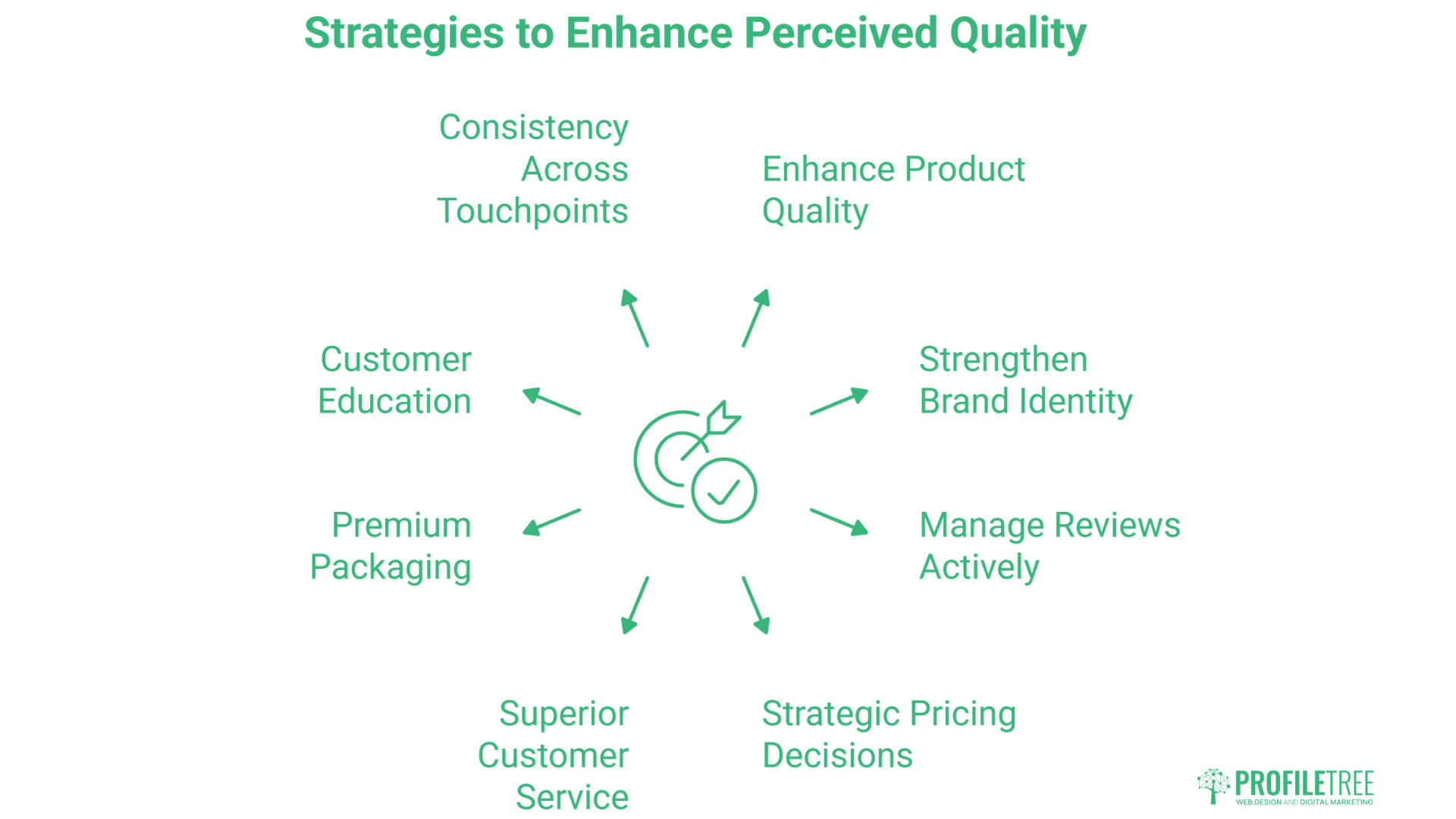
Improving perceived quality requires coordinated actions across multiple business dimensions, from product development through customer service, marketing, and ongoing relationship management.
Enhance Actual Product Quality
Improving actual product quality remains the foundation of quality perception. No marketing strategy sustainably overcomes genuinely inferior products. For digital products and services, quality improvement focuses on reliability, performance, user experience, and feature completeness. Regular updates addressing user feedback, fixing bugs promptly, and adding requested capabilities demonstrate quality commitment that customers notice and appreciate.
Strengthen Brand Identity and Positioning
Strong brands associate with high quality through consistent messaging, professional presentation, and reliable delivery. Brand strengthening requires clear positioning statements, visual identity systems, tone of voice guidelines, and disciplined execution across all touchpoints.
For smaller businesses competing against larger brands, focused positioning around specific niches, local expertise, or specialised services creates quality associations within defined markets. Belfast businesses can position around local knowledge, Northern Ireland expertise, or regional service commitment—differentiators that larger national competitors cannot replicate.
Brand strengthening initiatives include:
- Visual Identity Refinement: Professional logo design, cohesive colour schemes, consistent typography, and photographic styles.
- Messaging Clarity: Clear value propositions, consistent brand voice, and focused positioning statements.
- Thought Leadership: Regular content demonstrating expertise, industry analysis, and innovative thinking.
- Community Involvement: Supporting local causes, participating in industry organisations, and contributing to professional communities.
Active Review Management and Response
Reviews significantly influence quality perception for prospective customers researching purchase decisions. Review generation strategies include:
- Systematic requests through automated emails following purchases increase review volume.
- A multiple-platform presence across Google, Trustpilot, industry-specific review sites, and social media platforms contributes to an overall review presence.
- Acknowledging reviews within 24-48 hours shows businesses value feedback.
- Gracious thanks for positive reviews and constructive responses to negative feedback demonstrate maturity.
Strategic Pricing Decisions
Pricing directly influences quality perception. Excessively low pricing creates inferior quality suspicions, whilst excessively high pricing deters purchase unless supported by strong quality signals justifying premiums.
- Competitive analysis, understanding competitor pricing, creates context for positioning decisions.
- Price presentations should emphasise the value received rather than the costs incurred.
- Multiple service levels or product tiers allow customers to self-select appropriate quality-price combinations.
- Clear pricing without hidden fees builds trust and positive quality perception through demonstrated respect for customers.
Superior Customer Service Excellence
Customer service quality directly influences overall brand perception. Responsive, knowledgeable, helpful support teams create positive experiences that override occasional product issues, whilst poor support undermines even excellent products.
- Multiple contact channels (phone, email, chat, social media) accommodate different customer preferences and urgency levels.
- Prompt initial responses acknowledge enquiries, even when immediate resolution requires additional time or research.
- Well-trained support teams provide accurate information and effective solutions without multiple contacts or escalations.
- Post-resolution contact confirming satisfaction demonstrates ongoing care beyond immediate problem-solving.
Premium Packaging and Presentation
Product presentation—both physical packaging and digital presentation—creates immediate quality impressions before customers experience actual products. A professional, attractive presentation signals attention to detail and quality commitment.
- Substantial materials, high-quality printing, and thoughtful construction create a premium impression, justifying higher pricing.
- Carefully arranged contents, protective materials, and opening sequences create memorable experiences customers share through social media, generating word-of-mouth marketing.
- Clear instructions, quality documentation, and helpful guides demonstrate customer care whilst reducing support requirements.
- Environmentally responsible packaging appeals to conscious consumers whilst demonstrating broader value commitments beyond pure profitability.
Digital presentation equivalents include professional photography, video demonstrations, detailed descriptions, and professional web design.
Customer Education Initiatives
Customers sometimes fail to perceive quality simply because they don’t understand product features or proper usage.
- How-To guides demonstrate optimal product usage or service implementation.
- Video tutorials educate whilst showcasing quality through actual product performance.
- Webinars and workshops demonstrate expertise whilst building customer relationships.
- Resource libraries provide self-service support whilst demonstrating commitment to customer success.
ProfileTree’s digital training programmes exemplify this approach—comprehensive workshops teaching SEO fundamentals, AI adoption strategies, and digital marketing best practices. These educational initiatives position ProfileTree as expert partners rather than mere service vendors, enhancing perceived quality through demonstrated expertise and commitment to client success.
Consistency Across All Touchpoints
Consistent quality across every customer interaction—website, social media, email, phone, in-person—creates reliable experiences that build trust and positive quality perception. Inconsistency undermines confidence, suggesting businesses lack control or commitment.
- Brand Presentation: Visual identity, messaging, tone of voice, and positioning should remain consistent across all channels and materials.
- Service Quality: Customer experiences should meet consistent standards regardless of contact channel, time, or specific staff member handling interactions.
- Product Performance: Products should deliver consistent results across batches, shipments, or time periods.
- Communication Timing: Regular update schedules, predictable response timeframes, and reliable content publishing create expectations that, when consistently met, build trust.
For digital agencies, consistency manifests through reliable project delivery, predictable communication, and sustained quality across different services and client engagements. ProfileTree’s project management processes create consistent client experiences whether delivering web design, video production, SEO campaigns, or AI implementation projects.
Advanced Topics in Quality Perception
Beyond fundamental strategies, several advanced considerations influence quality perception in specific contexts or for particular business types.
Repairing Damaged Perceived Quality
Brands experiencing damage to their quality perception due to product failures, service breakdowns, or public relations issues require specific recovery strategies. Reputation repair strategies include:
- Transparent communication, openly acknowledging problems, explaining causes, and detailing corrective actions, demonstrates responsibility and commitment to improvement.
- Concrete action through visible changes—product recalls, process improvements, personnel changes—provides evidence of serious problem-solving.
- Customer compensation demonstrates accountability.
- Reputation rebuilding requires sustained positive performance over extended periods, as trust rebuilds gradually through accumulated positive experiences.
- Independent certifications, audits, or endorsements provide credible evidence of quality improvements.
Digital channels accelerate both reputation damage and recovery. Social media amplifies negative experiences whilst providing platforms for transparent communication and service recovery demonstrations. Content marketing showcasing improvements, customer success stories, and renewed commitments helps rebuild quality perception through consistent positive messaging.
Cultural and Regional Quality Perceptions
Quality perception varies across cultures and regions, requiring localised approaches for businesses operating across diverse markets. For ProfileTree’s Belfast base serving Northern Ireland, Ireland, and the broader UK, regional considerations include:
- References to regional examples, case studies from familiar businesses, and content addressing local market conditions create relevance.
- Demonstrating understanding of UK-specific regulations, GDPR compliance, and regional business practices signals competence.
- Supporting local causes, participating in regional business networks, and contributing to local economies builds reputational quality.
- UK business communication expectations differ from US approaches—more reserved, less hyperbolic marketing resonates better with British audiences.
Understanding these regional nuances prevents quality perception failures from culturally inappropriate positioning or communication approaches.
B2B Versus B2C Quality Perception Drivers
Business-to-business (B2B) and business-to-consumer (B2C) quality perception drivers differ significantly, requiring adapted strategies for each market type.
B2B quality perception emphasises:
- Thought leadership content, technical specifications, detailed case studies, and industry credentials.
- Account management, responsive service, and consultative approaches create quality perceptions through demonstrated partnership commitment.
- Reliability evidence, financial stability indicators, client references, and proven track records reassure risk-averse business buyers.
- Detailed analyses of business outcomes, efficiency improvements, and financial returns address B2B decision criteria focused on quantifiable business impact.
B2C quality perception emphasises:
- Brand personality, storytelling, and values alignment create emotional bonds, driving consumer preferences beyond rational product comparisons.
- Customer reviews, social media engagement, and peer recommendations heavily influence consumer purchasing in ways less impactful for B2B decisions.
- Easy purchasing processes, flexible payment options, and hassle-free returns matter more to consumers than business buyers focused on long-term value.
- Aesthetics, packaging, and immediate sensory impressions disproportionately influence consumer quality perception compared to business purchasing.
ProfileTree’s digital marketing services address both contexts—helping B2B clients develop thought leadership content and expertise demonstration whilst supporting B2C businesses with engaging social media, video content, and conversion-optimised e-commerce design.
Technical SEO in Quality Perception
Technical SEO creates quality signals that extend beyond search rankings to influence human perception both directly and indirectly.
Directly, technical factors like page speed, mobile responsiveness, and security certificates create user experiences that feel professional and trustworthy. Slow-loading sites frustrate visitors, suggesting businesses don’t care about user experience. Security warnings deter engagement, signalling potential risks.
Indirectly, technical SEO influences quality perception through search visibility. Higher rankings create implied endorsements—users trust Google’s judgment that prominently displayed sites represent quality, authoritative sources. This “borrowed credibility” transfers to brand perception.
Structured data providing rich search results—star ratings, event information, FAQ snippets—enhances search presence whilst creating quality impressions through professional, information-rich presentations that stand out from basic text listings.
Core Web Vitals—loading performance (LCP), interactivity (FID), and visual stability (CLS)—now directly influence rankings whilst creating user experiences that shape quality perception. Fast, responsive, stable pages signal professional operations and user respect.
ProfileTree’s web development and SEO services prioritise these technical foundations, recognising that backend performance and frontend experience combine to create quality perceptions driving both search visibility and user conversion.
Perceived Quality and Brand Equity

Perceived quality represents one of five primary brand equity dimensions alongside brand loyalty, brand awareness, brand associations, and proprietary assets. These elements combine to create overall brand value—the intangible asset generating customer preference and financial premiums.
Perceived Quality’s Role in Brand Equity
Strong perceived quality enhances brand equity through multiple mechanisms:
- High-quality perception provides rational justification for preferring specific brands, even at premium prices.
- Strong quality perception in core categories transfers to new product categories, allowing successful brand extensions.
- Quality perception creates meaningful differences between functionally similar offerings.
- Perceived quality drives satisfaction and repeat purchase, increasing customer lifetime value through extended relationships.
- Customers proud of quality-associated brands naturally share preferences with peers, generating cost-effective marketing through authentic advocacy.
Building Brand Equity Through Digital Marketing
Digital marketing provides primary channels for building brand equity components, including perceived quality:
- Content Marketing: Authoritative articles, comprehensive guides, and thought leadership content demonstrate expertise whilst providing value.
- Social Media Engagement: Active community participation, responsive customer service, and valuable content sharing create a quality perception through demonstrated customer commitment.
- Search Visibility: Prominent search rankings create awareness whilst conferring implied quality endorsements through search engine validation.
- Video Content: Professional video production showcases products, services, and team members, creating quality impressions through polished presentation and authentic communication.
- Website Experience: Professional design, intuitive navigation, and reliable performance create foundational quality impressions that all subsequent brand interactions build upon.
ProfileTree’s integrated digital marketing services address multiple brand equity dimensions simultaneously—building awareness through SEO, creating quality associations through content marketing, fostering loyalty through effective website experiences, and supporting brand extensions through strategic positioning.
Measuring ROI on Perceived Quality Initiatives

Quality perception improvements require investments—in better products, professional services, enhanced customer service, and strategic marketing. Measuring returns on these investments validates strategies and guides resource allocation.
Direct Revenue Impact
Quality perception improvements should ultimately drive revenue through multiple channels:
- Price Premium Realisation: Ability to maintain or increase prices without volume loss demonstrates quality perception supporting premium positioning.
- Market Share Growth: Increasing sales relative to competitors indicates quality perception, attracting customers from alternative providers.
- Customer Acquisition Cost Reduction: Word-of-mouth referrals and improved conversion rates reduce the marketing expenditure required to acquire new customers.
- Customer Lifetime Value Increase: Improved retention rates and higher purchase frequencies from individual customers demonstrate quality perception driving loyalty.
Indirect Business Benefits
Beyond direct revenue impacts, quality perception improvements generate broader business benefits:
- Talent Attraction: Strong brand reputations attract higher-quality employment candidates whilst reducing recruitment costs and staff turnover.
- Partnership Opportunities: Recognised quality brands receive collaboration approaches from other reputable organisations seeking association benefits.
- Media Coverage: Journalists and industry analysts more readily cover businesses with strong quality reputations, generating valuable earned media.
- Investment Appeal: For businesses seeking funding, strong brand equity, including quality perception, enhances valuation and investment attractiveness.
Attribution Challenges and Solutions
Isolating quality perception’s specific contribution to business outcomes proves challenging, given multiple simultaneous influences on customer behaviour. Addressing this attribution difficulty requires:
- Control Group Analysis: Comparing markets or customer segments receiving quality initiatives against those that don’t isolates initiative impact.
- Time-Series Analysis: Tracking metrics before and after quality initiatives identifies changes potentially attributable to interventions.
- Survey Correlation: Linking individual customer quality perceptions to their specific purchase behaviours reveals perception-action relationships.
- Multi-Touch Attribution: Marketing analytics platforms tracking customer touchpoints identify quality-building activities’ roles in conversion paths.
For ProfileTree’s clients, we implement comprehensive analytics tracking to website performance, search rankings, social engagement, and conversion metrics, providing evidence of digital marketing impact on business outcomes.
Perceived Quality in Different Industries
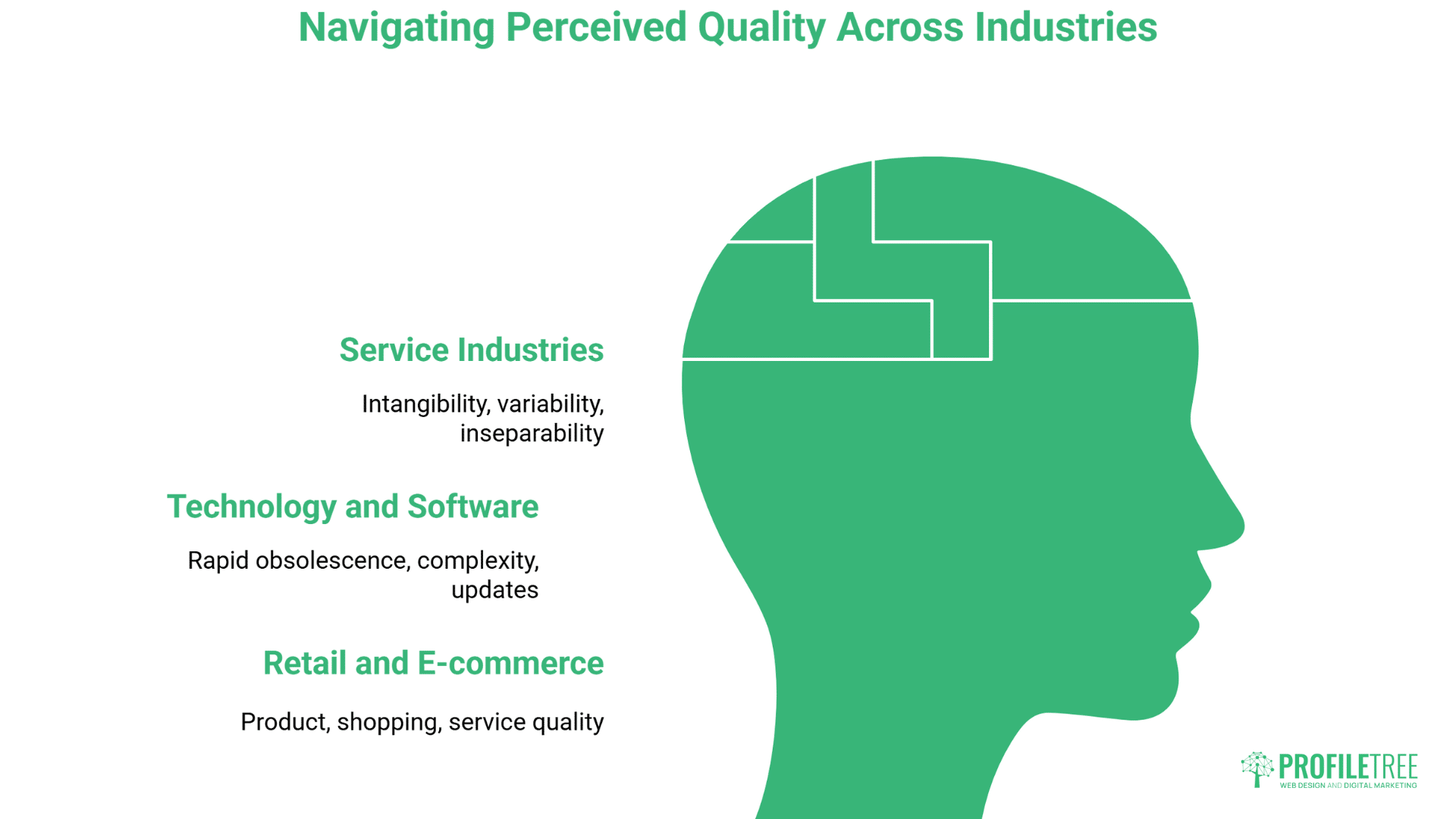
Quality perception drivers and management approaches vary significantly across industries, requiring sector-specific strategies that acknowledge unique market dynamics.
Service Industries
Professional services—legal, accounting, consulting, healthcare—face particular quality perception challenges due to the intangibility, variability, and inseparability of services from providers. Service quality perception drivers include professional credentials, facility quality, communication clarity, process transparency, and personal connection.
Digital marketing for service industries requires a particular focus on demonstrating expertise, building relationships, and creating trust through content marketing, professional website presentation, and authentic video content.
Technology and Software
Technology products face unique quality perception challenges from rapid obsolescence, complexity, and frequent updates. Quality perception requires balancing cutting-edge innovation signals with reliability assurances. Technology quality perception drivers include innovation leadership, reliability assurance, user experience, support quality, and update frequency.
ProfileTree’s AI implementation services for Northern Ireland SMEs address these technology quality perceptions by emphasising practical, proven solutions rather than bleeding-edge experimentation—balancing innovation with reliability appropriate for risk-averse business buyers.
Retail and E-commerce
Retail quality perception combines product quality, shopping experience quality, and service quality, all of which contribute to overall brand impressions that require coordination across multiple touchpoints. Retail quality perception drivers include product range, website usability, product presentation, delivery reliability, and ease of returns.
ProfileTree’s e-commerce web design services address these quality drivers through user-focused design, professional product presentation, and conversion optimisation that balances business goals with customer experience quality.
Future Trends in Perceived Quality
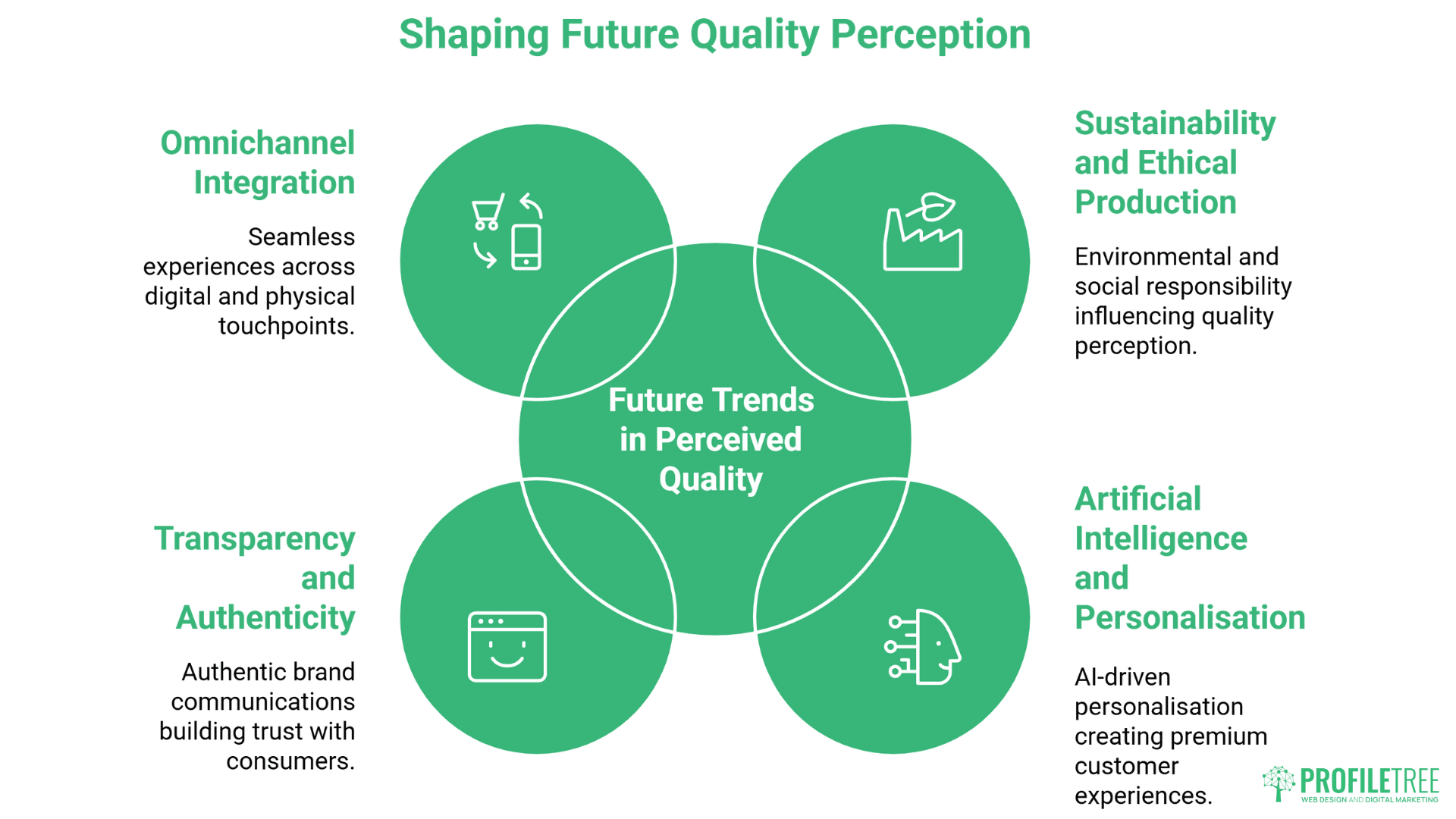
Quality perception continues evolving as technology, consumer expectations, and market dynamics shift. Forward-thinking businesses anticipate these trends, positioning themselves ahead of competitors whilst still addressing current requirements.
Sustainability and Ethical Production
Environmental and social responsibility increasingly influence quality perception, particularly for younger consumers. Supply chain transparency, environmental impact metrics, and circular economy initiatives become quality differentiators.
Businesses building sustainability credentials now position themselves advantageously as these factors increasingly influence purchase decisions across demographics.
Artificial Intelligence and Personalisation
AI-driven personalisation creates premium experiences previously available only through high-touch personal service. Intelligent recommendations, predictive service, and adaptive experiences create personalised interactions at scale.
ProfileTree’s AI training and implementation services prepare Northern Ireland businesses for this personalisation future, developing capabilities that enhance quality perception through intelligent customer experiences.
Transparency and Authenticity
Consumers increasingly value authentic brand communications over polished marketing messaging, influencing how businesses should communicate quality. Behind-the-scenes content, honest limitations, and real customer stories prove more persuasive than brand-created promotional content.
This transparency trend requires businesses to align their actual quality with the quality they communicate, as audiences quickly detect and penalise inauthenticity.
Omnichannel Integration
Quality perception increasingly depends on seamless experiences across digital and physical touchpoints rather than isolated channel excellence. Cross-channel consistency, integrated customer data, flexible fulfilment, and unified communication all contribute to quality perception.
Web design, content strategy, and technical integration all contribute to omnichannel quality perception—areas where ProfileTree’s comprehensive digital marketing services provide coordinated approaches rather than siloed channel tactics.
Conclusion
For Belfast businesses, Northern Ireland companies, and UK organisations seeking to enhance market position, perceived quality offers a powerful competitive lever. ProfileTree’s comprehensive digital marketing services—web design, SEO, content marketing, video production, AI implementation, and digital training—address the multiple dimensions shaping quality perception in modern markets.
Strategic focus on perceived quality through professional digital presence, authoritative content, responsive service, and consistent execution creates market differentiation that protects margins, builds loyalty, and drives sustainable growth. The investment in quality perception generates returns through multiple channels over extended timeframes, making it among the most valuable strategic initiatives businesses can undertake.
Contact ProfileTree at the McSweeney Centre in Belfast to discuss how our digital marketing services can enhance your brand’s perceived quality and market position across Northern Ireland, Ireland, and the UK.
FAQs
How long does it typically take to improve perceived quality?
Minor improvements like a professional website redesign or active review management can shift perceptions within 3-6 months. Comprehensive transformations addressing multiple quality dimensions typically require 12-18 months for measurable perception changes. Consistency matters more than speed—sustained quality signals over time prove more effective than intensive short-term campaigns.
Can small businesses compete on perceived quality against established brands?
Absolutely. Small businesses successfully compete through focused positioning, local expertise, and personalised service that larger competitors cannot replicate at scale. Digital marketing, in particular, favours smaller operations—professional websites and authoritative content cost similar amounts, regardless of business size. Belfast businesses competing against national brands leverage local knowledge and community involvement as quality differentiators.
What budget allocation should businesses dedicate to quality perception initiatives?
Successful businesses typically allocate 15-25% of total marketing budgets to perception-building activities, including web development, content marketing, video production, and review management. Businesses entering new markets or recovering from reputation damage may temporarily increase allocation to 30-40%. Professional WordPress websites, social media engagement, and content marketing provide cost-effective alternatives to traditional advertising.
How do generational differences affect quality perception strategies?
Baby Boomers value established reputation and formal credentials. Generation X prioritises practical functionality and transparent pricing. Millennials seek authentic brand values and peer recommendations. Generation Z demands sustainability credentials and mobile-optimised experiences. Successful businesses develop multi-layered quality strategies addressing diverse generational preferences simultaneously.
What role do micro-moments play in shaping perceived quality?
Micro-moments—brief mobile interactions when customers research or purchase—disproportionately influence quality perception despite lasting only seconds. Page load delays exceeding three seconds create negative impressions that subsequent content rarely overcomes. Businesses must optimise for these critical brief interactions through technical performance, intuitive mobile design, and immediate information access.
How can ProfileTree help improve my business’s perceived quality?
ProfileTree enhances perceived quality through comprehensive digital marketing services, including professional web design that creates a strong first impression, SEO that improves visibility and implied credibility, authoritative content marketing that demonstrates expertise, video production that builds trust, AI implementation that enables personalisation, and digital training that develops internal capabilities. Our Belfast-based team serves businesses across Northern Ireland, Ireland, and the UK with integrated strategies addressing multiple quality perception dimensions simultaneously.
Hey, this is Mansura from Zambia. your website really helped me during my thesis project. The information is well-structured and elaborate, despite a few omissions it is perfect.
Thank you