
Small Business Website Development: UK & Irish SME Decision Guide
Table of Contents
A website without a search strategy is an expensive digital brochure. Most small business owners discover this about 18 months after launch, when the site looks exactly as it did on day one and the phone has not rung once. Small business website development decisions made early, particularly around platform, structure, and SEO foundations, determine whether a site becomes a lead-generation asset or a recurring cost with no return.
This guide is written for business owners in Northern Ireland, Ireland, and the UK who are deciding whether to build it themselves, use a low-cost builder, or work with a professional agency. The platform decision matters less than most people think; the SEO architecture decision matters far more, and getting that wrong is costly to fix after launch.
Professional agency development and DIY are not the only options: a hybrid approach, where an agency builds the technical foundation and trains you to manage content, often gives small businesses the best long-term value. And grants are available in both Northern Ireland and the Republic of Ireland that cover a significant portion of professional development costs, yet most small businesses never apply for them.
DIY Builders vs Professional Agency: Which Is Right for Your Business?
The most common mistake in small business website development is treating the build decision as a binary: either you do it yourself, or you hire someone. Most businesses fall into one of three situations, and the right approach differs for each.
The Hidden Costs of Website Builders
Wix, Squarespace, and similar platforms appear cost-effective at £12 to £40 per month. That figure is accurate as far as it goes. What it does not include is the opportunity cost of the constraints you accept in exchange.
Website builders use proprietary hosting and code structures that search engines parse less efficiently than self-hosted WordPress. Migrating from a builder to a custom CMS later, once you outgrow the platform, typically costs more than building on WordPress from the start. Your site content is also not truly portable: if you move platforms, you rebuild rather than migrate.
For a business that only needs a simple online brochure with minimal search ambition, a builder is a reasonable short-term choice. For any business that expects organic search to drive enquiries, the limitations compound quickly.
When Professional Website Development Pays for Itself
Custom website development makes financial sense when organic search is part of your growth plan, when you need specific functionality that a builder cannot provide, or when credibility matters to the sales process and your current site undermines it.
The businesses that see the fastest returns from professional web development tend to be service businesses in competitive local markets, trades and professional services competing on trust, and e-commerce businesses where conversion rate is a direct revenue variable. In each case, the measurable outcome of a well-built site, better rankings, better conversion, and shorter sales cycles, offsets the upfront investment within twelve to eighteen months in most cases.
The Hybrid Approach: Professional Build, Owner-Managed Content
There is a third option that few discussions of small-business website development cover: a professional agency builds the technical and SEO architecture and then trains the business owner or an internal team member to manage content independently after launch.
ProfileTree’s digital training programme is built around exactly this model. The agency handles the decisions that need specialist knowledge: site structure, technical SEO, hosting configuration, and performance optimisation. The client handles what only they can do well: writing about their own business, publishing updates, and responding to enquiries the site generates.
This approach reduces the long-term cost of professional involvement without sacrificing the foundation that makes the site findable.
The 7-Step Roadmap to Small Business Website Development
The order of these steps matters. Skipping the early strategic stages and jumping straight to design is the single most common reason small business website development projects fail to perform.
Step 1: Strategy, Site Mapping, and SEO Research
Before any domain is registered or a platform chosen, define what the website needs to do commercially. Which services generate the most revenue? Which customer types do you most want to attract? What geographic market are you targeting?
These answers determine the site architecture. A Belfast-based accountancy firm targeting SME clients needs a different page structure to a Galway restaurant targeting tourist bookings. Local SEO research at this stage shapes the URL structure, the heading hierarchy, and the content calendar for the first six months post-launch.
“Most small businesses come to us having already built a site that cannot rank, because no one asked what they needed to rank for before the build started,” says Ciaran Connolly, founder of ProfileTree. “The SEO strategy and the development plan have to be the same document.”
Step 2: Domain Selection
For UK businesses, a .co.uk domain signals local relevance and tends to outperform .com for UK-based searches where geographic intent is clear. For Republic of Ireland businesses, .ie carries the same local authority. If you operate genuinely across both markets, a .com with strong localised content can work, but it requires more deliberate effort to establish geographic signals.
Register your domain independently of your hosting provider and your developer. Owning the domain registration directly means you retain full control regardless of who manages the site.
Step 3: Platform Selection
For most small businesses in Northern Ireland, Ireland, and the UK, the choice comes down to WordPress versus a proprietary builder. According to W3Techs data, WordPress powers approximately 43.5% of all websites globally and offers the widest range of SEO control, hosting flexibility, and long-term scalability.
The web development approach that ProfileTree uses for SME clients is built around self-hosted WordPress, because it gives clients full ownership of their data, full portability if they ever change agency, and access to the full range of SEO configuration options that Google’s Search Central documentation recommends.
Shopify is the right choice for businesses where e-commerce is the primary function. For service businesses, professional practices, and content-driven businesses, WordPress is the more versatile and search-friendly option in almost every case.
Step 4: UX and Design with a Local Audience in Mind
Mobile traffic accounts for the majority of web visits across most SME sectors in the UK and Ireland. Any site that is not fully responsive, fast-loading on mobile, and easy to move through on a phone is losing enquiries before a visitor has read a single word.
Design decisions should be driven by how your specific audience behaves. A trades business in Belfast gets most mobile visits from people who searched urgently and need a phone number within three seconds. A professional services firm in Dublin receives desktop visits from decision-makers who are carefully comparing options. The design brief is different in each case.
Step 5: Content Creation and Core Pages
Every small business website needs five pages that do genuine commercial work: a home page that states clearly what you do and who for, a services or products page with enough detail to answer pre-purchase questions, an about page that establishes the people and credibility behind the business, a contact page with multiple contact methods, and at least one page that targets a specific local search query.
Content that answers the questions your customers actually ask, written in plain language and structured so Google can extract clear answers, outperforms content written to sound impressive every time. If you are not sure what questions your customers ask, your SEO guide and Google’s People Also Ask panels for your main service keywords are the fastest place to start.
Step 6: Technical SEO and Mobile Optimisation
Technical SEO is not optional. It is the difference between a site that Google can find, read, and rank, and a site that exists but does not appear in search results.
The core technical requirements for any small business website are: an SSL certificate (HTTPS), a mobile-responsive layout, page load times under 3 seconds, properly structured heading tags (H1, H2, H3 in logical order), a submitted XML sitemap, and a properly configured robots.txt file. These are not advanced features; they are the baseline.
Beyond the baseline, schema markup for local businesses, FAQ markup for question-based content, and structured data for services and reviews all improve how search engines display your site and increase click-through rates from the results page.
Step 7: The Pre-Launch Compliance Check
This step is where most DIY and low-cost builds fall short, and where the consequences can be serious. UK and Republic of Ireland law imposes specific obligations on business websites, and many small business owners are not aware of them.
- UK-GDPR and ICO registration: If your website collects any personal data, including names, email addresses, or IP addresses captured by analytics tools, you are likely required to register with the Information Commissioner’s Office (ICO) and publish a compliant privacy policy. As of February 2025, the annual registration fee is £52 for micro-businesses (turnover under £632,000 or fewer than ten staff), confirmed by the ICO’s updated fee structure. Operating without registration when required is a legal risk.
- Cookie consent: UK law requires that visitors explicitly consent to non-essential cookies before they are set. A cookie banner that loads after the cookies have already fired does not satisfy this requirement. Many standard website builder setups fail this test.
- Company disclosure: UK company law requires that limited companies display their registered company name, company number, and registered office address on their website. This is commonly omitted on small business sites.
- Republic of Ireland compliance: Irish businesses operating under the Companies Act 2014 have equivalent disclosure requirements, and GDPR enforcement in Ireland is handled by the Data Protection Commission.
Regional Funding and Grants for Small Business Website Development
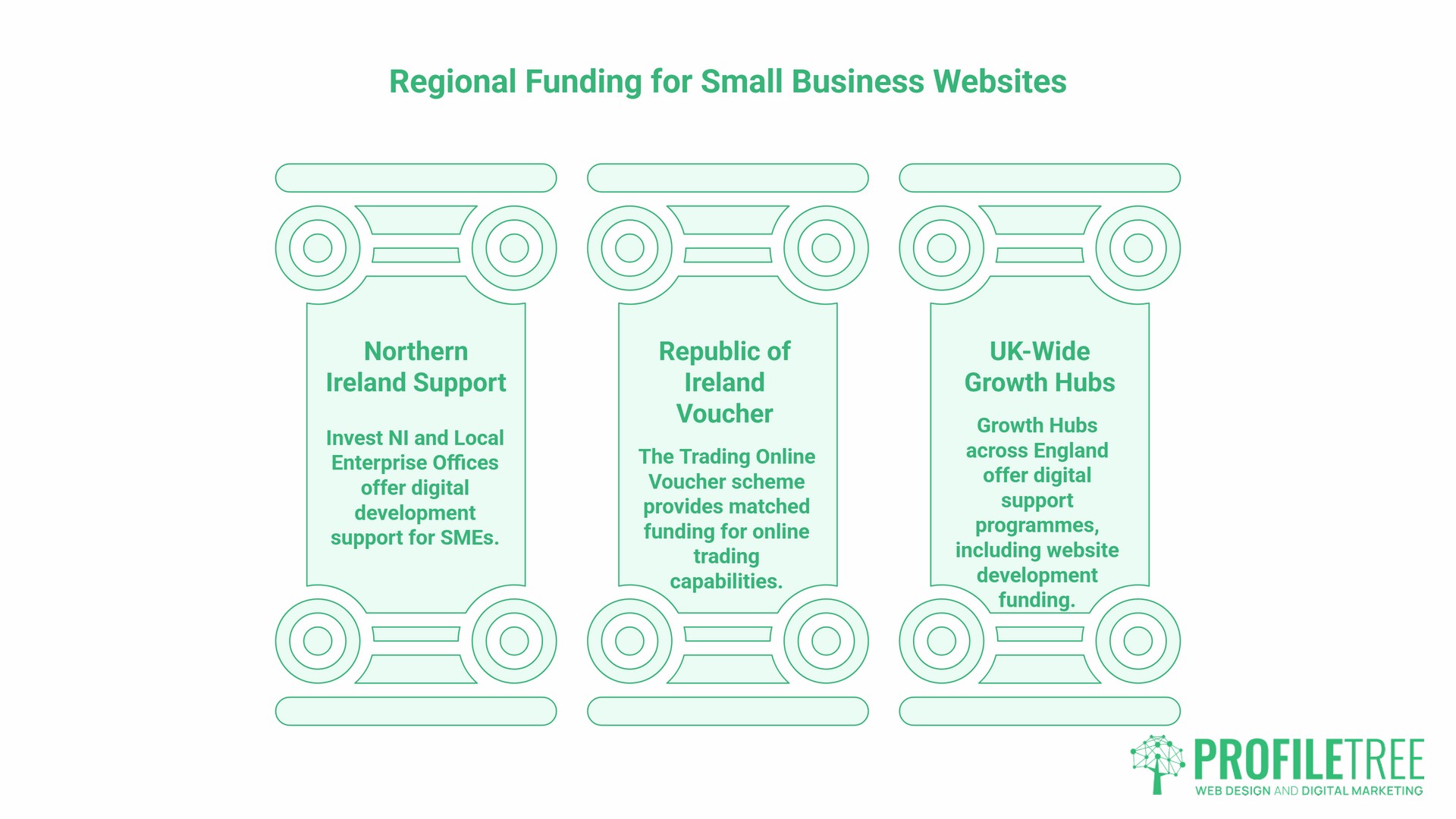
This is the section that most guides on small-business website development, written for a global audience, miss entirely, and it represents genuine money available to offset professional development costs.
Northern Ireland: Invest NI and Local Enterprise Support
Invest NI and the network of Local Enterprise Offices in Northern Ireland periodically offer digital development support for SMEs. The availability and structure of these programmes change, so the most reliable approach is to contact your nearest Local Enterprise Office directly or check Invest NI’s current SME support programmes at investni.com. Support has historically been available for website development, digital marketing infrastructure, and e-commerce capability building.
Republic of Ireland: The Trading Online Voucher Scheme
The Trading Online Voucher (TOV) scheme, administered through Local Enterprise Offices across the Republic of Ireland, provides matched funding of up to 50% of eligible costs, to a maximum of €2,500, for qualifying small businesses investing in online trading capability. Website development, e-commerce integration, and digital marketing setup are all eligible costs.
To qualify, your business must have fewer than ten employees, have been trading for at least six months, and have a turnover under €2 million. Applications go through your nearest Local Enterprise Office, and you must attend a short information seminar before applying. Because availability depends on the annual budget allocated to each LEO, contact your local office to confirm the current intake before committing to any expenditure. Critically, you must receive written approval before incurring costs: the voucher cannot be used to reimburse work already paid for.
If you are a Republic of Ireland business considering professional website development, applying for the TOV before engaging an agency can significantly reduce the net cost.
UK-Wide: Digital Support Through Growth Hubs
The Growth Hub network across England offers a range of digital support programmes for SMEs, some of which include funding toward website development and digital marketing. Eligibility and availability vary by region. The GOV.UK Business Finance and Support Finder is the most reliable place to check current availability for your location.
What Does Small Business Website Development Actually Cost?
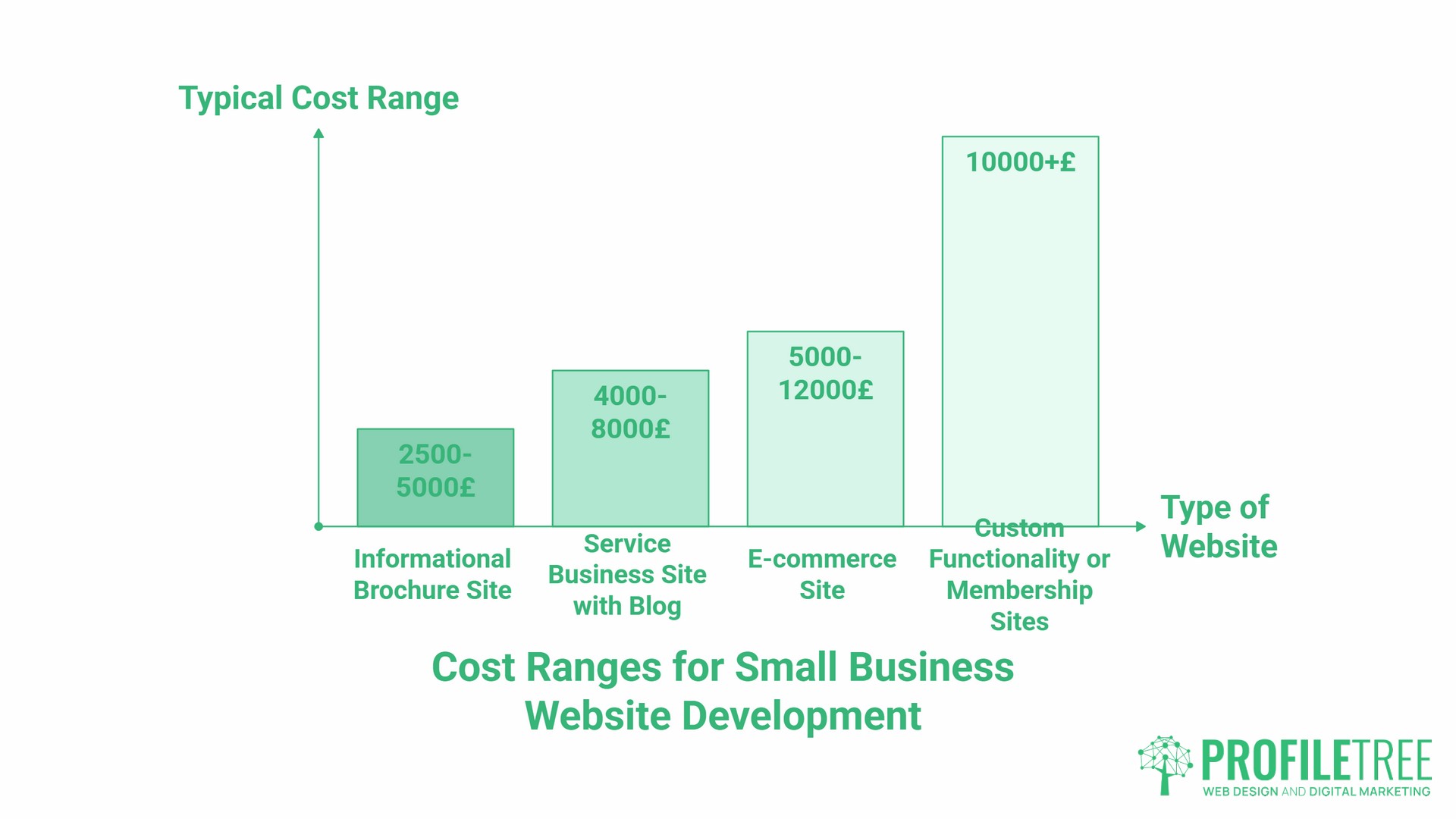
Getting the cost of small business website development right means separating the one-off build cost from the ongoing running costs. The ranges below reflect realistic costs for professionally developed websites in the UK and Ireland. They are provided as orientation, not quotation. Actual costs depend on the complexity of the brief, the number of pages, any e-commerce or booking functionality, and ongoing support requirements.
| Type of site | Typical cost range | What it includes |
|---|---|---|
| Informational brochure site (5 to 8 pages) | £2,500 to £5,000 | Design, WordPress build, basic SEO setup, mobile optimisation |
| Service business site with blog (10 to 20 pages) | £4,000 to £8,000 | As above, plus content strategy, blog architecture, and local SEO |
| E-commerce site (up to 50 products) | £5,000 to £12,000 | As above plus content strategy, blog architecture, and local SEO |
| Custom functionality or membership sites | £10,000 and above | WooCommerce or Shopify build, payment integration, and product pages |
Ongoing costs to budget for separately: Domain renewal (£10 to £20 per year), hosting (£10 to £50 per month for managed WordPress hosting), SSL certificate (often included in managed hosting), and security and maintenance (£50 to £150 per month if managed by an agency, or your own time if self-managed).
The cheapest professional website option is not necessarily the one with the lowest upfront cost. A site built cheaply on an unsupported framework, without proper SEO foundations, that requires rebuilding within two years, costs more in total than a well-built site from the start.
Small Business Website Development by Industry Type
The priorities for small business website development vary by sector. What drives enquiries for a solicitor’s practice is structurally different from what drives sales for an independent retailer.
Local Service Businesses (Trades, Repairs, Personal Services)
Speed and clarity matter most. A visitor searching “plumber Belfast emergency” on a mobile phone needs a phone number and a sense of trust within the first three seconds. Service area pages, prominence of emergency contact information, and Google Business Profile integration are the priorities. Reviews displayed on the site, pulled from Google or collected directly, provide the social proof that converts hesitant visitors.
Professional Services (Accountants, Solicitors, Consultants)
Credibility architecture is the priority. Testimonials, team credentials, professional accreditations, and clearly explained processes all reduce the perceived risk of engaging a new firm. Content that answers the pre-purchase questions your specific clients ask (What does an audit cost? How long does a commercial lease review take?) positions your site as genuinely helpful rather than simply promotional.
Retail and E-commerce
Product imagery quality, mobile checkout experience, and delivery information clarity are the variables most directly connected to conversion rate. For Northern Ireland and Republic of Ireland retailers serving both markets, currency handling, VAT display, and courier options need to be addressed explicitly in the site build, not as afterthoughts.
Hospitality and Tourism
Booking engine integration, photography that sells the experience rather than documents it, and local search visibility for key terms (“boutique hotel Causeway Coast”, “seafood restaurant Kinsale”) are the primary priorities. Many hospitality businesses underinvest in the website relative to social media, despite the website being the conversion point for most bookings.
ProfileTree’s Approach to Small Business Website Development
ProfileTree is a Belfast-based digital agency that has worked with SMEs across Northern Ireland, Ireland, and the UK since 2011. Small business website development projects constitute a significant part of the agency’s work, and the approach is consistent: strategy before design, SEO before launch, and training built into the handover so clients are not dependent on the agency’s involvement for routine content updates.
The web design and development work ProfileTree delivers is built on WordPress, hosted on managed UK-based infrastructure, and structured from the start around the search architecture the site will need to generate enquiries. That means URL structure, heading hierarchy, page speed, and structured data are addressed during the build, not retrofitted after the site is live.
For businesses that qualify for the Trading Online Voucher Scheme in Ireland or comparable support in Northern Ireland, ProfileTree can advise on how to structure the engagement to maximise eligible costs within the grant framework.
The questions below address the most common points that come up before a project begins.
FAQs
How much does small business website development cost in the UK and Ireland?
A professionally developed informational site with SEO foundations typically costs between £2,500 and £5,000 for a five to eight-page build. Service business sites with blog architecture and local SEO work range from £4,000 to £8,000. E-commerce sites start around £5,000 and rise depending on the number of products and the complexity of the integration. These are rough orientations. Get a detailed scope and written quotation before committing to any project.
Can I get a grant for my business website in Ireland or Northern Ireland?
In the Republic of Ireland, the Trading Online Voucher scheme offers matched funding of up to 50% of eligible costs, to a maximum of €2,500, for qualifying small businesses. Applications are processed through your nearest Local Enterprise Office, but you must obtain written approval before incurring any costs. In Northern Ireland, Invest NI and Local Enterprise Offices periodically offer digital development support; contact them directly for current availability as programmes change.
What is the best platform for a small business website?
WordPress is the most flexible and search-friendly option for most small businesses, particularly where organic search matters to the business model. Shopify is the right choice when e-commerce is the primary function. Website builders like Wix or Squarespace suit businesses that only need a basic online presence with minimal search ambition, but they carry long-term scalability and portability limitations.
Do I own my website if I build it on Wix or Squarespace?
You own your content, but you do not own the site in the way you would with a self-hosted WordPress build. Builder platforms host your site on their infrastructure and use their proprietary code. If you move platforms, you cannot simply export and migrate the site: you rebuild. With self-hosted WordPress, the code and content are yours, and you can move hosting provider or agency at any time without starting from scratch.
How long does small business website development take?
Timelines for small business website development depend on the scope. A standard five- to ten-page informational site typically takes four to eight weeks from the confirmed brief to launch, assuming the client provides content promptly. More complex sites with e-commerce, booking engines, or significant custom functionality take twelve weeks or more. The most common cause of delays is content: written copy and photography being slower to produce than the technical build.
Does my small business website need to comply with the UK GDPR?
Yes, if it collects any personal data. That includes contact form submissions, email newsletter signups, and analytics tools like Google Analytics that capture IP addresses. UK GDPR applies to all UK-based businesses and to any business targeting UK customers. You are likely required to register with the ICO and pay the annual fee (£52 for most micro-businesses as of 2025), publish a compliant privacy policy, and implement proper cookie consent. Businesses in the Republic of Ireland have the same obligations under the GDPR as those enforced by the Data Protection Commission.