
AI in Business: Why Irish Companies are Investing in Staff Training
Table of Contents
Irish businesses confront a critical decision point as artificial intelligence fundamentally restructures global industry landscapes. Organisations across Dublin, Belfast, and Cork must choose between leading technological transformation or accepting competitive obsolescence. The distinction between organisational prosperity and basic survival increasingly correlates with implementation speed for AI capabilities that revolutionise operational processes, customer relationship management, and strategic market positioning.
ProfileTree leads AI transformation initiatives for Irish enterprises through practical training programs prioritising immediate application over theoretical concepts. Comprehensive AI in Business education has equipped hundreds of SMEs across Northern Ireland and the Republic with implementation competencies, generating 30-40% documented productivity improvements within months following training completion, rather than abstract knowledge without measurable business impact.
AI in Business adoption urgency across Ireland reflects tangible competitive pressures as early-adopting organisations report substantial improvements in customer service efficiency, content development velocity, and analytical decision-making capabilities. Companies postponing implementation risk irreversible competitive disadvantages as pioneering businesses establish compound productivity advantages that become increasingly difficult for late adopters to overcome through traditional operational approaches.
The AI in Business transformation represents workforce amplification rather than replacement, enabling human employees to leverage intelligent automation for enhanced capability and strategic focus. Organisations implementing systematic AI training develop internal expertise that supports sustainable competitive advantages through technological competency that defines success parameters in increasingly AI-enhanced business environments where adaptation speed determines market leadership versus market irrelevance.
Strategic AI adoption requires structured learning approaches that translate technological possibilities into practical business applications with measurable returns on training investments.
The Current State of AI Adoption in Irish Business
Irish businesses demonstrate varying AI maturity levels, with tech companies in Dublin’s docklands contrasting sharply with traditional manufacturers in regional areas. Yet even sectors historically resistant to technological change now recognise AI’s transformative potential. Financial services firms in IFSC lead adoption rates, while retail, healthcare, and professional services accelerate their AI journeys.
The skills gap represents the primary barrier preventing wider AI adoption. While executives understand AI’s strategic importance, many lack practical knowledge about implementation pathways. Middle management often fears AI will eliminate their roles rather than understanding how it amplifies their capabilities. Front-line staff need reassurance and training to work effectively alongside AI tools.
Investment patterns reveal increasing commitment to AI capability building. Enterprise Ireland reports that AI-related training requests have increased 400% over the past eighteen months. Companies allocate average budgets of €15,000-50,000 annually for AI training, recognising that human capability development determines AI success more than technology spending.
Northern Ireland’s unique position offers both challenges and opportunities. Brexit complications initially slowed AI adoption as businesses focused on immediate trade concerns. However, this disruption catalysed recognition that technological advancement provides paths to competitiveness independent of political uncertainties.
Irish businesses that delay AI adoption risk permanent disadvantage,” warns Ciaran Connolly, ProfileTree founder and AI training specialist. “We’re seeing companies transform operations through AI implementation, while their competitors struggle with outdated processes. The gap widens daily, and catching up becomes exponentially harder.” Speaking at the NI Tourism Conference 2024 on AI implementation, Connolly demonstrated how even traditional sectors achieve remarkable results through structured AI adoption.
ProfileTree’s AI training programmes address this urgent need through practical, immediately applicable instruction. Our comprehensive guide to future-proofing your business with AI provides frameworks that Irish SMEs can implement regardless of their technical background.
Why Irish Companies Can’t Afford to Wait
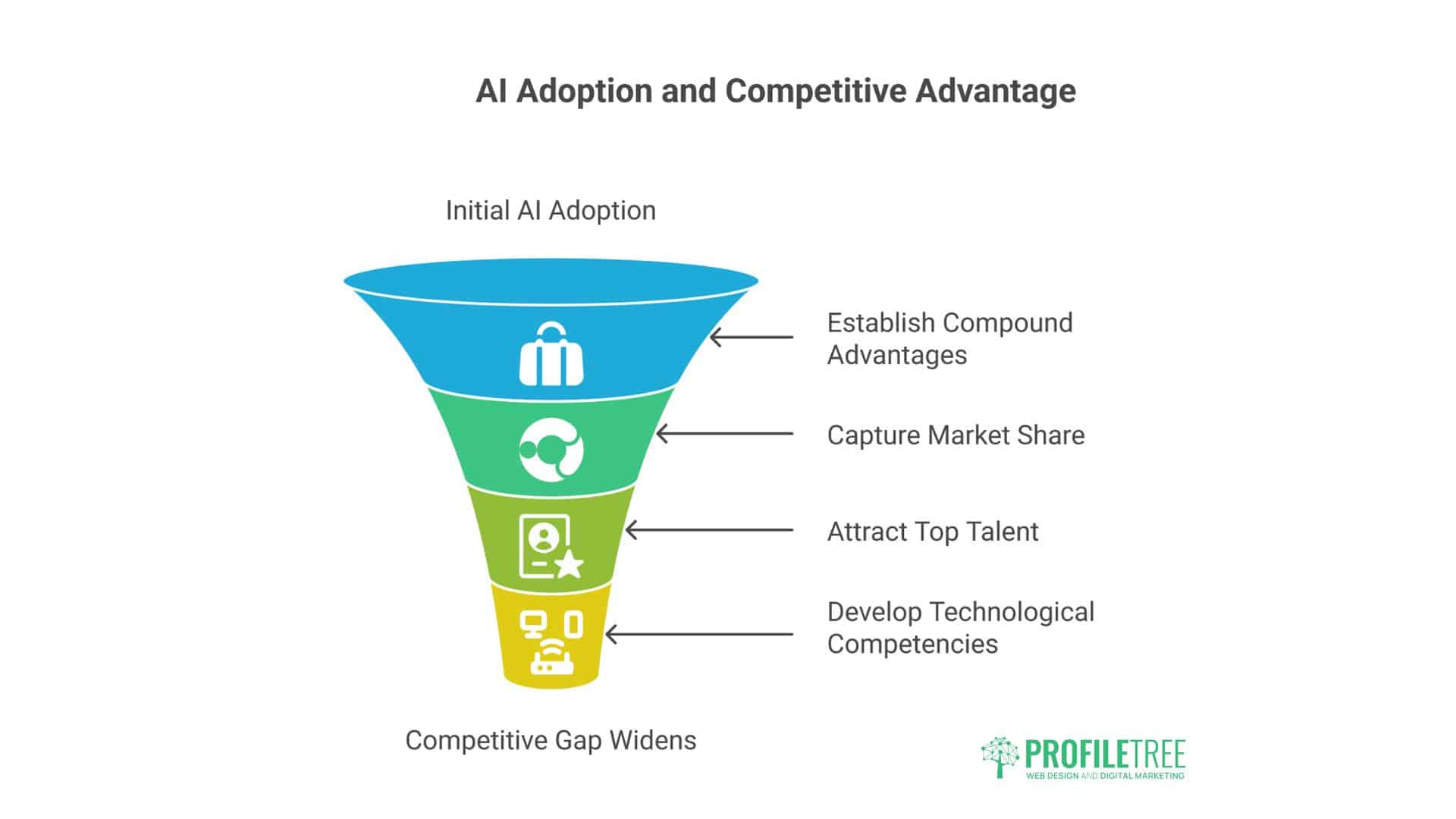
Irish companies delaying AI implementation face rapidly widening competitive gaps as early adopters establish compound advantages through automated processes, enhanced decision-making capabilities, and operational efficiencies that become increasingly difficult to match through traditional methods alone. The window for competitive AI adoption narrows monthly as pioneering businesses capture market share, attract top talent seeking AI-enhanced roles, and develop technological competencies that create barriers to entry for companies attempting late-stage implementation without established internal expertise or systematic training foundations.
Competitive Disadvantage Compounds Daily
Every day without AI implementation represents lost productivity that competitors capture. Companies using AI for customer service handle three times more queries with the exact staff numbers. Marketing teams produce content ten times faster using AI assistance. Sales teams identify and qualify leads with unprecedented accuracy.
The productivity gap becomes unbridgeable as AI-enabled companies reinvest efficiency gains into further advancement. They experiment with new AI applications while laggards struggle with basic implementation. This creates winner-take-all dynamics where early adopters dominate entire market segments.
International competition intensifies pressure on Irish businesses. UK companies accelerated AI adoption post-Brexit to maintain competitiveness. European firms benefit from EU AI investment programmes. American corporations deploy AI at scale. Irish companies must match this pace or lose market share to international competitors.
Customer expectations evolve rapidly as AI-powered experiences become standard. Consumers expect instant responses, personalised recommendations, and seamless service across channels. B2B buyers demand sophisticated proposals, detailed analytics, and rapid customisation. Meeting these expectations without AI becomes increasingly impossible.
Talent retention depends increasingly on offering modern work environments. Skilled professionals, particularly younger workers, expect employers to provide AI tools that eliminate mundane tasks and enable creative work. Companies without AI capabilities struggle to attract and retain top talent who seek technologically progressive employers.
Cost Reduction Through Intelligent Automation
AI automation delivers immediate cost savings that justify training investments many times over. Administrative tasks that consumed hours are now completed in minutes. Data analysis that requires specialist consultants happens internally through AI-powered tools. Content creation costs plummet while quality improves through AI assistance.
Customer service transformation through AI chatbots and automated responses reduces support costs by 40-60% while improving satisfaction scores. These systems handle routine queries instantly, freeing human agents for complex issues requiring empathy and creativity. AI chatbot implementation becomes straightforward once teams understand the underlying principles.
Marketing efficiency improvements through AI tools revolutionise content production economics. Teams produce blog posts, social media content, and email campaigns in fractions of the previous time. AI-powered design tools eliminate expensive outsourcing for routine graphics work. Video editing that took days now completes in hours.
Operations optimisation through predictive analytics prevents costly failures before they occur. Manufacturing companies predict equipment maintenance needs, reducing downtime. Retailers optimise inventory levels, minimising waste while avoiding stockouts. Service businesses forecast demand patterns, optimising staff scheduling.
Financial analysis acceleration enables better decision-making with reduced consultant dependency. AI tools analyse vast datasets, identify trends, and generate insights that previously required extensive manual analysis. This democratises sophisticated analysis capabilities across organisations.
Market Trends Driving AI Investment
Market trends driving AI investment include accelerating customer expectations for personalised experiences and instant service delivery that traditional systems cannot provide. At the same time, competitive pressures intensify as businesses across all sectors report measurable advantages through AI-powered automation and data analysis. Economic factors such as rising operational costs, skilled labour shortages, and demand for 24/7 service availability create compelling business cases for AI adoption, with Irish companies recognising that AI implementation offers sustainable solutions to workforce challenges while improving service quality and operational efficiency simultaneously.
Government Support and Initiatives
Irish government recognition of AI’s economic importance translates into substantial support programmes. The National AI Strategy allocates €225 million toward AI development, with significant portions supporting business capability building. These funds make AI training accessible to SMEs that might otherwise struggle with investment justification.
Enterprise Ireland’s AI Start programme provides vouchers worth up to €5,000 for AI consultancy and training. This initiative has supported over 500 companies in beginning their AI journeys, with participants reporting average productivity improvements of 25% within six months.
IDA Ireland attracts AI-focused multinationals while supporting indigenous companies in AI adoption. Their partnership programmes connect Irish SMEs with international AI expertise, accelerating local capability development. These connections provide Irish companies with insights into global best practices.
Regional development funds increasingly prioritise AI capability building. Local Enterprise Offices across Ireland offer AI workshops, mentoring programmes, and implementation support. This grassroots approach ensures AI benefits extend beyond Dublin to regional economies.
Educational institutions align curricula with industry AI requirements. Universities introduce AI modules across disciplines, while further education colleges offer practical AI application courses. This educational infrastructure supports long-term AI capability development.
Industry-Specific Adoption Patterns
Financial services lead AI adoption with applications in fraud detection, risk assessment, and customer service. Irish banks report a 50% reduction in fraud losses through AI-powered transaction monitoring. Insurance companies use AI for claims processing, reducing settlement times from weeks to days.
Retail transformation accelerates as companies implement AI for inventory management, demand forecasting, and personalised marketing. Irish retailers using AI-powered recommendation engines report 20-30% increases in average order values. Customer service chatbots handle 70% of initial queries without human intervention.
Healthcare applications expand rapidly despite regulatory constraints. Irish hospitals use AI for diagnostic imaging analysis, reducing radiologist workload while improving accuracy. GP practices implement AI triage systems, optimising appointment allocation and identifying urgent cases.
Manufacturing companies deploy AI for quality control, predictive maintenance, and supply chain optimisation. Irish food producers use computer vision for quality inspection, reducing waste while maintaining standards. Pharmaceutical manufacturers optimise production schedules through AI-powered planning systems.
Professional services firms integrate AI into core offerings. Law firms use AI for contract analysis and legal research. Accounting practices automate data entry and preliminary analysis. Digital strategy consultancies incorporate AI insights into client recommendations.
The Real Cost of Delayed AI Adoption
Delayed AI adoption creates compounding costs, including lost productivity opportunities that competitors capture, increased operational expenses as manual processes become relatively more expensive, and talent retention challenges as skilled employees seek AI-enhanced roles at forward-thinking organisations. The financial impact extends beyond immediate efficiency losses, including market share erosion, reduced profit margins from inefficient operations, and the exponentially higher costs of implementing AI systems after competitors have established technological advantages that require catch-up investments rather than strategic positioning for market leadership.
Quantifiable Business Losses
Revenue erosion accelerates as AI-enabled competitors capture market share. Companies report losing 15-20% of customers to competitors offering AI-powered experiences. Price pressure intensifies as competitors’ AI efficiency enables aggressive pricing while maintaining margins.
Operational inefficiency costs compound daily. Manual processes that AI could automate waste thousands of staff hours annually. Data entry, analysis, and decision-making error rates remain high without AI assistance. These inefficiencies translate directly to reduced profitability.
Innovation stagnation occurs when teams spend time on routine tasks rather than creative work. Without AI handling mundane activities, skilled professionals waste capabilities on administrative work. This misallocation of human talent prevents breakthrough innovations that drive growth.
Recruitment challenges intensify as top talent gravitates toward AI-progressive employers. Companies report 40% longer recruitment cycles when competing against AI-enabled organisations. Salary premiums of 20-30% become necessary to attract professionals willing to work without modern tools.
Customer churn accelerates as service expectations go unmet. Response times that seemed acceptable become intolerable when competitors offer instant AI-powered support. Personalisation expectations impossible to meet manually become table stakes in AI-enabled markets.
Strategic Positioning Erosion
Market leadership positions become vulnerable without AI capabilities. Companies that dominated through traditional advantages find themselves disrupted by AI-native startups. Historical market knowledge becomes less valuable than AI-powered insight generation.
Partnership opportunities diminish as potential collaborators seek AI-capable partners. International companies selecting Irish partners increasingly require AI integration capabilities. Government contracts specify AI components that unprepared companies cannot deliver.
Investment attractiveness decreases for companies without clear AI strategies. Venture capital and private equity firms view AI capability as fundamental to growth potential. Valuations suffer when companies cannot articulate credible AI implementation plans.
Brand perception shifts as companies appear outdated without AI integration: customers, particularly younger demographics, associate a lack of AI with technological backwardness. B2B buyers question whether non-AI companies can meet future needs.
ProfileTree’s Comprehensive AI Training Approach
ProfileTree’s comprehensive AI training approach combines industry-specific curriculum development with hands-on implementation support, ensuring participants learn relevant AI applications within their actual business contexts rather than generic theoretical concepts that don’t translate to workplace productivity. The methodology emphasises practical skill development through real-world project work, ongoing mentorship support, and performance measurement frameworks that track business outcomes rather than course completion, creating sustainable AI competencies that continue delivering value long after formal training ends.
Foundational AI Understanding
Our training begins by demystifying AI, removing the fear and confusion that prevent adoption. Participants learn what AI actually does versus science fiction portrayals. In practical business terms, we then explain machine learning, natural language processing, and computer vision.
Significant focus is given to ethical AI implementation, ensuring Irish businesses deploy AI responsibly. We address bias prevention, data privacy compliance, and transparency requirements. Understanding ethical considerations prevents future reputational and legal issues.
Tool selection guidance helps businesses navigate the overwhelming array of AI solutions. We evaluate platforms based on Irish business needs, GDPR compliance, and integration requirements. Participants learn to assess AI tools critically rather than falling for marketing hype.
Implementation roadmapping provides clear pathways from current capabilities to AI transformation. We help companies identify quick wins that build momentum while planning longer-term strategic implementations. This staged approach prevents organisations from being overwhelmed with excessive change.
Digital marketing training programmes incorporate AI, showing practical applications in familiar contexts. Participants see immediate relevance rather than abstract concepts.
Hands-On Practical Application
Real-world exercises using actual business scenarios ensure immediate applicability. Participants work with AI tools on business challenges, not hypothetical examples. This practical focus means teams implement learnings immediately upon returning to work.
ChatGPT mastery for business applications forms a core component. Teams learn prompt engineering, output refinement, and integration with existing workflows. We demonstrate how ChatGPT transforms everything from email writing to strategic planning.
AI-powered content creation training revolutionises marketing capabilities. Participants learn to efficiently generate blog posts, social media content, and marketing copy. Content marketing strategies evolve dramatically when teams understand AI assistance.
Data analysis democratisation through AI tools empowers non-technical staff. Sales teams analyse customer patterns, HR departments identify retention risks, and operations managers optimise processes. Specialist capabilities have previously become accessible across organisations.
Automation workflow design helps companies identify and implement efficiency improvements. We teach process mapping, automation tool selection, and change management strategies. Participants leave capable of leading automation initiatives within their departments.
Ongoing Support and Development
Post-training support ensures successful implementation rather than abandoning participants after sessions. We provide follow-up consultations, troubleshooting assistance, and implementation guidance. This ongoing relationship ensures training translates into tangible business improvements.
Community building connects Irish businesses on similar AI journeys. Peer learning accelerates adoption as companies share experiences and solutions. This network effect multiplies training value beyond initial instruction.
Regular updates keep participants current with rapidly evolving AI capabilities. Monthly webinars introduce new tools and techniques. Quarterly workshops dive deep into emerging applications. Annual conferences bring together Ireland’s AI business community.
Customised department training addresses specific functional needs. Sales teams receive different training from accounting departments. This specialisation ensures relevance while maintaining organisational coherence.
Success measurement frameworks help companies track the impact of AI implementation. We establish baseline metrics, monitor improvements, and adjust results-based strategies. This data-driven approach proves ROI while identifying optimisation opportunities.
Success Stories from Irish Businesses
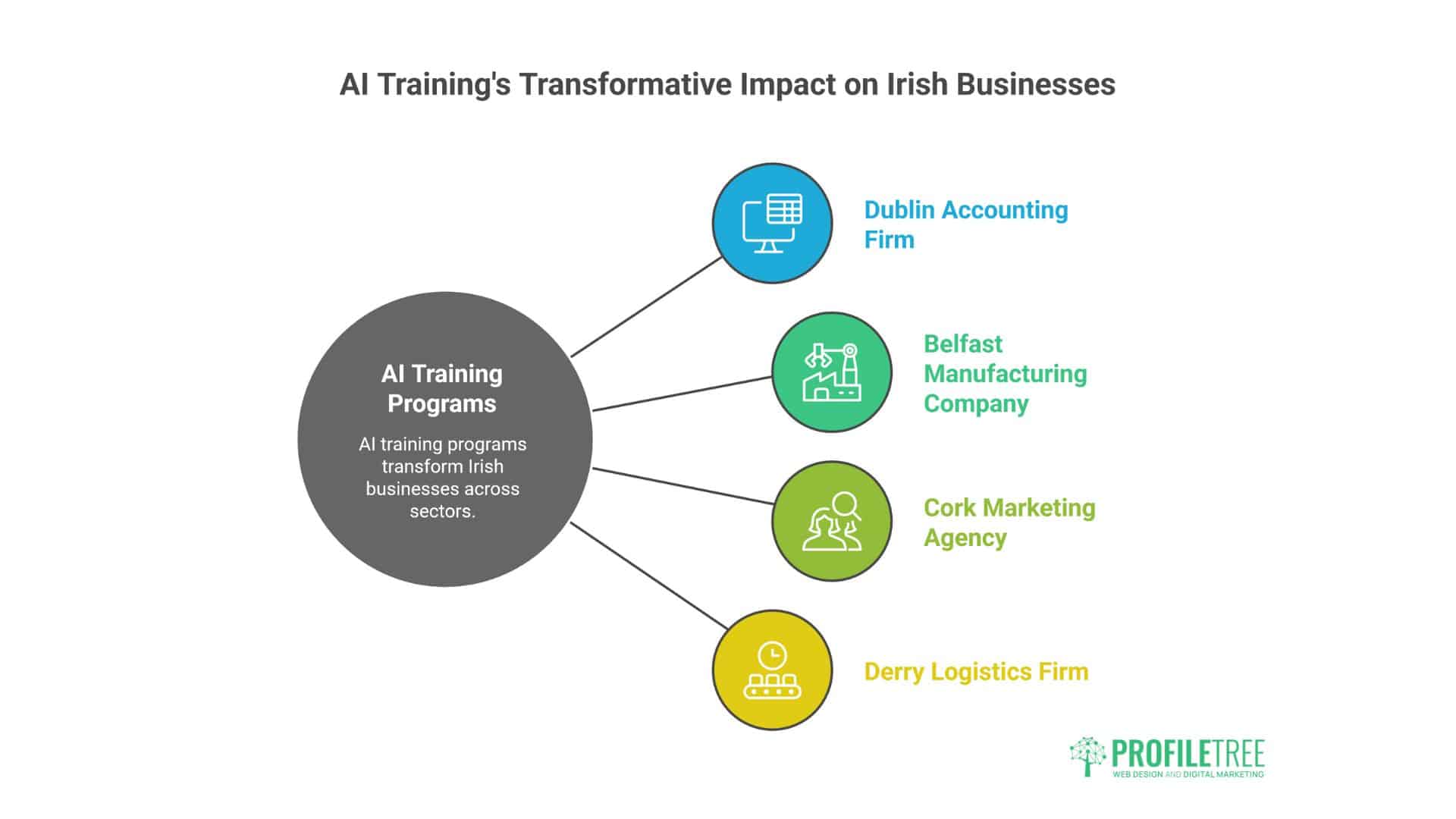
Irish businesses implementing ProfileTree’s AI training programs report measurable transformation across diverse sectors: a Dublin accounting firm reduced client onboarding time by 65% through automated document processing training. A Belfast manufacturing company achieved 45% faster quality control through AI-powered inspection systems training. Additional documented successes include a Cork marketing agency that increased campaign performance by 50% using AI-driven customer segmentation training, and a Derry logistics firm that optimised delivery routes to reduce operational costs by 35% while improving customer satisfaction through predictive scheduling capabilities developed during their customised AI training program.
SME Transformation Examples
Belfast marketing agency (name withheld for confidentiality) reduced content production time by 75% after ProfileTree’s AI training. Their team now produces four times more content with the same resources, enabling aggressive growth without proportional cost increases.
Dublin accounting firm implemented AI-powered document processing following our training programme. Invoice processing time decreased from hours to minutes, while accuracy improved dramatically. Staff redirected to higher-value advisory work report greater job satisfaction.
After our training, a Cork manufacturing company deployed predictive maintenance AI, which helped it understand its capabilities. Equipment downtime was reduced by 45%, saving hundreds of thousands annually in lost production and emergency repairs.
Galway retailer transformed customer service using AI chatbots configured during training sessions. Response times dropped from hours to seconds while customer satisfaction scores increased 30%. Human agents now handle only complex, high-value interactions.
Enterprise Implementation Patterns
Large organisations benefit from structured AI adoption frameworks learned in ProfileTree training. Department-by-department rollouts prevent organisational disruption while systematically building capability. Change management strategies ensure employee buy-in rather than resistance.
Cross-functional AI teams emerge from training programmes, breaking down silos that previously hindered innovation. Marketing, sales, and operations collaborate on AI initiatives that benefit entire organisations, multiplying AI impact beyond individual department improvements.
Governance structures established during training ensure responsible AI deployment. Companies create AI ethics committees, establish usage guidelines, and implement monitoring systems. These frameworks prevent issues while maximising benefits.
Cultural transformation accompanies technical implementation as organisations embrace experimentation. Failure becomes a learning opportunity rather than a career risk, and innovation accelerates as teams feel empowered to explore AI applications.
Implementing AI Training in Your Organisation
Implementing AI training in your organisation requires strategic planning that begins with a comprehensive skills assessment, clear objective setting, and stakeholder buy-in from leadership levels to frontline employees who use AI tools daily. Successful implementation involves phased rollout approaches that start with pilot programs in specific departments, provide adequate time for skill development and system integration, and establish measurement frameworks that track individual competency improvements and organisational performance gains that justify continued investment in AI capability development.
Building Buy-In Across Levels
Executive sponsorship is critical for successful AI training initiatives. Leaders must communicate strategic importance while honestly addressing concerns. We help craft compelling business cases that secure necessary investment and support.
Middle management engagement requires addressing job security fears directly. Training demonstrates how AI amplifies management capabilities rather than replacing managers. Practical examples show enhanced decision-making and team leadership through AI assistance.
Front-line staff participation improves when training emphasises skill enhancement over replacement. Workers learn to collaborate with AI tools, becoming more valuable rather than redundant. Success stories from peers prove AI creates opportunities rather than threats.
Union consultation, where applicable, prevents resistance that derails implementation. Transparent communication about AI’s role, augmenting rather than replacing workers, builds trust. Joint training initiatives demonstrate commitment to workforce development.
Measuring Training Impact
Productivity metrics provide immediate evidence of training effectiveness. Time saved on routine tasks, output volume increases, and error rate reductions demonstrate tangible benefits. These measurements justify continued investment while identifying additional training needs.
Quality improvements often exceed productivity gains. AI-assisted work shows fewer errors, better consistency, and enhanced creativity. Customer feedback, peer reviews, and output analysis reveal quality transformations.
Employee satisfaction typically increases as AI eliminates mundane tasks. Staff report greater engagement when focusing on creative, strategic work. Retention improves as employees appreciate investment in their development.
Revenue impact emerges through various channels. Faster service delivery, improved customer satisfaction, and enhanced competitive positioning drive growth. Cost reductions from efficiency improvements flow directly to the bottom line.
Innovation metrics track new capabilities enabled by AI training. The number of AI initiatives launched, process improvements implemented, and new services developed indicates transformation depth.
Choosing the Right AI Training Partner
Choosing the right AI training partner requires evaluating providers based on practical business experience, industry-specific expertise, and proven track records of delivering measurable outcomes rather than impressive marketing materials or theoretical credentials that don’t translate to workplace results. Key selection criteria include assessment of their curriculum relevance to your sector, availability of ongoing support beyond initial training sessions, demonstrated ability to customise content for your specific business context, and transparent measurement frameworks that track actual productivity improvements and ROI rather than just participant satisfaction scores.
Essential Evaluation Criteria
Practical experience matters more than theoretical knowledge. ProfileTree’s extensive work with Irish SMEs provides insights that pure training companies lack. We understand implementation challenges specific to Irish business contexts.
Industry relevance ensures training addresses actual business needs. Generic AI training often fails to connect with practical applications. Our programmes focus on tools and techniques immediately applicable in Irish business environments.
Ongoing support distinguishes professional training from one-off workshops. AI evolution requires continuous learning and adaptation. ProfileTree’s AI training services include long-term partnership elements ensuring sustained success.
Cultural fit with Irish business practices influences training effectiveness. Understanding local market dynamics, regulatory requirements, and business culture ensures relevant instruction. International training providers often miss these crucial contextual factors.
A commitment to measurable outcomes demonstrates confidence in training quality. We establish success metrics upfront and track achievement. This accountability ensures training delivers the promised business value.
Red Flags to Avoid
An overly technical focus that alienates business users indicates misaligned training. Effective business AI training translates complex concepts into practical applications. Providers emphasising technical details over business outcomes miss the point.
Vendor lock-in to specific platforms limits future flexibility. Quality training teaches principles applicable across platforms rather than single-tool dependency. Beware providers pushing proprietary solutions over industry-standard tools.
Lack of customisation, treating all businesses identically, wastes time and money. Different industries, company sizes, and capability levels require tailored approaches. One-size-fits-all training rarely delivers optimal results.
The absence of post-training support abandons organisations during critical implementation phases. Initial training represents the AI transformation journey’s beginning, not the end. Providers disappearing after training sessions leave companies struggling with implementation.
The Path Forward for Irish Business
AI transformation represents the defining business challenge of our generation. Irish companies must choose between leading this change or becoming its casualties. The window for competitive AI adoption narrows daily as early movers establish commanding positions.
Investment in AI training delivers returns far exceeding costs through productivity improvements, reductions, and competitive advantages. Companies reporting 10x ROI on AI training investments are becoming common rather than exceptional.
Starting immediately matters more than perfection. Even imperfectly, companies beginning AI journeys today position themselves ahead of those still deliberating. The learning curve steepens as AI capabilities expand exponentially.
ProfileTree’s comprehensive AI training programmes provide structured pathways for Irish businesses to build AI capabilities rapidly. Our practical, business-focused approach ensures immediate application rather than theoretical understanding.
Watch our detailed guide on future-proofing your business with AI to understand how AI transformation happens in practice. For companies ready to enhance their marketing capabilities, explore how AI enhances marketing effectiveness across all channels.
Taking Action Today: AI in Business
The question isn’t whether Irish businesses should adopt AI, but how quickly they can build necessary capabilities. Every day of delay widens the gap between AI-enabled companies and those clinging to traditional methods.
ProfileTree leads AI transformation for Irish businesses through practical, immediately applicable training. Our proven methodologies have helped hundreds of companies across Ireland implement AI, achieving remarkable productivity improvements and competitive advantages.
Contact ProfileTree’s AI training team today to discuss your organisation’s AI journey. Whether you’re beginning from scratch or expanding existing capabilities, our comprehensive programmes provide the knowledge, tools, and support necessary for successful AI transformation.
The future belongs to businesses that embrace AI today. Irish companies have the opportunity to lead rather than follow this transformation. Any organisation can build AI capabilities that deliver a lasting competitive advantage with proper training and support.
FAQs
What’s the minimum technical knowledge required for AI business training?
None. Practical AI business training assumes no technical background and focuses on practical application rather than programming. Most business AI tools feature user-friendly interfaces requiring only basic computer skills. Our training starts with fundamentals, gradually building confidence.
How quickly can companies see ROI from AI training investment?
Most companies report measurable improvements within 4-6 weeks of training completion. Quick wins like automated email responses or AI-assisted content creation deliver immediate value. Larger transformational benefits typically emerge within 3-6 months as teams gain confidence and expand AI applications.
Will AI really replace jobs in Irish companies?
AI augments rather than replaces human workers in most business contexts. Jobs transform rather than disappear, with mundane tasks automated while human creativity, empathy, and strategic thinking become more valuable. Training helps workers adapt to AI-enhanced roles rather than competing against AI.
What industries benefit most from AI training in Ireland?
Every industry benefits, but professional services, retail, financial services, and manufacturing see robust returns. Service businesses improve customer experience, manufacturers optimise operations, and knowledge workers multiply productivity. Even traditional sectors like agriculture and construction find valuable AI applications.
How does GDPR affect AI implementation in Irish businesses?
GDPR compliance is built into our AI training programmes. We teach data minimisation, purpose limitation, and transparency requirements. Most business AI applications process aggregated or anonymised data, avoiding personal data complications. Proper training ensures compliant, ethical AI deployment.
Should small businesses wait until AI technology matures further?
Waiting means falling further behind. Current AI tools are mature enough to deliver significant business value. Technology will continue evolving, but companies need to start learning now. Small businesses benefit more from AI than large corporations due to the greater efficiency impact on limited resources.