
Starting Your AI Transformation Journey: A Step-by-Step Guide for SMEs
Table of Contents
Most businesses in Northern Ireland, Ireland, and across the UK are somewhere in the middle of a question they haven’t fully answered yet: where does AI actually fit in what we do, and how do you get started without wasting time and money?
That question is harder than it looks. Most of the advice available online is written for organisations with dedicated data science departments and transformation budgets that most SMEs simply don’t have. This guide takes a different approach. It’s built around what it actually takes for a small or medium-sized business to start an AI transformation, from the first internal conversations through to scaling what works, and it covers the regulatory questions that generic guides tend to skip for businesses trading across the Irish Sea.
ProfileTree, a Belfast-based digital agency, has worked with SMEs across Northern Ireland, Ireland and the wider UK on AI training and implementation. What follows draws on the patterns seen across that work.
On this page: What AI transformation means for an SME · The readiness audit · The four-stage roadmap · Navigating UK and Ireland regulation
What AI Transformation Actually Means for an SME
AI transformation is the process of changing how a business operates, makes decisions, and creates value by integrating artificial intelligence into its core processes. It is not the same as buying an AI tool.
The distinction matters. A business can subscribe to 20 AI tools and not transform anything. Transformation happens when AI changes how work gets done, how decisions get made, or how a business serves its customers, and when those changes are deliberate, measured, and repeatable.
For most SMEs, this starts modestly. The goal is not to become a technology company. It is to make existing operations smarter, faster, and less dependent on repetitive manual effort.
How AI Transformation Differs from Digital Transformation
Digital transformation was about moving processes online and connecting systems. AI transformation goes further: it takes those connected systems and adds the ability to learn, predict, and automate judgment-based tasks.
| Digital Transformation | AI Transformation | |
|---|---|---|
| Primary goal | Digitise and connect processes | Automate decisions and generate insight |
| Core technology | Cloud, SaaS, CRMs, ERPs | Machine learning, NLP, generative AI |
| Workforce impact | Retraining for digital tools | Redefining roles around human-AI collaboration |
| Data dependency | Moderate | High, quality data is essential |
| Timeframe | One to three years typically | Ongoing, capabilities compound over time |
Many businesses in Northern Ireland are still completing their digital transformation. Starting an AI transformation does not require completing a digital transformation first, but it does require honest answers about data infrastructure and internal skills. If your business is still working through the earlier stage, ProfileTree’s guide to digital transformation for SMEs covers that groundwork in more detail before you layer AI on top of it.
A lot of that “data infrastructure” question comes down to whether your website, CRM and internal systems actually talk to each other. A business running a five-year-old website with no proper data structure behind it is not ready for AI-driven personalisation or automation, no matter how good the AI tool is. This is often where a website development refresh becomes the first real step in an AI transformation, rather than a separate project alongside it.
The AI Transformation Readiness Audit
Before committing resources to AI, the most useful thing a business can do is assess where it actually stands. Skipping this step is one of the main reasons AI projects stall after the pilot phase.
Assessing Your Data Foundation
AI systems are only as good as the data they learn from. A readiness audit should start here.
Ask honestly: is customer data clean, consistent, and stored in a format that allows querying? Do operational systems capture the information that matters, or is critical knowledge locked in emails, spreadsheets, or people’s heads?
If the answer is uncertain, that is not a reason to delay. It is a reason to make data infrastructure the first investment. A business that spends three months organising its data before engaging an AI tool will almost always outperform one that implements AI on top of a messy foundation. For businesses whose data problem is really a website or platform problem, a web design Belfast rebuild with proper CRM integration and structured content often does more for AI readiness than any AI tool purchase.
Evaluating In-House Capability
An SME does not need a data science team to start an AI transformation. It needs people who are willing to learn, people who understand the business well enough to identify where AI can add value, and at least one person with the authority to remove obstacles.
Map the current team against three questions:
- Who understands the business processes that need changing?
- Who has the technical appetite to learn new tools?
- Who has the authority to make it happen?
The answer to all three need not be the same person. But all three need to be represented. Training staff on AI tools is one of the most overlooked parts of this process, and it typically pays back faster than any technical investment. ProfileTree’s digital training programmes and AI training for business workshops are built specifically to address this gap: getting a non-technical team comfortable using AI tools inside their actual roles, rather than watching generic tutorials.
Understanding Your Change Readiness
AI transformation is a people problem as much as a technology one. The businesses that struggle most are not those with the worst data. They are those with leadership that mandates change without building the cultural conditions for it.
Before starting, assess:
- Does leadership genuinely champion this, or is it a compliance exercise?
- Are middle managers included in the conversation, or will they feel bypassed?
- Does the team have the psychological safety to flag when something is not working?
The BCG 10/20/70 rule is a useful reference point here: BCG’s own research on AI transformation programmes has argued that roughly 10% of the work is algorithms, 20% is data and technology, and 70% is business process change and people. Most SME plans get the proportions backwards. It is worth verifying the exact figures against BCG’s published research before quoting them directly in client-facing material, since the split is sometimes cited with slightly different numbers depending on the source.
Building Your AI Transformation Strategy
A strategy is not a list of tools to buy. It is a set of decisions about where AI will add the most value, in what sequence, and how success will be measured.
Identifying High-Value Use Cases
Start by listing every part of the business that involves repetitive tasks, large volumes of information to process, or decisions made from incomplete data. Those are the candidates.
Then apply a simple filter. For each candidate, ask: How technically feasible is this with the available tools? How much value would it create if it worked?
A 2×2 matrix with feasibility on one axis and impact on the other will quickly reveal where to start. High feasibility and high impact are the priority tier. Avoid starting with high-complexity, high-impact projects; they are where pilots go to die.
Common first-use cases for UK and Irish SMEs include:
- Customer service triage using AI chat tools
- Content generation and first-draft production
- Data extraction from documents and reports
- Lead scoring and CRM enrichment
- Internal knowledge search and question answering
Content generation is worth a closer look because it is where most SMEs start, and where most go wrong. An AI tool can produce a first draft in seconds, but it still needs a brand voice check, an SEO structure pass, and a fact-check before publication. Businesses that treat AI drafting as a starting point rather than a finished product, supported by a proper content marketing process, get far more usable output than those who publish AI drafts unedited. ProfileTree’s content marketing Belfast team, for example, uses AI at the research and planning stage while keeping final copy in human hands, which is a reasonable template for how an SME might structure its own first content pilot.
Reviewing the cost-benefit analysis of AI implementation in SMEs before committing to a use case is time well spent. The economics vary significantly depending on the sector and the starting point.
Setting Measurable Objectives
Vague objectives are what keep AI projects permanently in “exploration mode.” Before starting, define what success looks like in numbers.
Not “improve customer service” but “reduce first-response time from four hours to under thirty minutes.” Not “use AI in marketing” but “reduce time spent on first-draft content from eight hours per week to two.”
Set a target, a measurement method, and a review date. If a use case cannot be defined this specifically, it is not ready to start.
The Four-Stage AI Transformation Roadmap
This framework reflects how AI transformation actually progresses for most mid-sized businesses, not the idealised linear model, but the messier, more iterative reality.
Stage 1: Pilot Projects and Proof of Value
Choose one use case from the high-feasibility, high-impact tier. Scope it tightly. A pilot should be complete within eight to twelve weeks, involve a small team, and produce a clear measurable outcome.
The purpose of a pilot is not to prove that AI works in general. It is to prove that this specific application works in this specific business context. Keep the scope small enough that failure is instructive rather than expensive.
A structured approach to picking that first pilot looks a lot like the audit stage of a standard digital marketing strategy process: define the objective, gather the current-state data, plan the intervention, then measure and refine. Applying that same audit-plan-deliver-review discipline to an AI pilot, rather than treating it as a separate exercise, tends to produce cleaner results.
Stage 2: Evaluate and Document
A pilot that does not produce a written evaluation is a wasted learning exercise. After each pilot, document what worked, what did not, what it cost in time and money, what it produced, and what would be done differently.
This documentation becomes institutional memory. It is also the evidence base needed to get leadership support for scaling.
Stage 3: Scale What Works
Scaling is not running the same pilot in more places. It is taking a proven approach, refining the process around it, and building the operational capability to sustain it without constant manual oversight.
This stage typically requires more attention to workflow integration than the pilot did. An AI tool that works well when one person uses it carefully may create problems when twenty people use it under time pressure. Build the guardrails before scaling.
Stage 4: Continuous Reinvention
AI capabilities change quickly enough that a strategy set twelve months ago is worth revisiting. Establish a regular review cadence, quarterly at a minimum, to assess whether current tooling still represents the best available option and whether new use cases have emerged.
The businesses that sustain an AI transformation advantage are not those that implemented the most tools earliest. They are the ones who built the organisational habit of continuous evaluation.
Navigating UK and Ireland Regulatory Frameworks
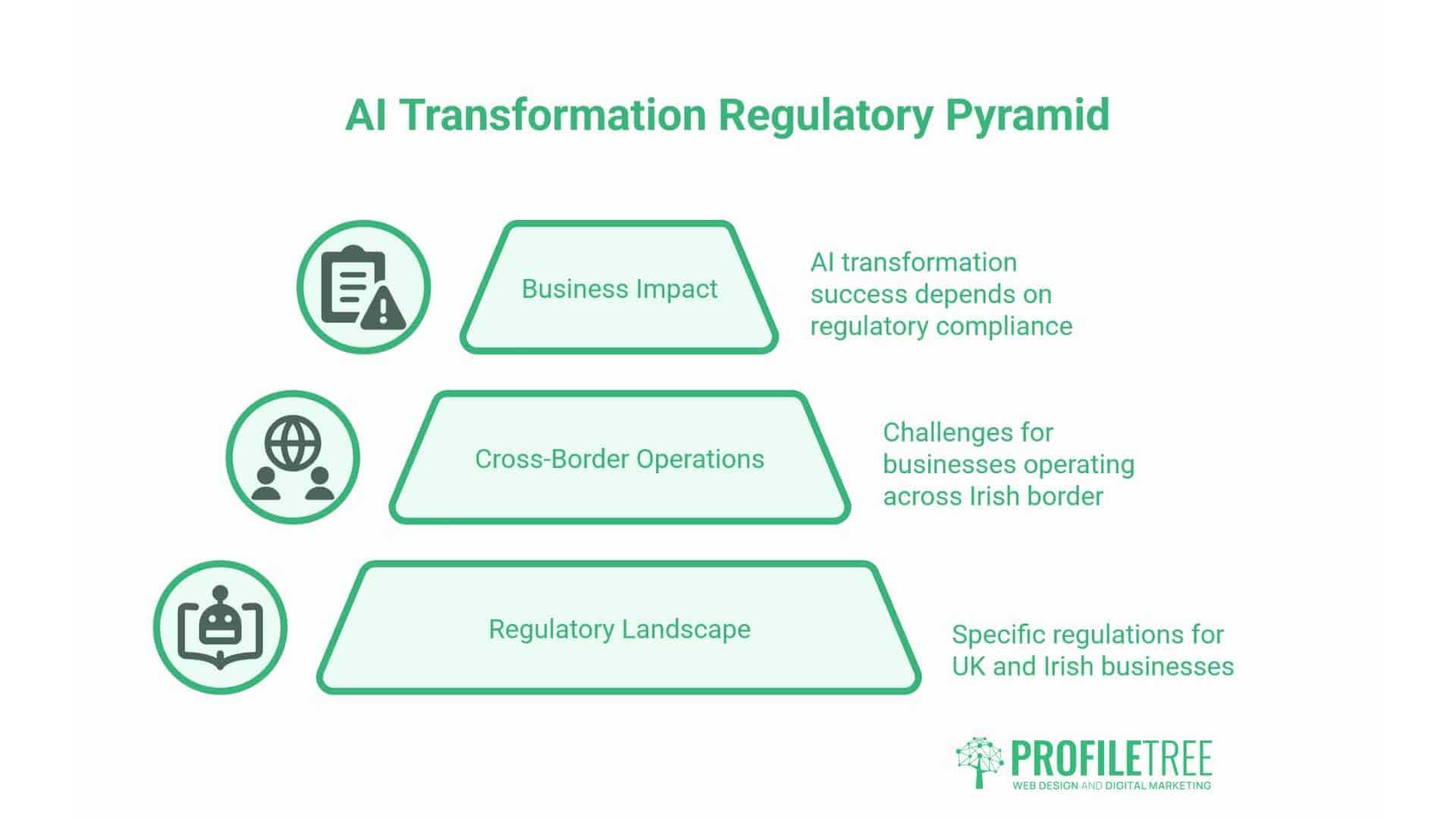
This is where most generic AI transformation guides fail UK and Irish businesses. The regulatory landscape is specific, and it matters, particularly for any business operating across the Irish border.
The UK AI Framework
The UK government has taken a sector-led, principles-based approach to AI regulation rather than the EU’s prescriptive framework. The key principles set out in the government’s AI regulation white paper are safety, transparency, fairness, accountability, and contestability. UK businesses are not yet subject to a single binding AI regulation. Instead, existing sector regulators, including the FCA, ICO and CMA, apply their existing frameworks to AI use cases.
For most SMEs, the practical implication is that GDPR compliance remains the primary legal constraint. Any AI system that processes personal data needs the same data protection analysis as any other tool.
EU AI Act Implications for Irish-Based Firms
The EU AI Act came into force in August 2024, with provisions phasing in through 2025 and 2026. Irish businesses are directly subject to it. UK businesses with customers or operations in EU member states may also fall within its scope.
The Act classifies AI systems by risk level. Most SME use cases, including content generation, customer service tools and internal analytics, fall into the minimal or limited risk categories, which carry lighter obligations. High-risk categories include AI used in hiring decisions, credit scoring, and certain public-facing services. Businesses operating in those areas need specific legal advice.
The Practical Reality of Operating Across the Border
For a Belfast-based business with customers in Dublin, or a business anywhere in Northern Ireland trading into the Republic, this dual regulatory environment is not a hypothetical concern. Compliance with GDPR and the EU AI Act’s transparency requirements, while staying within UK ICO guidance, requires a deliberate governance approach rather than assuming a single framework covers both. In practice, this usually means treating the stricter of the two requirements as the baseline for any AI feature that touches customer data on either side of the border, rather than running separate compliance tracks for UK and Irish customers.
Why AI Transformations Fail: The SME Reality Check
Failure rates for AI transformation projects are widely reported as high, though the specific percentage varies across sources. Gartner’s frequently cited estimates of pilot-to-production failure rates are worth checking against the original research before quoting a specific figure. Understanding why projects stall is more useful than optimism.
Pilot Purgatory, and How to Recover From It
The most common failure mode is not dramatic. It is gradual. A pilot gets good results. Leadership is pleased. Then nothing happens for six months because nobody owns the decision to scale, the budget for scaling was never allocated, and the team that ran the pilot has moved on to other priorities.
If a pilot has already stalled, recovery starts with the same audit that should have happened at the start: what did the pilot actually prove, what would scaling cost, and who owns the decision now. Avoiding pilot purgatory in the first place requires a named owner for every pilot outcome, a pre-agreed decision gate (“if this pilot achieves X by date Y, proceed to Z”), and a scaling budget earmarked before the pilot starts, not after it succeeds.
Data Quality Problems Discovered Late
Many AI projects surface data quality issues that were hidden inside manual processes. When a person handles a customer enquiry, they compensate for inconsistent data without noticing. When an AI system encounters the same inconsistency, it fails visibly.
This is not a reason to avoid AI. It is a reason to treat the data audit as a non-optional first step, not something to circle back to if problems emerge. ProfileTree’s overview of common patterns in automating SME processes covers this in more depth for businesses weighing up which processes are actually ready for automation.
Measuring the Wrong Things
Projects that measure adoption, “how many people are using the tool,” rather than outcomes, “what has changed in our results,” tend to drift. Adoption is at best a leading indicator. What matters is whether the use case delivers against the business objective set at the start.
SMEs that have successfully implemented AI solutions consistently share one characteristic: they defined success in business terms before choosing their tools, not after.
Building the AI Transformation Team
An SME does not need to hire for AI transformation before starting. It needs to identify the people already in the business who can carry it.
The core team for an SME AI transformation typically needs four types of contributions:
Executive sponsorship. Someone with budget authority and the ability to remove blockers. Without this, every project stalls the first time it encounters resistance.
Business process knowledge. People who understand the processes being changed well enough to spot when AI output is wrong. This is not a technical role. It is often the most experienced people on the operational team.
Technical implementation. This does not require an internal data scientist. It requires someone comfortable with software tools who can configure, test, and integrate AI products. Many SMEs fill this through training rather than hiring, which is where AI training and implementation support tends to be most useful, particularly for a first project.
Change management. Someone who can communicate what is changing and why, handle the anxiety that comes with it, and build the internal adoption that makes tools actually used rather than just installed.
Evaluating an AI Transformation Partner
At some point in this process, most SMEs consider bringing in outside support, whether for the technical implementation, the training, or both. A few practical criteria help separate a genuinely useful partner from one selling generic AI hype:
- Recent hands-on experience over academic credentials. AI tools change monthly. A partner whose knowledge comes from running current projects will be more useful than one citing research from two years ago.
- A named process, not a vague promise. Ask what the first thirty days actually look like: what gets audited, what the pilot scope is, and how success gets measured.
- Willingness to say no to a use case. A partner who tries to sell AI for every problem a business raises is optimising for the sale rather than the outcome.
- Local market and regulatory context. For a Northern Ireland or Irish business, a partner who understands the UK-Ireland regulatory position described above will save considerable back-and-forth later.
- Transparent pricing and scope. Fixed deliverables and a clear scope of work reduce the risk of an open-ended engagement that never reaches a decision point.
These are the same questions worth asking of any digital partner, not just an AI specialist, and they apply equally whether the engagement covers AI-enhanced marketing, technical implementation, or team training.
Integrating AI into Business Processes
The goal of integration is not replacement. It is an augmentation. AI works best when it handles the predictable, high-volume, or data-intensive parts of a process, freeing people to handle the parts that require judgement, relationships, and context.
Automating the Right Tasks
Start with tasks that are clearly defined, high-volume, and currently consuming skilled time on low-value work. Document processing, first-draft content, data extraction, meeting summaries, and routine customer enquiries are all strong candidates.
The test is simple: can a clear, consistent set of rules be written for how this task should be done? If yes, AI can probably do it. If the answer is “it depends on a lot of context that’s hard to describe,” start with human-in-the-loop approaches where AI assists rather than replaces. The same logic applies to website management: AI tools can now flag broken links, suggest alt text, and draft meta descriptions, but a properly built site still needs a website design foundation for those tools to work against.
Improving Decision-Making with AI
Beyond automation, AI creates value by surfacing patterns in data that people would not find manually. Customer behaviour trends, operational bottlenecks, pricing signals, and churn indicators are all areas where AI-assisted analysis can improve decisions without removing human judgement from the loop.
A practical example sits in the video and content performance. Analysing which video formats or topics actually hold attention, and which search terms are driving demand, is exactly the kind of pattern-spotting AI is suited to, and it feeds directly into a video marketing or video production plan rather than sitting in a dashboard nobody acts on. The key is connecting AI output to a decision workflow, not just a report.
Measuring Business Impact
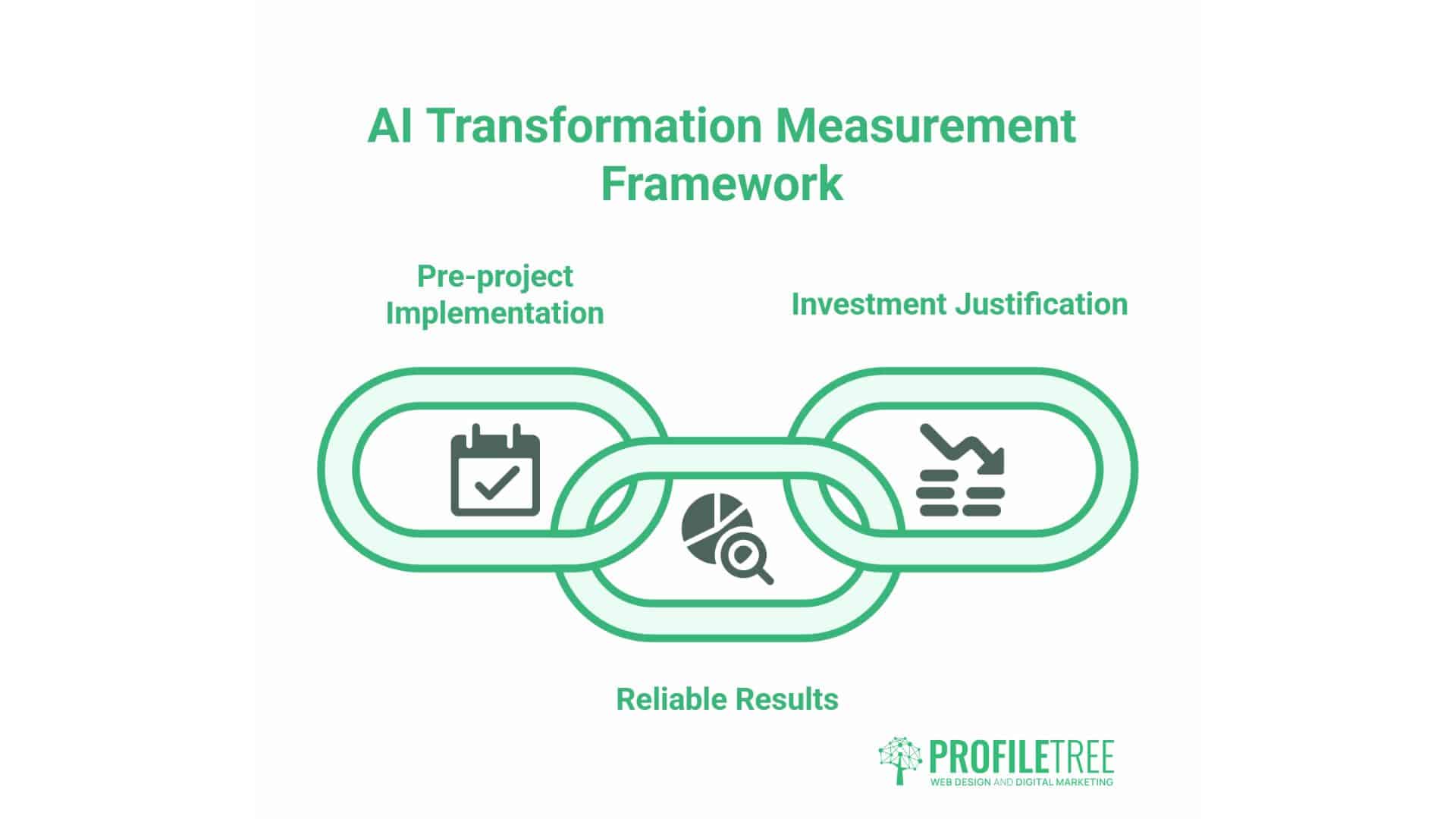
Every AI transformation project should have a measurement framework in place before it starts. Retrofitting measurement after the fact produces unreliable results and makes it harder to justify the next investment.
Measuring ROI on AI Investment
The unit economics of AI often differ from traditional software. Costs tend to be variable, per-use pricing, compute costs, and integration work, rather than fixed. Benefits tend to be in time saved, errors avoided, or revenue opportunities created, not always easy to quantify cleanly.
A practical approach: measure the current state carefully before making any changes. Document how long the process takes, how many errors occur, and what it costs in staff time. Then measure the same metrics after implementation. The comparison is the ROI evidence. Use a simple template like the one below, filled in with the business’s own figures, never invented ones:
Your ROI tracking template (fill in with your own baseline and post-implementation figures):
- Time per task: record hours before implementation, then after, then calculate the reduction
- Error rate: record the percentage before implementation, then after, then calculate the reduction
- Cost per unit: record the cost before implementation, then after, then calculate the savings
- Throughput: record the volume before implementation, then after, then calculate the increase
ProfileTree’s guide to measuring the ROI of AI investments for SMEs goes through this calculation in more detail, including how to handle benefits that are harder to quantify directly.
Benchmarking Progress Against Your Own Baseline
Comparing a business to competitors on AI maturity is less useful than measuring its own progress against its own starting point. Build an internal AI maturity baseline at the start of the transformation, and revisit it every six months.
Ciaran Connolly, founder of ProfileTree, puts it this way: “The businesses that make the most progress on AI are the ones that stop asking what everyone else is doing and start asking what would change most for us if this worked. That shift in framing changes everything about how they approach it.”
Ethical AI Deployment
Governance is not a constraint on AI transformation. It is what makes it sustainable.
The risks that matter most for SMEs are practical: generating inaccurate content that gets published, making automated decisions that unfairly disadvantage customers, processing personal data in ways that breach GDPR, or creating overreliance on AI output without adequate human review.
Build human review into any AI workflow that produces customer-facing output or informs significant decisions. Keep an audit trail of AI-assisted decisions. Be transparent with customers when they are interacting with an AI system. These are not bureaucratic requirements. They are the practices that prevent reputational damage from visible AI failures.
Start Your AI Transformation with the Right Support
The businesses seeing real results from AI are not the ones that bought the most tools. They are the ones who planned carefully, started small, measured honestly, and built internal capability alongside external implementation. If you want an outside view on where your business stands and what a sensible starting point looks like, ProfileTree’s AI transformation team works with SMEs across Northern Ireland, Ireland, and the UK on exactly this kind of structured, phased approach.
FAQs
What is the difference between AI transformation and digital transformation?
Digital transformation digitises and connects processes. AI transformation goes further by automating decisions and generating insight from data. Most SMEs benefit from solid digital foundations before investing heavily in AI, though both can progress in parallel.
What is the first step in an AI transformation strategy?
Conduct a readiness audit covering data quality, in-house capability, and change readiness before selecting any tool. Businesses that pick a use case before completing this audit are more likely to hit data quality problems mid-pilot.
How long does an AI transformation take?
A well-scoped pilot should produce measurable results within eight to twelve weeks. Moving to scaled deployment typically takes six to eighteen months, with full organisational transformation a multi-year programme.
How much does AI transformation cost for an SME?
Many SME use cases can be addressed with commercial AI tools at modest monthly cost, plus internal staff time for configuration and integration. More complex implementations involving custom models or system integration cost considerably more. Exact figures depend heavily on scope, so a specific quote is more useful than a general benchmark.