
AI Training for SMEs in Ireland & the UK: How to Start and See ROI
Table of Contents
Small and medium enterprises across Ireland and the UK document 30-40% productivity improvements through strategic artificial intelligence adoption, yet 73% of SME leaders incorrectly perceive AI implementation as financially and technically inaccessible. This fundamental misconception between AI reality and business perception generates substantial opportunity costs while forward-thinking competitors leveraging AI training establish decisive advantages in increasingly digitised market environments.
Contemporary AI applications designed specifically for SME requirements contradict popular media narratives depicting complex enterprise systems requiring substantial capital investments and technical expertise. Modern AI tools targeting smaller businesses operate within monthly subscription models costing less than typical office coffee services, demand minimal technical knowledge, and generate quantifiable returns within weeks rather than extended implementation periods.
The primary implementation barrier involves knowledge gaps and confidence deficits, which comprehensive AI Training for SMEs in Ireland and the UK systematically addresses. From Belfast manufacturing companies automating quality assurance processes to Dublin marketing agencies delivering personalised customer experiences, SMEs implementing practical AI applications transform operational efficiency without disrupting established, successful systems.
Structured AI Training for SMEs in Ireland & the UK transcends generic awareness programs to deliver specific, actionable implementation frameworks customised for individual business contexts and industry-specific requirements. Success depends on strategic training approaches that identify relevant AI applications, provide hands-on implementation guidance, and establish measurement systems that demonstrate tangible business value rather than technological novelty.
The competitive advantage emerges through systematic AI adoption rather than wholesale technology replacement, enabling SMEs to enhance existing capabilities while maintaining operational stability.
Why SMEs in Ireland and the UK Need AI Training Now
The competitive landscape for SMEs has shifted fundamentally. Large corporations no longer monopolise advanced technology advantages. Cloud-based AI services democratise capabilities previously requiring millions in infrastructure investment. A five-person accountancy firm in Derry can now deploy document processing AI that rivals systems used by Big Four consultancies. A family-run retailer in Cork accesses customer behaviour prediction tools matching those of multinational chains.
Yet without proper training, these powerful tools remain unused or misapplied. SME owners and employees need structured learning that bridges the gap between AI potential and practical implementation. Generic YouTube tutorials and vendor documentation fail to address specific challenges facing smaller businesses with limited resources and unique operational constraints.
The economic argument for AI training becomes compelling when examining actual returns. SMEs implementing AI report average efficiency gains of 35%, customer satisfaction improvements of 28%, and cost reductions of 22% within the first year. These aren’t theoretical projections—they’re documented outcomes from businesses across Northern Ireland, Ireland, and the UK that invested in proper AI education before implementation.
Timing matters critically for AI adoption. Early adopters in each sector gain competitive advantages that become increasingly difficult for followers to overcome. The estate agent using AI for property valuations and customer matching wins listings. The manufacturer employing predictive maintenance prevents costly breakdowns that competitors still experience. The restaurant’s AI-powered inventory management reduces waste while others struggle with stock control.
Government support programmes across Ireland and the UK increasingly focus on AI adoption for SMEs. Enterprise Ireland’s Digitalisation Fund includes AI training components. Invest Northern Ireland’s Innovation Vouchers cover AI consultancy and education. UK Research and Innovation provides grants for AI implementation. These programmes recognise that economic growth depends on SME digital transformation, with AI training forming the foundation.
Understanding AI Fundamentals: What SME Owners Actually Need to Know
Artificial intelligence for SMEs isn’t about understanding neural networks or machine learning algorithms. Practical AI training focuses on recognising opportunities, selecting appropriate tools, and managing implementation effectively. Business owners need functional knowledge rather than theoretical understanding.
Pattern Recognition and Prediction
AI excels at identifying patterns humans miss and predicting future outcomes based on historical data. For SMEs, this translates into concrete applications: predicting customer churn before it happens, forecasting demand to optimise inventory, automatically identifying fraudulent transactions, and spotting quality issues in manufacturing processes.
Training helps SME owners understand which business problems suit pattern recognition solutions. Not every challenge benefits from AI. Sometimes, simple rule-based systems or human judgment work better. Practical training develops the discrimination to know when AI adds value versus unnecessary complexity.
Natural Language Processing Applications
Natural language AI enables computers to understand and generate human language. SMEs use these capabilities for customer service chatbots that handle routine enquiries, automated email responses that maintain a personal touch, document analysis that extracts key information instantly, and sentiment analysis that monitors brand perception.
Practical training demonstrates how to implement language AI without losing the personal relationships SMEs build with customers. The goal isn’t replacing human interaction but augmenting it—freeing staff from repetitive tasks to focus on complex problems requiring empathy and creativity.
Computer Vision Opportunities
Visual AI analyses images and videos to extract information, monitor processes, and make decisions. SME applications include quality control in manufacturing, security monitoring for retail premises, inventory counting through photograph analysis, and damage assessment for insurance claims.
Training demystifies computer vision, showing it as an accessible tool rather than science fiction. Modern services require no coding knowledge. Upload images, define what to look for, and receive automated analysis. The complexity happens behind the scenes while users interact through simple interfaces.
Automation and Integration
AI’s most excellent value for SMEs is automating routine tasks and integrating disconnected systems. Invoice processing, data entry, report generation, and customer communications can run automatically while maintaining accuracy and consistency.
Practical training teaches SMEs to identify automation opportunities within existing workflows. Start small with single processes before expanding. Learn to calculate time savings and ROI. Understand when human oversight remains necessary and how to implement quality controls.
Sector-Specific AI Applications for Irish and UK Businesses
Different industries benefit from distinct AI applications that address sector-specific challenges: retail businesses leverage inventory optimisation and customer behaviour prediction. At the same time, manufacturing companies implement quality control automation and predictive maintenance systems that reduce downtime costs. Professional services firms utilise AI for document analysis and client communication automation, healthcare practices benefit from appointment scheduling and patient data management systems, and hospitality businesses implement dynamic pricing and guest experience personalisation that directly impacts revenue performance and operational efficiency.
Retail and E-commerce
Retail SMEs compete against Amazon and other giants through localised AI advantages. Inventory optimisation prevents stockouts while minimising carrying costs. Dynamic pricing adjusts to market conditions and competitor actions. Personalised recommendations increase average order values. Visual search helps customers find products using photos rather than descriptions.
Retail training focuses on customer experience enhancement and operational efficiency. Learn to implement recommendation engines that suggest complementary products. Understand how predictive analytics forecasts seasonal demand. Master chatbot deployment for 24/7 customer service without overnight staff.
Belfast boutiques report 23% sales increases after implementing AI-powered personal shopping assistants. Dublin restaurants reduce food waste by 31% using AI demand forecasting. These aren’t outliers—they’re typical results from proper AI training and implementation.
Professional Services
Accountants, solicitors, consultants, and other professional service providers use AI to eliminate mundane tasks while improving service quality. Document analysis extracts relevant information from contracts and reports. Automated workflows route tasks to appropriate team members. Predictive analytics identifies clients likely to need additional services.
Professional services training emphasises compliance and accuracy. AI must meet regulatory requirements while maintaining professional standards. Learn to implement AI that enhances rather than replaces professional judgment. Understand liability implications and insurance considerations.
Small accountancy practices across Ireland process year-end accounts 40% faster using AI-assisted categorisation. Through AI document analysis, Manchester law firms reduce contract review time by 60%. Consulting firms in Edinburgh win larger contracts by demonstrating AI-enhanced service delivery.
Manufacturing and Engineering
Through AI implementation, manufacturing SMEs achieve remarkable efficiency gains. Predictive maintenance prevents equipment failures before they occur. Quality control systems identify defects that human inspectors miss. Supply chain optimisation reduces inventory costs while avoiding production delays. Energy management systems minimise utility expenses through usage pattern analysis.
Manufacturing-focused training addresses implementation in production environments. Learn to deploy AI without disrupting operations. Understand data collection requirements and sensor integration—master change management techniques for shop floor adoption.
Engineering firms use generative design AI to create optimised components. Food processors employ computer vision for quality grading. Textile manufacturers predict equipment maintenance needs weeks in advance. These applications become accessible through proper training that translates AI capabilities into manufacturing contexts.
Healthcare and Life Sciences
Healthcare SMEs, including private clinics, dental practices, and specialist providers, use AI to optimise appointment scheduling, patient record analysis, diagnostic assistance, and personalise treatment plans. While maintaining strict regulatory compliance, AI enhances care quality while reducing administrative burden.
Healthcare AI training emphasises patient privacy and regulatory requirements. GDPR compliance, medical device regulations, and professional ethics guide implementation decisions. Learn to evaluate AI tools for clinical validity and implement appropriate oversight mechanisms.
Private clinics in Dublin reduce no-show rates by 35% using AI appointment reminders tailored to patient preferences. Dental practices in Birmingham use AI imaging analysis to identify issues earlier. Physiotherapy clinics in Belfast optimise treatment plans through movement analysis AI.
Construction and Property
Construction SMEs apply AI to project scheduling, cost estimation, safety monitoring, and quality assurance. Property firms use valuation algorithms, market analysis tools, and virtual viewing technologies. These applications address industry-specific challenges while maintaining sector knowledge advantages.
Construction training focuses on project-based implementation. Learn to use AI for tender preparation and risk assessment. Understand how drone imagery, combined with AI, monitors site progress—master techniques for integrating AI with existing project management systems.
Estate agencies across Northern Ireland report 25% faster property valuations using AI comparative analysis. Construction firms in Cardiff reduce project delays through AI schedule optimisation. Property management companies in Glasgow automate maintenance scheduling based on predictive analytics.
Building Your SME’s AI Training Programme
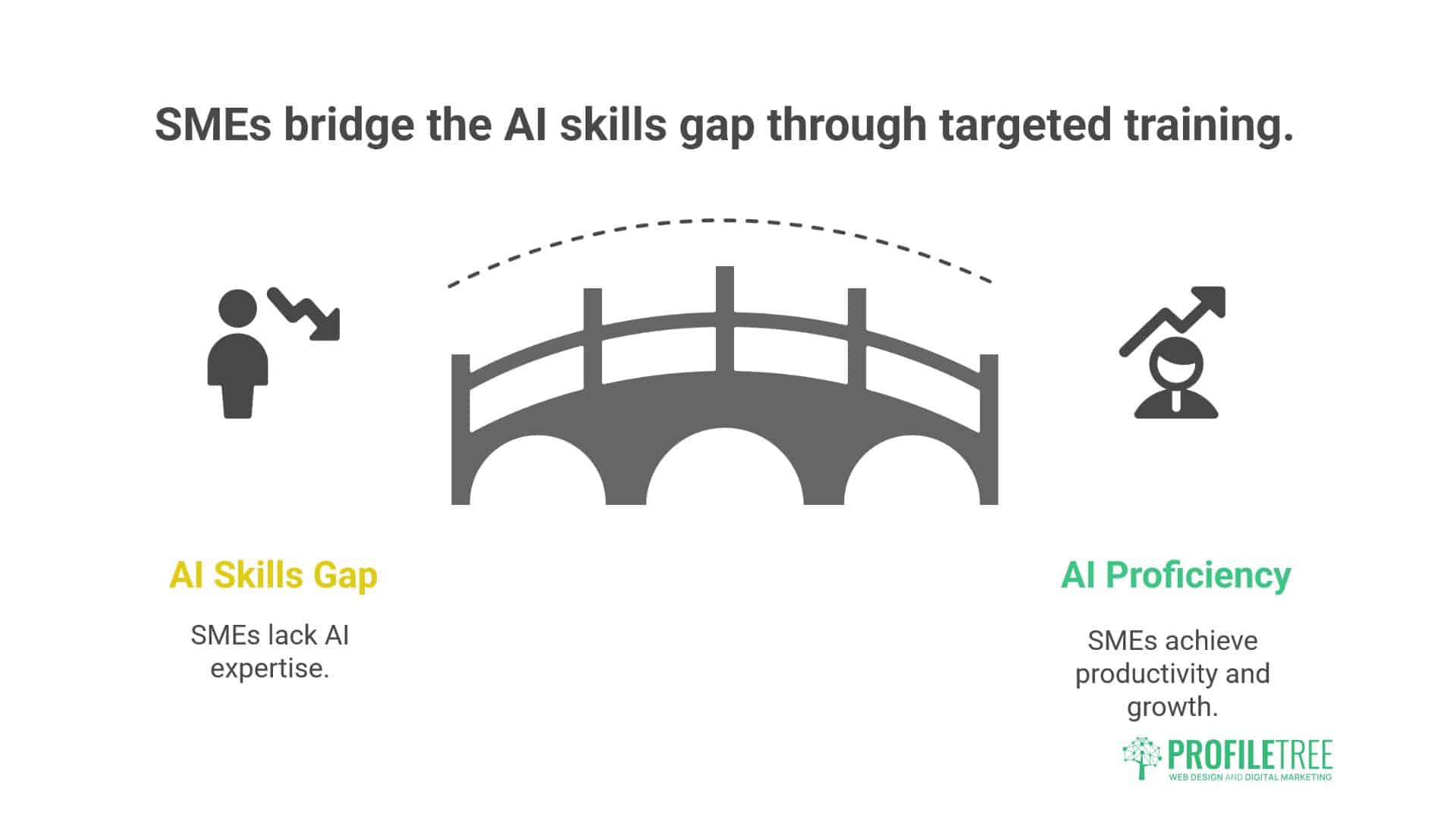
Effective AI training programmes for SMEs begin with a comprehensive skills assessment identifying current technological capabilities, specific business challenges, and learning preferences across different team roles and departments. Successful programme development involves creating phased learning pathways that start with foundational AI literacy before progressing to hands-on tool implementation. This ensures each training module directly addresses real business applications rather than abstract concepts that fail to translate into practical workplace improvements and measurable productivity gains.
Assessing Current Capabilities
Before beginning AI training, SMEs must understand their starting position. Digital maturity assessments reveal existing capabilities and gaps. Data availability audits identify what information exists for AI training. Skills inventories highlight training needs across different roles.
Professional assessment goes beyond simple questionnaires. It examines actual workflows to identify AI opportunities, reviews technology infrastructure for compatibility, and evaluates organisational culture for change readiness. This foundation ensures training addresses real needs rather than theoretical possibilities.
Identifying Training Priorities
Not everyone needs the same AI training. Owners and senior managers require strategic understanding—recognising opportunities, evaluating vendors, and making investment decisions. Operational staff need practical skills—using AI tools, interpreting outputs, and identifying issues. Technical personnel require more profound knowledge—configuring systems, managing data, and troubleshooting problems.
Priority setting considers business impact and implementation complexity. Start with high-impact, low-complexity applications that demonstrate value quickly. Build confidence through early wins before tackling challenging implementations—sequence training to match planned rollout schedules.
Selecting Training Formats
SMEs benefit from varied training approaches suiting different learning styles and operational constraints. Workshop formats bring teams together for intensive learning and discussion. Online modules allow self-paced progress around business commitments. Mentoring programmes provide ongoing support during implementation. Peer learning groups share experiences and solutions.
Effective programmes combine multiple formats. They begin with workshops that establish foundations and generate enthusiasm. They follow with online modules that develop specific skills. During initial implementations, they provide mentoring. They also facilitate peer networks for continuous improvement.
Creating Implementation Roadmaps
Training without implementation wastes investment. Successful programmes include clear roadmaps from learning to deployment. Define specific projects for applying new skills. Set realistic timelines considering business cycles and resource availability. Establish success metrics measuring both learning outcomes and business impact.
Roadmaps break significant transformations into manageable phases. For example, month one might focus on automating customer enquiry responses, month three could add inventory forecasting, and month six might integrate supplier systems. Each phase builds on previous successes while maintaining operational stability.
Practical AI Tools Every SME Should Master
Essential AI tools for SME mastery include customer relationship management systems with intelligent lead scoring, automated email marketing platforms that personalise content based on user behaviour, and chatbot solutions that handle routine customer inquiries while capturing qualified prospects. Additional core tools encompass financial forecasting software that predicts cash flow patterns, inventory management systems with demand prediction capabilities, and social media scheduling platforms that optimise posting times and content performance to maximise engagement and conversion rates across different audience segments.
Customer Relationship Management Enhancement
Modern CRM systems incorporate AI for lead scoring, opportunity prediction, and customer segmentation. Training teaches SMEs to configure these features for maximum benefit. They learn which data points improve predictions, understand how to interpret AI recommendations, and master techniques for maintaining human relationships using AI insights.
Practical exercises use real business data to demonstrate impact. See how lead scoring prioritises sales efforts. Watch customer segmentation reveal hidden market opportunities. Experience automated follow-up sequences that maintain a personal touch. These hands-on experiences transform abstract concepts into tangible benefits.
Content Creation and Marketing Automation
AI writing assistants help SMEs create marketing content, product descriptions, and customer communications. Image generation tools produce visual content for social media and websites. Marketing automation platforms use AI to optimise campaign timing, audience targeting, and message personalisation.
Training develops judgment about appropriate AI use. Learn when AI-generated content works versus when human creativity remains essential. Understand how to maintain brand voice while using AI assistance. Master prompt engineering techniques that produce better outputs.
SMEs report 70% time savings on content creation while maintaining quality. Social media engagement increases through AI-optimised posting schedules, and email open rates improve via AI subject line testing. These gains come from understanding tool capabilities and limitations through proper training.
Financial Analysis and Forecasting
AI-powered financial tools help SMEs with cash flow prediction, expense categorisation, and anomaly detection. Training covers practical applications like automated invoice processing, expense report analysis, and financial scenario modelling.
Learn to interpret AI predictions while understanding uncertainty ranges. Develop skills for identifying when AI recommendations require human review—master integration between AI tools and existing accounting systems. Understand compliance requirements for AI use in financial processes.
Small businesses improve cash flow management through accurate payment prediction. Expense processing time is reduced by 60% through automated categorisation. Fraud detection catches issues that traditional methods miss. These benefits require training that goes beyond software features to include financial understanding.
Process Automation Platforms
No-code automation platforms enable SMEs to create sophisticated workflows without programming knowledge. Connect applications, automate data transfer, and implement business logic through visual interfaces. Training develops skills for identifying automation opportunities and implementing solutions.
Start with simple automations like synchronising contacts between systems. Progress to complex workflows involving multiple applications and decision logic. Learn to monitor automated processes and handle exceptions. Understand when automation helps versus when it creates unnecessary complexity.
Manufacturing SMEs automate quality reporting across production lines. Service businesses streamline customer onboarding through connected systems. Retail operations automatically synchronise inventory across channels. Success comes from structured training that builds automation skills progressively.
Measuring ROI from AI Training Investments
AI training ROI measurement requires tracking specific productivity metrics, including time saved on routine tasks, error reduction rates, customer response time improvements, and revenue increases attributable to AI-enhanced processes rather than generic efficiency claims. Effective measurement frameworks combine quantitative data, such as reduced operational costs, increased output volumes, and shortened project completion times, with qualitative indicators like employee satisfaction improvements and enhanced decision-making capabilities that demonstrate comprehensive value creation beyond immediate cost savings.
Direct Cost Savings
AI training ROI begins with measurable cost reductions. Calculate time saved through automation multiplied by hourly labour costs. Include reduced error rates and associated correction expenses. Factor in decreased software licensing through consolidation around AI-enhanced platforms.
Training programmes costing £5,000-£10,000 typically generate first-year savings of £20,000-£50,000 for SMEs. A 10-person marketing agency saves £2,000 monthly through AI content creation. A 50-employee manufacturer reduces quality inspection costs by £40,000 annually. These returns justify training investments within months.
Document savings meticulously for future investment decisions. Track hours saved per process automated. Record error reductions with associated costs. Monitor software consolidation savings. This data supports business cases for expanded AI adoption.
Revenue Enhancement
AI training enables revenue growth through improved customer experience, faster service delivery, and enhanced product quality. Measure conversion rate improvements from AI-powered personalisation. Track sales cycle acceleration through automated lead nurturing. Monitor customer lifetime value increases from AI-driven retention programmes.
Belfast retailers report 18% revenue increases from AI recommendation engines. Dublin service firms win 25% more contracts through AI-enhanced proposals. Manchester manufacturers command premium prices for AI-verified quality. Training unlocks these opportunities by showing SMEs how to implement revenue-generating AI applications.
Productivity Improvements
Productivity gains from AI extend beyond simple time savings. When AI handles routine tasks, employees focus on higher-value activities. Decision quality improves through AI-augmented analysis. Innovation increases as teams gain time for creative work.
Measure productivity through output per employee, project completion rates, and quality metrics. Account for both quantity and quality improvements. Consider employee satisfaction and retention benefits from eliminating mundane work.
Professional services firms report 30% productivity gains after AI training. Staff handle more complex cases while AI manages routine queries. Client satisfaction improves through faster response times and more thorough analysis. These compound benefits multiply training ROI.
Competitive Advantage Valuation
Some AI training benefits resist simple financial calculation but provide substantial competitive advantages. First-mover advantages in applying AI to industry-specific challenges. Enhanced reputation as innovative, forward-thinking businesses. Improved ability to attract top talent interested in working with cutting-edge technology.
Consider market share gains from superior customer experience. Value increased win rates from AI-enhanced proposals. Account for partnership opportunities with larger companies seeking AI-capable suppliers. These strategic benefits often exceed direct financial returns.
Common AI Implementation Challenges for SMEs
SMEs frequently encounter predictable AI implementation challenges, including employee resistance to technological change, inadequate data quality that undermines AI system accuracy, and unrealistic expectations about immediate results that lead to premature project abandonment. Additional common obstacles involve insufficient technical infrastructure to support AI tools,a lack of clear implementation roadmaps that result in scattered adoption efforts, and budget constraints that force businesses to choose cheaper solutions that may not deliver promised capabilities or integrate effectively with existing business systems.
Data Quality and Availability
AI requires data for training and operation, but many SMEs lack organised, accessible information. Customer data sits in disconnected spreadsheets, financial records exist only in accounting software, and operational information remains in employees’ heads rather than documented systems.
Training addresses data challenges through practical strategies. Learn to identify valuable data already available. Understand the minimum data requirements for different AI applications. Master techniques for incrementally improving data quality. Develop data governance practices that support AI while maintaining simplicity.
Start with AI applications requiring minimal data. Build data collection into new AI implementations. Improve data quality through automated validation. These approaches make AI accessible even for data-poor organisations.
Integration with Existing Systems
SMEs often use various software systems that don’t communicate effectively. Accounting software doesn’t connect to CRM. Inventory management stands separate from e-commerce platforms. Email marketing exists independently of customer service systems.
AI training includes integration strategies suitable for SME resources. Learn about API connections and middleware platforms. Understand when integration adds value versus unnecessary complexity—master techniques for phased integration that maintain operational stability.
Modern integration platforms make connections easier than ever. No-code tools enable visual workflow creation. Pre-built connectors link popular SME applications. Training develops skills for effectively leveraging these capabilities.
Change Management and Adoption
Employees may resist AI adoption through fear of job loss or technology anxiety. Long-serving staff comfortable with existing processes see no need for change, while younger employees might embrace AI too enthusiastically without proper controls.
Practical training addresses human factors alongside technology. Learn change management techniques specific to AI adoption. Understand how to communicate AI benefits without creating fear. Master strategies for involving staff in AI implementation rather than imposing solutions.
Successful SMEs frame AI as augmentation rather than replacement. They involve employees in identifying AI opportunities, celebrate early successes publicly, and provide ongoing support during transition periods. These approaches, taught through comprehensive training, ensure smooth adoption.
Cost Management and Budgeting
AI costs extend beyond initial software licenses. Training, integration, ongoing maintenance, and scaling expenses must be considered. SMEs need realistic budgets that account for the total cost of ownership while maintaining positive ROI.
Training develops cost management skills specific to AI projects. Learn to evaluate total costs, including hidden expenses. Understand when to use subscription services versus one-time purchases. Master techniques for starting small and scaling based on proven returns.
Budget frameworks help SMEs invest appropriately. Start with pilot projects requiring minimal investment. Scale successful applications before moving to new areas. Maintain contingency funds for unexpected integration costs. These disciplines ensure sustainable AI adoption.
ProfileTree’s Approach to AI Training for SMEs
At ProfileTree, we’ve developed AI training programmes specifically designed for SME needs and constraints. Our Belfast-based team understands the unique challenges facing smaller businesses across Ireland and the UK. We combine technical expertise with practical business experience to deliver training that transforms operations without overwhelming participants.
Our training methodology focuses on immediate, practical application rather than theoretical knowledge. Participants work with their own business data and processes from day one. We identify quick wins that demonstrate value while building toward transformative implementations. Every exercise relates directly to real business challenges rather than abstract examples.
We excel at translating complex AI concepts into understandable business language. Whether training retail owners in customer behaviour prediction or teaching manufacturers about predictive maintenance, we ensure participants understand how and why AI solutions work. This deeper understanding enables confident decision-making about AI investments.
Ciaran Connolly, ProfileTree founder, explains: “Most AI training fails SMEs because it’s designed for enterprise organisations with dedicated IT departments and massive budgets. We’ve developed programmes that recognise SME realities—limited time, stretched resources, and need for immediate returns. Our participants implement AI solutions during training, not months later. They see real results with their business data, building confidence that AI works for their specific situation.”
Our integrated approach means AI training connects with broader digital transformation strategies. We show how AI enhances existing SEO efforts, amplifies content marketing impact, and accelerates web development projects. This holistic perspective ensures AI becomes part of comprehensive business growth rather than isolated technology experiments.
Post-training support distinguishes ProfileTree from generic training providers. We maintain relationships with participants, providing ongoing guidance as they implement and scale AI solutions. Our community of AI-adopting SMEs shares experiences and solutions, creating peer learning networks that extend training value indefinitely.
Success Stories: SMEs Winning with AI
Real SME success stories demonstrate measurable AI impact across diverse sectors: a Cork furniture manufacturer reduced production errors by 60% through AI-powered quality inspection systems. In comparison, a Belfast marketing agency increased client campaign performance by 45% using predictive analytics for ad targeting. Additional success cases include a Galway accounting firm that automated 70% of routine bookkeeping tasks, enabling staff redeployment to higher-value client advisory services, and a Cardiff logistics company that optimised delivery routes to reduce fuel costs by 35% while improving customer satisfaction through more accurate delivery predictions.
Retail Transformation in Belfast
A family-owned Belfast retailer with three locations faced competition from online giants and struggled with inventory management across stores. After completing structured AI training, they implemented demand forecasting that reduced stockouts by 45% while decreasing overall inventory costs by 20%.
The training revealed opportunities beyond initial expectations. Customer behaviour analysis identified purchasing patterns enabling targeted promotions that increased average transaction values by 28%. Automated reordering freed staff to focus on customer service, improving satisfaction scores by 35%.
Most importantly, the business developed internal AI capabilities rather than depending on external consultants. Staff members now identify new AI opportunities independently, continuously improving operations through technology adoption.
Manufacturing Excellence in Dublin
A Dublin-based food manufacturer producing artisan products for export markets used AI training to address quality consistency challenges. Computer vision systems now inspect products more accurately than human inspectors, reducing customer complaints by 67%.
Predictive maintenance prevents equipment failures that previously caused production delays. Energy optimisation AI reduced utility costs by 23% through demand management and efficiency improvements. Automated reporting saves 15 hours weekly in compliance documentation.
The transformation required no additional technical staff. Existing employees learned to operate and maintain AI systems through comprehensive training. The company now leads their sector in technology adoption, winning contracts based on AI-verified quality standards.
Professional Services Innovation in Manchester
A Manchester accounting practice with eight employees transformed its business model through AI adoption. Document processing AI reduces data entry time by 75%, enabling staff to handle more clients without expanding headcount.
AI-powered analysis identifies tax savings opportunities human review might miss. Automated workflows ensure compliance deadlines never slip. Client portals with AI chatbots answer routine queries instantly, improving service while reducing interruptions.
The practice now markets AI-enhanced services as a differentiator, attracting larger clients that were previously beyond its capacity. Revenue increased 40% within 18 months of AI training completion, and profit margins improved through operational efficiency.
Future-Proofing Your SME Through Continuous AI Learning
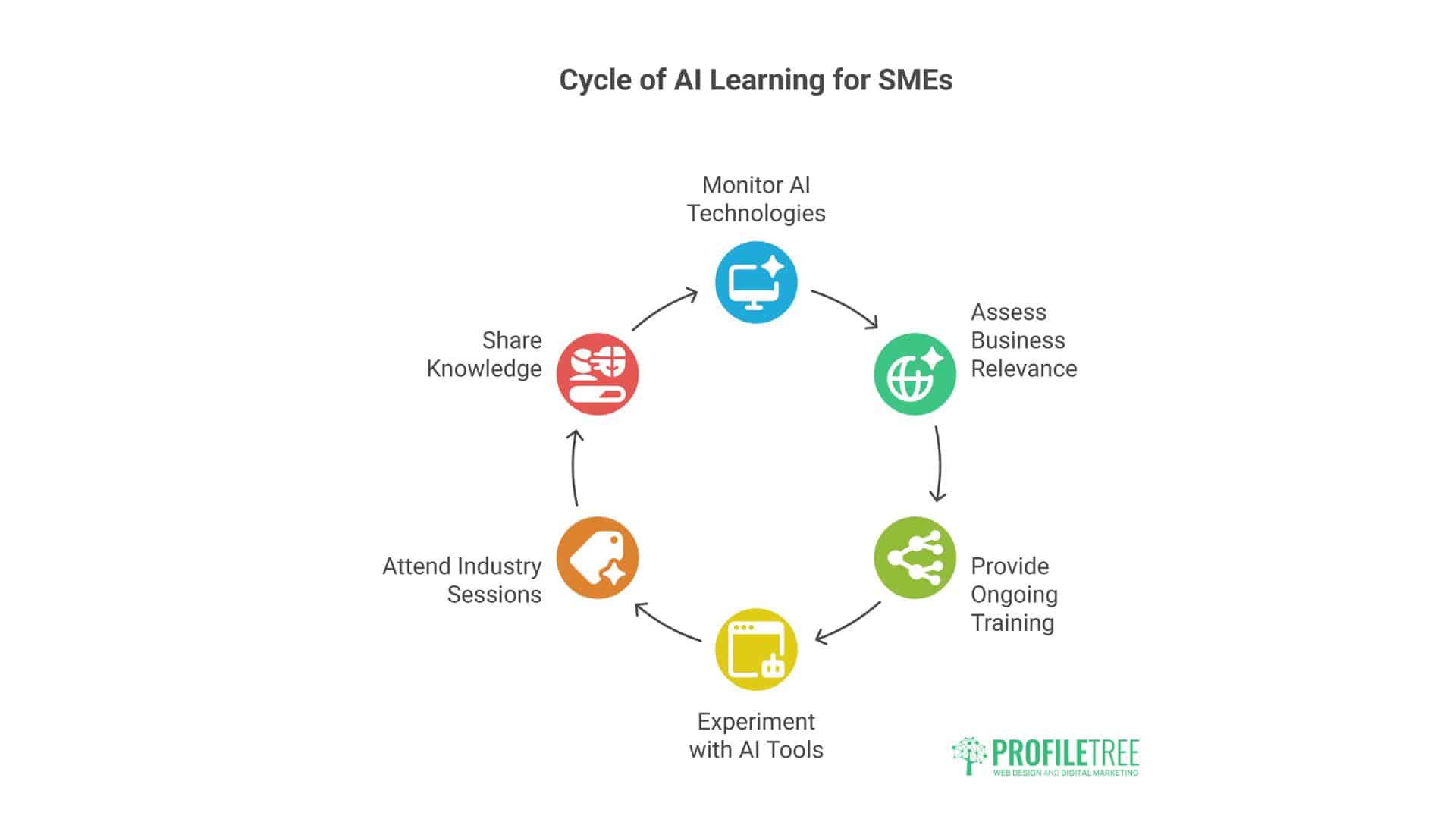
Future-proofing SMEs through continuous AI learning requires establishing systematic knowledge update processes that monitor emerging AI technologies, assess their business relevance, and provide ongoing team training that prevents skill obsolescence in rapidly evolving technological landscapes. Sustainable AI competitiveness demands creating learning cultures where employees regularly experiment with new AI tools, attend industry training sessions, and participate in peer knowledge-sharing networks that ensure businesses adapt quickly to technological advances rather than falling behind competitors who maintain more aggressive AI adoption and capability development strategies.
Staying Current with AI Developments
AI technology evolves rapidly, with new capabilities emerging monthly. SMEs need strategies for maintaining current knowledge without overwhelming limited resources. Continuous learning programmes, industry newsletters, and peer networks help businesses stay informed about relevant developments.
Focus on developments affecting your specific sector rather than following all AI news. Join industry associations discussing AI applications. Attend relevant webinars and conferences. Participate in online communities where SMEs share AI experiences.
ProfileTree provides ongoing education for training alumni through regular updates, workshops, and community events. We filter massive amounts of AI information to highlight what matters for SMEs, saving businesses time while ensuring they don’t miss significant opportunities.
Scaling AI Capabilities
Initial AI implementations often reveal additional opportunities. Customer service chatbots might expand into sales assistance. Inventory forecasting could extend to supplier negotiations. Document processing may grow into knowledge management systems.
Scaling requires structured approaches that maintain stability while expanding capabilities. Develop AI governance frameworks, establishing implementation standards. Create centres of excellence where AI knowledge concentrates and spreads. Build partnerships with technology providers supporting growth.
Training programmes should include scaling strategies from inception. Learn to evaluate when expansion makes sense versus optimising existing systems. Understand resource requirements for different scaling approaches. Master techniques for maintaining ROI during growth phases.
Building AI-Ready Culture
Sustainable AI adoption requires cultural change beyond initial training. Organisations must embrace experimentation, accept intelligent failure, and celebrate learning. Employees need encouragement to identify AI opportunities and confidence to suggest improvements.
Develop innovation frameworks that encourage AI exploration while managing risk. Establish safe spaces for testing new applications. Reward employees who identify successful AI use cases. Share failures as learning opportunities rather than hiding mistakes.
Cultural transformation happens gradually through consistent actions. Regular AI showcases demonstrate ongoing value. Success stories inspire broader adoption. Continuous training ensures skills keep pace with ambition. These elements combine to create organisations where AI becomes natural rather than forced.
Getting Started: Your AI Training Action Plan
The journey from AI-curious to AI-capable begins with a commitment to structured learning. Random YouTube videos and vendor tutorials won’t deliver the comprehensive understanding SMEs need for successful implementation. Professional training programmes for smaller businesses provide frameworks, practical skills, and ongoing support that ensure positive outcomes.
Start by assessing your organisation’s readiness for AI adoption. Examine existing digital capabilities, data availability, and cultural openness to change. Identify specific business challenges where AI might help. Consider competitive pressures and market opportunities that AI could address.
Select training that matches your business context and objectives. Generic AI courses waste time on irrelevant content. Industry-specific programmes deliver immediately applicable knowledge. Look for training combining multiple learning formats with practical implementation support.
Commit appropriate resources, including time, budget, and personnel. AI transformation requires investment, but returns justify costs when implementation follows proper training. Assign dedicated team members to lead AI initiatives. Allocate time for learning and experimentation—budget for training and initial implementation costs.
Create implementation timelines that balance ambition with realism. Plan quick wins for momentum while working toward transformative applications. Allow time for learning, testing, and refinement. Build buffers for unexpected challenges that arise during adoption.
Most importantly, recognise that AI training isn’t a one-time event but an ongoing journey. Technology evolves, new applications emerge, and business needs change. Successful SMEs commit to continuous learning that keeps pace with AI advancement while maintaining focus on business value.
Conclusion: AI Training for SMEs in Ireland & the UK
The question for SMEs isn’t whether to adopt AI but how quickly they can develop capabilities before competitors gain insurmountable advantages. Every day without AI training represents lost efficiency, missed opportunities, and growing competitive gaps. Businesses thriving five years from now will be those that invest in AI knowledge today.
Professional AI training designed for SMEs removes barriers that previously made advanced technology inaccessible to smaller businesses. You no longer need computer science degrees, massive budgets, or dedicated IT departments. Modern AI tools and proper training enable any motivated business to implement transformative solutions.
The return on investment from AI training extends far beyond immediate cost savings or revenue gains. Businesses develop innovation capabilities that compound over time. Employees gain valuable skills that increase job satisfaction and market value. Organisations build resilience against disruption while positioning for future opportunities.
Irish and UK SMEs face unique opportunities in AI adoption. Government support programmes provide funding assistance. Concentrated business communities enable peer learning. Strong educational institutions offer expertise and partnerships. These advantages disappear if businesses delay training until AI becomes mandatory rather than advantageous.
The path forward is clear: invest in comprehensive AI training that transforms your business capabilities. Choose programmes explicitly designed for SME needs rather than generic courses. Focus on practical implementation rather than theoretical knowledge. Build internal capabilities rather than perpetual consultant dependence.
ProfileTree stands ready to guide your AI transformation journey. Our proven training programmes have successfully helped hundreds of SMEs across Ireland and the UK implement AI. We understand your challenges, speak your language, and deliver results that matter for smaller businesses.
Don’t let another quarter pass while competitors gain AI advantages. Contact ProfileTree today to discuss your AI training needs and develop a customised programme for your business. Visit ProfileTree’s AI training services to explore how we can accelerate your AI adoption and ensure you win rather than wonder about AI’s potential.
The future belongs to SMEs that embrace AI thoughtfully and strategically. With proper training, that future includes your business. Take action today—your competitors already are.
FAQs
How much should SMEs budget for comprehensive AI training?
SMEs should budget £2,000-£5,000 per participant for comprehensive AI training programmes, including workshops, online modules, and implementation support. Group training for 5-10 employees typically costs £8,000-£15,000. While this seems substantial, average first-year returns of 300-400% justify investments, with many businesses recovering costs within 3-4 months through efficiency gains alone.
What’s the minimum technical knowledge required for AI training?
Basic computer literacy and familiarity with standard business software like spreadsheets and email suffice for most SME AI training. Modern AI tools designed for business users require no programming knowledge. The ability to think logically about business processes matters more than technical expertise. Our training starts with fundamentals, ensuring everyone progresses regardless of starting point.
How long before SMEs see real results from AI training?
Most SMEs implement their first AI solutions during training and see immediate results within 2-4 weeks. Simple automations like email categorisation or invoice processing deliver value immediately. More complex applications like demand forecasting or predictive maintenance typically show results within 2-3 months. The key is starting with quick wins that build confidence and demonstrate value.
Can tiny businesses (under 10 employees) benefit from AI?
Absolutely. Smaller businesses often see proportionally larger benefits from AI because they have less slack in their operations. A 5-person consultancy automating proposal generation saves significant time. A 3-person online retailer using AI for customer service handles more enquiries without adding staff. Size constraints make AI more valuable, not less.
What happens if AI implementation fails after training?
Proper training significantly reduces failure risk by teaching implementation best practices and common pitfalls avoidance. When challenges arise, they’re usually scaling issues rather than complete failures. Quality training includes troubleshooting skills and support networks for addressing problems. Most “failures” are valuable learning experiences that inform better second attempts.