
Cost of Living Crisis: Marketing Resilience for UK & Irish SMEs
Table of Contents
The cost of living crisis changed the rules of consumer spending in ways that outlasted the headline inflation figures. UK inflation peaked at 11.1% in October 2022, according to the Office for National Statistics, and while the rate has since moderated, the psychological shift it triggered has not reversed. Households that rewired their spending habits under pressure do not simply return to old patterns when the numbers improve. For SMEs across Northern Ireland, Ireland, and the UK, that means the marketing environment of 2019 no longer exists.
The businesses managing this well are not the ones that slashed budgets and went quiet. They are the ones that redirected their marketing spend toward tactics with a measurable return: search visibility, trust-building content, and digital channels that work harder per pound spent. This guide covers the consumer psychology driving current purchase decisions, the messaging approaches that hold up under economic scrutiny, and the specific digital levers available to SMEs that want to emerge from this period with stronger customer relationships than they entered with.
What the Cost of Living Crisis Actually Did to Consumer Behaviour
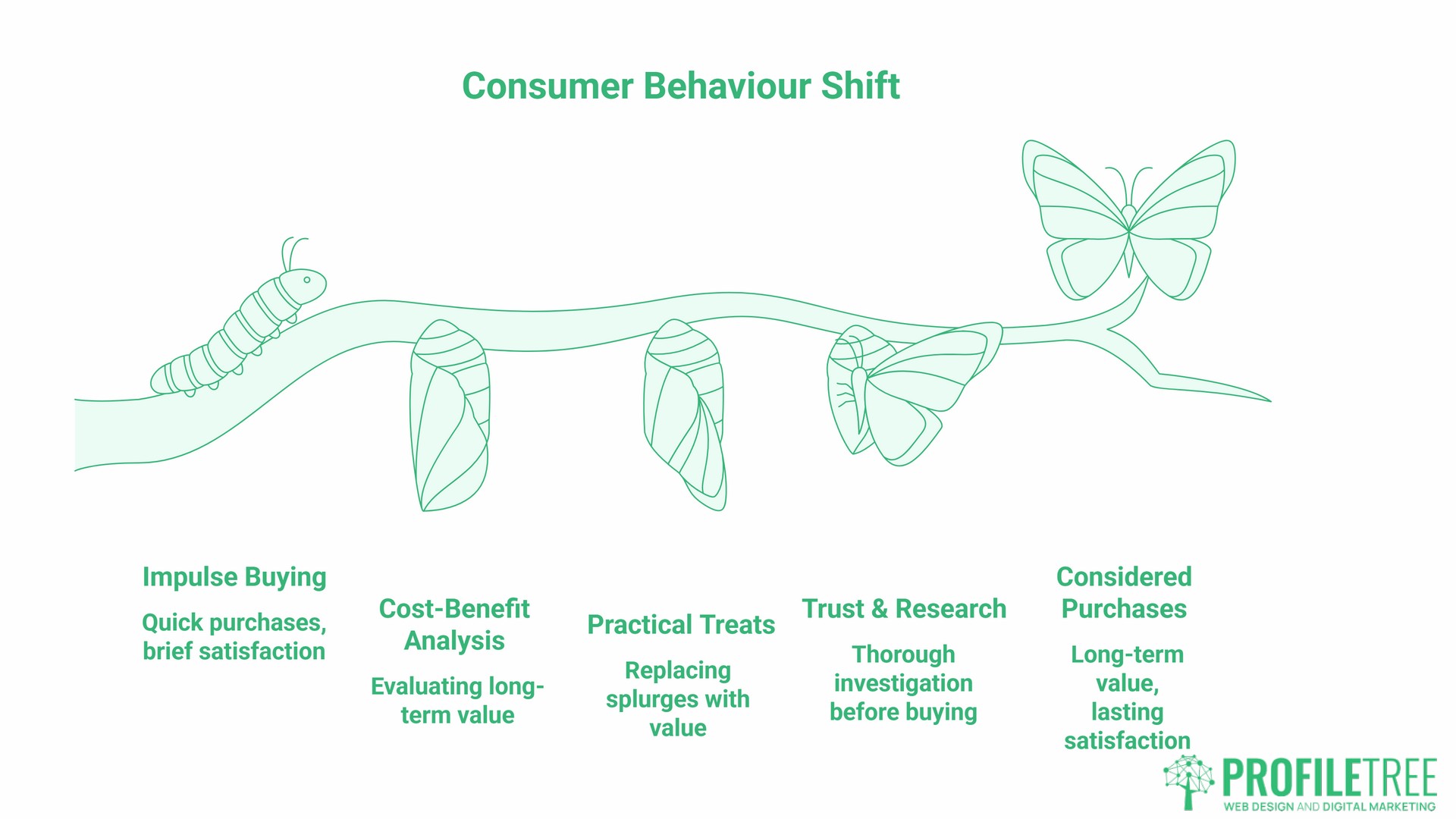
The shift in spending goes deeper than price sensitivity. Consumers are now running a mental cost-benefit calculation on every purchase that simply did not exist at the same intensity before the crisis. Value perception has expanded to include cost per use, expected lifespan, multifunctionality, and even resale potential. A product that looks expensive on the sticker but works out cheaper over three years is, for many buyers, the smarter choice.
Several patterns have become consistent across the UK and Irish markets. Considered purchases now generate more satisfaction than impulse buys, reversing the pre-crisis pattern in which a quick purchase provided a brief positive feeling. The “practical treat” has replaced the lifestyle splurge: a coffee subscription with a known monthly cost beats a variable habit; a long-lasting item at a higher price beats a cheaper one that needs replacing.
Trust has become a prerequisite for purchase rather than a bonus. Buyers research more thoroughly, read reviews with more scrutiny, and are quicker to walk away from businesses that feel exploitative or opaque. Social proof carries more weight than brand messaging, particularly in local and regional markets where peer recommendations travel fast.
For Northern Ireland specifically, the border economy adds a layer of complexity. NI businesses operate across two currency zones and benefit from access to both UK and EU markets, but that also means consumers can compare prices across jurisdictions. Local positioning, community connection, and transparency about pricing matter more here than in purely domestic UK markets.
Why Business as Usual Carries the Greatest Risk
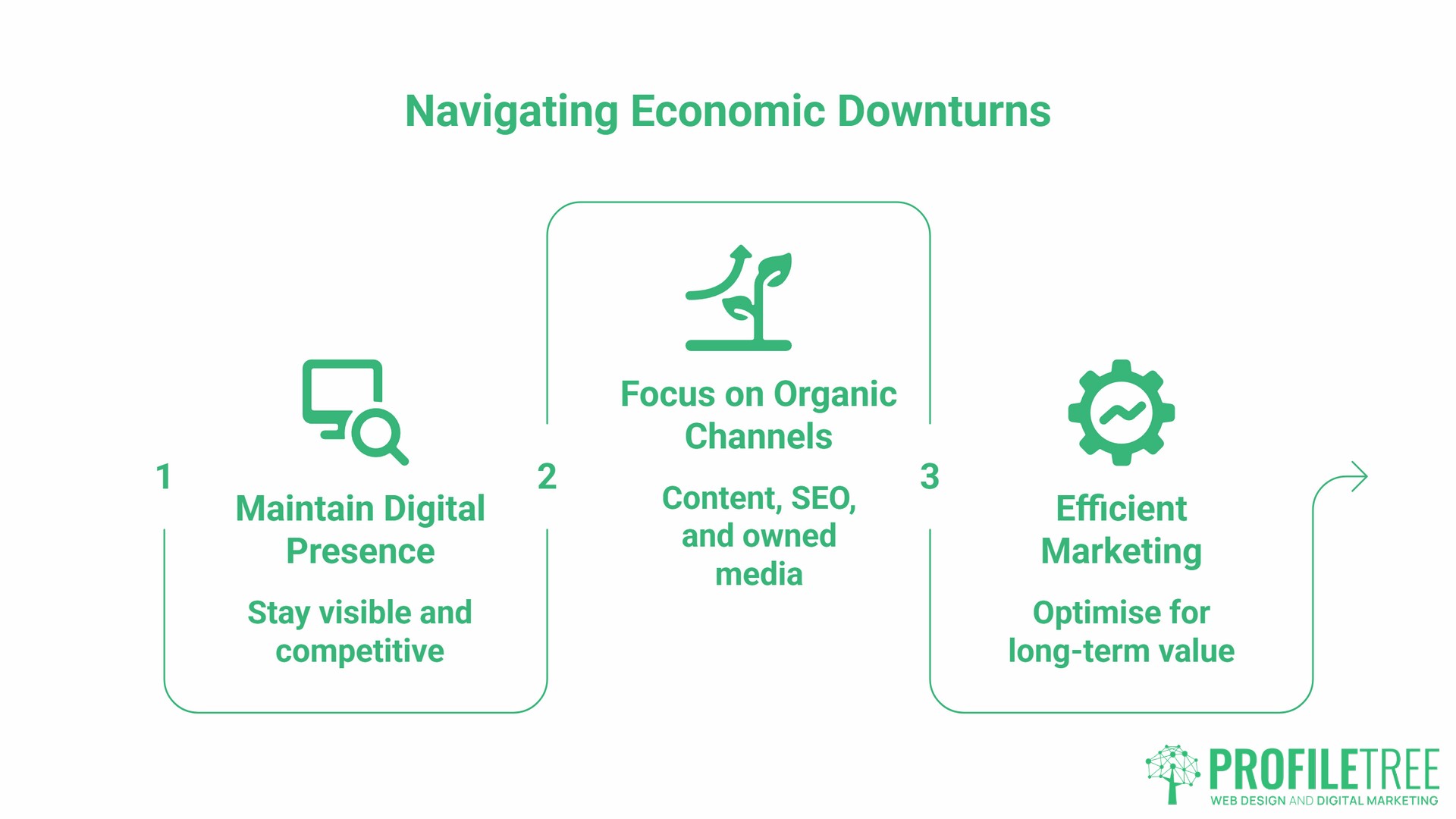
The instinct to cut marketing spend during economic pressure is understandable and almost always wrong. Businesses that reduce their digital presence during a downturn hand market share to competitors who stay visible, and rebuilding lost search rankings or audience trust after a period of silence costs significantly more than maintaining them would have.
The evidence from previous downturns is consistent: brands that maintain or increase their share of voice during recessions gain market share that persists into the recovery. The cost of living crisis is not a short interruption to be waited out. It is a permanent recalibration of how a significant portion of your customer base makes decisions.
The practical question is not whether to market but how to market more efficiently. That is where the case for organic search, content, and owned channels becomes strongest. Paid advertising costs per click rise during downturns as businesses compete for a smaller pool of buying intent. Organic SEO and content marketing, by contrast, compound over time: the traffic earned by a well-optimised article this quarter is still arriving two years from now at no additional cost.
Shifting to High-Intent Search: SEO as an Efficiency Engine
When consumer confidence falls, search behaviour changes in a predictable direction. Informational and comparison queries increase sharply. People search “how to reduce energy bills” rather than browsing lifestyle content. They search for “best value broadband” rather than respond to brand-awareness advertising. “Alternatives to” and “instead of” queries rise. Problem-solving content outperforms product promotion by a wide margin.
This shift benefits SMEs with strong content and SEO foundations, because they appear exactly when a prospective buyer is actively looking for a solution. Profltree’s SEO services work from this principle: identify the specific queries your target customers are using as their buying anxiety increases, then produce content that answers those questions with authority.
For a professional services firm in Belfast, that might mean ranking for “how to reduce legal costs small business Northern Ireland.” For a retail business in Dublin, it might mean ranking for “long-lasting [product category] worth the price.” The keyword research required to find these queries is a structured process, not guesswork, and the content built around them continues to generate enquiries long after it is published.
Local SEO deserves particular attention during the cost of living crisis. Searches with “near me” modifiers intensify when people are reducing discretionary travel and want certainty about where they are spending. If your Google Business Profile is incomplete, your local citations are inconsistent, or your site does not carry clear geographic signals, you are invisible at exactly the moment local intent is highest.
Content Marketing: Moving From Awareness to Action
Content that performs under economic pressure is useful content. Not content that generates vague brand awareness, but content that solves a specific problem the reader has today. During the cost of living crisis, this distinction matters because it changes what you write, how you structure it, and where you place it in the buyer journey.
Utility-first content builds trust in a way that promotional content cannot. An SME that publishes a genuine guide to getting more from its product or service, or that explains its pricing honestly with a cost comparison, is signalling something about its values. That signal is read by buyers who are scrutinising every transaction.
Content marketing structured around the questions people are actually asking also performs better in AI search environments. Platforms such as Google’s AI Overviews, ChatGPT, and Perplexity draw on pages that provide clear, self-contained answers to specific questions. A page structured around real questions with direct answers above the fold is significantly more likely to be cited than a page built around brand messaging.
“The businesses that do best in a difficult market are the ones that make themselves genuinely useful to their customers,” says Ciaran Connolly, founder of ProfileTree. “That means creating content that helps people make better decisions, not content that just pushes them toward a sale. When times are tight, trust is the currency.”
The format this content takes matters. Comparison frameworks, honest how-to guides, checklists, and cost breakdowns all perform well because they match the research-heavy mindset of the cost-conscious buyer. Articles that address a specific question in the first paragraph, then support the answer with evidence and examples, earn both search rankings and reader confidence.
Video: Building Trust at Scale on a Tighter Budget
Video is not a luxury tactic during the cost of living crisis. It is one of the most efficient ways to build the human connection that turns a cautious prospect into a paying customer, and it does not have to be expensive.
Behind-the-scenes content showing your team, your process, and the people behind the business humanises what might otherwise be an anonymous transaction. Buyers who feel they know a business are more likely to choose it when price differences are marginal. Educational video content, such as tutorials, maintenance guides, or process explainers, provides lasting value: it keeps appearing in search results and social feeds long after it is made, without ongoing spend.
Short-form video on platforms including TikTok, Instagram Reels, and YouTube Shorts suits the reduced attention spans of a distracted, anxious audience. Quick tips, direct answers to common questions, and honest product demonstrations work well in this format. The production bar for short-form is low enough that an SME with a smartphone and a clear message can compete effectively.
ProfileTree’s video marketing services cover both production and strategy. For time-poor SMEs that want to maintain video output without building an in-house capability, a structured video content programme can be planned and produced externally, then repurposed across channels. A single well-produced expert interview, for example, can be edited into a long-form YouTube piece, several short clips, and a written article, yielding multiple content outputs from one production session.
Website Optimisation: Removing the Barriers to a Cautious Purchase
When a prospective customer reaches your website during the cost of living crisis, they arrive with more scepticism and less patience than they would have three years ago. Every element of your site either builds their confidence or erodes it. There is less tolerance for friction than there used to be.
Price transparency has moved from a nice-to-have to a ranking factor in buyer trust. Websites that hide costs until checkout or use unclear pricing structures lose buyers at the point where they are closest to converting. Showing your pricing openly, even if it’s premium, signals confidence in your value.
Trust signals need to be front and centre, not buried in the footer. Review scores, accreditations, client logos, and any recognisable affiliations should be visible above the fold on service pages. A buyer who is anxious about spending needs reassurance before they scroll.
Site speed is directly tied to conversion rates. A slow site that takes more than 3 seconds to load will cost you sales from mobile users who are researching during commutes or breaks. Web design and development built around performance, not just aesthetics, is a commercial decision with a measurable impact on enquiry rates.
Payment options and return policies should be visible throughout the purchase journey, not just at checkout. Clarity about what happens if something goes wrong reduces the perceived risk of a purchase for a buyer who is already uncertain.
AI and Digital Training: Doing More With Less
AI tools have made it genuinely possible for an SME dealing with the cost of living crisis to produce consistent, quality marketing output without proportionally increasing headcount or spend. The constraint is knowing which tools to use, how to integrate them into existing workflows, and where human judgment remains irreplaceable.
The risk in this area is that businesses adopt AI tools without a strategy for using them. Content produced at volume without editorial control tends to be generic, and generic content does not rank or convert. The efficiency gains from AI are real, but they require the right training and workflow design to capture them without sacrificing quality.
ProfileTree’s AI implementation and digital training programmes are built for SMEs that want to use these tools practically. That includes understanding where AI can automate repetitive tasks (scheduling, basic reporting, first-draft content), where it requires human oversight (strategy, audience insight, final editorial), and how to measure whether the tools are actually saving time and improving output.
For SMEs implementing AI solutions, the most common mistake is treating it as a cost-cutting exercise rather than an efficiency one. The goal is not to spend less on marketing overall. It is to generate more marketing output from the same investment, with better targeting and less wasted spend.
Messaging Frameworks That Hold Up Under Scrutiny
How you talk about your business during the cost of living crisis matters as much as where you show up. Messages built on emotional manipulation, vague reassurance, or tone-deaf luxury positioning are filtered out by buyers who have become more analytically rigorous about every purchase.
The messaging approaches that work share a common structure: they acknowledge reality, communicate specific value, and demonstrate confidence in what they offer without overclaiming.
Value communication works best when it is specific and comparative. Showing the cost per day for a product, or the five-year total cost compared with a cheaper alternative, gives a buyer the information they need to justify the purchase to themselves. Reframing premium pricing around longevity or total cost of ownership is not spin; it is providing the calculation that a cost-conscious buyer is already trying to do.
Empathy without exploitation is harder to execute than it sounds. Acknowledging that times are difficult lands well when it is followed by a concrete action: a price freeze, a payment plan, a free resource, or a genuine reduction in friction. It lands badly when it is followed by a sales pitch that ignores the acknowledgement entirely.
Community positioning resonates particularly strongly in Northern Ireland and the Republic of Ireland, where the local economic argument (“spending here keeps money in this community”) carries genuine cultural weight. This is not a marketing gimmick when applied honestly. Businesses with genuine local roots and local employment have a credible case to make, and making it explicitly is more effective than leaving it implied.
Regional Considerations: Northern Ireland and the Republic of Ireland
The cost of living crisis played out differently across UK and Irish regions, and Northern Ireland occupies a distinctive position. NI businesses operate under UK inflation and monetary policy while remaining part of the EU single market for goods under the Windsor Framework. That dual-market access is a genuine competitive advantage for some sectors, but it also means NI businesses face more complex cost pressures than their counterparts in Great Britain.
Energy costs in Northern Ireland have historically been higher than the GB average due to lower interconnection and less competitive gas supply. For energy-intensive businesses, this amplifies the cost pressures the crisis has already created. Digital efficiency, in this context, is not an abstract benefit but a direct reduction in operational costs.
The Republic of Ireland experienced its own inflation cycle, peaking above 9% in mid-2022 according to the Central Statistics Office, before moderating. Irish consumer behaviour shows patterns similar to those in the UK, with increased research intensity and price sensitivity, but with some regional distinctions. Irish consumers show a stronger preference for local businesses when the price difference is perceived as fair, and community-oriented messaging tends to perform well.
Cross-border businesses face the additional complexity of GBP/EUR currency fluctuation, which directly affects pricing competitiveness. Digital marketing that clearly addresses both markets, with appropriate localisation rather than a single generic message, captures a genuinely underserved audience.
Campaign Approaches That Survive Cynical Scrutiny
Solidarity campaigns work when they are backed by real action and fail when they are not. A business that freezes prices, offers extended payment terms, or creates a genuinely useful community resource during a difficult period earns the kind of loyalty that outlasts any advertising campaign. A business that puts “we’re in this together” in its social media bio while quietly raising margins earns contempt.
The test for any campaign during the cost of living crisis is simple: if you removed the branded elements, would the content still be useful? If the answer is yes, you are building trust. If the answer is no, you are producing noise that buyers will filter out.
Humour, used carefully, can work. Self-aware acknowledgement of the economic situation, combined with genuine value, strikes a note that more earnest messaging sometimes misses. The risk is in misreading the room. Comedy about economic hardship requires precision that most brands should not attempt. The safer territory is warmth and specificity rather than wit.
Measuring What Matters During Economic Pressure
Success metrics need to shift during the cost of living crisis. Reach and awareness are easier to achieve when ad prices are low, but they do not pay wages. The metrics that matter under economic pressure are those tied to commercial outcomes.
Customer retention rate is more important than new customer acquisition right now. Keeping an existing customer costs a fraction of finding a new one, and retained customers in a difficult period tend to show higher lifetime loyalty. Tracking retention, monitoring churn triggers, and building systematic re-engagement programmes for lapsed customers gives a better return on effort than broad acquisition campaigns in most sectors.
Share of wallet (the proportion of a customer’s category spending that goes to your business) is a more useful measure than total revenue when category spending is down. A business that retains its share of a smaller pie is in a better position than one that maintains revenue by acquiring customers competitors have lost.
Engagement depth, measured through time on site, email open and click rates, and direct message volume, indicates the quality of your audience relationship. A smaller, highly engaged audience is more commercially valuable during economic pressure than a large, passive one.
The Strategic Case for Investing in Digital Now
Downturns create market share opportunities for businesses willing to maintain or increase their digital investment while competitors retreat. The businesses that come through the cost of living crisis in the strongest position will not necessarily be the ones with the largest budgets. They will be the ones that used a difficult period to build content depth, technical SEO foundations, customer trust, and digital capabilities that compound in value over time.
This is the argument ProfileTree makes to every SME client considering reducing digital investment: the spend saved this quarter will cost more to replace next year, both in rebuilding rankings lost through inactivity and in recovering customer confidence that faded through silence. The brands that stay present, useful, and honest during the cost of living crisis are the ones customers remember when the pressure eases.
The practical starting point is a digital audit. Understanding where your current visibility sits, which content is driving traffic and which is not, what your website conversion rate looks like relative to industry benchmarks, and where your competitors are investing gives you a basis for decision-making. Without that data, cuts are guesswork and investments are wishful thinking.
FAQs
How can digital marketing help my business during the cost of living crisis?
Digital marketing, particularly organic SEO and content, shifts your customer acquisition cost away from paid channels that become more expensive during downturns. By building search visibility for high-intent queries, you reach buyers who are actively looking for what you sell at the moment they are most likely to convert. Content that answers real questions also builds the trust that cautious buyers need before committing to a purchase. The compounding nature of organic traffic means the investment pays returns over a long period, not just while you are spending.
Should I cut my marketing budget to save money?
Cutting marketing spend during a downturn is one of the most reliably counterproductive decisions a business can make. It reduces visibility at exactly the moment when maintaining presence is cheapest relative to the long-term return. Businesses that maintain their share of voice during recessions consistently gain market share that persists into recovery. The better question is whether your current spend is allocated to the highest-return channels. Redirecting budget from low-ROI activity toward organic search, content, and owned channels is a strategic reallocation, not a cut.
What is the fastest way to reduce digital spend without losing leads?
Audit your paid search campaigns for negative keywords and irrelevant traffic first. This is often where the largest proportion of wasted spend sits. Then review your landing pages for conversion rate, because improving conversion means each pound of existing spend generates more leads. Shifting the balance toward local SEO is also effective: local visibility is less competitive and captures the intensified local intent that characterises consumer behaviour during economic pressure.
Are there grants available for NI and ROI businesses to help with digital costs?
InterTradeIreland offers programmes supporting cross-border trade and business development for SMEs operating across both jurisdictions. Local Enterprise Offices in the Republic of Ireland provide funding for digital capability development. Invest Northern Ireland has supported digital transformation projects for eligible NI businesses. Availability and eligibility criteria change, so checking current programmes directly with these bodies is the right approach rather than relying on any fixed list.
How does consumer behaviour in Ireland differ from the UK during a cost of living crisis?
The broad patterns are similar: increased research intensity, stronger price sensitivity, and preference for businesses that communicate transparently. The differences are in degree and context. Irish consumers show a stronger stated preference for local businesses when the price differential is within a tolerable range. The ROI energy market operates differently from the UK market, creating distinct cost pressures. Currency fluctuation between GBP and EUR affects cross-border purchasing decisions in ways that do not apply in purely domestic markets.
How is the cost of living crisis affecting B2B businesses differently from B2C?
B2B businesses face the cost of living crisis as a cost-of-doing-business problem rather than a consumer psychology one. Their clients are under the same margin pressure they are, which means procurement processes have become more rigorous, payment terms are being renegotiated, and discretionary spend is being scrutinised. B2B digital marketing during this period needs to demonstrate ROI explicitly: not “here is what we offer” but “here is the measurable return you can expect.” Content that presents a cost-benefit framework, an efficiency case, or a risk-reduction argument performs better than content built around services in the abstract.