
Questions to Ask an SEO Company Before You Hire
Table of Contents
SEO companies are not all the same, and picking the wrong one means the bill arrives twice: once for the work that never moved the needle, and again for the cleanup. The questions you ask in the first meeting are the cheapest insurance you have against that. They tell you, fast, whether you are talking to a genuine specialist or someone selling reports.
This is a practical vetting guide for SME owners and marketing managers across Northern Ireland, Ireland and the UK. It covers the questions to ask an SEO company, the answers that should reassure you, the answers that should worry you, and a quick way to check an agency is actually doing the work you pay for. Where it helps, it shows how ProfileTree, a Belfast digital agency, answers the same questions, so you have a real benchmark to hold others to.
Can You Show Me Your Own Rankings and Results?
Ask this first. Any SEO company worth hiring should be able to show its own search visibility and point to results it has delivered for businesses like yours. An agency that cannot rank or be found for its own terms is a warning in itself.
A good answer points you to specific, checkable evidence: terms the agency ranks for, client examples in your sector, and the change over time, rather than a single snapshot. A weak answer hides behind “client work comes before our own site” or refuses to share anything at all.
How ProfileTree answers it: the agency’s own rankings are public and can be checked in any browser, and its work spans more than 1,000 web projects since 2011 for businesses across Northern Ireland, Ireland and the UK. You can read more on the SEO services page and see how the same team handles website design and web development under one roof. If you are weighing several UK agencies, ProfileTree’s guide to UK SEO companies is a useful starting point.
How Do You Report Results, and Can I Verify the Work?
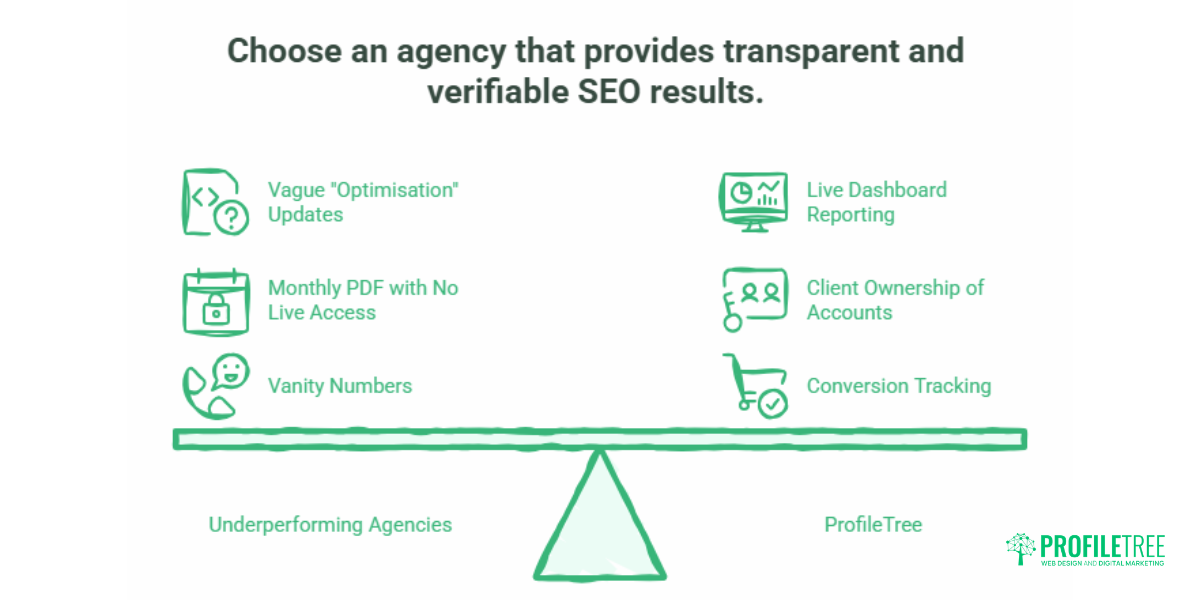
This is where most relationships succeed or fail. Professional reporting shows what changed, why, and what it did for the business, not just a list of tasks. Vague “optimisation” updates and a monthly PDF with no live access are how underperforming agencies hide.
Strong reporting includes a live dashboard, before and after position tracking, traffic attributed to organic search, and conversions rather than vanity numbers. You should keep ownership of Google Analytics and Search Console, and you should be able to ask “what did you actually do last month?” and get a clear answer.
How ProfileTree answers it: monthly dashboard reporting with before and after position tracking, organic traffic attribution and conversion tracking, with the client keeping ownership of their own accounts. The same reporting discipline runs through its digital strategy work.
The 15-minute check anyone can run.
You do not need to be technical to confirm an agency is doing something. Three quick checks help:
- Run a
site:yourdomain.comsearch to see how many pages Google has indexed, and watch whether that grows. - Compare this month’s published or updated pages against what the report claims was delivered.
- Check that titles, meta descriptions and new content on your priority pages have actually changed.
If the numbers in the report never match what you can see on the live site, ask why. If you would rather hand the whole review to a specialist, a structured SEO audit guide walks through the same checks in more depth.
How content, digital PR and SEO support each other on a real campaign.
What is your link-building and SEO Tactics Approach?
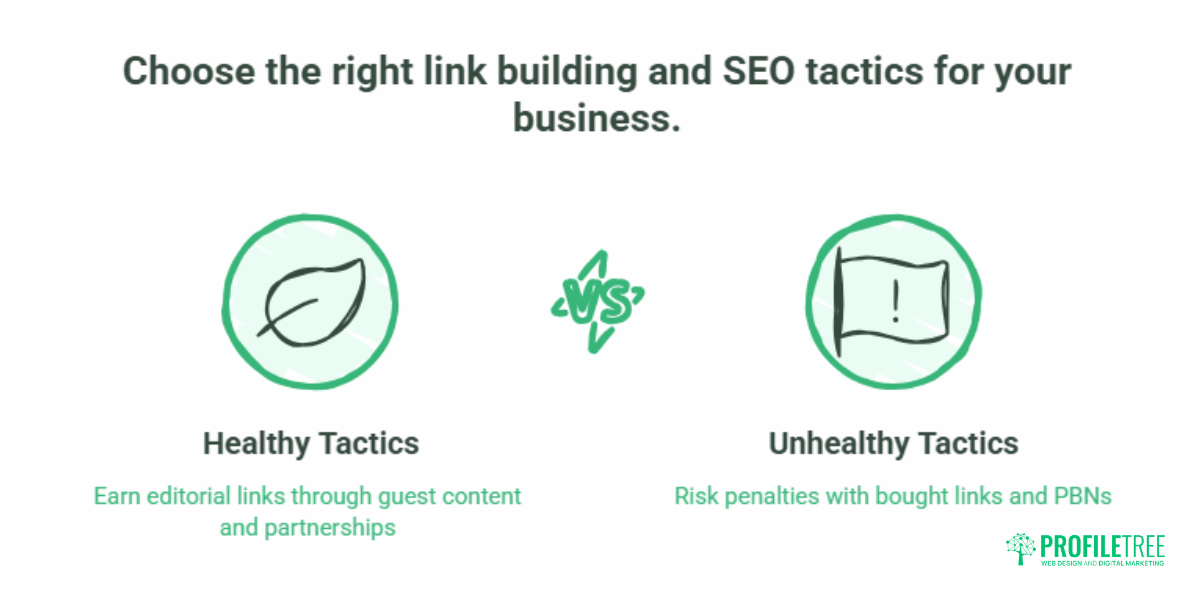
Links still matter, and the wrong approach to them can earn a penalty that takes months to undo. Ask the agency to explain, in plain terms, how it earns links and what tactics it avoids. This is the moment to verify the transparency of their link building and SEO tactics: a real specialist will happily walk you through it.
Healthy answers describe editorial links from relevant, real sites: guest content, digital PR, resource outreach and genuine partnerships. Answers that should stop you cold include bought links, private blog networks, automated directory submissions, and “we have our own secret method”.
How ProfileTree answers it: editorial backlinks earned through guest content and digital PR, not paid links or PBNs. Link earning sits alongside the content marketing that gives other sites a reason to cite you in the first place. Local visibility also leans on consistent listings, which is why a tidy presence on business listing sites still pays off for service businesses.
How Will You Optimise My Brand for AI Search?
Most vetting guides were written for ten blue links. That era is ending. Buyers should now be asking what an AI-first SEO consultancy does, so its audit covers core web vitals and advanced schema, and how the agency plans to get the brand cited in AI answers from tools like Google AI Overviews, ChatGPT and Perplexity.
A forward-looking agency can talk about structured data, entity clarity, content built to answer whole questions, and how it measures brand visibility inside AI results. An agency that waves this away as a fad is telling you it is a step behind.
How ProfileTree answers it: AI search readiness is treated as part of the core work, with schema, entity-rich content and measurement of AI visibility, backed by hands-on AI training and AI marketing support. For businesses adding assistants to their own sites, there is dedicated work on AI chatbots, too. The same judgment that helps you vet an SEO agency applies when choosing AI partners, and it pairs naturally with AI local SEO for area-based businesses.
“The businesses that get the most from SEO are the ones that ask the awkward questions early. Ask an agency how they will get you cited in AI answers, not just ranked in blue links, and ask them to show you the actual work behind last month’s report. If the answer is vague, that tells you everything. A good agency, in Belfast or anywhere else, should be able to explain exactly what changed on your site and why.”Ciaran Connolly, founder, ProfileTree
Do You Specialise in Any Particular Industries or Areas?
Sector and regional knowledge shortens the path to results. A local SEO company that understands cross-border trade between Northern Ireland and the Republic, or the seasonal patterns in your industry, will waste less of your budget learning the basics. This is a fair question to ask a local SEO company before you commit.
Useful experience shows up as work in your sector, awareness of UK and Irish market differences, and local citation sources rather than generic templates. If every answer is “we do everything for everyone”, press harder.
How ProfileTree answers it: the focus is SME work across Northern Ireland, Ireland and the UK, spanning website design, SEO, content, video marketing and AI implementation, run from a Belfast base. Where teams need to build the skills in house instead, there is structured digital training. If your real gap is people rather than tactics, there is a useful read on hiring marketing help is worth a read.
Why the site behind your SEO matters as much as the search work itself.
What Happens in the First 90 Days, and Who Owns the Data?
The first three months reveal whether an agency has a plan or is improvising. Ask what the onboarding looks like and what you should expect to see by day 90.
A clear answer covers a technical audit and quick wins early, keyword and content mapping, and a few measurable improvements by the end of the quarter. On the commercial side, confirm the exit terms before you sign: notice period, what happens to the work, and, above all, who holds the accounts.
You should retain ownership of Google Analytics, Tag Manager, Search Console and every content asset. If an agency sets these up under its own control and will not hand them over, that is a lock-in by another name. Reasonable contracts use a short trial or a 30-day notice period rather than a long tie-in, because good agencies keep clients through results, not penalty clauses.
What Should SEO Cost in the UK and Ireland?
Most online pricing advice is quoted in US dollars and means little here. As a rough guide for the UK and Ireland, the table below shows typical ranges by tier. Treat anything far below the bottom of this range with caution: sub-£500 a month usually buys automated reports and little real work, the same logic that makes a £99 package a false economy.
| Tier | Typical monthly retainer (UK) | Hourly (UK / Ireland) | What is usually included |
|---|---|---|---|
| Local/small business | £750 to £1,500 | £80 to £120 / €90 to €130 | Local SEO, a handful of target areas, basic reporting |
| Mid-market / national | £1,500 to £4,000 | £100 to £150 / €120 to €170 | Technical, content and link earning, multi-location |
| Enterprise / competitive | £4,000 to £6,000+ | £150 to £200+ / €170 to €200+ | Full strategy, large sites, AI search work |
Price should always be read against scope and accountability, not in isolation. A clear breakdown of hours, deliverables and reporting is worth more than a low headline number. For context on where budgets often go first, a guide to website costs sets sensible expectations.
SEO Agency Red Flags to Watch For
Some answers should end the conversation. Watch for these warning signs when hiring an SEO company:
- Guaranteed rankings. Nobody controls Google’s results. A guarantee of a number one position points to either dishonesty or black-hat tactics.
- Secret proprietary methods. SEO is not magic. Refusing to explain the approach usually hides something.
- Instant results. Real organic gains take three to six months. Promises of overnight wins often mean paid ads dressed up as SEO.
- Cold mass outreach. Unsolicited “we noticed your site needs SEO” emails rarely come from agencies you want.
- No verifiable business. A real agency has a real address and a registered company you can check on Companies House.
- Rock-bottom pricing. Proper SEO takes time and skill. Bargain packages tend to deliver automated reports and nothing that ranks.
A quick scorecard for interviews
Score each agency you speak to against the same criteria. Three or more amber answers are a reason to slow down.
| Criteria | Green flag | Amber flag | Red flag |
|---|---|---|---|
| Reporting | Live dashboard, before/after positions | Monthly PDF only | No data access |
| Link building | Editorial links, named sources | “We have our methods” | Guaranteed links, PBNs |
| AI search | Talks schema, entities, and AI citations | Aware but no plan | “AI does not matter” |
| Data ownership | You own GA and Search Console | Shared logins | Agency-controlled accounts |
| Promises | Realistic timelines | Hedged guarantees | Guaranteed number one |
Where video fits into a modern search and content plan.
Making the Decision With Confidence
Interview at least three agencies, run the same questions past each, and verify the answers yourself rather than taking them on trust. The right partner will welcome hard questions because their work holds up to them. The wrong one will get defensive, and that is useful information.
For external grounding, Google’s own guidance on hiring an SEO sets out what to expect from a legitimate provider and is a sensible cross-check before you sign anything. Whatever you decide, keep your accounts in your own name and keep asking what changed and why.
If you would rather build the skills in house, training is an alternative to a retainer.
Frequently Asked Questions
How do I choose a good SEO company?
Start by getting clear on the commercial outcome you want, whether that is leads, local visibility, e-commerce sales or a technical fix. Then judge each agency on three things: alignment with that goal, proof of work in a sector like yours, and transparency about how they report and earn links. Background-check the people who will actually run your account, not just the sales contact, and ask for verifiable examples rather than vague claims. The agency that can explain its work in plain language and show you is usually the safer choice.
How much should I pay for SEO in the UK and Ireland?
Professional UK retainers typically run from around £1,500 to £6,000 or more a month, depending on competitiveness and scope, while hourly consulting tends to sit between £80 and £180 in the UK and roughly €90 to €200 in Ireland. Local campaigns can start lower, but packages far below £500 a month rarely fund real work and usually amount to automated reporting. Always read price against scope, so you are comparing deliverables and accountability rather than headline numbers.
How do I know if an SEO company is legit?
Look for transparency signals you can verify. A legitimate agency gives you live dashboard access, explains its link building openly, lists real staff you can find on LinkedIn, and operates from a registered business you can check on Companies House. Run a quick site search on your own domain to see indexing, and compare published changes against what the reports claim. An agency that hides its reporting, its team or its methods is telling you something.
Do SEO companies guarantee search rankings?
No honest one does. Google updates its systems constantly, and competitors are always moving, so a specific ranking cannot be guaranteed. Treat any promise of a number one position as a definite red flag.
What questions should I ask when hiring an SEO agency?
Four questions cut through quickly: How do you report results, and can I see the dashboard? How do you earn links, and what do you avoid? How will you get my brand cited in AI answers, not just ranked? And who owns the analytics and content if you part ways? The quality and openness of those answers will tell you most of what you need.
What is the typical contract length when hiring an SEO company?
Because SEO usually takes three to six months to show meaningful returns, some commitment is reasonable, but the structure should protect you. A short trial period or a 30-day notice arrangement is healthier than a long tie-in with penalty clauses. Good agencies keep clients through results, so be wary of anyone who relies on the contract to keep you to your promises.