
TikTok Copywriting for NI Brands: SME Guide to Going Viral
Table of Contents
TikTok copywriting is one of the most overlooked skills in small business marketing. TikTok is increasingly where Northern Ireland consumers discover local businesses, and the brands making an impact there are not always the ones with the biggest budgets. What separates the accounts that get watched from those that get ignored comes down to one thing: TikTok copywriting. The words on screen, the captions beneath the video, the question that ends each post: these are the mechanics that decide whether a viewer scrolls past or stops, watches, and follows.
This guide covers how TikTok copywriting works, why Northern Ireland businesses have a genuine structural advantage on the platform, and how to apply the techniques that drive real engagement. Whether a business owner is creating content personally or working with a team, the principles here apply to any NI SME trying to build a meaningful audience.
“TikTok rewards founders who speak plainly about what they do and why it matters,” says Ciaran Connolly, founder of ProfileTree. “Northern Ireland businesses have a natural storytelling instinct. The challenge is channelling that into copy that works in three seconds.”
Why NI Brands Have a TikTok Advantage
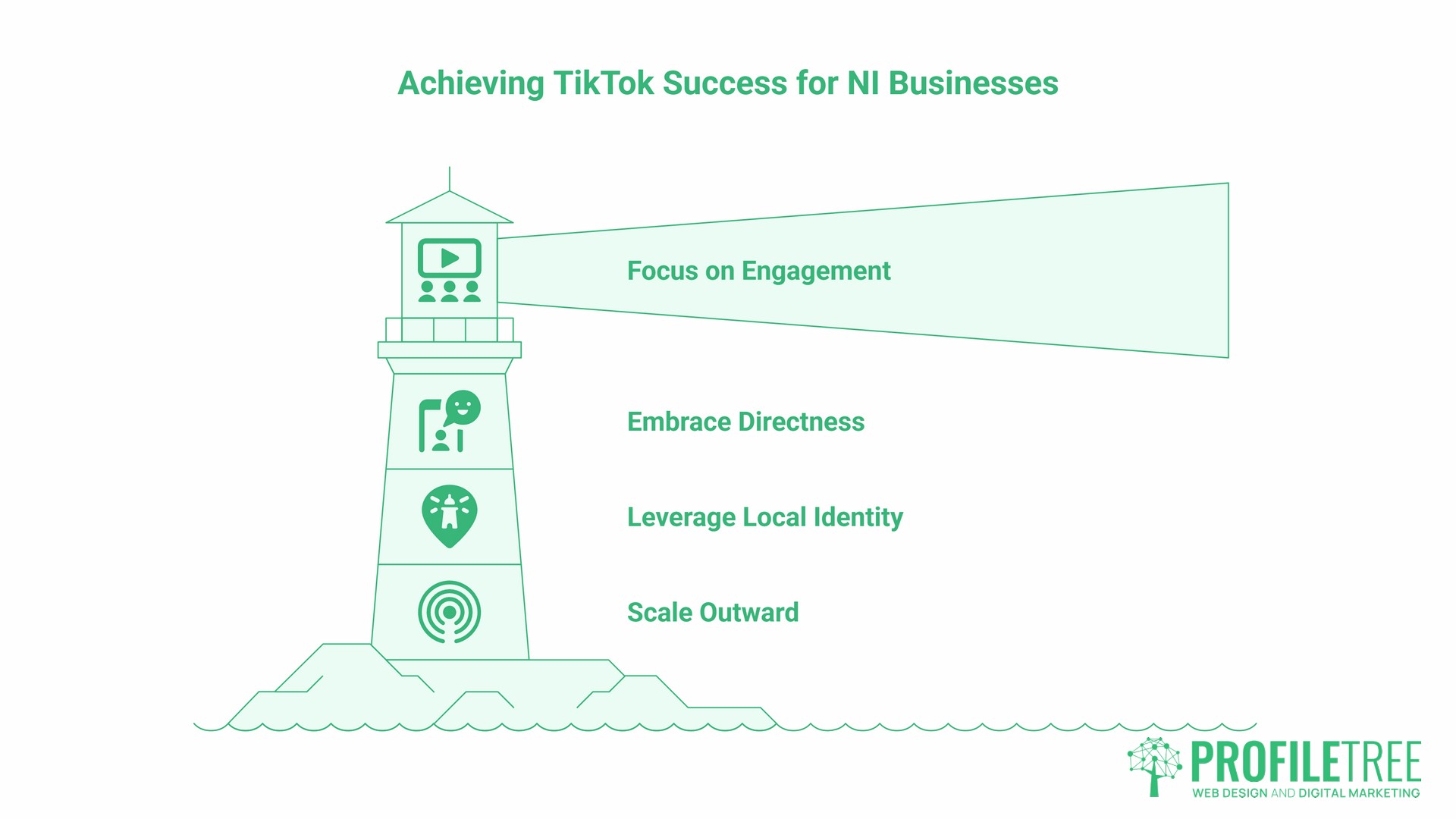
The TikTok algorithm does not care where a business is based. It responds to engagement: watch time, comments, shares, and saves. These signals are driven by content that feels specific, personal, and genuine, which is precisely what Northern Ireland’s business culture produces naturally.
The directness of NI communication translates well to short-form video. Where a polished corporate account might spend ten seconds on a branded intro, a Belfast café owner starts with the thing itself: the soda bread coming out of the oven, the repair job that went wrong before it went right, the honest answer to a question a customer asked. This kind of content earns attention because it feels real.
Geographic specificity also performs better than most NI businesses expect. Content that names a street, a town, or a local reference creates an insider signal for local viewers and genuine curiosity for everyone else. “Things you’ll only get if you’re from Ballymena” draws local engagement while intriguing an international audience that has never heard of Ballymena. This is the proximity advantage: local identity scales outward on TikTok in a way it rarely does on other platforms.
For businesses wanting to understand broader TikTok behaviour before diving into copywriting, the TikTok statistics for UK businesses article is a useful starting point for context on how the platform operates in this market.
The Anatomy of a Viral TikTok Script
TikTok copywriting follows a consistent structure across almost every format that performs well. The specifics change; the skeleton stays the same.
The 3-Second Hook: Stopping the Scroll
The hook is the most important element of any TikTok post. TikTok’s algorithm heavily weights completion rates: if viewers swipe away within the first few seconds, the platform limits its distribution. According to multiple independent analyses of TikTok’s 2026 algorithm, the completion rate threshold for wider distribution has risen to approximately 70%, up from around 50% in 2024. That means seven in ten viewers need to watch your video to the end before the platform considers pushing it to a larger audience. Get the hook right, and the rest of the content has a chance to work.
Effective hooks share one characteristic: they create an open loop. The viewer cannot close the loop without watching more.
| Hook Type | Example | Why It Works |
|---|---|---|
| Curiosity gap | “Nobody in Belfast believed this would work” | Forces the viewer to find out what “this” is |
| Problem identification | “The fade everyone gets wrong” | Addresses a pain point the target viewer recognises |
| Contrarian claim | “Why we stopped using hashtags” | Challenges received wisdom, demands explanation |
| Local specificity | “Things you’ll only understand if you’re from Derry” | Creates an insider signal; outsiders get curious |
| Question hook | “Is this normal in your town?” | Turns the viewer into a participant before they decide to engage |
The single most common TikTok copywriting mistake is burying the hook. Starting with “Hi, welcome back to our channel” or “Today we’re going to talk about…” immediately loses viewers. The hook is the first sentence on screen or the first words out of the creator’s mouth. Nothing comes before it.
Body Content: Delivering the Craic or the Value
Once the hook has held attention for three seconds, the body of the video needs to deliver on whatever was promised. TikTok audiences are highly sensitive to bait-and-switch content: if the hook implied a reveal, the reveal needs to land.
For NI brands, the body section is where local character pays off. The dry wit, the self-deprecation, the willingness to show the process, including the parts that went wrong. These elements are not just personality quirks. They are engagement mechanics. A video that shows a genuine failure before a success holds attention better than one that presents only polished outcomes.
Keep the copy in the body section directly. One idea per text overlay. Write for someone watching with no sound on a commute.
The CTA: Directing Local Intent
A TikTok CTA buried in the caption rarely performs. The most effective calls to action on TikTok are those woven into the content itself, at the moment when the viewer is most engaged.
“The supplier link is in my bio” within a useful recommendation outperforms “Link in bio!” at the caption end. “Follow for part two”, said at the natural pause point in a story works better than the same phrase tagged on after the content ends. The timing of a CTA on TikTok matters as much as the wording.
For NI businesses with physical locations, the CTA can direct to Google Maps, a booking system, or a WhatsApp link, wherever the conversion actually happens for that business.
Mastering the “Norn Iron” Voice in TikTok Copywriting
The question of how much local dialect to use in TikTok copy is one that NI brands handle regularly. The answer depends on the content’s purpose and the intended audience.
For community-facing content, local vernacular works well. “Dead on,” “wee buns,” “catch yourself on,” and “bout ye” signal authenticity to a Northern Irish audience and create a sense of shared identity that builds genuine followings. This kind of content does not need to translate itself; the in-group nature is part of the appeal.
For educational or instructional content aimed at a broader audience, standard English performs better in the caption while local character comes through in the audio. A Belfast food business explaining a recipe can convey personality through spoken commentary while keeping on-screen text readable for any English-speaking viewer.
The approach to avoid is performing Irishness for an outside audience. Audiences on TikTok are particularly attuned to content that feels manufactured, and the “fellow kids” register when a brand awkwardly adopts slang it does not naturally use, which damages credibility faster on this platform than on any other.
The “Norn Iron” voice works best when it reflects how the person behind the business actually speaks, rather than how they think a Northern Irish TikTok account should sound. Authenticity on this platform is not a brand value; it is a technical requirement.
For businesses struggling to find that voice consistently across content, social media marketing support in Northern Ireland can help establish a tone framework that holds across platforms.
TikTok SEO: Getting Your Captions Found
TikTok is increasingly functioning as a search engine. According to Adobe’s January 2026 study of 807 US consumers, 49% of consumers have used TikTok as a search engine, up from 41% in 2024. Among Gen Z specifically, 65% have used the platform for search. For local businesses, restaurants, and service providers, this represents a meaningful and growing discovery channel. TikTok copywriting now has an SEO dimension that did not exist in the platform’s earlier years.
The principles of TikTok SEO differ from Google optimisation in important ways. TikTok users search in natural language: “best lunch spots in Belfast city centre” rather than “Belfast lunch.” Captions and on-screen text that match conversational search patterns perform better in TikTok’s own discovery system.
Keyword integration in TikTok captions also follows different norms. A caption reading “Belfast café | sourdough | Northern Ireland food” functions as a searchable description rather than keyword stuffing. This is appropriate for the platform and improves discoverability.
For hashtag strategy, specificity outperforms reach for local businesses. #BelfastSmallBusiness reaches a more relevant audience than #SmallBusiness. #NorthernIrelandFood attracts more targeted viewers than #FoodTikTok. A practical mix for most NI businesses:
- Two to three broad reach tags (
#SmallBusiness,#ForYouPage) - Two to three location or niche-specific tags (
#BelfastFood,#NIBusiness) - One trending tag where it fits naturally
Closed captions improve search visibility because TikTok indexes both the spoken word in videos and the caption text. Northern Irish accents can occasionally confuse auto-captions; manually checking and correcting them is a straightforward improvement that pays off in both accessibility and discoverability.
Profile optimisation matters too. A bio reading “Belfast Baker | Sourdough & Pastries | Northern Ireland | Order via link” provides multiple search touch points and tells both the algorithm and potential customers exactly what the account offers.
Caption Optimisation: The Supporting Act
TikTok captions serve a different purpose than Instagram or Facebook captions. They are not a second version of what is happening in the video. They are an extension of it.
Effective TikTok copywriting in captions follows a simple rule: add context, do not repeat. The most effective approach for NI brands is context addition. If the video shows a result, the caption explains the process. If the video shows a process, the caption explains why it matters. If the video asks a question, the caption provides the framework for the answer that the comments will deliver.
Captions that continue a story work particularly well. A video ending on an ambiguous moment, with a caption that begins to resolve it, creates a reading incentive in addition to the viewing incentive. This double-engagement signal tells the algorithm the content is holding attention across two separate behaviours.
Keep emoji use minimal. Two to three at most, chosen for meaning rather than decoration. TikTok audiences respond better to plain language than to heavy emoji formatting, which tends to read as a generic corporate social media approach rather than genuine communication.
On-Screen Text: Writing for the Silent Viewer
On-screen text is a core element of TikTok copywriting that many NI businesses underuse. Research on mobile video consumption consistently shows that the majority of social video is watched without sound: figures from multiple 2024 and 2025 studies range from 75% to 85% of mobile viewers watching on mute at least some of the time. On commutes, in quiet spaces, during working hours: a significant portion of any video’s audience will never hear what is being said. For these viewers, on-screen text carries the entire narrative.
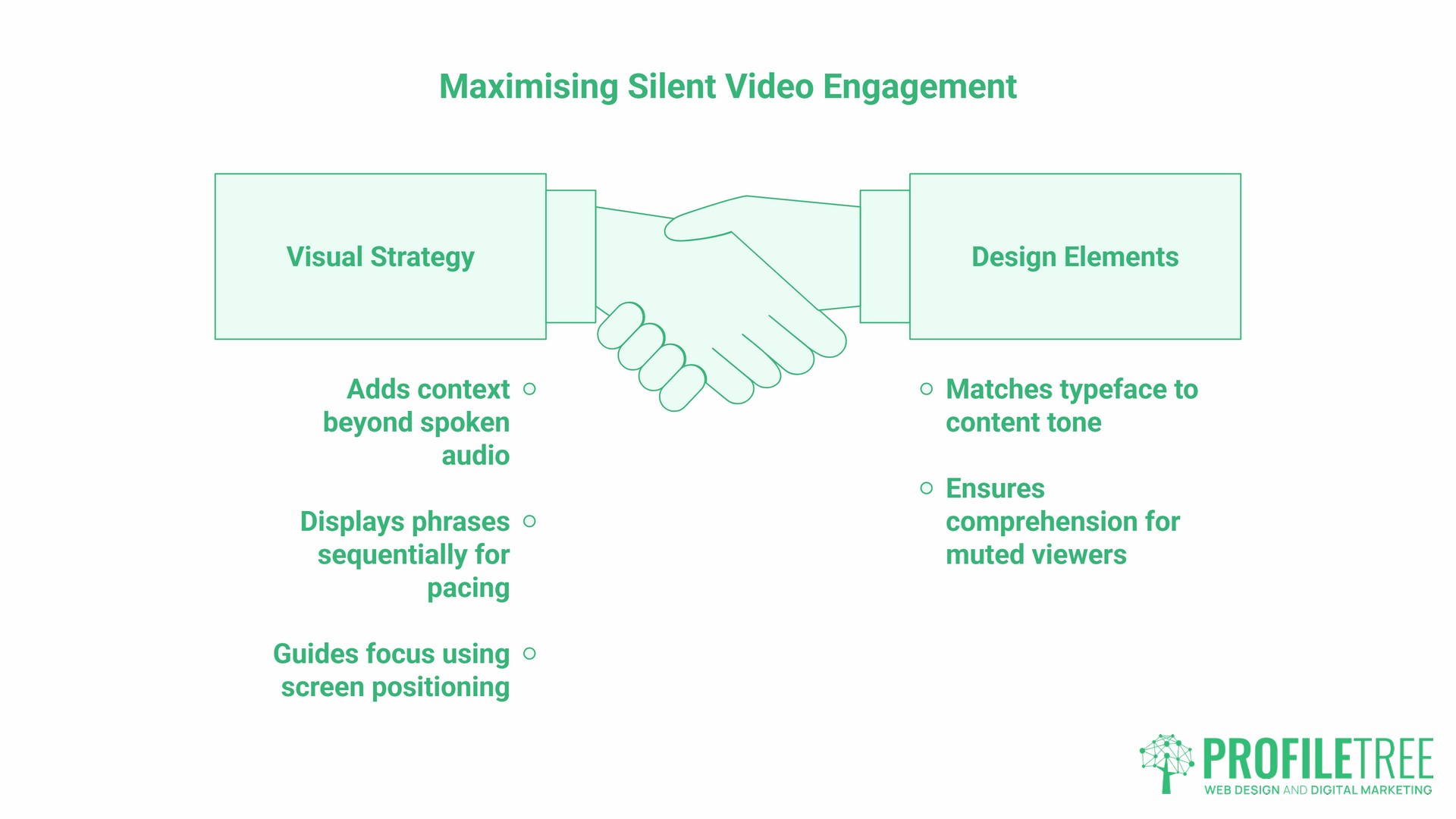
This is not a subtitling task. On-screen text on TikTok functions as parallel storytelling. It can add context that the audio does not include, create comedic timing by appearing slightly before or after the relevant visual moment, or provide technical detail while the spoken content handles tone and personality.
Font choice on TikTok carries associations. The platform’s Classic font reads as direct and straightforward; Handwriting reads as personal and informal; Typewriter carries a documentary or serious register. Matching font to content type is a small decision that affects how content is received.
Text placement guides viewer attention. Upper third works for primary information. Lower third suits supplementary detail. Centre placement draws focus to the most important moment. On mobile screens, these positional choices affect what viewers actually read before the text transitions.
Progressive text revelation: showing phrases sequentially rather than displaying full sentences, which maintains pace and prevents the screen from feeling cluttered. This is particularly useful for instructional content where each step needs its own moment.
Common TikTok Copywriting Mistakes NI Brands Make
Understanding what not to do in TikTok copywriting saves time and avoids the posting patterns that suppress reach.
- Over-polishing removes authenticity. TikTok users are highly sensitive to the visual and tonal markers of corporate production. Content that looks like an advertisement gets treated like one. The platform’s most successful brand accounts maintain a roughness that signals a real person made this.
- Selling directly repels audiences. TikTok users are on the platform for entertainment, education, or community. Content that opens with a product pitch or closes with a hard sell interrupts that experience. Effective TikTok copywriting sells through value: the product or service becomes interesting because the content around it is interesting.
- Ignoring comments limits algorithmic reach. TikTok weighs comment engagement heavily. Accounts that post without responding miss both the direct relationship-building value and the algorithmic signal that active comment sections send. Responding in the first hour after posting matters more here than on any other platform.
- Chasing trends without relevance looks desperate. Using a trending sound or format only works when there is a genuine connection between the trend and the content. Forcing a brand message into an unrelated trend format immediately reads as a brand trying too hard, which is exactly the register NI businesses should avoid.
For a detailed breakdown of the patterns that suppress TikTok reach, the article “Five Common TikTok Marketing Mistakes” covers them in more depth.
Building a Content Strategy Around TikTok Copywriting
Viral individual videos are satisfying, but not a strategy. Sustainable TikTok growth for NI SMEs comes from a variety of content within a consistent framework.
Effective content pillars for NI businesses tend to cluster around a few categories: behind-the-scenes process content, educational material specific to the business’s area of expertise, transformation or before-and-after content, and local culture content that builds community identity. Most successful NI TikTok accounts draw from at least three of these.
Series development is where TikTok copywriting pays off in the long term. It compounds the return on individual content. A naming convention like “Mot Failure Monday” or “Ask the Mechanic” establishes audience expectation and gives followers a reason to return. Series content also builds narrative continuity: new viewers who discover one video in a series often watch earlier episodes, significantly increasing overall watch time.
Content banking (filming multiple videos in a single session) solves the consistency problem that stops many NI businesses from maintaining a posting schedule. Writing captions in batches maintains voice consistency while being more time-efficient than drafting each one individually.
From Content to Clients: How Professional Support Scales TikTok Results
Most NI SMEs manage TikTok content themselves, at least initially. This makes sense: the platform rewards authentic founder voices, and no agency can replicate the credibility of a business owner who knows their product and their community. The point where professional support adds value is when the content strategy is working and the bottleneck shifts from idea to execution.
Video production support becomes relevant when a business needs consistent content at a quality level that phone filming cannot reliably achieve: product demonstrations, brand story content, and testimonials. The distinction is not about replacing the authentic voice but about giving that voice better production conditions.
Digital training offers a different kind of support: building the internal capability to create and manage TikTok content without external dependency. For NI businesses where the founder is the face of the content, training gives the team around them the skills to handle scripting, scheduling, and analytics without requiring the founder to manage every detail.
The content strategy question (which platforms, which content types, which keywords, how TikTok fits into a broader digital presence) is where a structured social media marketing strategy conversation is worth having. TikTok copywriting does not exist in isolation; what a business posts on TikTok should connect to what appears on its website, in its Google Business profile, and across its other channels.
TikTok Copywriting Checklist for NI Businesses
Before publishing any piece of TikTok content, this TikTok copywriting checklist covers the essentials:
- Hook is in the first three seconds: the video or caption opens with a curiosity gap, question, or problem statement, not an introduction
- On-screen text works without audio: a viewer with no sound can follow the content entirely through text
- Caption adds context, not repetition: the caption extends or expands the video; it does not describe what is already visible
- CTA is embedded, not bolted on: the call to action appears at a moment of genuine relevance, not as a tagged-on afterthought
- Local character is authentic, not performed: the dialect, references, and tone match how the business actually communicates
Frequently Asked Questions
Does a Northern Ireland business need a local accent to perform well on TikTok?
No. The accent helps with authenticity signals among local audiences, but is not the determining factor. What matters more is specificity: naming real locations, referencing real local experiences, and communicating in a way that feels like a person rather than a brand. International TikTok audiences are often drawn to NI content precisely because the cultural references are unfamiliar.
What are the best hashtags for Northern Ireland brands on TikTok?
Location-specific tags consistently outperform broad ones for local businesses. #BelfastBusiness, #NorthernIreland, #NIFood, #BelfastEats (for hospitality), and #NISmallBusiness They are all worth including, depending on the sector. Use three to five total: one or two broad, two or three niche or location-specific.
How long should a TikTok script be for an NI SME?
For maximum completion rates, 15 to 30 seconds performs best across most content types. Educational content can extend to 60 seconds without a significant drop-off if the hook is strong and the pacing is tight. Scripts longer than 90 seconds require a compelling narrative reason; most product or service content does not meet that bar.
How many times a week should an NI business post on TikTok?
Consistency matters more than frequency. Multiple platform analysts and the TikTok algorithm research community point to three to five posts per week, maintained reliably, as producing better algorithmic results than burst-and-disappear patterns. The platform rewards accounts that provide it with regular engagement signals for evaluation.
Can TikTok copywriting principles apply to other platforms?
Yes, with adaptation. The hook-first principle applies across all short-form content, including Instagram Reels and YouTube Shorts. The specific caption style and hashtag approach differ by platform, but the underlying logic: earn attention in the first three seconds, deliver what you promised, make the next step obvious, transfers directly.
Can NI professional services businesses use TikTok effectively?
Yes, though the content angle differs from product-based businesses. Solicitors, accountants, recruiters, and consultants succeed on TikTok by demystifying their field: explaining processes in plain language, addressing common misconceptions, and showing the human side of professional work. The “educational expert” format works well for professional services because it builds trust before any direct commercial message appears.