
SEO-Optimised Web Content: The UK Guide to Ranking Higher
Table of Contents
Most businesses understand that content matters for search rankings. Fewer understand why their pages sit on page four despite ticking what feel like all the right boxes. The gap between content that ranks and content that languishes usually comes down to a handful of specific, fixable decisions about structure, intent, and how well the writing serves the actual search query.
This guide covers the full process: from identifying the right keywords and understanding what searchers really want, through to structuring your pages for AI Overviews, auditing underperforming content, and measuring what is actually working. The focus is the UK and Irish market, where search behaviour, spelling conventions, and commercial intent often differ from the US-centric advice that dominates most SEO writing guides.
Whether you are writing your first blog post or reviewing a library of legacy pages, you will find practical frameworks here that apply directly to businesses operating in Belfast, Dublin, and across the wider UK.
What Is SEO-Optimised Web Content?
SEO-optimised web content is written material designed to satisfy both a human reader and a search engine at the same time. The definition sounds straightforward, but the balance is harder to strike than it appears. Content that leans too far towards keyword repetition becomes unreadable; content that ignores search signals entirely rarely surfaces in results at all.
The Difference Between Writing for Search and Writing for Users
Writing for search used to mean placing target phrases at specific densities and calling it done. That approach stopped working reliably around the time Google introduced its Helpful Content System, which now evaluates entire sites rather than individual pages. A page that exists primarily to rank, rather than to genuinely inform or assist, is treated with scepticism by the algorithm.
Writing for users means starting from the question the searcher is actually asking, not from a keyword you want to rank for. The practical difference is subtle but significant: a keyword-first article opens with the phrase and builds around it; a user-first article opens with the problem and uses the keyword because it naturally appears in any thorough answer to that problem.
The overlap is where SEO-optimised content lives. You need both: clear topical signals for the algorithm and genuine utility for the reader. Neglecting either side reduces the ceiling on how well a page can perform. For SMEs working with professional copywriting services, this balance is exactly what distinguishes content that drives enquiries from content that simply exists.
Why UK Context Changes the Equation
Most of the authoritative writing on SEO content comes from US-based publications. That creates a quiet problem for UK and Irish businesses: the advice is usually sound in principle, but the examples, spelling conventions, and search intent patterns do not always translate directly.
British searchers use different terminology. “Solicitor” rather than “attorney.” “Redundancy” rather than “layoff.” “Optimised” rather than the American “optimised.” Google’s algorithm is sensitive enough to treat these as distinct queries in some contexts, which means a page written in American English may underperform in UK SERPs even if the underlying content is strong.
There are also regulatory and cultural differences that affect content credibility. GDPR language, references to Companies House, UK-specific accreditations, and local geographic signals all contribute to how trustworthy a page appears to both readers and crawlers. Northern Ireland businesses, in particular, operate in a dual-market context, with relevance to both the UK and the Irish Republic, which opens additional audience opportunities when content is structured thoughtfully. For businesses across the region, Northern Ireland’s major cities each carry distinct commercial search intent worth factoring into local content planning.
The Modern Definition of Search Intent
Search intent describes what a user actually wants to achieve when they type a query. There are four broadly accepted categories: informational (learning something), navigational (finding a specific site), transactional (ready to buy), and commercial investigation (comparing options before buying).
Matching your content format to the intent behind a query is one of the most reliable ways to improve rankings without any other changes. A blog post written to rank for a transactional query will struggle because the format signals “I am here to inform,” while the searcher is signalling “I am here to purchase.” Conversely, a service page targeting an informational query will often underperform because it lacks the depth and educational structure the algorithm expects to see for that intent type.
The Four Pillars of SEO Content Strategy
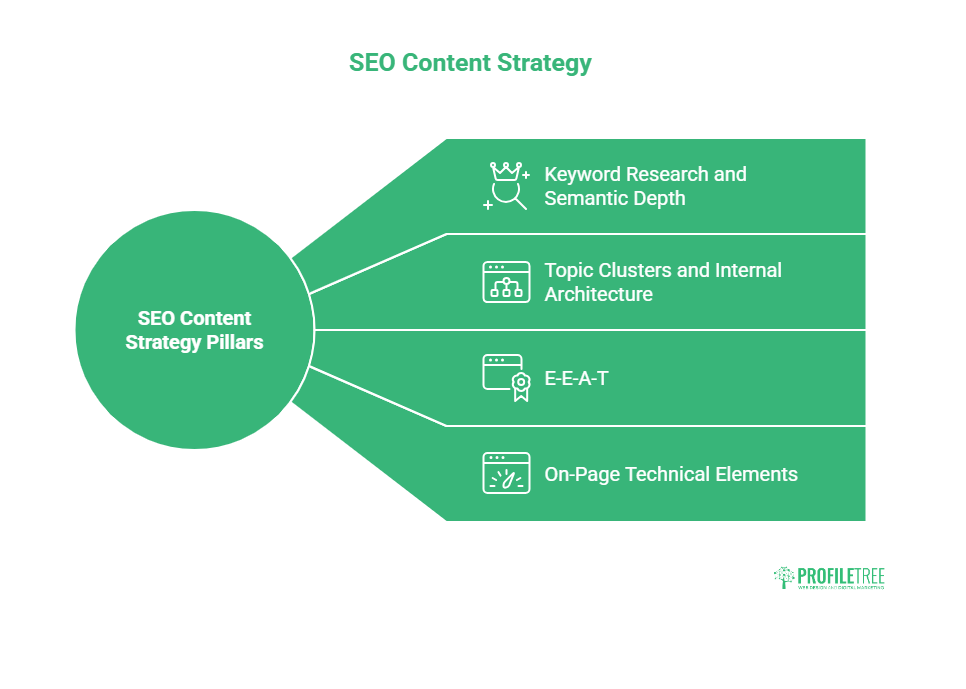
Strong SEO content does not emerge from writing well in isolation. It depends on four interconnected elements working together: keyword research, topic clustering, E-E-A-T signals, and on-page technical execution. Each pillar supports the others; weaknesses in any one of them limit what the others can achieve.
Keyword Research and Semantic Depth
Effective keyword research starts with search volume and competition data, but it does not end there. The more useful output of a thorough keyword research process is a map of related terms, questions, and subtopics that collectively define the semantic territory around your primary topic.
For a UK business targeting “SEO-optimised web content,” for example, the primary phrase sits alongside related searches including “writing web content for SEO,” “SEO content strategy,” “content optimisation checklist,” and “SEO content writing services UK.” Pages that address this broader territory, rather than targeting a single phrase in isolation, tend to attract more varied organic traffic and accumulate authority across a wider range of queries.
Tools like Ahrefs, SEMrush, and Google Search Console’s query reports all surface this related territory. The Search Console data for this specific URL shows significant impressions for variants including “SEO-optimised content,” “optimised website,” and “writing web content for seo,” with zero clicks on all of them, positions sitting in the sixties and seventies.
That pattern points to content that Google considers somewhat relevant but not authoritative enough to serve at the top of results. Improving topical depth is the primary lever for changing that. Explore the YMYL SEO guide for more on how Google evaluates content authority by topic type.
Topic Clusters and Internal Architecture
A single well-written article rarely builds lasting authority on its own. Search engines evaluate topical authority across a site, not just at the page level. This is why a hub-and-spoke content architecture, where a central pillar page links to and receives links from a cluster of supporting articles, consistently outperforms collections of isolated posts.
For a digital agency or SME building content around SEO, the pillar page covers the broad topic comprehensively. Supporting pages go deeper on subtopics: keyword research, meta tag optimisation, content auditing, local SEO, and so on. Each supporting page links back to the pillar and across to relevant siblings. This structure makes it easier for crawlers to understand the topical map and for readers to navigate to more specific guidance. Reviewing your content strategy framework is a sensible first step before building out a topic cluster.
E-E-A-T: Experience, Expertise, Authoritativeness, Trustworthiness
Google’s quality rater guidelines place significant weight on E-E-A-T signals, particularly for pages that could affect a reader’s health, finances, or safety. For most business content, the practical implication is that pages need to demonstrate who wrote them, what makes that person qualified to write them, and why the business behind the site should be considered credible.
Experience, the first E, is the newest addition to the framework and the most interesting. It rewards content that shows first-hand involvement: actual project outcomes, real decisions made under real constraints, honest accounts of what worked and what did not. This is content that could not have been generated without someone having genuinely done the thing the article is about.
Expertise is demonstrated through accurate, detailed, and technically sound information. Authoritativeness builds through external mentions, backlinks from credible sources, and the overall standing of the site within its topic area. Trustworthiness comes from clear author attribution, accurate factual claims, transparent sourcing, and consistency between what the page says and what the business actually does.
On-Page Technical Elements
Technical on-page elements are the scaffolding that helps search engines read and categorise your content. They do not substitute for quality writing, but they amplify it.
Title tags should contain the primary keyword within the first 40 characters and stay under 60 characters total. Meta descriptions (under 155 characters) do not directly influence rankings but significantly affect click-through rate; a well-written meta description that addresses the searcher’s question directly and honestly will outperform a generic one even when the underlying ranking position is identical.
Heading hierarchy matters for both accessibility and crawlability. A single H1 per page, followed by H2 sections and H3 subsections, gives the algorithm a clear map of the content’s structure. Alt text on images, internal linking with descriptive anchor text, and page speed all contribute to how well a page performs across the full range of ranking signals.
How to Write SEO Content: A Step-by-Step Framework
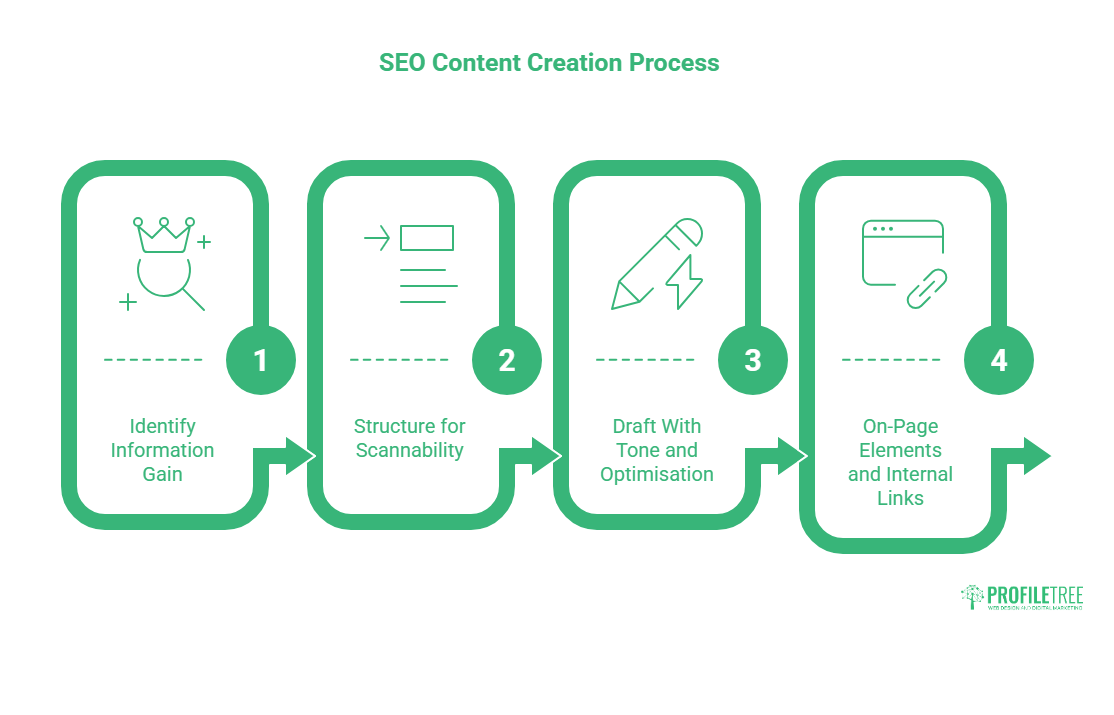
The process of producing SEO-optimised web content is more systematic than most guides suggest. It is not simply a matter of writing clearly and adding keywords. The steps below reflect how content that consistently ranks is actually built, from the initial research phase through to publication.
Step 1: Identifying Information Gain
Information gain describes the degree to which your content adds something that existing ranking pages do not already contain. Google’s algorithm increasingly rewards this property, particularly as AI-generated content makes it easier to produce text that covers a topic at the surface level without contributing anything new.
Before drafting, audit the top five to ten results for your target query. Note what every result covers. Then ask what none of them covers. That gap, whether it is a regional perspective, a specific use case, a comparison of approaches, or a more honest account of costs and timelines, is where your content’s ranking potential lives. Content that simply restates what is already ranking has a limited ceiling; content that adds a genuinely new angle gives Google a reason to surface it.
For SMEs in Northern Ireland and Ireland, the regional angle is often the clearest information gain opportunity. US and UK-wide guides rarely address search intent patterns in Belfast, Dublin, or Galway, or the practical implications of operating across both markets. That specificity is hard to replicate and worth building into your content deliberately.
Step 2: Structuring for Scannability
Online readers scan before they read. Eye-tracking studies consistently show that most visitors read the heading, the first sentence of each paragraph, and any bold text or bullet points before deciding whether to read in full. Content structure should reflect this behaviour rather than fighting it.
Short paragraphs of two to four lines, subheadings every 200 to 300 words, and front-loaded sentences that give the key point before the supporting detail all reduce cognitive load and keep readers on the page. Dwell time, while not a confirmed direct ranking signal, correlates strongly with content quality in ways that do affect rankings indirectly.
Tables are particularly effective for SEO content. A comparison table, a checklist, or a data summary signals to both readers and crawlers that a page contains structured, specific information rather than generic prose. Pages with tables are significantly more likely to appear in AI Overviews and featured snippets. See the comparison table below for a practical illustration of old versus new SEO content principles.
| Old SEO Approach | Current Best Practice |
|---|---|
| Keyword density targets (e.g. 2-3%) | Entity salience and semantic coverage |
| Long content for length’s sake | Depth and information gain regardless of word count |
| Generic titles with keywords inserted | Intent-matched titles with a clear reason to click |
| Backlinks from any source | Backlinks from topically relevant, credible sources |
| Writing for the algorithm first | Writing for the reader, with algorithmic signals built in |
| Date-bumping to appear fresh | Material content updates with new data and examples |
Step 3: Drafting With Tone and Optimisation in Balance
The drafting phase is where many SEO content guides fall short. They provide structural advice but say little about how to write in a way that feels authoritative and specific rather than generic and generated. The distinction matters more than ever now that AI content production tools are widely accessible.
Specificity is the most reliable indicator of genuine expertise. Rather than “many businesses see improved results after optimising their content,” a credible writer would say “after restructuring the introduction and adding a comparison table, average time on page increased by 40% across three client sites in the professional services sector.” The second version is harder to produce without real experience, which is precisely why it carries more weight with readers and, increasingly, with ranking systems.
Varying sentence length is another practical technique. AI-generated text tends to produce sentences of roughly similar length (15 to 20 words) with consistent clause structures. Human writing has natural burstiness: a short, punchy sentence followed by a longer one that builds the point, then a brief observation that lands the idea. Reading your draft aloud will surface uniform rhythm faster than any readability score tool.
Step 4: On-Page Elements and Internal Links
Once the draft is complete, the on-page optimisation layer can be applied systematically. Work through the following in order: title tag and H1 (both containing the primary keyword, both distinct from each other), meta description, subheadings reviewed for keyword and intent alignment, alt text on all images, and internal links with descriptive anchor text.
Internal links are frequently underused in SME content. A well-linked page passes authority to related pages, keeps readers on the site longer, and gives crawlers a richer understanding of topical relationships. The anchor text for each link should describe what the reader will find, not simply say “read more.” For instance, linking to a dedicated guide on dynamic keyword insertion is more useful to both readers and crawlers than a generic “learn more” link to the same page.
Optimising for AI Overviews and Featured Snippets
Google’s AI Overviews, alongside AI-powered answers from ChatGPT, Perplexity, and Gemini, now represent a meaningful share of how searchers consume information. Understanding how these systems select content to cite is increasingly important for any business investing in content marketing.
How AI Overviews Select Content to Cite
AI Overviews synthesise responses from multiple sources rather than pulling from a single page. Research from Ahrefs, analysing millions of AI citations, found that long-form content of 2,000 words or more is cited three times more frequently than shorter posts. Pages that cover multiple sub-questions within a single topic are 161% more likely to appear in AI Overview results. Content with structured tables performs at 2.5 times the citation rate of equivalent prose-only pages.
The implication for content writers is clear: comprehensive, well-structured pages that address a topic from multiple angles are better positioned than narrow, tightly focused articles. This does not mean padding content with filler to hit a word count. It means genuinely covering the adjacent questions that a thorough reader would have after engaging with the primary topic.
For businesses producing digital content for 2025 and beyond, structuring pages with self-contained sections of 100 to 300 words, each opening with a direct answer before supporting detail, directly mirrors how AI systems extract and synthesise information.
Structuring Content for Featured Snippets
Featured snippets (the boxed answers at the top of some Google results pages) follow a different selection logic from AI Overviews, but there is significant overlap in the structural signals that attract both. Google typically pulls snippet content from concise definition paragraphs (40 to 60 words), numbered list sections, or comparison tables.
Placing a short, direct definition or answer in the first paragraph under each H2 heading is the most reliable technique for improving snippet eligibility. The paragraph should answer the question implied by the heading completely and in plain language, without requiring the reader to have absorbed earlier sections of the article to understand it.
Schema Markup for Enhanced Visibility
Schema markup is structured data added to a page’s code that tells search engines what type of content is present. For content-focused pages, FAQPage schema is the most directly applicable: it makes individual FAQ answers eligible for expanded display in SERPs, increasing the visual footprint of the result without improving ranking position.
The article schema and the BreadcrumbList schema both contribute to how a page is represented in results. Neither requires significant technical resources to implement, but both are frequently absent from SME websites. A development team briefed on which pages need schema added can typically implement FAQ and Article schema across a full blog within a few hours using a plugin or manual JSON-LD blocks.
Auditing and Optimising Legacy Content
Creating new content is only half of the SEO content challenge. Most established websites carry a library of older pages that rank partially for relevant queries but never reach page one. Identifying and upgrading these pages is often more efficient than producing new content from scratch, because the pages already have some crawl history and, in many cases, a handful of backlinks.
How to Identify Underperforming Pages
Google Search Console’s Performance report is the primary tool for content auditing. Filter for pages with significant impressions but low click-through rates, or pages with rankings between positions 8 and 25. These are pages close enough to page one to be worth improving, but not performing well enough to deliver meaningful traffic in their current state.
The pattern of zero clicks across all ranking queries, as seen in the GSC data for this article’s target URL, is a strong indicator that the page needs both structural and depth improvements. Queries like “writing web content for seo” and “SEO-optimised content” generate impressions in the twenties and sixties, all with zero clicks, suggesting Google is showing the page tentatively, but searchers are not choosing it. A stronger title tag and meta description would improve click-through; deeper, more specific content would improve position.
Once you have identified the priority pages, categorise them by the scale of work required. Pages with strong rankings worth protecting need lighter editing; pages with no clicks despite reasonable impressions need more substantial rewrites. Aligning the depth of intervention with the current performance level prevents over-editing pages that are close to breaking through and under-investing in pages that need a proper rebuild. The process of competitive content analysis is a useful starting point for understanding why specific pages are underperforming relative to competitors.
What a Genuine Content Refresh Involves
Changing a publication date without updating the content is not a refresh. Search engines have become effective at detecting this pattern, and the temporary rankings boost that date changes used to produce has largely disappeared. A genuine refresh means adding new sections, updating statistics to current figures, improving the structure to better match current search intent, and expanding areas where the original content was thin.
For pages that were written primarily as keyword vehicles rather than to serve a reader, the refresh often requires reconsidering the angle entirely. What question is this page actually answering? Is that the question the target searcher is asking? If the original page was built around a keyword phrase rather than an intent, the most effective intervention is often to rewrite the introduction, restructure the headings, and add the depth that was absent originally, while preserving any sections that remain accurate and useful.
Measuring the Impact of Content Optimisation
Content optimisation produces results over weeks and months, not days. After publishing an updated page, allow four to eight weeks before drawing conclusions from the data. During that window, track ranking positions for the primary and secondary keywords, click-through rate from Search Console, average engagement time (replacing bounce rate as a primary metric in GA4), and any changes in the number of queries generating impressions.
A successful optimisation will typically show rankings gradually moving up, followed by increased impressions as the page becomes eligible for a wider range of queries, followed by improved click-through as the position improves. If rankings improve but click-through does not, the title tag and meta description are the first things to review. Using Google Analytics for content performance gives you the engagement data needed to distinguish between a page that readers are finding and a page they are abandoning quickly.
Measuring Success: KPIs for SEO-Optimised Content
Defining success for content requires choosing metrics that reflect the goal of the page. A blog post written to attract top-of-funnel traffic should be judged on organic impressions, click-through rate, and new user sessions. A service page should be judged on conversion rate, enquiry form submissions, and assisted conversions in GA4. Using the same metrics across all content types produces misleading conclusions.
The Metrics That Actually Matter
Organic search traffic is the most direct measure of SEO content performance. Track it at the page level, not the site level, to understand which pieces are working and which are not. Ranking position matters because it determines the traffic ceiling for a page; even exceptional click-through rates cannot compensate for a position-50 ranking on a keyword with reasonable search volume.
Engagement rate in GA4 (sessions where the user actively engaged with the page for at least 10 seconds, triggered a conversion event, or visited at least two pages) is a more useful metric than the old bounce rate. A high engagement rate suggests the content is genuinely serving the reader; a low engagement rate with strong rankings is an early warning sign that the page satisfies the algorithm but not the person.
Setting Realistic Timelines
New content on an established site typically begins appearing in search results within a few weeks of publication, but meaningful ranking movement for competitive queries takes three to six months. For brand new sites or sites with limited authority, the timeline extends further. Setting internal expectations around these timelines prevents premature decisions about whether content is working.
Regular monthly reviews of Search Console data, checking for new queries the page is beginning to rank for and tracking position trends over time, give an early signal of whether a page is building momentum. A page gaining impressions for new query variants is almost always moving in the right direction, even before click traffic increases noticeably.
When to Revisit and When to Move On
Not all content will reach its ranking potential regardless of how well it is written. Pages targeting queries dominated by high-authority global sites may perform acceptably but never break through to the top positions without significant external link building. In those cases, the more productive decision is often to target related queries where the competitive gap is smaller, build authority through a cluster of supporting pages, and return to the primary target once the domain’s topical authority has grown.
Conversely, pages that were performing well and then decline warrant prompt attention. A sudden drop in rankings for an established page often signals a core algorithm update, a technical issue, or a competitor improving their content in the same area.
Search Console will surface the pattern; identifying the cause requires looking at what changed on the page, what changed on the site, and what the SERP looks like for the target query now compared to before the drop. A content quality audit can help identify whether thin or AI-generated sections are triggering algorithmic scepticism.
Conclusion
SEO-optimised web content is not a formula to follow once; it is a practice to maintain. The fundamentals of matching search intent, demonstrating genuine expertise, and structuring content for both human readers and algorithm systems remain stable even as ranking signals evolve. If your current content library is underperforming, the audit process outlined above is the most practical starting point.
ProfileTree works with SMEs across Northern Ireland, Ireland, and the UK to build content that ranks and converts. Explore our copywriting services to find out how we can help.
FAQs
What is SEO-optimised content?
SEO-optimised content is written material that satisfies both the search engine’s ranking criteria and the reader’s need for accurate, useful information. It involves matching the content’s structure, language, and depth to the intent behind a specific search query, so the page surfaces in relevant results and delivers value when a reader arrives.
How do you write SEO content for a UK website?
Writing SEO content for a UK website requires UK English spelling throughout, references to UK-specific regulations, pricing in GBP, and examples drawn from the UK or Irish market where relevant. Beyond language, the same principles apply globally: match search intent, demonstrate genuine expertise, structure content clearly, and include internal links to related pages on your site.
What are the four types of SEO content?
The four primary types are blog posts and articles (informational), service and product pages (transactional), pillar guides and resource hubs (covering broad topics in depth), and FAQ pages (targeting specific questions directly). Most effective content strategies use all four types in a connected hub-and-spoke architecture rather than producing each in isolation.
Can I use AI to write my SEO content?
AI tools can assist with drafting and ideation, but content produced without human editing and genuine first-hand knowledge rarely performs well in competitive SERPs. Google’s quality systems are increasingly effective at identifying content that lacks original insight or experience. The risk is not that the content contains AI-generated writing; it is that the content says nothing a human with real expertise would not have said more clearly and specifically.
How much does SEO content writing cost in the UK?
UK freelance SEO content writers typically charge between £80 and £300 per 1,000 words, depending on technical complexity and the writer’s experience. Agency-produced content with full SEO strategy, keyword research, and optimisation included ranges from £250 to £800 per article. All prices and figures in this guide are indicative UK examples and correct at the time of writing; use them as a benchmark rather than fixed quotations.