
What is a Cover Letter: 8 Tips for Success and What to Avoid
Table of Contents
What is a cover letter? It is a one-page document sent alongside your CV when applying for a job, and it does a job your CV cannot: it explains why you want this specific role, at this specific organisation, and why your experience makes you the right fit for it.
Most job seekers spend hours perfecting their CV and minutes on their cover letter. That tends to be the wrong priority. A hiring manager reading 200 applications for the same role is looking for a reason to keep reading, and the cover letter is where that reason either appears or does not. Your CV lists what you have done. Your cover letter makes the case for why it matters here.
This guide covers how to write a cover letter that works in the UK and Irish job market, eight practical tips that separate strong applications from forgettable ones, and the mistakes that cost candidates interviews before anyone has opened their CV.
What a Cover Letter Actually Does
Your CV lists what you have done. A cover letter explains why it matters for this specific job at this specific organisation. Those are two very different things.
A recruiter reading 200 applications for a marketing coordinator role does not need another document that restates the CV. They want to quickly determine whether you have read the job description properly, can communicate clearly, and have a genuine reason for applying. A cover letter that does all three in 300 words will outperform a technically superior CV attached to a generic opening paragraph.
The document also serves a secondary function that most guides do not mention: it tells the hiring manager how you write. For roles in communications, marketing, content, or client-facing work, your cover letter is effectively a writing test. Treat it as one.
Cover Letter vs CV: The Key Difference
| Cover Letter | CV | |
|---|---|---|
| Purpose | Explain fit for this specific role | Record of qualifications and experience |
| Length | 250 to 400 words (one page maximum) | One to two pages |
| Tone | Personalised, direct, professional | Formal, factual |
| Updated | For every application | When experience changes |
| Focus | Why you, why now, why this company | What you have done |
Do You Still Need a Cover Letter in 2026?
The short answer is yes, particularly in the UK and Irish job markets, where cover letters remain standard for most professional, public sector, and graduate roles.
The longer answer is more nuanced. Many online application portals now mark the cover letter field as optional. Research from the Chartered Institute of Personnel and Development consistently shows that hiring managers in the UK treat a well-written optional cover letter as a positive signal, and a missing one as a neutral or mildly negative one, particularly for roles where written communication is part of the job. If the field exists, fill it properly.
There is also the question of Applicant Tracking Systems, or ATS. These are the software platforms that screen applications before a human ever reads them. ATS tools scan the job description for keywords, check formatting, and filter out applications that fail to meet basic criteria. A cover letter that mirrors the language of the job description, without copying it verbatim, gives your application an additional layer of keyword matching that your CV alone may not provide.
One area where the “optional” label genuinely applies is speculative applications, which are letters sent to organisations that are not actively recruiting. These are common in the UK’s hidden job market, where many roles are filled through direct approaches before they are ever advertised. A speculative cover letter needs a slightly different structure, which we cover below.
The Anatomy of a Strong Cover Letter
Every cover letter has the same basic job: get the recruiter to open the CV. How you structure the letter determines whether that happens in the first ten seconds or not at all. A strong cover letter follows a clear, logical sequence — contact details, a specific opening, a body that connects your experience to the role, and a direct close. Get each section right, and the whole thing reads confidently and thoughtfully. Get one wrong, and the entire letter suffers for it.
Your contact details and the date
At the top of the letter, include your full name, phone number, email address, and LinkedIn profile URL if you have one. LinkedIn is now widely used by UK recruiters to verify candidates before an interview, so including the link removes a step and signals you are comfortable being found online. For guidance on building a strong LinkedIn presence, ProfileTree’s overview of LinkedIn for business networking and growth covers the key principles in practical terms.
Address the letter to a named person wherever possible. Check the job listing, the company website, or LinkedIn to find the hiring manager’s name. “Dear Hiring Manager” is acceptable only if no name is available after a genuine search. “Dear Sir/Madam” signals you did not try.
The opening paragraph: make it specific
State the role you are applying for and give one clear, specific reason why you are suited to it. Not a generic claim (“I am a highly motivated individual”) but a concrete connection between something in your background and something in the job description.
A strong opening sounds like this: “I am applying for the Digital Marketing Executive role advertised on your careers page. Having spent three years producing content for a Belfast-based SME and managing their paid social campaigns, I have direct experience with the kind of audience your team is targeting.”
A weak opening sounds like this: “I am writing to express my interest in the above-mentioned position. I believe I would be a great asset to your team.”
The difference is specificity. One saves the recruiter time. The other creates more work.
The body: connect your experience to their requirements
Use one to two paragraphs to draw clear links between what the job description asks for and what you have actually done. Refer to specific skills, tools, or responsibilities from the listing. If the role asks for experience with content management systems, name the ones you have used. If it requires client-facing communication, give a brief example from a previous role.
This is where quantifying your contribution helps. “I managed the company’s social media accounts” tells a recruiter very little. “I managed three social channels for a product business, growing organic reach by 40% over six months through a consistent posting schedule and targeted content”, tells them considerably more.
Do not restate your CV. If you mention a qualification or role, add something the CV does not already cover.
The closing paragraph: be direct
Thank the reader for their time, confirm your availability for the interview, and end. Do not pad the closing with filler. A sentence like “I would welcome the chance to discuss the role further and can be available for an interview at short notice” is direct and easy to respond to.
8 Tips for a Good Cover Letter
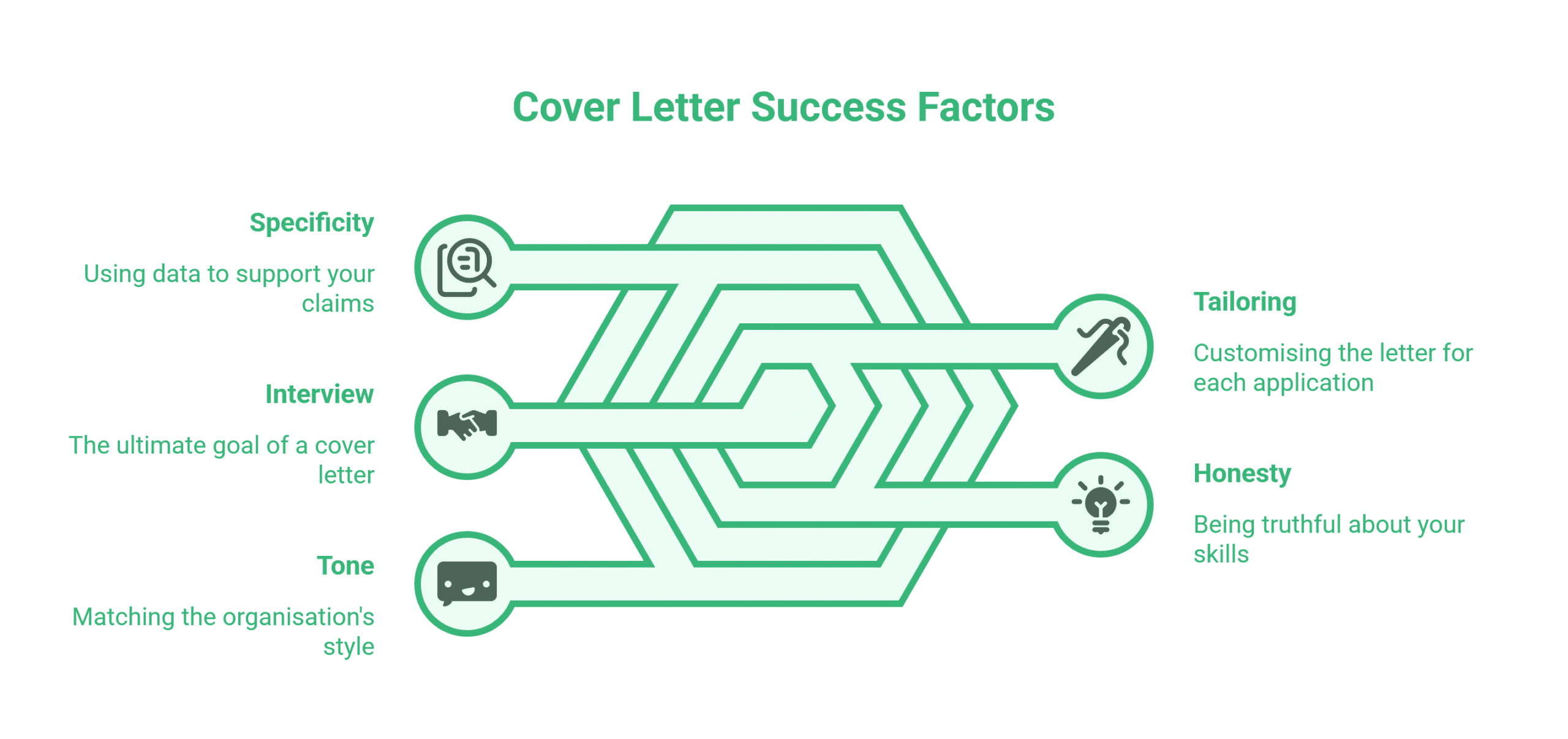
Most cover letter advice focuses on structure. These eight tips focus on the decisions that set apart letters that get interviews from those that do not.
1. Be honest about what you can actually do
Do not claim skills or experience you do not have. If you say you have managed a team of ten and cannot speak to it in an interview, you will be caught out. Instead, identify your genuine strengths and make the strongest possible case for those. If there is a gap between your experience and the job description, acknowledge it briefly and explain how you plan to close it. Honesty combined with self-awareness reads well.
2. Back yourself without overclaiming
Many candidates, particularly those earlier in their careers, understate what they have achieved. You do not need to exaggerate, but you do need to make a clear argument for why you should be considered. If you are unsure how to articulate your value, working through a personal and professional development exercise before writing can help you identify what is genuinely worth highlighting.
3. Keep it to the point
One page, 250 to 400 words for most roles. If you find yourself writing more, it usually means you are including information that belongs in the CV rather than the letter, or that you have not yet identified which points actually matter most. Cutting is not modesty. It is editorial judgment, and recruiters notice it.
4. Match the tone to the organisation
A cover letter for a law firm reads differently from one for a digital agency. Before you write, look at the company’s website, their LinkedIn page, and the language used in the job description. If the listing is written in a direct, informal style, a stiff formal letter will feel like a mismatch. Mirror their register without abandoning professionalism.
5. Use specific figures where you have them
Numbers carry weight in a way that adjectives do not. “I supervised training for 40 colleagues on a new CRM system” is more credible than “I have strong training experience.” “I led a content campaign that increased newsletter subscribers by 28% over three months”, tells a recruiter something. “I have experience in content marketing” tells them very little. Use the figures you have. Do not invent ones you do not.
6. Tailor the letter for every application
A template structure is efficient. Generic content is not. The sections that reference the specific role, the company, and why this job at this organisation should be rewritten each time. Recruiters read enough cover letters to identify boilerplate phrasing within a sentence or two, and a generic letter signals that the candidate is not particularly interested in this particular job.
7. Proofread properly — then ask someone else to read it
A single spelling or grammar error in a cover letter will end an application for any role where communication matters. Read the letter aloud to catch awkward phrasing. Run it through a spellchecker. Then ask a colleague, friend, or family member to read it before you send. A second pair of eyes catches things you have stopped seeing after multiple drafts.
8. Build your digital presence alongside the letter
For roles in digital marketing, content, web development, or any client-facing capacity, your cover letter will prompt a recruiter to search for you online. An incomplete LinkedIn profile, an outdated personal website, or no digital presence at all undermines a strong letter. ProfileTree’s resources on LinkedIn industries and the art of communication cover how to present yourself credibly across professional platforms, which now functions as an extension of your application.
UK and Irish Specifics: Public Sector, NHS, and Northern Ireland
Most cover letter guides are written for the private sector. The UK and Irish public sectors operate differently, and the differences are significant enough that generic advice will get applications filtered out.
Civil Service Success Profiles
Applications for UK Civil Service roles do not use a traditional cover letter. Instead, candidates complete a Behaviour Statement for each of the relevant Civil Service Behaviours listed in the job advert. Each statement is typically 250 words and follows a structured format: Situation, Task, Action, Result (STAR). These are evaluated against a scoring grid. If you are applying for a Civil Service role in Northern Ireland or Great Britain, follow the Success Profiles framework precisely. A conventional cover letter submitted in place of Behaviour Statements will be rejected at the shortlisting stage.
NHS Personal Statement
NHS jobs use a personal statement rather than a cover letter. The field is typically 1,500 words and asks you to demonstrate how your skills and experience match each point in the person specification. Work through the person specification methodically, address every essential criterion, and give concrete examples. Vague claims with no supporting evidence will fail the shortlisting process regardless of your actual experience.
Fair Employment Monitoring in Northern Ireland
Job applications in Northern Ireland are often accompanied by a Fair Employment Monitoring Form under the Fair Employment and Treatment (NI) Order 1998. This is a separate legal requirement for monitored employers and is not part of your cover letter. Fill it in accurately and separately.
Using AI to Help Write Your Cover Letter
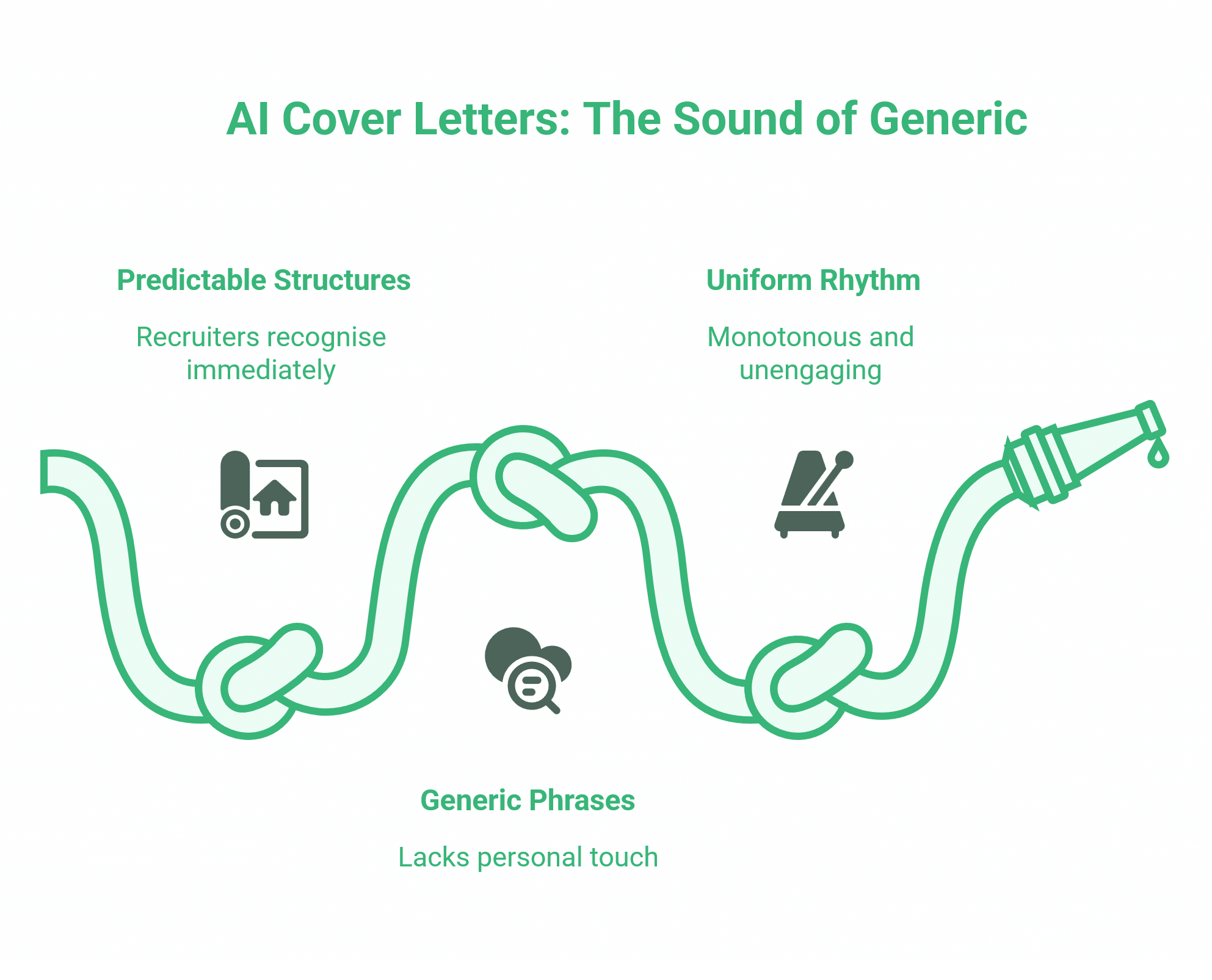
AI writing tools can help you draft and refine a cover letter, but they come with a specific problem. Most AI-generated cover letters sound like AI-generated cover letters. They use predictable structures, generic phrases, and a uniform sentence rhythm that recruiters now recognise immediately.
“I am a results-driven professional with a passion for delivering excellence” is an AI output. It tells the reader nothing and signals a candidate who outsourced their application.
The productive use of AI in cover letter writing is as a structural aid, not a ghostwriter. Use it to confirm that you have addressed all the key requirements outlined in the job description. Use it to identify gaps in your argument. Use it to suggest alternative phrasing for sentences you are not happy with. Then rewrite in your own voice before submitting.
At ProfileTree, our digital training services cover how to use AI tools effectively across professional tasks without losing the human element that gives your work credibility. The same principle applies here: AI drafts, humans decide.
One practical check before submitting: read your cover letter aloud. If it sounds like something a press release would say, rewrite it. If it sounds like you explaining something to a colleague, it is probably in good shape.
ATS: Getting Past the Software
Most applications submitted through online portals are filtered by ATS software before a human reads them. ATS systems scan job descriptions for keywords and flag applications that match the requirements, or reject those that do not.
To pass ATS screening, keep your cover letter formatting simple. Use a standard font, avoid tables or columns, and save as a .docx or PDF as specified in the application instructions. Include exact phrases from the job description where they genuinely apply to your experience. If the listing asks for “project management experience,” use that phrase in your letter rather than paraphrasing it as “experience managing projects.”
Do not keyword-stuff. ATS platforms have become more sophisticated, and recruiters can tell when a letter is padded with terms that do not naturally flow with the surrounding content.
Tailoring Your Letter for Different Roles
The fundamentals of a good cover letter do not change, but the emphasis does. A letter for a digital agency role needs to read differently from one for a public sector post, and a career changer needs to make a different argument from someone applying within their existing field. Knowing which version of your experience to lead with is what tailoring actually means in practice.
Applying for a digital or tech role
For roles in digital marketing, web development, or tech, you can reference your online presence as supporting evidence in your cover letter. A portfolio website, a well-maintained LinkedIn profile, or a GitHub repository can all be linked. Recruiters in these sectors expect candidates to have a visible digital footprint, and a cover letter that acknowledges this is more credible than one that ignores it.
Applying for a role with no direct experience in that sector
Career changers need to work harder to identify transferable skills. Identify the three or four core requirements of the role and map your existing experience to each one, even if the industry context is different. A former teacher applying for a training and development role has directly relevant experience; the skill set transfers even if the sector does not. ProfileTree’s guide to self-development skills is a useful starting point for identifying transferable strengths before writing.
The speculative cover letter
A speculative letter is sent to a company that is not advertising a specific vacancy. It is common in creative industries, digital agencies, and the SME sector across Northern Ireland and Ireland, where many roles are filled before they are advertised. A speculative letter should state which type of role you are interested in, explain briefly why this particular company appeals to you (be specific rather than generic), and make clear what you are asking for. Keep it to three short paragraphs and be direct about the next step.
Ciaran Connolly, founder of ProfileTree, reflects this from a hiring perspective: “When we review applicants for digital roles, we are not necessarily looking for people who have done exactly that job before. We are looking for people who understand communication, think clearly about audiences, and can demonstrate that they pick up new skills quickly. A cover letter that makes that argument directly, with evidence, will always get read.”
What to Avoid
Most cover letters are not rejected because of what they include. They are rejected because of what they repeat, what they leave vague, and what they signal about how much care the candidate actually put in. The issues below are common enough to appear in the majority of applications, which means addressing them puts you ahead of most of the competition before a recruiter has read past the first paragraph.
Repeating your CV
Your cover letter and CV are read together. Do not use the letter to list the same experience in a different order. Use it to add context, give examples, and make an argument. If the letter could be replaced by the CV without losing anything, rewrite it.
Vague claims without evidence
“I am an excellent communicator,” “I work well under pressure,” and “I am passionate about this industry” appear in hundreds of applications for every competitive role. If you want to make a claim about a skill, back it with a specific example, even a brief one.
Spelling and grammar errors
A single obvious error in a cover letter will cost you an interview for any role where written communication matters. Read the letter aloud. Use a grammar checker. Ask someone else to read it before you send.
Generic content that could apply to any job
If the body of your cover letter would work equally well for a different role at a different organisation, it needs to be rewritten. The most effective letters reference something specific about the company, the team, or the role that you could only know from reading the listing carefully.
Conclusion
Writing a strong cover letter takes less time than most candidates think, but more thought than most are willing to give it. Get the structure right, tailor the content to each role, back your claims with specific examples, and keep it to one focused page. Those four things alone will put your application ahead of the majority.
For professionals looking to build the broader communication and digital skills that employers across Northern Ireland, Ireland, and the UK now expect, ProfileTree’s digital training services offer practical programmes that develop exactly the kind of ability a strong cover letter is trying to demonstrate.
FAQs
What is a cover letter, and what is it used for?
A cover letter is a short document you send with your CV when applying for a job. Its purpose is to explain why you are applying for a specific role, connect your experience to the employer’s requirements, and give the hiring manager a reason to read your CV. It is not a summary of your CV — it is an argument for why you are the right candidate for this particular position.
How long should a cover letter be?
One page maximum. For most roles in the UK, 250 to 400 words is the right length. It gives you enough space to address the key requirements and demonstrate your ability to communicate concisely. Anything over 500 words risks losing the reader’s attention before you reach your strongest points.
Should I use the same cover letter for every application?
No. A template structure is fine, but the content that references the role, the company, and your reasons for applying must be tailored each time. Recruiters identify generic letters quickly, and they rarely progress.
Can AI write my cover letter for me?
AI tools can help you structure and draft a cover letter, but submitting unedited AI output is a risk. Most recruitment professionals can now identify AI-generated writing by its rhythm and phrasing. Use AI to plan and review, then write in your own voice. The goal is a letter that sounds like you thinking clearly.