
Sustainable Web Design: Speed, SEO, and Green Hosting for SMEs
Table of Contents
If your website takes more than three seconds to load, most visitors leave before they see a single word of your content. That is not an environmental statistic. That is a commercial one. Sustainable web design addresses both at the same time, and that intersection is exactly why it matters to SMEs in Northern Ireland, Ireland, and the UK right now.
The core principle is straightforward: a website that wastes less energy also performs better. Lighter pages load faster. Cleaner code reduces server demand. Optimised media improves Core Web Vitals scores. None of these trade off against good design. They are good designs, and businesses that build with this thinking get measurable improvements in search rankings, bounce rates, and conversion.
This guide sets out what sustainable web design actually means in practice, which principles produce the biggest gains for typical SME websites, and how to apply them, whether you are building on WordPress, Shopify, or a custom stack. If you have been searching for what makes web design sustainable in commercial terms rather than just ethical ones, that is the question this article is built around.
What Is Sustainable Web Design?
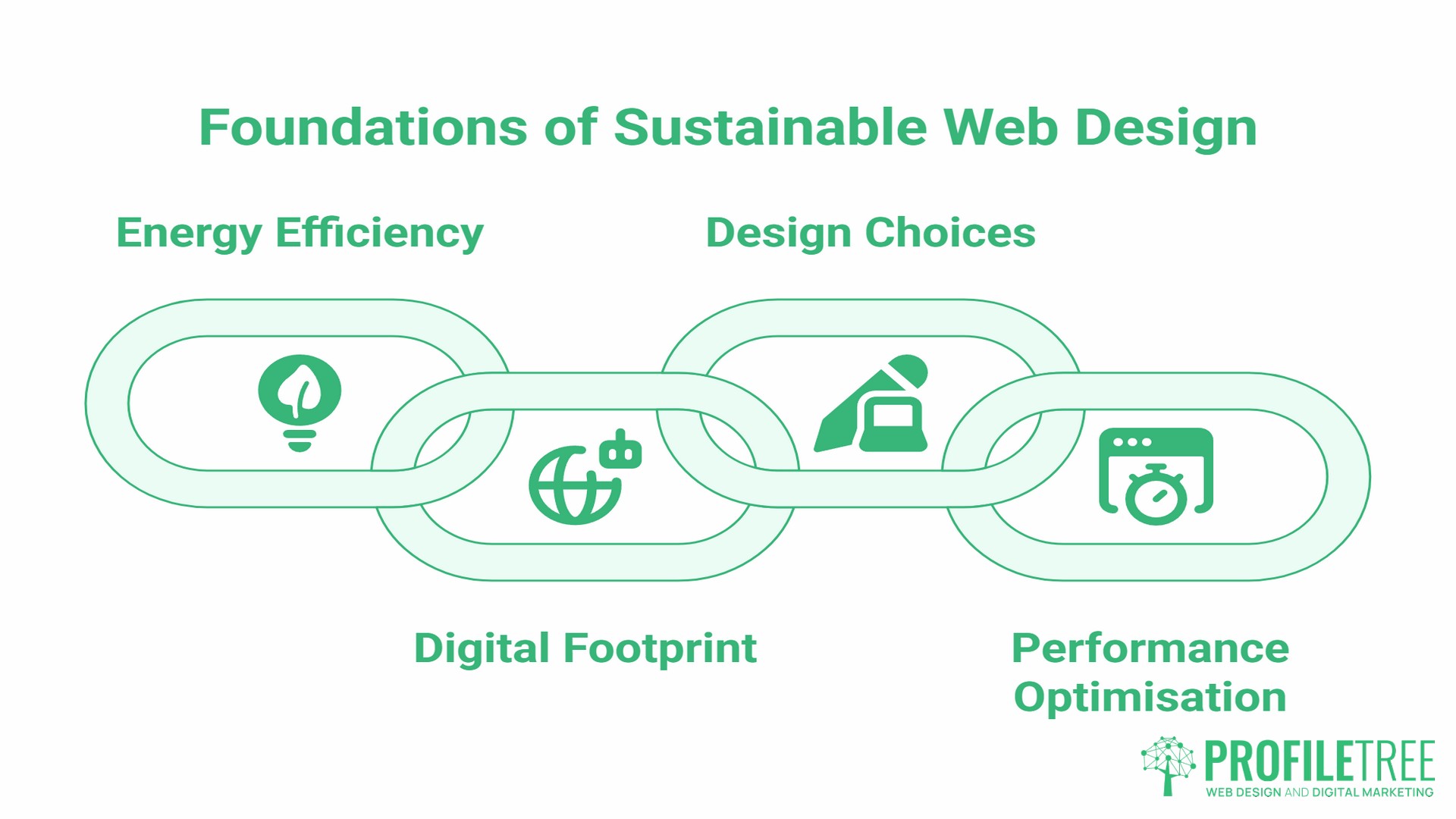
Sustainable web design is the practice of building websites that minimise unnecessary energy consumption without compromising functionality or user experience. Every page load travels through a chain of infrastructure: the server that hosts the files, the network that carries the data, and the device that renders the result. Energy is consumed at each stage, and the amount consumed is directly proportional to the page’s weight.
The ICT sector as a whole accounts for between 1.5% and 4% of global greenhouse gas emissions, a figure that rivals the aviation industry, according to a 2024 joint report by the World Bank and the International Telecommunication Union. In Ireland specifically, data centres consumed 22% of the country’s total metered electricity in 2024, according to figures published by Ireland’s Central Statistics Office and confirmed by the Commission for Regulation of Utilities. That share is projected to reach 31% by 2034. For businesses in Dublin or Belfast, the proximity to concentrated data infrastructure makes digital efficiency a locally relevant issue, not just a global one.
From a design perspective, sustainable practice means making deliberate choices about what goes on a page. Every image, script, font, and animation has a file size, a render cost, and a consequence for load speed. Removing what does not serve the user journey is both an eco-friendly act and a performance improvement.
“At ProfileTree, we treat page weight as a design constraint from the first wireframe,” says Ciaran Connolly, founder of ProfileTree. “A site that loads in under two seconds on mobile is almost always a leaner build. Those two outcomes are not separate goals.”
Why Sustainable Web Design Is a Business Advantage
The commercial case for sustainable web design runs through three interconnected areas.
Speed and Core Web Vitals
Google’s Core Web Vitals measure three things: Largest Contentful Paint (how fast the main content loads), Interaction to Next Paint (how quickly the page responds to a click), and Cumulative Layout Shift (how stable the layout is during load). All three are influenced by page weight. Heavy images push LCP scores up. Render-blocking JavaScript delays interactivity. Unstable layouts caused by late-loading elements hurt CLS.
Pages that score well on Core Web Vitals are, by definition, lighter, faster, and more energy-efficient. Sustainable web design and SEO performance are not competing priorities; they are the same priority expressed differently.
Search Visibility
Google uses page experience signals, including Core Web Vitals, as ranking inputs. A site built on sustainable principles, with compressed images, deferred non-critical scripts, and a clean heading structure, will generally perform better in organic search than an equivalent site built without those constraints. For SMEs competing in local search in Belfast, Dublin, or across the UK, this is a practical ranking lever.
Brand and Procurement
Consumer expectations around environmental responsibility are rising. In B2B contexts, UK public sector procurement increasingly requires suppliers to demonstrate social and environmental value. The UK Government’s Social Value Model, which applies to contracts above the OJEU threshold, includes criteria related to net-zero commitments and sustainable supply chains. A verifiably eco-friendly website, hosted on renewable energy and built to performance standards, is a legitimate credential in that context.
The Four Pillars of a Sustainable Website
The following framework covers the decisions that have the greatest impact on a typical SME website.
1. Green Web Hosting
Hosting is the foundation of a sustainable website. Traditional shared hosting often runs on data centres powered by fossil fuels. Green hosting providers use renewable energy sources, purchase certified carbon offsets, or operate their own on-site generation.
In the UK and Ireland, several providers operate data centres powered by renewable electricity. When evaluating a hosting provider, ask for their Power Usage Effectiveness (PUE) rating: this measures how efficiently the facility converts power into useful computing work. A PUE of 1.2 is considered efficient; anything above 1.5 is not. Providers with ISO 14001 environmental management certification or Green-e accreditation have undergone independent verification of their claims.
For WordPress sites, managed hosting platforms that bundle performance infrastructure such as full-page caching, a content delivery network, and server-side optimisation reduce both energy consumption and management overhead. ProfileTree’s WordPress hosting service covers this infrastructure layer so clients do not need to configure it separately.
| Hosting type | Environmental profile | Typical PUE |
|---|---|---|
| Standard shared hosting | Mixed; often fossil-fuel dependent | 1.5–2.0 |
| Managed WordPress hosting (renewable) | Renewable energy certified | 1.2–1.4 |
| Dedicated server (green provider) | Renewable energy certified | 1.1–1.3 |
| Cloud (major providers) | Varies; partial renewable | 1.1–1.5 |
2. Efficient Design and UX
Design decisions directly affect how much data a browser has to download and process. A page with twelve decorative background images, four web fonts, a full-screen autoplay video, and a parallax scrolling effect uses significantly more energy than a page that achieves the same goal with one hero image, one font stack, and clean typography.
This is not an argument for bare, utilitarian websites. It is an argument for purposeful design. Every element on a page should earn its place by contributing to the user journey or the conversion goal. Elements that do not serve either purpose are digital waste: they increase load time, raise bounce rates, and consume unnecessary energy.
Dark mode reduces energy consumption on OLED and AMOLED screens, which now account for a large share of mobile browsing. Offering a dark mode toggle is a small development investment with measurable benefits for users on those devices.
Minimalist colour palettes reduce rendering overhead on older or lower-powered devices, which make up a meaningful proportion of the SME audience. A streamlined, well-structured layout communicates more clearly and loads more quickly than a visually complex one.
3. Lean Development and Code
Bloated code is one of the most common and least visible performance problems on SME websites. It typically accumulates over time through plugin proliferation on WordPress, leftover JavaScript from features that were removed, and unoptimised CSS files that load styles for elements that no longer exist.
Clean, efficient code starts with minimisation: removing whitespace, comments, and redundant characters from HTML, CSS, and JavaScript files before they are served. Most caching and performance plugins handle this automatically. Beyond minimisation, the principle is to reduce dependencies wherever possible. Every third-party library, tracking pixel, and social sharing widget added to a page introduces additional HTTP requests and additional load time.
For WordPress sites specifically, plugin audits are one of the highest-return maintenance activities available. A site running 40 active plugins will almost always contain redundant functionality, duplicate scripts, and conflicting stylesheet calls. Reducing the plugin set to the minimum required, using a lightweight theme framework, and loading third-party scripts asynchronously can halve page weight without changing how the site looks or functions.
Responsive design is part of this: building a single codebase that adapts to all screen sizes eliminates the energy cost of maintaining separate mobile and desktop versions, and removes the risk of mobile users downloading desktop-sized assets.
4. Optimised Content and Media
Images and video are the largest contributors to page weight on most SME websites. A single unoptimised hero image in JPEG format can weigh 3–5MB. The same image exported in WebP format at appropriate dimensions typically weighs 200–400KB, with no perceptible difference in visual quality at normal screen sizes.
The tools to address this are well established.
- Image format: WebP offers significantly better compression than JPEG or PNG for most web images. AVIF offers better compression, though browser support is broader for WebP. Both formats are now supported by all major browsers. Switching to WebP is the single highest-impact image optimisation for most SME websites.
- Image compression: Tools such as TinyPNG and ImageOptim reduce file sizes further within a given format. Most modern image management plugins for WordPress automate this on upload.
- Lazy loading: Images below the fold should only load when the user scrolls toward them. This reduces initial page weight, improves Largest Contentful Paint scores, and saves data for users on mobile connections. Lazy loading is now a native HTML attribute (
loading="lazy") and requires no plugin to implement. - Video: Self-hosted video files are almost always the wrong choice for SME websites. Hosting video on YouTube or Vimeo and embedding it saves server bandwidth, reduces page weight, and improves initial load time. The video loads only when the user chooses to play it, rather than preloading on page load.
ProfileTree’s web design process applies these optimisation standards by default at the build stage, so clients receive a performant site without needing to manage individual file settings after launch.
Sustainable Web Design for UK and Irish SMEs: The Practical Reality
Most guides on sustainable web design are written for developers working on bespoke builds with full control over the codebase. The reality for UK and Irish SMEs is different. The majority of small business websites run on WordPress with Elementor or a similar page builder, or on Shopify, and they are maintained by business owners rather than full-time developers.
The practical advice for that context looks different from the advice aimed at JavaScript engineers.
- On WordPress: Install a reputable caching plugin (WP Rocket and W3 Total Cache are widely used), configure image compression on upload, set a rule to load Google Fonts locally rather than from Google’s CDN (this removes a cross-origin request), and audit active plugins twice a year. Run your site through Google PageSpeed Insights and address the items flagged under “Opportunities.”
- On Shopify: Shopify’s infrastructure is managed and hosted on renewable energy through its partnership with AWS. The main variables within your control are theme weight (avoid themes with multiple bundled sliders, parallax effects, and preloaded animations), app count (each installed app adds to page load time), and image sizes at upload. Shopify’s built-in image handling will serve WebP automatically to browsers that support it.
- On any platform: use a content delivery network if your audience is geographically dispersed. A CDN stores copies of your static files on servers closer to the user, reducing the distance data has to travel and the energy consumed in transit.
ProfileTree’s digital training programme covers website performance monitoring for business owners who want to manage these settings themselves, including how to read PageSpeed Insights reports and what to prioritise when working with a limited budget.
Measuring Your Website’s Environmental Impact
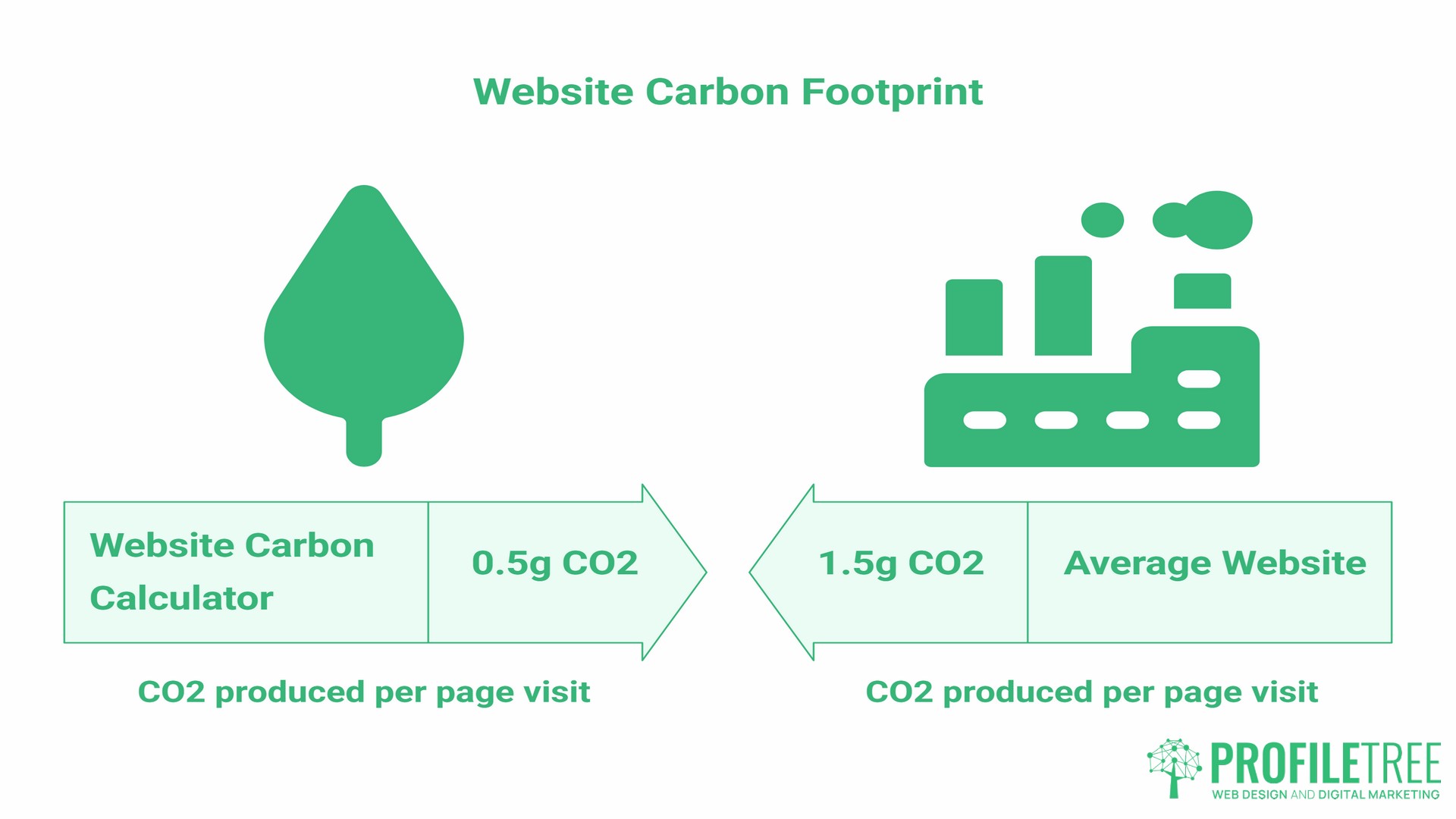
Several free tools give a practical picture of a website’s carbon footprint and performance profile.
- Website Carbon Calculator (websitecarbon.com): Enter a URL to get an estimate of CO2 produced per page visit, benchmarked against a database of tested sites. This provides a starting point for comparison and for tracking improvements.
- Google PageSpeed Insights: The most directly actionable tool for performance. It scores pages on Core Web Vitals, flags specific issues with file sizes and load order, and suggests fixes. Running this against your home page and most-visited landing page monthly is a minimal maintenance habit.
- GTmetrix: Provides waterfall charts showing which assets take the longest to load, which is useful for identifying specific images or scripts causing delays.
- Ecograder (ecograder.com): Evaluates a site across several sustainability dimensions, including hosting, page weight, and accessibility, and produces a scored report.
Running these tools against your site before and after optimisation work gives a measurable baseline. For SMEs preparing sustainability credentials for procurement bids, documented improvements using these tools provide concrete supporting evidence.
For a broader view of how a website is performing in organic search, ProfileTree’s website performance analysis resource covers the metrics that matter and how to interpret them.
Sustainable Web Design in the UK and Ireland
The UK and Irish regulatory and policy context adds practical dimensions to sustainable web design that global guides rarely address.
- The UK Green Claims Code (enforced by the Competition and Markets Authority) sets out what businesses can and cannot claim about their environmental credentials. If you describe your website as “carbon neutral” or “eco-friendly,” that claim needs to be substantiated. Vague environmental language without evidence is subject to enforcement action. Using a verified green hosting provider and documenting your site’s carbon footprint through a tool like Website Carbon Calculator puts you in a much stronger position than simply asserting sustainability.
- The Northern Ireland Climate Change Act 2022 commits Northern Ireland to net zero greenhouse gas emissions by 2050, with a bridging target of at least a 48% reduction by 2030. For businesses operating in Northern Ireland, digital operations, including website hosting, are part of the broader emissions picture as environmental reporting requirements expand.
- Social Value in UK procurement: The Public Services (Social Value) Act 2012 requires contracting authorities to consider social, economic, and environmental value in public sector procurement decisions. The UK Government’s Social Value Model, used for central government contracts, includes specific themes around net zero and climate action. For Northern Ireland and Irish SMEs tendering for public contracts, a demonstrably sustainable digital presence, backed by green hosting credentials and documented performance standards, is a verifiable contribution to those criteria.
- Irish data centres: The Republic of Ireland hosts a disproportionately large concentration of European data centre capacity, largely due to EU headquarters clustering in Dublin. EirGrid has published concerns about data centre energy demand relative to national grid capacity. For Irish businesses, choosing hosting providers that prioritise energy efficiency and renewable sourcing is a direct response to a documented national infrastructure challenge.
How ProfileTree Approaches Sustainable Web Design
ProfileTree, the Belfast-based web design and digital marketing agency, builds performance and efficiency into every project as a default rather than an optional add-on. The overlap between eco-friendly web design and commercial performance means these are the same decisions. Making web design sustainable is not a niche specialism; it is the standard expected of any build that needs to perform in organic search.
On each new web build, the standard approach covers: compressed WebP images processed at upload, a CDN configuration for static assets, minimised CSS and JavaScript bundles, lazy loading for below-fold images, and a managed hosting environment with caching pre-configured. Core Web Vitals scores are checked before launch and form part of the handover review.
For clients on existing sites with performance problems, ProfileTree’s web design service includes a technical audit that identifies the specific causes of slow load times and outlines a prioritised remediation plan.
Sustainable web design is not a separate service offering. It is the standard of build. Every project ProfileTree delivers is assessed against sustainable web design principles before launch.
FAQs
What is the most sustainable way to design a website?
The most effective combination is green hosting on a renewable energy-powered provider, compressed images in WebP format with lazy loading, minimised CSS and JavaScript, and a content delivery network. On WordPress, adding a caching plugin and reducing the active plugin count to only what is genuinely needed covers the majority of gains available without a rebuild.
Does sustainable web design affect SEO?
Yes, directly. Google’s Core Web Vitals (LCP, INP, and CLS) are confirmed ranking signals. All three are improved by reducing page weight, optimising images, and deferring non-critical scripts. These are the same actions that reduce a page’s energy consumption. Web design, sustainable practices, and good SEO practices are the same set of decisions. A sustainably built site will generally score better in page experience assessments than an equivalent site built without those constraints.
Can a WordPress site be sustainable?
Yes. WordPress sites can be made highly efficient through the right hosting environment, a lightweight theme, aggressive image compression, full-page caching, and careful plugin management. The biggest risk on WordPress is plugin accumulation over time. Each additional plugin can add scripts and stylesheets that load on every page, whether they are needed or not. An annual plugin audit is one of the highest-return maintenance tasks for any WordPress site.
Why should UK businesses care about digital sustainability?
Beyond the environmental argument, there are commercial and regulatory reasons. Core Web Vitals affect search rankings. The Green Claims Code means environmental claims need to be substantiated. Public sector procurement frameworks increasingly reward demonstrable sustainability credentials. Consumer expectations around environmental responsibility are rising across B2B and B2C markets. Digital sustainability is becoming a standard business expectation rather than a differentiator.
Is green web hosting more expensive?
Not significantly. The market for renewable-energy-powered hosting has matured to the point where green providers are broadly price-competitive with standard alternatives at equivalent performance tiers. For managed WordPress hosting in particular, the performance infrastructure bundled with most managed green hosts often exceeds that of a standard non-managed host.
How do I check my website’s carbon footprint?
The simplest starting point is the Website Carbon Calculator at websitecarbon.com. Enter your URL, and it produces an estimate of CO2 per page visit with a percentile benchmark. Google PageSpeed Insights provides complementary data on page weight and performance. Running both tools against your key pages takes under ten minutes and provides a documented baseline.