
User Journey Mapping for UK and Irish SMEs: A Practical Guide
Table of Contents
User journey mapping shows you every point where a customer meets your business, from the first Google search to the review they leave a year later. For most SMEs in Northern Ireland, Ireland and the UK, the value is simple: you stop guessing where people drop off and start fixing the moments that actually lose you sales. This guide walks through the core stages, how to map your touchpoints, and how to turn a static diagram into something your team uses every week.
Why User Journey Mapping Matters
A user journey map is worth building because it replaces opinion with evidence about how people move toward buying from you. Instead of treating a sale as a single event, you see the chain of smaller interactions that build trust along the way, and you can spot the weak links.
A whole-journey view beats a funnel view.
A traditional funnel counts how many people reach the bottom. A journey map asks why they did or did not. Someone might find your blog on a phone during a coffee break, check your reviews three days later on a laptop, then ring you a week after that. Each of those moments shapes the decision, and a funnel hides most of them. Mapping the full path is closer to how buying really happens.
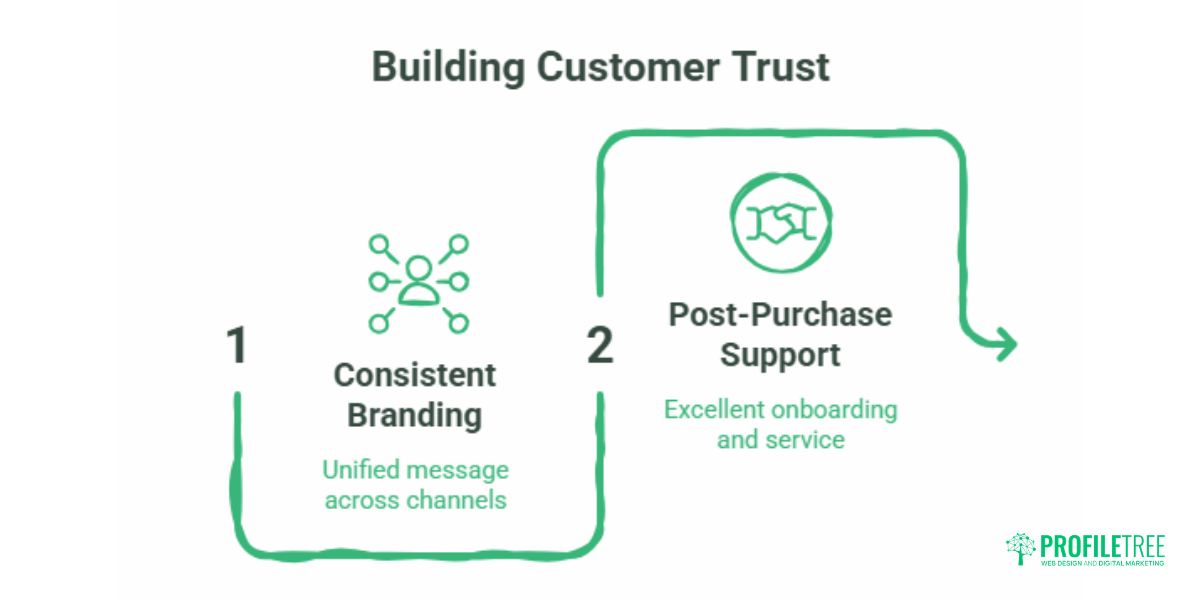
Consistency across channels builds trust.
When your social posts, your website and your follow-up emails all sound like the same business, customers relax. When they contradict each other, people hesitate. Bain & Company has long argued that small gains in customer retention can produce outsized profit gains, and the broader research consensus is that consistent cross-channel experiences correlate with higher loyalty. The practical takeaway for an SME: every touchpoint should carry the same promise, the same tone, and the same standard of service.
The journey does not end at checkout.
The period after a purchase often decides whether a one-time buyer becomes a repeat customer or an advocate. Onboarding emails, a helpful support reply, a clear invoice: these post-purchase touchpoints are cheap to improve and easy to ignore. Mapping them is where a lot of quiet revenue hides.
The Core Stages of a User Journey
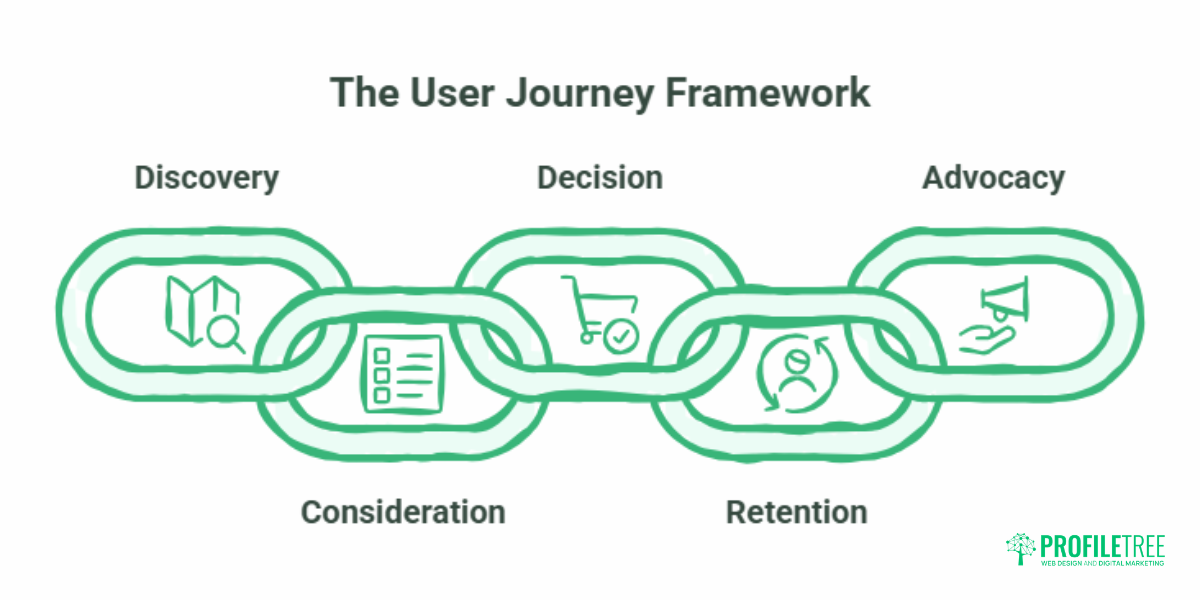
Most SME journeys move through five stages: discovery, consideration, decision, retention and advocacy. Each one needs a different kind of content and a different measure of success. Here is what to watch at each step, with a few realistic ways the work maps onto digital services.
Discovery: getting found in the first place
Discovery is where someone first learns you exist, usually through search, social media or a referral. If your site does not appear when a Belfast customer searches for what you sell, the journey never starts. This stage is largely a search engine optimisation and content marketing problem: useful pages, ranking for the terms your buyers actually type. A trades business near Derry, for example, lives or dies on whether it shows up for local service searches.
Consideration: earning the shortlist
At the consideration stage, people compare you against two or three alternatives. They read reviews, scan your service pages and look for proof you can do the job. Clear, fast, well-structured pages do the heavy lifting here, which is why website design and the words on those pages matter so much. A confusing site at this point quietly removes you from the shortlist.
Decision: removing friction at the point of action
The decision stage is the enquiry form, the checkout, and the phone call. Friction here is expensive. A form asking for ten fields when three would do, a checkout that breaks on mobile, an unclear next step: any of these can lose a customer who had already chosen you. Reducing that friction is a website development job as much as a marketing one.
Retention and advocacy: turning buyers into promoters
After the sale, retention keeps customers coming back, and advocacy turns them into people who recommend you. Onboarding sequences, useful updates and the occasional short video explaining how to get the most from a product all help. Your happiest customers leaving reviews and referring friends is the cheapest marketing you will ever get, and it only happens if the earlier stages are delivered.
Journey map versus touchpoint map
People use these terms interchangeably, but they are not the same thing, and the difference matters when you sit down to build one.
| Customer journey map | Touchpoint map | |
|---|---|---|
| Primary focus | The customer’s experience, thoughts and emotions | An internal inventory of every system and channel |
| Main question | How does it feel to deal with us? | Where exactly do we meet the customer? |
| Typical owner | Marketing or a customer experience lead | Operations, working with marketing and support |
| End output | A narrative of the experience, stage by stage | A working register of assets and owners |
In practice, you want both. The journey map tells you what the experience should feel like; the touchpoint map is the operational list that makes it happen.
How to Map Your Touchpoints: A Five-Step Framework
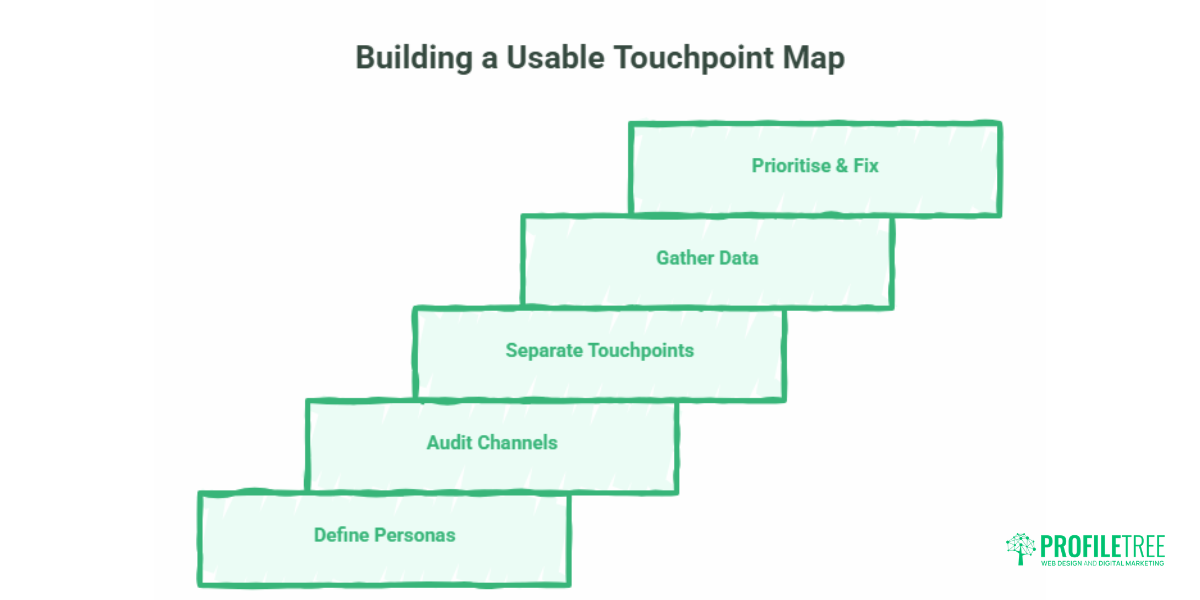
The quickest way to build a usable map is to work through five steps in order. Do not aim for a perfect diagram on the first pass. Aim for an honest one.
- Define your personas and their stage. Decide who you are mapping for and where they are in the buying process. A returning customer and a first-time visitor travel very different paths.
- Audit your channels and systems. List every place you meet customers: website pages, email, social accounts, phone, in-person, review sites, and even packaging. Note the tool or system behind each one.
- Separate direct and indirect touchpoints. Split the ones you control (your site, your emails) from the ones you do not (third-party reviews, word-of-mouth in a local WhatsApp or Slack group). Both shape the decision.
- Gather the numbers and the words. Pull the quantitative data from analytics and the qualitative data from short customer surveys or calls. This is where digital strategy work earns its keep, because the two together tell you where people stall and why.
- Prioritise, fix and assign ownership. Rank the high-friction touchpoints, decide which to fix first, and give each one an owner. A map with no named owner is a poster, not a tool.
Common touchpoints across the lifecycle
It helps to list touchpoints by stage so nothing slips through. A rough starting set for a typical SME looks like this: at the discovery stage, organic search results, paid ads, social posts and local directories; at the purchase stage, the checkout or enquiry form, billing and any sales conversation; at the post-purchase stage, onboarding emails, the support inbox, renewal reminders and a customer community. Your own list will differ, but the categories rarely do.
Mapping compliance touchpoints under UK GDPR
One set of touchpoints that mainstream guides skip: the compliance ones. Under UK GDPR and ICO guidance, your cookie consent banner, your marketing opt-in, and your preference or account-deletion flows are all real touchpoints, and they are often the very first friction a visitor hits. A clumsy consent banner can cost you a customer before they have read a word. Map these alongside the rest, and treat reducing their friction as part of the experience rather than a legal afterthought.
Mapping the hidden touchpoints
Not every interaction shows up in analytics. Recommendations in a private group, a mention at a local business meetup, a forwarded email: these untracked touchpoints often carry more weight than the ones you can measure. You cannot put a number on them, but you can uncover them by asking new customers a single question: ” How did you first hear about us? Their answers will surprise you and will usually point to touchpoints you had not mapped.
This is also the point where good video marketing earns its place. A short explainer or customer story shared in those informal channels travels further than a text post, and it gives people something concrete to forward.
Tools and methods that help
You do not need expensive software to start. A spreadsheet works. Empathy maps, written from the customer’s point of view, help your team understand what someone is thinking and feeling at each stage. Simple personas keep you focused on real buyers rather than an imagined average. A flow diagram, even a hand-drawn one, shows the branches where people take different paths. The method matters less than the habit of looking at the journey from the outside in.
Here is where the work pays off, in the words of ProfileTree founder Ciaran Connolly:
“When a business maps its journey honestly, the first thing it usually finds is that the moment it thought was the problem isn’t the problem at all. The drop-off is two steps earlier, somewhere nobody was looking. Fixing that one quiet touchpoint often does more than any new campaign.”Ciaran Connolly, founder, ProfileTree
Keeping Your Journey Map Alive
A journey map is only useful if it changes. Channels shift, tools get replaced, and customer behaviour moves with them. Review the map at least twice a year, and any time you add a major channel or launch a new product. Watch your conversion data for the points where people consistently exit, and treat each one as a prompt to revisit that touchpoint.
Two habits keep a map honest. First, share it across teams, because sales, support and operations each see a different slice of the journey. Second, build a simple feedback loop: a short post-purchase survey, the occasional customer call, and an exit question when someone unsubscribes. The numbers tell you what is happening; the conversations tell you why. Teams that want to build these habits internally often start with some structured digital training so the skill stays in-house rather than walking out the door.
Conclusion
User journey mapping turns customer engagement from guesswork into something you can measure and improve. Map the five stages, list every touchpoint, including the compliance and hidden ones, fix the high-friction moments first, and review the map regularly. Do that, and you guide people from a first search to a genuine recommendation without losing them at a step nobody was watching. The reward is steadier conversions, better retention, and customers who do some of your marketing for you.
Frequently Asked Questions
What is the difference between a customer journey map and a touchpoint map?
A journey map captures the customer’s end-to-end experience, including their thoughts and emotions. A touchpoint map is an internal register of every system, channel and asset where you actually meet the customer. You want both: one describes the experience, the other makes it operational.
What are the three types of customer touchpoints?
They are usually grouped as digital or static (websites, ads), interactive or transactional (portals, billing, checkout) and human (sales calls, customer support).
How do you map customer touchpoints?
Define your personas, audit every channel and system, separate the touchpoints you control from those you do not, gather analytics and customer feedback, then prioritise and assign an owner to each high-friction point.
How often should a business update its touchpoint map?
Review it twice a year as a minimum, and any time you add a major channel, swap a key tool, or launch a new product or service line.
Who should own the touchpoint map?
Mapping is a cross-functional job involving marketing, sales and support, but one person, often a customer experience lead or product owner, should hold overall custody so the map stays current.