
Web Design for Lead Generation: A Practical SME Guide
Table of Contents
Web design for lead generation is not about making a website look good. It is about making it work, pulling in enquiries, contact form submissions, and phone calls from the people who actually want to buy. For most SMEs across Northern Ireland, Ireland, and the UK, this is where website investment either pays back or quietly drains budget with nothing to show for it.
A site built purely for aesthetics can look polished and still convert no one. The difference between a website that generates leads and one that does not almost always comes down to a handful of design and structure decisions made early in the build process.
This guide covers those decisions: what to prioritise, what commonly goes wrong, and when it makes sense to bring in a professional web design team rather than trying to retrofit conversion into a site that was never built for it.
What Web Design for Lead Generation Actually Means
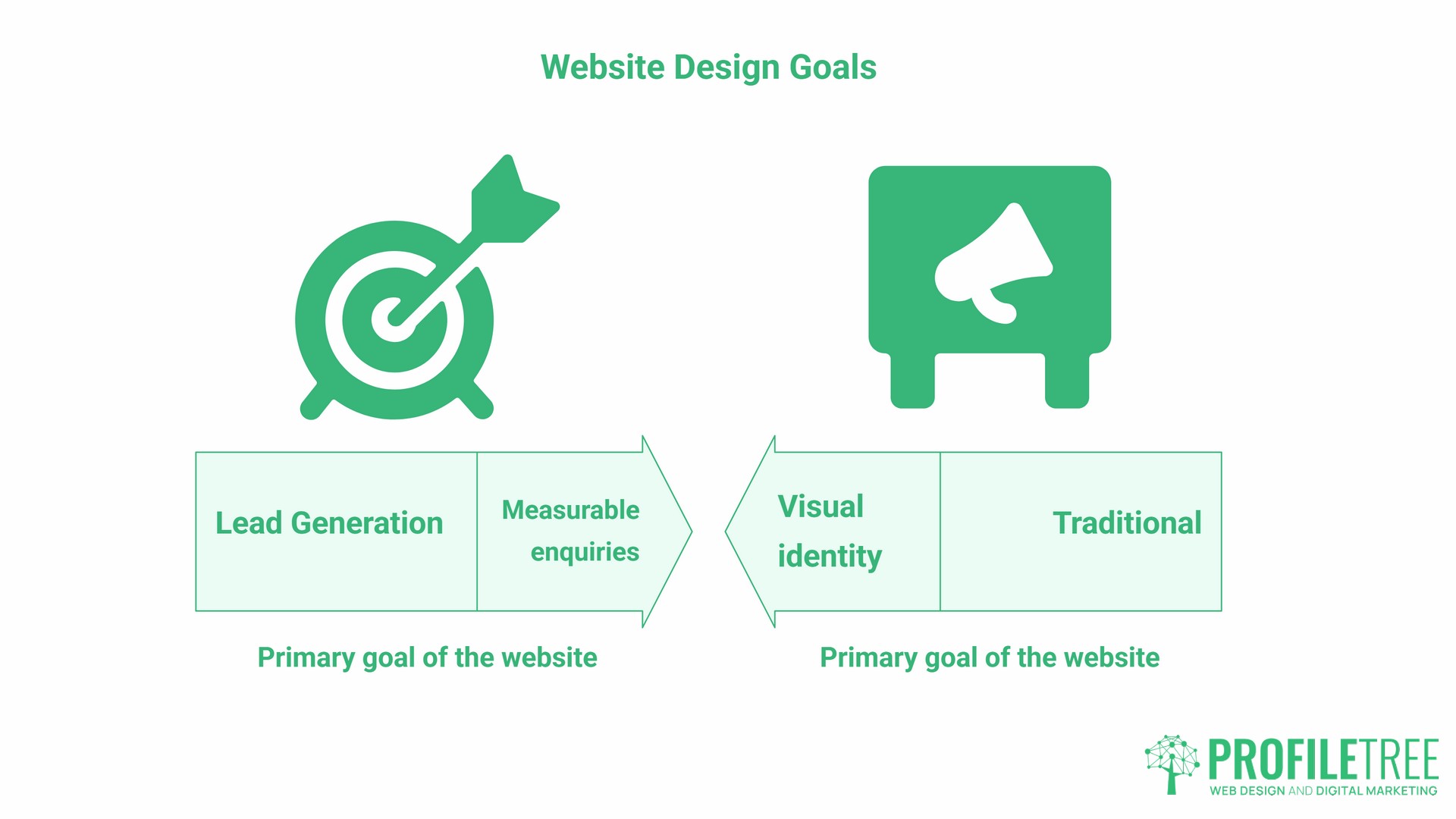
Web design for lead generation, in practical terms, means shaping every element of a page to guide a visitor toward a specific action: filling out a form, requesting a quote, booking a call, or subscribing. It sounds simple. In practice, it requires every element of the page, from the headline to the button colour to the number of fields in a form, to pull in the same direction.
Most websites are built with aesthetics as the primary goal and lead generation as an afterthought. The result is sites with beautiful imagery, vague calls to action, and contact pages buried in the footer. Traffic arrives and leaves without leaving any trace.
| Traditional web design | Lead generation web design |
|---|---|
| Primary goal: visual identity | Primary goal: measurable enquiries |
| CTA placement: footer or contact page | CTA placement: above the fold, repeated throughout |
| Navigation: broad and exploratory | Navigation: focused, guides toward conversion |
| Forms: long, generic | Forms: short, specific, low friction |
| Success metric: page views | Success metric: conversion rate |
The distinction matters because briefing a designer for one type of site and expecting the results of the other almost always ends in frustration.
Why Most SME Websites Fail to Generate Leads
- Poor web design for lead generation is rarely about one catastrophic mistake. It is usually a collection of smaller decisions, each individually defensible, that combine to produce a site that looks credible but converts no one. The most common patterns are worth naming directly.
- Unclear value proposition above the fold. Visitors form an opinion within seconds of landing on a page. If the first thing they see does not clearly explain what the business does, who it serves, and why they should care, most will leave. A hero section that opens with an abstract tagline and a stock image isn’t doing the job.
- Weak or misplaced calls to action. A call to action buried at the bottom of the page, written as “Contact Us” in a small link, will be ignored. Every major section of a lead generation page should include a clear, specific prompt: “Get a free quote,” “Book a 20-minute consultation,” “Download the guide.” The action should be obvious and easy to find.
- Forms that ask too much. Conversion rates fall as form length increases. A Formstack study found that reducing the number of form fields from 11 to 4 increased conversions by 120% in its dataset. For most SME lead capture forms, name, email address, and one qualifying question is enough to start a conversation.
- No social proof near the conversion point. Trust is the primary obstacle to lead generation for SMEs. Visitors who do not know your business need a reason to believe you deliver. Testimonials, Google star ratings, and client logos placed near forms and CTAs reduce the hesitation that stops people from clicking.
- Slow page load. Google’s research, published on the Think with Google platform, found that as page load time increases from 1 second to 5 seconds, the probability of a mobile visitor bouncing increases by 90%. A high-converting page that takes six seconds to load will underperform a plain, fast-loading one on every conversion metric.
The Anatomy of a High-Converting Lead Generation Website
Effective web design for lead generation follows a consistent anatomy. The specific visual treatment varies, but the structural logic stays the same across almost every high-performing site.
Above the Fold: the Most Valuable Space on Your Site
Everything visible before a visitor scrolls is prime conversion real estate. It needs: a clear headline that states what you do and for whom; a supporting sentence that adds proof or specificity; a primary CTA button; and at least one trust signal (a review score, a client logo, or an accreditation badge). Most SME homepages waste this space on animation and vague slogans.
Strategic CTA Placement
Do not put a single CTA at the bottom and hope visitors will find it. Place the primary CTA above the fold. Repeat it in the middle of long pages. Include it at the end of every major section. Varying the wording slightly prevents repetition from feeling mechanical: “Get a free quote,” then “Talk to our team,” then “Start your project today.” Same destination, different framing.
Social Proof as a Conversion Tool
The placement of social proof matters as much as its presence. A testimonial block in a sidebar nobody reads does nothing. A specific client quote placed directly above a contact form, where the visitor is already considering whether to get in touch, reduces friction at the exact moment it matters. Google star ratings with a visible review count outperform generic “trusted by hundreds of businesses” claims because they are specific and verifiable.
Lead Magnets for Longer Sales Cycles
Not every visitor is ready to enquire on the first visit. For businesses with longer decision cycles, professional services, higher-value web projects, and marketing retainers, a lead magnet gives visitors a reason to share their contact details before they are ready to buy. A practical guide, a website audit offer, or a free consultation: anything that provides genuine value in exchange for an email address extends the reach of the page beyond its immediate enquiries.
GDPR and Web Design for Lead Generation: What UK and Irish SMEs Need to Know
This is the section that most guides on web design for lead generation skip entirely, and it is one of the most consequential for UK and Irish businesses.
GDPR does not stop you from generating leads online. What it does is require that you collect consent properly, store data lawfully, and give people a way to opt out. Getting this right in your web design is not just a legal obligation; it improves lead quality by ensuring your list is made up of people who genuinely want to hear from you.
- Consent-compliant forms. UK and Irish lead generation forms must not use pre-ticked opt-in boxes. Consent must be active, specific, and freely given. A checkbox that reads “I agree to receive marketing communications from [company],” placed below the form fields and unticked by default, is the minimum standard. The ICO (Information Commissioner’s Office) publishes detailed guidance on lawful consent at ico.org.uk.
- Cookie consent and analytics tracking. Retargeting pixels and analytics tools, including Google Analytics, require user consent under UK GDPR and the Privacy and Electronic Communications Regulations (PECR). A compliant cookie consent banner gives visitors a genuine choice. Sites that load tracking scripts before consent is given are in breach of PECR. This has a practical consequence for measurement: a proportion of visitors will decline tracking, so your analytics will not capture the full picture.
- What this means for design. Compliance and conversion are not in conflict if form design is handled carefully. A clearly worded consent checkbox adds one field but builds trust. Visitors who understand what they are agreeing to and feel in control are more likely to complete a form. Treating compliance as a design element rather than a legal afterthought produces better outcomes on both counts.
Technical Pillars of Web Design for Lead Generation
Page Speed
Every additional second of load time reduces the likelihood that a visitor will stay and convert. Google PageSpeed Insights and GTmetrix both identify the specific issues dragging performance down: uncompressed images, render-blocking scripts, and poor server response times are the most common on SME sites. For WordPress websites, which represent a large proportion of SME sites across the UK and Ireland, page speed issues are often fixable through caching, image optimisation, and removing unused plugins rather than a full rebuild. ProfileTree’s website development services include performance optimisation as standard on every project.
Mobile-First Lead Capture
Mobile traffic accounts for the majority of web visits in most SME sectors. Designing lead capture for mobile means more than making a form smaller on a phone screen. It means using click-to-call buttons so visitors on mobile can contact you without typing. It means keeping forms short enough to complete without excessive scrolling. It means testing every CTA at thumb-reach height on a real device.
Drop-down menus, multi-step forms that require switching between fields, and CTAs positioned where the browser’s navigation bar overlaps are all common mobile conversion killers that only reveal themselves when you test on an actual handset rather than a desktop browser.
Site Architecture and Internal Linking
Lead generation does not only happen on homepages. Blog content, service pages, and resource guides all attract traffic, and each should have a clear pathway to a conversion point. Every service page needs a CTA. Every blog post covering a topic related to your services should link to the relevant service page. Internal linking connects traffic to conversion, and most SME websites do this poorly.
“Ciaran Connolly, founder of ProfileTree, notes that many SME websites generate reasonable organic traffic but convert almost none of it, simply because the path from an informational blog post to a service enquiry is never made explicit. Traffic without direction is wasted.”
Content Strategy: What to Say to Get the Lead
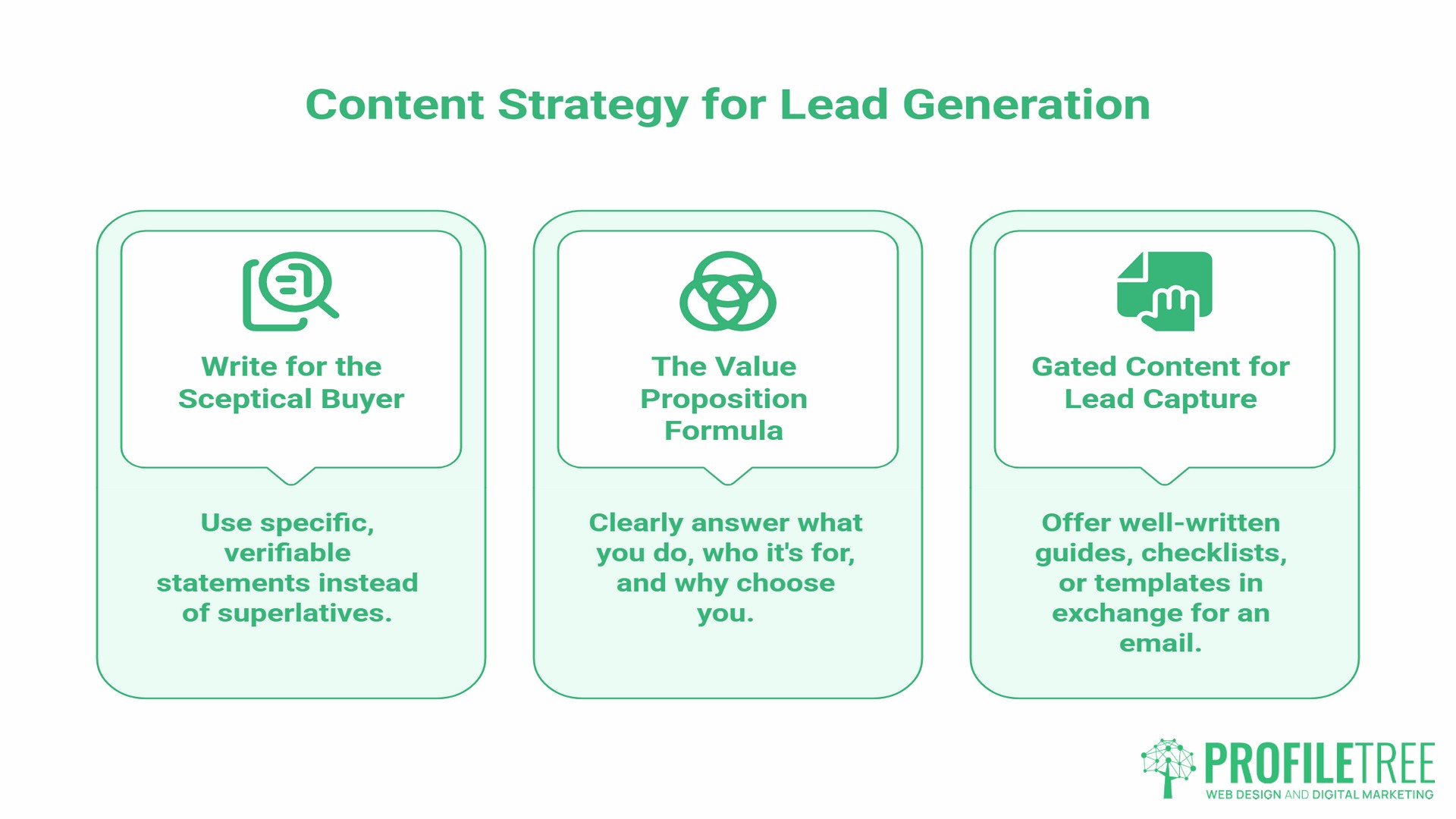
Design gets visitors to the form. Copy gets them to fill it in. Even the most technically sound web design approach for lead generation will underperform if the page copy does not give visitors a reason to act.
- Write for the sceptical buyer. SME buyers, particularly in B2B contexts, are not moved by superlatives. Claims like “industry-leading solutions” or “world-class service” register as noise. Specific, verifiable statements do the work instead: the number of projects completed, a typical turnaround time, or a concrete and attributable outcome from real client work.
- The value proposition formula. A clear value proposition answers three questions: what do you do, who is it for, and what makes it worth choosing over the alternative? It belongs in the hero section, not buried in an About page paragraph. “WordPress website design for professional services firms in Northern Ireland, delivered in six weeks with a fixed project fee” is a value proposition. “We help businesses grow online” is not.
- Gated content for lead capture. A well-written guide, checklist, or template offered in exchange for an email address can generate leads from visitors who are not yet ready to enquire directly. The keyword is well-written: a gated asset that delivers no genuine value damages trust rather than building it.
SEO and Lead Generation: Why Traffic Comes First
Web design for lead generation only produces results if people arrive at the site. A high-converting page with no traffic is still generating zero leads. This is why treating SEO and web design as separate disciplines, planned in separate conversations, delivered by separate teams, so often produces disappointing outcomes.
Page speed affects both search rankings and conversion rates. Clear heading structure improves both readability and search engine comprehension. Content that answers specific questions earns organic traffic and builds the trust that converts visitors into enquiries.
For SMEs targeting customers in specific locations, local SEO adds a further dimension: Google Business Profile optimisation, location-specific landing pages, and consistent name, address, and phone number data across the web all feed into how prominently a business appears in local search results. ProfileTree’s SEO services are built around this combination of technical foundations and content strategy, applied from the point a website is first planned rather than as an afterthought after launch.
When to Hire a Professional Agency for Web Design for Lead Generation
DIY website builders have lowered the barrier to getting something online. They have not lowered the barrier to building something that generates consistent, qualified leads from your target market. The decision to bring in a professional web design agency for lead generation typically comes down to one of three points.
- The site exists but is not converting. Traffic is arriving, but enquiries are not following. This is a design and content problem, and it is almost always fixable without a full rebuild if the right audit is done first.
- The business is growing, and the current site is a constraint. What worked at launch no longer reflects the scale of the operation, the range of services, or the quality of the work. A site that undersells the business’s costs leaves competitors with more credible online presences.
- A new website is being planned. This is the highest-value moment to get the foundations right. Decisions made at a brief stage, about structure, content, CTA strategy, and technical build, are far cheaper to address before launch than to retrofit after.
The cost of a professionally built lead generation website varies by scope. Getting a scoped proposal is the only reliable way to understand what applies to a specific brief. Talk to the ProfileTree team about what a conversion-focused build would look like for your business.
Measuring the Performance of Your Lead Generation Website
A lead generation website that is not measured is not being managed. These are the metrics that tell you whether your web design decisions are working.
- Conversion rate by page. What percentage of visitors to each key page take the desired action? A homepage converting at 1% has a different problem than a service page converting at 0.1%. Tracking conversion rate at the page level, rather than site-wide, points you toward specific fixes.
- Traffic source breakdown. Leads arriving from organic search behave differently to those from paid advertising or referral traffic. Understanding where your converting visitors come from tells you where to invest further and where to reduce spend.
- Form completion versus form abandonment. Most basic analytics setups track form submissions but not form starts. Adding event tracking to forms reveals which field people drop out of, often pointing directly to what needs to change. Google Tag Manager makes this trackable without custom development on most WordPress sites.
- Heatmaps and session recordings. Tools such as Hotjar show where visitors click, how far they scroll, and where they stop engaging. Sections you expected visitors to spend time on often get ignored, while a line of copy near the top of the page stops people in their tracks. Review these monthly and use them to prioritise what to test next.
FAQs
What is the best type of website for web design for lead generation?
Service-based businesses generate most leads from focused service pages and dedicated landing pages rather than from homepages. A homepage covering every service rarely converts as well as a page targeting a specific offer with a single, clear CTA. For product-based businesses, category pages with strong filtering and visible trust signals tend to perform best. The principle is consistent: fewer competing goals on a single page means higher conversion rates.
How many fields should a lead generation form have?
For most SME enquiry forms, three to five fields is the practical range. Name, email address, and a brief description of the enquiry give a team enough to follow up meaningfully. Adding a phone number as an optional rather than required field typically recovers leads from visitors who would otherwise abandon a form that forces a mobile number. More than six required fields will reduce conversion rate for most audiences unless the visitor has a compelling reason to provide additional detail.
How do I make my website a lead generation machine?
Start with five specific steps. First, audit your above-the-fold content: does it state clearly what you do and for whom? Second, check every CTA: is it specific and placed where visitors actually look? Third, reduce your form fields to the minimum needed to start a conversation. Fourth, add social proof, reviews, client logos, and case study references near every conversion point. Fifth, run a page speed test using Google PageSpeed Insights and fix the biggest performance issue first. These changes alone will move most SME websites from passive to active in terms of lead generation.
Does GDPR stop me from generating leads online?
No. GDPR regulates how you collect and store personal data; it does not prevent lead generation. The practical requirements are: use unticked opt-in checkboxes, include a clear privacy notice link near your forms, and ensure tracking scripts load only after cookie consent is given. Businesses in the UK operate under the UK GDPR, which is governed by the ICO and publishes clear guidance at ico.org.uk. The practical requirements align closely with EU GDPR.
How much does a lead generation website cost in the UK?
Costs vary significantly by scope and agency. A small service business website of five to eight pages, built with conversion as the primary goal, sits at a different price point than a multi-service enterprise site with custom integrations and automation. The most useful first step is to get a scoped proposal from an agency that asks detailed questions about your business goals, target audience, and existing digital presence before providing a quote.
How long does it take to see results from a new lead generation website design?
A redesigned or newly launched page can show conversion rate improvements almost immediately if the changes are substantive. Organic traffic growth takes longer: a new or significantly updated page typically takes three to six months to build ranking momentum, depending on the competitiveness of the target search terms. Combining strong web design with an active SEO strategy shortens the gap between launch and measurable lead growth.