
Trust in Media Statistics: What the Numbers Mean for Your Business
Table of Contents
Public trust in the media has been in decline for years. According to the Reuters Institute Digital News Report 2025, around 40% of people across 47 markets say they trust most news most of the time. That means roughly six in ten people approach what they read, watch, or hear with some degree of scepticism. For journalists, that is a professional crisis. For businesses, it is a strategic reality that affects how they communicate.
When audiences stop trusting traditional media, they do not simply stop consuming information — they find other sources. They turn to search, to video, to peer recommendations, and increasingly to AI-generated summaries. The businesses that understand this shift and build their own credible digital presence are the ones that stay visible, trusted, and competitive. The ones that rely solely on press coverage or paid advertising face an increasingly difficult environment.
This guide covers what the latest media trust statistics actually say, why the numbers differ so sharply across generations and regions, and what practical steps businesses in the UK and Ireland can take to build the kind of digital authority that fills the gap left by declining media trust.
What Are the Latest Trust in Media Statistics?
Global trust in news has held at roughly 40% for several years, with no significant recovery on the horizon. The Reuters Institute’s 2025 research, drawing on data from 47 countries, found that this plateau is not evenly distributed. Trust varies enormously by country, age group, platform, and the type of outlet being evaluated.
Global Averages and Regional Variations
Finland consistently ranks among the highest-trust countries, with over 60% of respondents saying they trust most news. Greece and Hungary sit at the lower end of the spectrum. The UK sits in the middle of the international rankings, with Ofcom’s 2025 news consumption research indicating that television news remains the most trusted format for UK audiences, though trust in all formats has declined compared to a decade ago.
In Northern Ireland and the Republic of Ireland, media trust presents particular complexities. NISRA’s Programme for Government indicators show that trust in the media correlates with trust in public institutions more broadly, suggesting that trust in the media in Northern Ireland is entangled with political identity and community experience in ways that do not apply, say, in Sweden.
The RTÉ payments controversy has had a measurable impact on trust in the Republic. Research tracking Irish audiences post-scandal found that confidence in the national broadcaster dropped significantly, driving audiences towards alternative sources — including independent digital publishers, podcasts, and direct social media accounts from journalists.
Trust by Platform: Where the Divide Is Sharpest
The most significant structural shift in media trust is not the overall decline — it is the divergence between platforms. Traditional broadcast and print media, while declining, still outperform social media platforms on trust measures. But usage patterns tell a different story.
Audiences are increasingly getting their news from TikTok, YouTube, and Instagram, even though they report lower trust in those platforms than in established outlets. This gap between trust and usage is particularly pronounced among Gen Z. A person can know they should be sceptical of a TikTok news video while still watching it because it is where the conversation is happening.
For businesses, this creates a direct opportunity. People are searching for trusted voices on platforms where institutional credibility is weak. A business that publishes consistent, accurate, well-produced content on YouTube or LinkedIn is not competing with the BBC. It is filling a space the BBC is not occupying.
The Generational Trust Divide
Understanding how trust differs by age group matters for any business deciding where to invest its communications budget.
Gen Z and Millennial Audiences
People under 35 show the sharpest scepticism toward traditional news organisations. Research consistently finds that younger audiences are more likely to discover news through social media, distrust institutional sources, and place greater weight on peer recommendations and creator content.
This does not mean they are poorly informed. It means they have built different verification habits. A Gen Z consumer may follow five independent journalists on Instagram, use an AI search tool to cross-reference claims, and watch long-form YouTube explainers for context — all while actively avoiding the homepage of a national newspaper.
For a business trying to reach this audience, the implication is direct: your content strategy needs to function independently of traditional media coverage. SEO, social media content, and video are not supplementary channels. For this audience, they are the primary touchpoints.
Gen X and Baby Boomer Audiences
Older audiences continue to show higher trust in established news organisations and broadcast television. Ofcom data consistently places TV news as the most credible format for over-55s. This group is also the primary demographic for many service businesses in the UK and Ireland — financial services, home improvement, professional services, and healthcare.
The digital literacy gap within this group is real but narrowing. Targeted digital advertising, Google search, and email marketing all reach this demographic effectively. The challenge is that they evaluate trust signals differently: they look for professional credentials, an established presence, and brand recognition rather than follower counts or engagement metrics.
For businesses serving this audience, a credible website, strong Google reviews, and clear professional credentials matter as much as social media presence.
Why Public Trust in Media Matters for SME Marketing
The connection between declining media trust and business marketing strategy is practical, not abstract.
Owned Content Fills the Gap Left by Traditional Media
When a business relies on press coverage for visibility, it is borrowing credibility from the outlet carrying the story. As audiences lose trust in those outlets, the borrowed credibility is worth less. A feature in a regional newspaper carries less weight than it did fifteen years ago — not because the journalist’s work is worse, but because trust in the format has declined.
Owned content — blog articles, YouTube videos, podcasts, email newsletters — does not depend on the credibility of a third-party outlet. It builds the business’s own reputation directly. A solicitor publishing detailed guides on what to expect during a property purchase builds trust with prospective clients directly, without a newspaper intermediary.
ProfileTree’s content marketing work with SMEs across Northern Ireland and Ireland consistently involves this shift: from relying on occasional press mentions to building a content archive that generates consistent organic search traffic and positions the business as a credible authority in its field.
SEO as a Trust Infrastructure
When someone searches for a service or product and a business appears prominently in Google results, that visibility conveys an implicit trust signal. Google’s own quality evaluation frameworks reward content that demonstrates experience, expertise, authoritativeness, and trustworthiness. A page that ranks well has, by definition, cleared a credibility threshold.
The businesses that invest in ethical SEO — genuinely useful content, clear author credentials, accurate information, proper site structure — are building the kind of digital presence that functions as trust infrastructure. As Ciaran Connolly, founder of ProfileTree, puts it: “Your website is the one channel you own completely. Unlike social platforms or press coverage, you control the content, the credibility signals, and the user experience. That is where long-term business trust is built.”
For SMEs unsure where to start with their digital presence, understanding what a search-optimised website entails is a practical first step. ProfileTree’s guide to transparency in content marketing covers some of the principles directly.
Video as a Credibility Builder
One of the clearest findings across media trust research is that seeing and hearing a real person builds trust more effectively than text alone. This is partly why broadcast television retains higher trust scores than print, even as both decline. The human element — tone of voice, eye contact, genuine expertise demonstrated in real time — communicates credibility in ways that a written article cannot fully replicate.
For businesses, this is a strong argument for video. A business owner or team member explaining their process, demonstrating their expertise, or walking through a common client concern on camera is doing something that generic stock photography and polished website copy cannot: demonstrating genuine knowledge. It is worth watching how ProfileTree approaches video for SMEs before deciding whether it is the right channel for your business.
Professional video production does not require a broadcast budget. For many SMEs, a series of short, well-filmed videos that address common client questions builds trust more than any press release.
The AI Trust Paradox
AI-generated content has introduced a new complication into the trust picture that no media research from five years ago anticipated.
High Usage, Low Trust
People are increasingly using AI tools — such as ChatGPT, Gemini, Perplexity, and Google AI Overviews — to find information, including news and business intelligence. At the same time, trust in AI-generated content is low. Research from 2025 found that audiences are aware that AI tools can produce confident-sounding content that is factually wrong, and this awareness shapes how they evaluate AI outputs.
This creates a genuine paradox: AI tools are directing more traffic than ever, but audiences approach that traffic with scepticism. A business cited in an AI answer benefits from the reach. Whether that citation converts to meaningful engagement depends on whether the business’s own content can then demonstrate credibility.
What This Means for Business Content
The practical response to this paradox is straightforward: publish content that demonstrates genuine expertise in ways AI cannot replicate. First-person experience, verified data, specific real-world examples, and clear author credentials are all signals that distinguish human-authored expertise from AI aggregation.
ProfileTree’s approach to AI content detection and responsible AI use in content creation is covered in more detail at profiletree.com/ai-content-detection/. The short version: AI tools can support content creation efficiently, but the expertise, judgement, and accuracy checks must come from the people behind the business.
For businesses considering AI adoption in their marketing, ProfileTree’s AI training and implementation help teams understand where AI adds genuine value and where human oversight is non-negotiable.
How Businesses Can Build Digital Trust
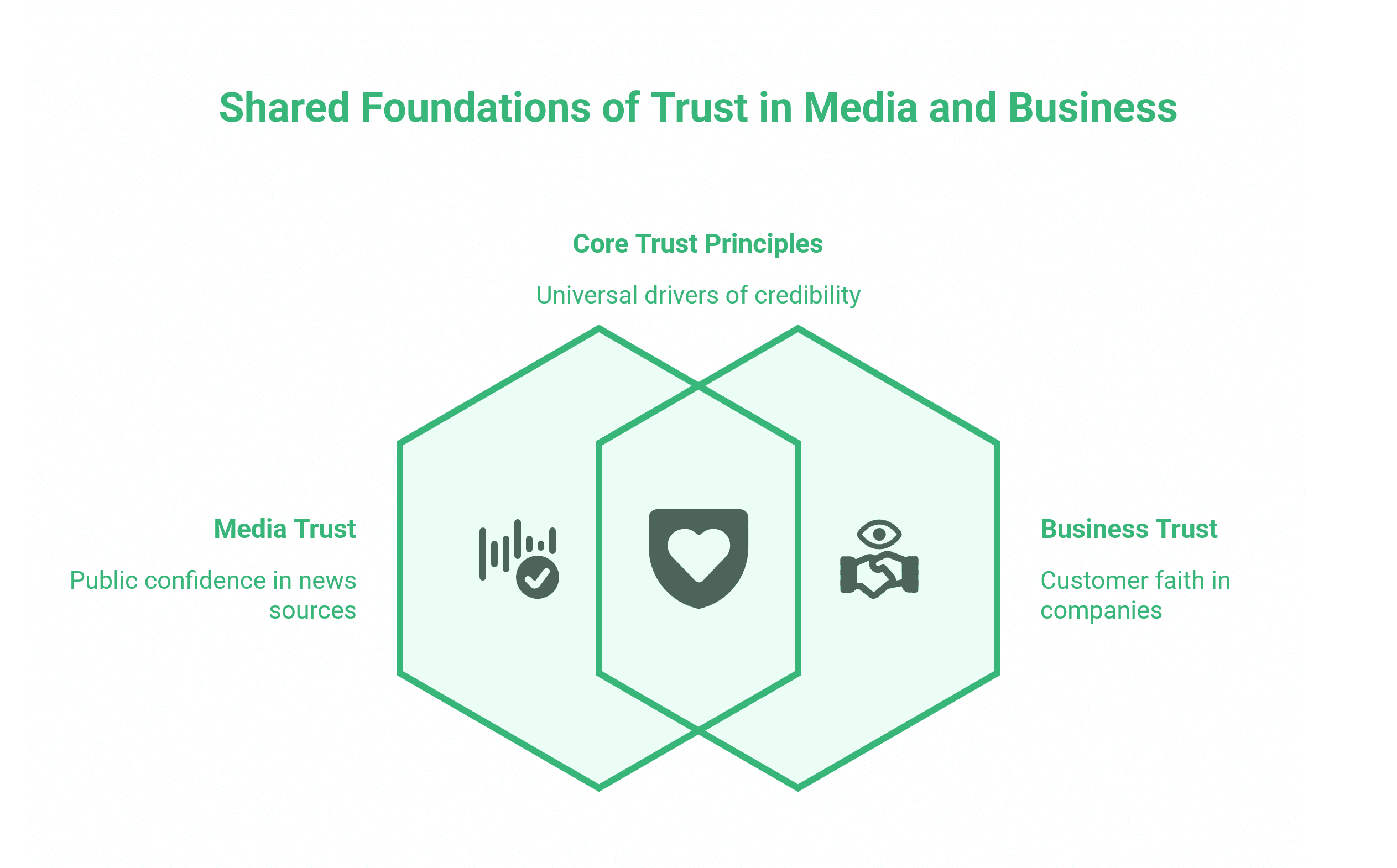
The research on what builds trust in media applies directly to what builds trust for a business online. The principles are consistent across both contexts.
Transparency About Sources and Process
Media organisations that publish their editorial standards, disclose funding, and show their fact-checking process consistently score higher on trust measures than those that do not. For businesses, the equivalent is transparency about process, pricing, and credentials. A website that explains how decisions are made, who the team is, and what the client journey looks like builds confidence in ways that generic marketing language does not.
ProfileTree’s work on the ethics and legalities of digital marketing explores the regulatory and ethical dimensions of this in more detail, particularly for businesses operating across the UK and Ireland.
Consistency Over Time
Trust in media correlates closely with consistency. The outlets that maintain standards year after year and through difficult stories retain credibility even in a low-trust environment. For businesses, the same principle applies to digital presence: consistent publishing, consistent branding, consistent responses to reviews and enquiries, and consistent content quality all compound over time into genuine authority.
This is not a short-term strategy. A business that publishes two blog posts and then goes quiet for six months gets no cumulative benefit. The businesses that build genuine search authority over time are the ones with consistent, well-planned content programmes.
Getting Digital Skills Right
Understanding how audiences evaluate trust online — what they look for, how they cross-reference claims, what signals matter across different platforms — is a practical skill. ProfileTree’s digital training programmes work with business owners and marketing teams across Northern Ireland, Ireland, and the UK to build exactly this kind of working knowledge.
For businesses that want to move from guessing about their digital presence to understanding it strategically, a structured training programme covers everything from reading analytics to understanding how search algorithms evaluate content quality. ProfileTree’s digital training courses give teams a practical framework they can apply immediately.
Northern Ireland and Ireland: Local Media Trust Trends
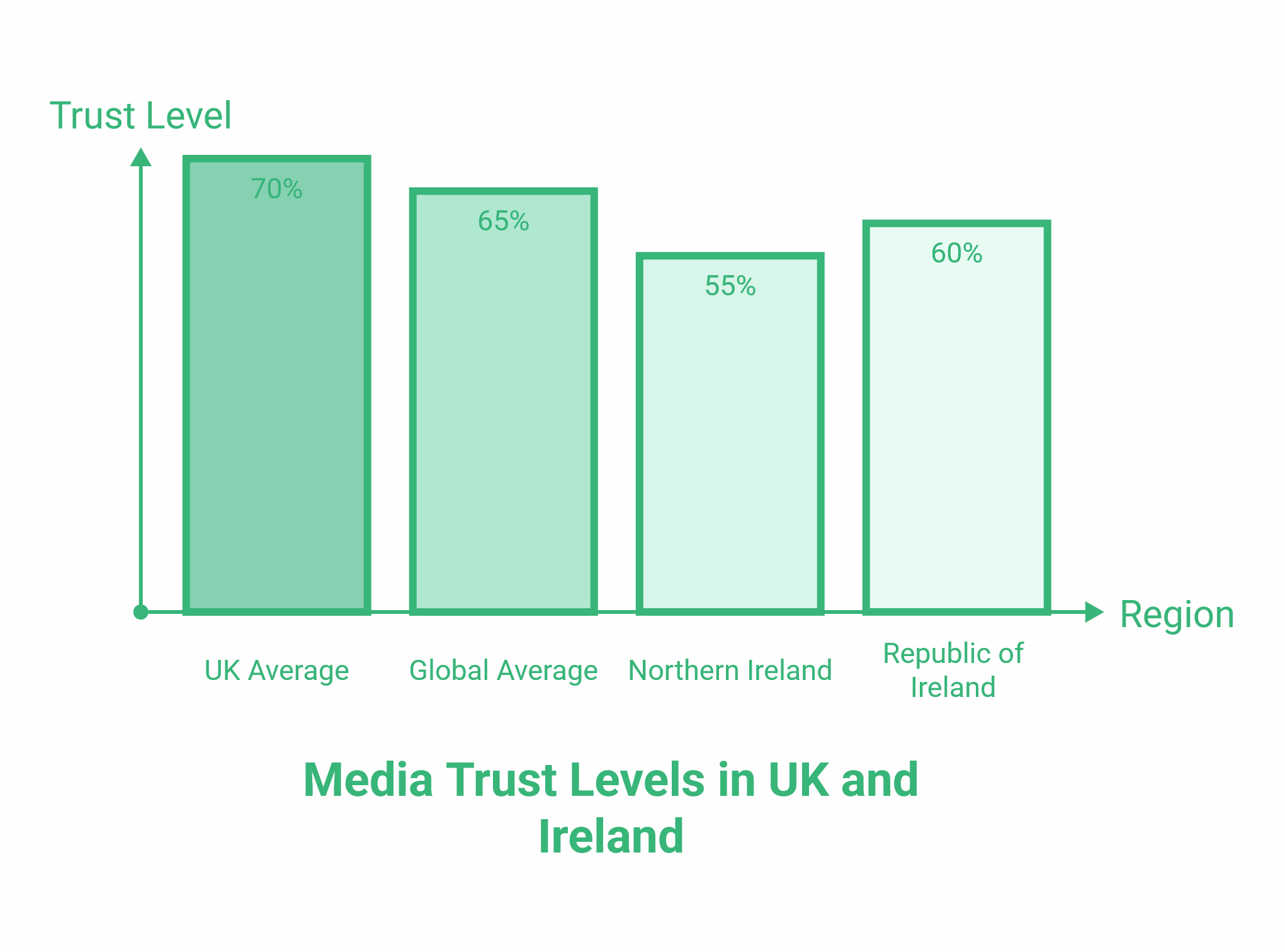
The UK-wide and global averages on media trust mask significant local variation. For businesses operating in Northern Ireland and the Republic of Ireland, the regional picture warrants separate consideration.
Northern Ireland: Trust, Politics, and Community Identity
NISRA’s Programme for Government indicators track trust in media alongside trust in public institutions, the Assembly, and local government. The data show that media trust in Northern Ireland does not operate in isolation. It correlates with community background and political identity in ways that rarely apply in England or Scotland.
This has direct implications for how businesses communicate. A business in Belfast serving customers across both communities needs to carefully consider which outlets it associates with, how it handles politically sensitive topics, and where it allocates its advertising spend. The safest ground for most SMEs is owned content — a website, a YouTube channel, an email list — where the business controls the editorial line entirely rather than being associated with any particular outlet’s positioning.
ProfileTree’s work with SMEs on digital marketing in Northern Ireland addresses exactly this kind of local context, which generic UK-wide digital marketing advice tends to overlook. The emerging content trends for Northern Ireland piece also covers how local businesses are adapting their content strategies to a market with its own particular dynamics.
The Republic of Ireland: Post-RTÉ Landscape
The RTÉ payments controversy measurably and quickly damaged confidence in the Republic’s national broadcaster. Research tracking Irish audiences in the period following the revelations found that viewers and listeners shifted toward independent digital sources, podcasts, and social media accounts from individual journalists they had come to trust personally.
For businesses in the Republic, this reinforces the broader global pattern: institutional credibility is no longer automatically conferred by size or heritage. An SME with a well-maintained website, consistent content output, and strong Google reviews can build more practical trust with its target audience than a press mention in a legacy outlet whose own credibility is under scrutiny.
The growth of digital consumption in Ireland also creates genuine opportunities. ProfileTree’s overview of AI in Ireland and its e-commerce opportunities in the Irish market both speak to an audience that is increasingly comfortable making purchasing decisions based solely on digital research, without ever encountering a business through traditional media.
Conclusion
Media trust is not recovering. Global averages have plateaued at roughly 40%, regional variations remain wide, and the generational divide between how younger and older audiences evaluate credibility is growing rather than closing. For businesses in the UK and Ireland, this is not background noise. It is the context in which every piece of content you publish, every ad you run, and every search result you appear in is evaluated.
The practical response is to build your own digital authority rather than relying on borrowed credibility from third-party media. Strong SEO, consistent content, professional video, and transparent communication are the foundations of business trust in a low-trust information environment. ProfileTree works with SMEs across Northern Ireland, Ireland, and the UK to build exactly that kind of presence. Get in touch with the team to talk through where to start.
FAQs
Is trust in the media declining in the UK?
Yes. Ofcom research shows that TV news retains the highest trust among UK formats, but all traditional media categories have recorded lower scores than a decade ago. Social media consistently scores below broadcast and print on trust, despite higher usage among younger audiences.
What is the most trusted news source in Ireland?
Trust shifted noticeably following the RTÉ payments controversy. The Irish Times and public affairs radio have maintained relatively higher trust levels, while confidence in RTÉ television news declined in the period following the scandal and has recovered only gradually.
Why do people not trust mainstream media?
Perceived political bias, commercial influence on editorial decisions, the spread of misinformation, and repeated high-profile errors are the most cited reasons. Research consistently identifies bias and lack of transparency as the two primary drivers of distrust.
How does social media affect trust in news?
Social platforms distribute news widely but score poorly on trust. The lack of editorial oversight, the algorithmic amplification of emotionally engaging content, and the difficulty in distinguishing verified reporting from opinion all reduce confidence in news encountered on social media.