
Social Media for Small Businesses: The UK and Ireland Growth Guide
Table of Contents
Social media for small businesses has become one of the most practical marketing tools, giving smaller operators access to audiences that once required substantial advertising budgets. Whether you run a cafe in Belfast, a trades business in Dublin, or a professional services firm in Manchester, the platforms are there, the audiences are active, and the cost of entry is low.
What separates the businesses that genuinely grow through social media from those that post sporadically and wonder why nothing happens is strategy. This guide covers what actually works for UK and Irish SMEs: which platforms suit which businesses, how much it realistically costs, how to run a weekly content system in under an hour, and where social media connects to the local search results your customers are already looking at.
What Social Media Actually Does for Small Businesses
Before committing time and budget, it helps to understand what you are working towards. Social media marketing for small businesses delivers across four areas that matter commercially.
Brand discovery. Most people look up a business on social media before they contact it. A well-maintained profile with recent activity signals that you are legitimate and active. An empty or neglected profile can cost you the enquiry before it starts.
Direct customer communication. Comments, messages, and replies give you a direct line to customers that no other channel matches. You can answer questions, handle complaints before they escalate, and turn a satisfied buyer into a public advocate, all in the same place.
Targeted reach without large budgets. Organic reach on most platforms has declined over the past few years, but targeted paid social remains one of the more cost-effective ways to reach a specific audience. A £5-per-day Facebook campaign targeted at homeowners within 10 miles of your location will usually outperform a printed leaflet drop on almost every metric you can measure.
Local search reinforcement. Social signals are not a direct Google ranking factor, but their indirect effects are real, and this is where many small business owners underestimate the connection. Active profiles generate branded searches. Branded searches build domain authority signals. Shares and mentions create backlinks. Businesses that rank well in local search almost always have active, well-maintained social profiles running alongside their SEO work. There’s more on that connection later in this guide.
Ciaran Connolly, founder of ProfileTree, makes the connection clear: “We see it consistently with SME clients across Northern Ireland and Ireland. The businesses that treat social media as part of a joined-up digital strategy, rather than a standalone task, are the ones that show compound growth. Social reinforces search, and search reinforces social.”
If you want the fuller case for why this matters commercially rather than as a vanity exercise, the benefits of social media marketing go well beyond brand awareness alone.
Small Business Social Media Adoption: What the Current Data Shows
The data on small business social media adoption points firmly in one direction, though the shape of that usage has shifted. Ofcom’s Adults’ Media Use and Attitudes 2026 report found that 89% of UK adult internet users now use at least one social media platform, rising to 97% among 16- to 34-year-olds. For most small businesses in the UK and Ireland, your customers are already there, regardless of which platform you choose.
That same research points to a more cautious and selective audience than a few years ago. Fewer adults are actively posting, sharing, or commenting compared with 2024, and more are simply watching or reading. For a small business, that shift matters: consistent, useful content still gets seen, but content built purely to chase engagement numbers runs counter to how people now use these platforms.
UK small business statistics generally show that most SMEs report some measurable benefit from social media, whether in leads, footfall, or straightforward brand awareness. The pattern holds: businesses that approach social media with a defined objective get results, while those that post without a goal rarely do. It’s also worth reading about the common reasons small businesses fail; inconsistent marketing and invisible online presence show up repeatedly in that list.
On posting frequency, resist the temptation to chase daily output. A better baseline for most small businesses is three to four posts per week, with genuine substance behind each one. Quality and consistency beat volume on every platform that matters to SMEs.
Choosing the Right Platforms: Quality Over Quantity
One of the most common mistakes in small business social media is trying to maintain a presence everywhere. Spreading effort across five platforms with no clear strategy produces mediocre results on all of them. Pick one or two platforms where your customers actually spend time, and do those well.
Here is a practical guide to platform selection based on business type.
| Platform | Best for | Primary audience | Content type |
|---|---|---|---|
| Local service businesses, retail, and hospitality | 25 to 55 age group | Mixed: posts, video, groups, ads | |
| Visual products, food, interiors, fashion, fitness | 18 to 40 age group | Images, Reels, Stories | |
| B2B services, professional services, recruitment | Business owners, managers | Thought leadership, company updates | |
| TikTok | Consumer brands targeting under-35s | 18 to 35 age group | Short-form video |
| Home, food, fashion, wedding, travel | Predominantly female, 25 to 45 | Visual inspiration |
For most local service businesses in Northern Ireland and Ireland, Facebook remains the most effective starting point. The demographic reach is broad, the local community group infrastructure is strong, and the advertising tools are unmatched for hyper-local targeting. A plumber in Antrim will usually find more relevant leads through a well-targeted Facebook campaign than through organic Instagram growth. Writing Facebook posts that actually get engagement is a different skill from writing for LinkedIn, so don’t reuse the same caption across both.
For B2B businesses and professional services, LinkedIn for business is worth a consistent investment. Publishing articles, sharing project outcomes, and commenting on industry conversations builds a professional reputation that converts to enquiries over months, not days. LinkedIn’s impact on UK business has grown steadily as the platform has evolved from a static CV site to a more industry-focused publishing network.
For businesses with strong visual products, Instagram remains relevant, particularly Reels. Short-form video content now receives significantly more organic reach than static images on the platform, so businesses that can show their work in motion have a clear advantage. A handful of Instagram usage facts are worth knowing before you commit budget or time to the platform, particularly around how the algorithm now favours video.
TikTok deserves a specific mention for businesses targeting a younger customer base. TikTok usage among UK audiences continues to grow across age groups, not just under-25s, and the platform now functions as a search engine in its own right for younger consumers researching local businesses. Before investing time here, it’s worth reading through common TikTok marketing mistakes; the format punishes anything that looks like a repurposed advert far more harshly than it does on other platforms.
There’s also a quieter shift worth noting: private groups, WhatsApp communities, and closed Facebook groups (sometimes called “dark social”) now account for a meaningful share of small-business word-of-mouth. A recommendation dropped into a local parents’ group or a trades WhatsApp chain doesn’t show up in any analytics dashboard, but it drives real bookings. You won’t be able to measure it directly, but you can encourage it by making your business easy to recommend: clear pricing, responsive messages, and a profile worth tagging.
The Local SEO Connection: How Social Media Affects Your Google Business Profile
This is the part most generic social media guides skip entirely, and it matters more for local businesses than almost anything else in this article.
Google does not use your follower count or your like count as a ranking signal. What it does respond to is the behaviour those signals generate. When someone checks your Facebook page before visiting your shop, searches your business name after seeing an Instagram post, or clicks through from a social profile to your website, that activity feeds into the same signals Google uses to understand how established and trusted your business is locally.
Google Business Profile statistics consistently show that profiles with recent photos, active responses to reviews, and regular posts outperform static ones in local search visibility. If your social channels and your Google Business Profile tell different stories, that inconsistency is doing you no favours. Keep your opening hours, address, phone number, and photos aligned across both, and treat your Google Business Profile as another channel in your content plan rather than a one-off setup task.
There’s also a growing role for AI tools in this space. Businesses are increasingly using AI for local SEO to keep listings accurate, generate review responses at scale, and spot gaps in how they appear for “near me” searches, freeing up time that would otherwise go to manual admin.
The 30-Minute Weekly Workflow: An AI-Assisted Approach for Time-Poor Owners
The most common objection to social media from small business owners is time. It is a legitimate concern. Running a business while maintaining a consistent social presence is genuinely difficult without a system.
The answer is content batching, not daily improvisation, and AI tools have made batching considerably faster than it was even two years ago.
Set aside 90 minutes once a week to produce content for the next five to seven days. Photograph products or completed work in one session. Use a tool like ChatGPT or Claude to turn rough notes or a voice memo into three or four caption drafts, then edit them into your own voice rather than posting AI output verbatim; readers can usually tell, and generic phrasing does nothing for a small local brand. Schedule posts using a free tool like Meta Business Suite or Buffer. Once the week is set up, daily management drops to 10 to 15 minutes of responding to comments and messages.
A simple weekly content structure for a local service business might look like this:
Monday: a completed project or before-and-after.
Wednesday: a practical tip or answer to a common customer question.
Friday: a team or behind-the-scenes post.
One paid post per week targeting local customers.
That’s four pieces of content produced in under two hours and scheduled in advance. Most small businesses that stick to a structure like this see measurable growth in engagement within 60 to 90 days.
Joanne McMillan, a ProfileTree client, described the shift after working through the agency’s digital training programme: “The sessions on social media were particularly helpful, providing clear strategies that I’ve already started implementing.”
If your team needs more than a quick read on this, ProfileTree’s digital training programmes cover social media strategy, content planning, and analytics through hands-on sessions rather than a slide deck. There’s a good case for why your business needs digital training if social media is currently left to whoever has a spare hour, rather than someone with a plan. For teams already experimenting with AI tools in their workflow, it’s also worth considering how to measure the effectiveness of AI training programmes once the initial novelty wears off.
Calculating the Cost: What Social Media Actually Costs a Small Business
One of the most unanswered questions in small-business social media content is what it actually costs. Here is a straightforward breakdown for UK and Irish SMEs.
Organic social media costs time, not money. The real investment is the hours you put into creating content, managing responses, and building a following. For most small businesses, this works out to three to six hours per week if done properly, less once a content-batching routine is in place.
Paid social advertising can start at very low daily budgets. A realistic starting point for Facebook and Instagram ads is £5 to £10 per day. At that spend level, you can run a well-targeted awareness or lead-generation campaign to a local audience and gather enough data within 30 days to understand what is working.
A rough cost framework for small businesses:
| Approach | Monthly cost | Time per week | Best suited to |
|---|---|---|---|
| Organic only | £0 in ad spend | 3 to 6 hours | Brand building, community engagement, early-stage businesses |
| Low-budget paid | £150 to £300 | 1 to 2 hours | Lead generation, local reach, seasonal promotions |
| Managed social (agency) | £500 to £1,500 | Minimal | Businesses scaling without the in-house time or skills to manage it themselves |
The businesses that see the strongest return on paid social are those that run it alongside a solid organic presence. Ads drive traffic; the organic profile builds the trust that converts that traffic. If you’re weighing up whether to bring in outside support, ProfileTree’s social media strategy service covers everything from a one-off audit through to ongoing organic channel management, and pairs naturally with SEO work if local search visibility is the underlying goal.
Measuring What Matters: Beyond Likes and Follower Counts
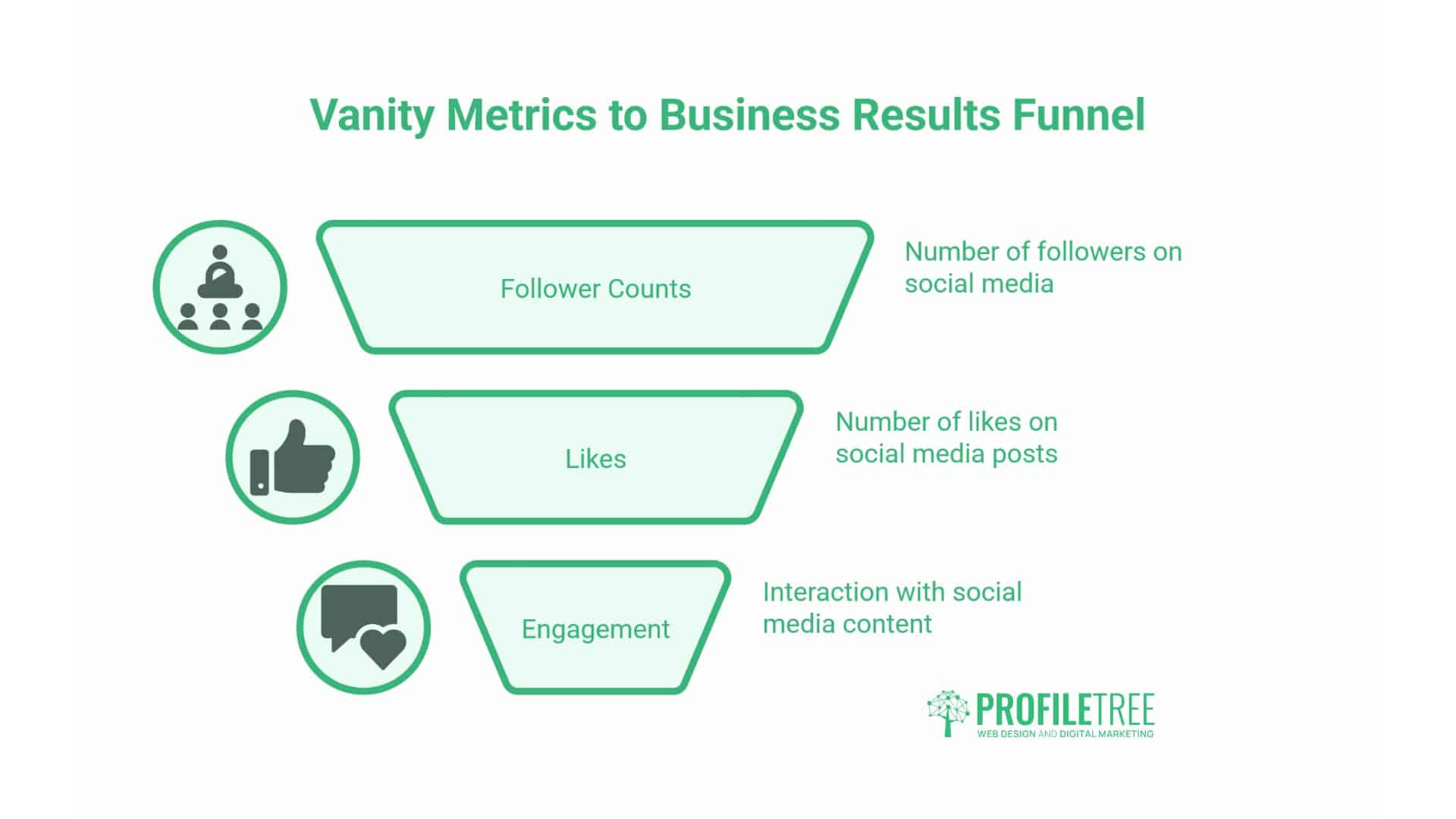
Vanity metrics are among the most persistent problems in small-business social media. Follower counts and likes feel meaningful, but they do not pay invoices.
The metrics that actually matter depend on your objective, but for most small businesses, the priority list looks like this:
Reach and impressions tell you how many people are seeing your content. This matters most for brand awareness campaigns, less so for lead generation.
Link clicks and website sessions tell you whether social is driving traffic to your site. Connect your Google Analytics account to your social platforms and track this monthly. If your website itself is the weak link in that chain, no amount of social traffic will convert; it’s worth an honest look at whether your website development needs attention before you scale up content output.
Direct messages and enquiries are the clearest signal for service businesses. If a post generates three enquiries, it worked. If it generates 200 likes and zero enquiries, it may not have reached the right audience, or the call to action wasn’t clear enough.
Follower growth rate matters more than raw follower count. A local business with 600 engaged local followers will generate more actual business than one with 6,000 followers spread across multiple countries with no local intent.
Review your performance monthly. Identify the two or three posts that performed best, understand why they worked, and produce more content in that vein.
A Regional Note: Marketing Across Northern Ireland and the Republic of Ireland
Businesses operating across the Irish border face a genuinely different marketing landscape from those trading purely within Great Britain, and most generic social media advice ignores this entirely.
Audiences in Northern Ireland and the Republic often overlap on platforms like Facebook and Instagram, but the tone, currency, and local reference points that land well in Belfast do not always translate to Dublin, and vice versa. A promotion priced in sterling means little to a customer browsing from Cork. If your business serves both markets, plan separate ad sets in local currencies and with locally relevant imagery rather than a single cross-border campaign, and be specific about which locations you serve so customers aren’t left guessing whether you deliver or travel to them.
Local community groups, in particular, carry outsized influence in both jurisdictions. A trades business with a strong reputation in a Belfast estate WhatsApp group or a Facebook community page for a town like Ballymena or Omagh often gets more qualified leads from that than from any paid campaign. ProfileTree is based in Belfast and works with SME clients across both Northern Ireland and the Republic, so this cross-border nuance tends to come up in nearly every strategy conversation with clients trading on both sides of the border.
How ProfileTree Approaches Social Media for SME Clients
ProfileTree is a Belfast-based digital agency that works with SMEs across Northern Ireland, Ireland, and the UK on social media strategy, content marketing, and the training that helps business owners manage their own channels confidently.
The agency’s work spans strategy through to execution. For some clients, that means building a social media framework they manage themselves. For others, it means ongoing management of channels as part of a wider digital strategy. The approach is always tied to commercial outcomes rather than platform metrics.
ProfileTree’s in-house brands provide a direct testing ground for social content strategies before they are applied to client accounts, giving the team current, first-hand experience of what performs across different formats rather than relying purely on theory.
For businesses that want to build in-house capability rather than outsource entirely, ProfileTree’s digital training sessions cover social media strategy, content planning, and analytics, and can be paired with a video marketing push to move into Reels and short-form content without starting from zero. If you’d rather talk through your specific situation than read another framework, get in touch with the team directly.
Common Mistakes That Cost Small Businesses Results
Understanding what not to do is as useful as knowing what works.
Posting without a content plan. Random posts that are not tied to a content strategy produce random results. Plan themes monthly, batch content weekly, and review performance regularly.
Ignoring comments and messages. Social media is a two-way channel. Businesses that post and never respond are missing the most valuable part of the platform. Unanswered messages damage trust and cost enquiries.
Using the same content on every platform. A LinkedIn article, an Instagram Reel, and a Facebook community post serve different audiences and require different formats. Repurpose content sensibly, but adapt it for each platform rather than cross-posting identically.
Chasing follower counts over engagement. A hundred engaged local followers who comment, share, and enquire are worth more than 10,000 passive global followers. Focus on relevance and engagement rate, not raw numbers.
Abandoning accounts after a slow start. Social media for small businesses builds momentum over months, not weeks. Most businesses that give up do so just before the algorithm starts favouring their content. Consistency over six months almost always produces visible results.
Treating social and search as separate jobs. As covered earlier, an active, consistent social presence indirectly supports your local search visibility. Businesses that run the two in isolation, one person handling social with no visibility on what the SEO side is doing, tend to duplicate effort and miss easy wins.
Building Momentum That Compounds
Social media for small businesses works best as part of a joined-up strategy, not a standalone task. Your customers are there, and so are your competitors. What separates the businesses that see real returns from those posting into the void is strategy, consistency, and measuring what actually matters.
Start with one platform. Build a simple weekly routine, using AI to speed up drafting rather than replace your judgement. Track enquiries and website traffic, not just likes. Review every 30 days, and keep your social activity and Google Business Profile telling the same story.
The technology is accessible, and the audience is reachable. The businesses that treat social media as part of their digital strategy, not an afterthought, are the ones that compound results over time.
FAQs
Do small businesses need to be on every social media platform?
No. Focus on one or two platforms where your target customers actually spend time. Doing one platform well consistently outperforms a fragmented presence across five, and it’s far easier to sustain when you’re running a business at the same time.
Which social media platform is best for small businesses?
It depends on your audience. Facebook suits most local service businesses in the UK and Ireland. Instagram works well for visual products. LinkedIn is the priority for B2B and professional services, and TikTok is worth testing if your customer base skews under 35.
How much does social media marketing cost for a small business?
Organic social costs time, not money. Paid campaigns can start at £5-£10 per day. Most small businesses see meaningful results with £150 to £300 per month in ad spend, managed alongside organic content.
Does social media help with Google rankings?
Not directly, but indirectly. Active social profiles drive branded searches, which reinforce domain authority signals, and shares or mentions can generate backlinks. Keeping your social profiles and your Google Business Profile consistent tends to matter more than raw follower counts for how you appear in local search.