
Online Advertising Techniques for Tourism: Maximising Your Reach
Table of Contents
Online advertising for tourism decides who books and who gets overlooked. Travel decisions now start on a screen: a Google search, an Instagram reel, a review on TripAdvisor. If your destination, hotel, or travel brand isn’t visible in those moments, someone else fills the booking. According to Ciaran Connolly, founder of Belfast-based digital agency ProfileTree: “Tourism businesses often invest heavily in the product itself but underinvest in being found. The digital journey that leads to a booking begins long before any visitor reaches your destination. Getting that journey right is the real competitive edge.”
This guide covers the full picture of online advertising techniques for tourism sector: from search and social to content, email, reviews, and the smart technologies now shaping how travellers decide where to go.
Understanding the Tourism Advertising Market
Effective online advertising for tourism starts before any campaign is written. You need a clear picture of who you’re trying to reach and what they want when they search.
Tourism audiences break into broadly recognisable segments: leisure travellers, business travellers, family groups, adventure-seekers, cultural tourists, and increasingly, slow travellers who prioritise depth over distance. Each segment behaves differently online. Leisure travellers browse Instagram and TripAdvisor weeks before they commit. Business travellers search with intent and book fast. Families compare prices, facilities, and reviews in detail before making a final call.
Demographic analysis gives you the starting point: age, income, origin, and travel motivation. Behavioural data refines it: what pages they visit, how long they stay, what they search for. Combining both gives you a working picture of your audience that informs every advertising decision you make.
Matching Advertising Intent to the Buyer’s Journey
Not every tourist is ready to book when they first encounter your content. Online advertising for tourism works best when it maps to where the traveller is in their decision process.
At the awareness stage, travellers are exploring options. Visual content, destination guides, and inspirational social posts perform well here. At the consideration stage, they’re comparing options: price, facilities, location, reviews. Detailed service pages, comparison content, and email sequences work here. At the decision stage, they’re ready to act. Paid search ads, strong calls to action, and frictionless booking paths convert at this point.
A common mistake is spending most of the advertising budget at the decision stage while ignoring the earlier stages where brand preference is actually formed.
Building a Digital Marketing Strategy for Tourism
A digital marketing strategy for tourism is not a collection of channels; it’s a connected plan. Before allocating budget to any platform, define three things clearly: who you’re trying to reach, what action you want them to take, and how you’ll measure whether it worked.
For tourism businesses, the most important strategic decision is which channels earn the most trust with your specific audience. A boutique rural hotel and a city-centre conference venue need different channel mixes. Trying to be everywhere with a limited budget spreads effort too thin and produces mediocre results on all platforms rather than strong results on two or three.
ProfileTree’s digital marketing services cover the full strategic layer: from audience mapping and channel selection through to campaign tracking and reporting. Getting this foundation right before spending on ads saves significant budget in the medium term.
Web Design as a Conversion Asset
Every advertising channel ultimately sends traffic to your website. If the website is slow, hard to navigate, or unconvincing, the advertising spend is wasted. This is one of the most common failures in tourism advertising: strong campaigns pointing to a weak destination.
A well-built tourism website does several things simultaneously. It ranks in organic search for destination and service queries. It converts browsers into enquiries or bookings. It builds trust through social proof, imagery, and clear information. And it performs on mobile, where the majority of travel searches now happen.
Professional web design and development for tourism sites should treat the website as a commercial asset, not a brochure. Page speed, mobile responsiveness, clear booking pathways, and structured data for search engines all affect whether a visitor stays or leaves within seconds.
Search Engine Optimisation for Tourism
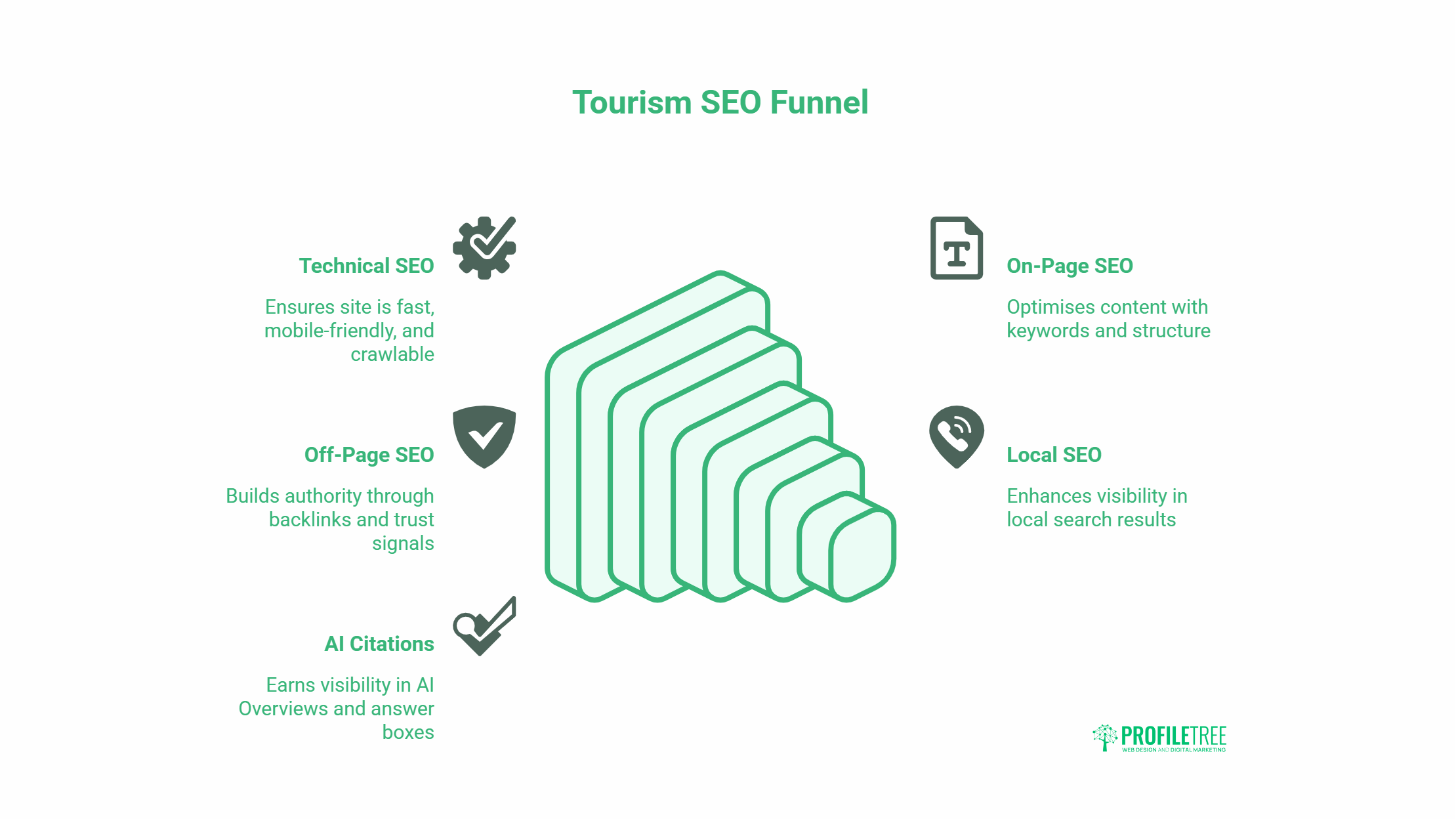
Organic search remains the highest-intent channel in tourism advertising. Someone typing “family-friendly hotels in County Antrim” or “guided cycling tours in Ireland” is actively looking. Paid advertising can place you in front of that person, but SEO means you’re there without paying per click, permanently.
Tourism SEO focuses on three layers. Technical SEO covers site speed, mobile performance, structured data, and crawlability. On-page SEO covers keyword relevance, content depth, and heading structure. Off-page SEO covers the authority signals that tell Google your site is trustworthy.
For tourism businesses, local SEO carries particular weight. Appearing in Google Maps results for location-based queries (hotels near, activities in, restaurants at) drives direct footfall and bookings from high-intent searchers. Consistent NAP data (name, address, phone number) across all directories and platforms is a basic requirement that many tourism businesses still get wrong.
Content That Earns Rankings and AI Citations
Search engines now surface content in AI Overviews and AI-powered answer boxes, not just standard blue links. Tourism content that earns citations in these features gets visibility that paid advertising cannot buy.
Pages covering multiple sub-questions within a topic are 161% more likely to be cited in AI Overviews (Ahrefs). For tourism, this means a destination guide that answers “what to do,” “where to stay,” “how to get there,” and “best time to visit” in a single, well-structured article outperforms four separate thin pages every time.
Content depth is the primary driver. Long-form content (2,000 words and above) gets cited three times more often than short posts. Content containing well-structured comparison tables gets cited 2.5 times more often. A 40 to 60 word direct answer at the top of each major section enables AI systems to extract and surface the content independently.
Social Media Advertising for Tourism
Instagram remains the dominant visual platform for travel inspiration. The platform’s emphasis on imagery makes it a natural fit for destination marketing, accommodation showcasing, and experience promotion.
An effective Instagram strategy for tourism combines three content types. Original photography that shows the destination authentically outperforms stock imagery. Short-form video (Reels) earns significantly higher organic reach than static posts. User-generated content repurposed from guests’ own posts provides social proof that feels more credible than brand-produced content.
Hashtag strategy matters, but the algorithm now weights saves and shares above follower count. Content that someone saves to revisit later (a packing checklist, a day itinerary, a price comparison) performs better over time than content that generates a quick like and is forgotten.
Paid Social Advertising on Meta and TikTok
Organic social reach has declined significantly across all platforms over the past three years. For most tourism businesses, paid social is now required to reach audiences beyond existing followers.
Meta (Facebook and Instagram) advertising offers the most sophisticated demographic and interest-based targeting available. Tourism advertisers can build audiences around travel interests, destination intent signals, life events (upcoming travel), and lookalike audiences based on past bookers.
TikTok has become a significant discovery channel for travel, particularly for audiences under 40. The platform’s algorithm surfaces content based on engagement patterns rather than follower count, meaning a well-produced short video from a smaller account can reach hundreds of thousands of people without paid promotion. Tourism brands that have invested in TikTok content early are seeing significant organic reach at low cost.
Using User-Generated Content Strategically
Guests sharing their own content creates something no advertising budget can replicate: third-party social proof at scale. A review photograph or spontaneous video from a genuine visitor carries more persuasive weight than any brand-produced creative.
Building a UGC strategy means actively encouraging guests to share during their experience rather than hoping they do it afterwards. Clear hashtag guidance, in-room prompts, and post-stay email campaigns that invite sharing all increase the volume of usable content. Repurposing this content across owned channels with the creator’s permission amplifies the signal further.
Content Marketing for Tourism Businesses
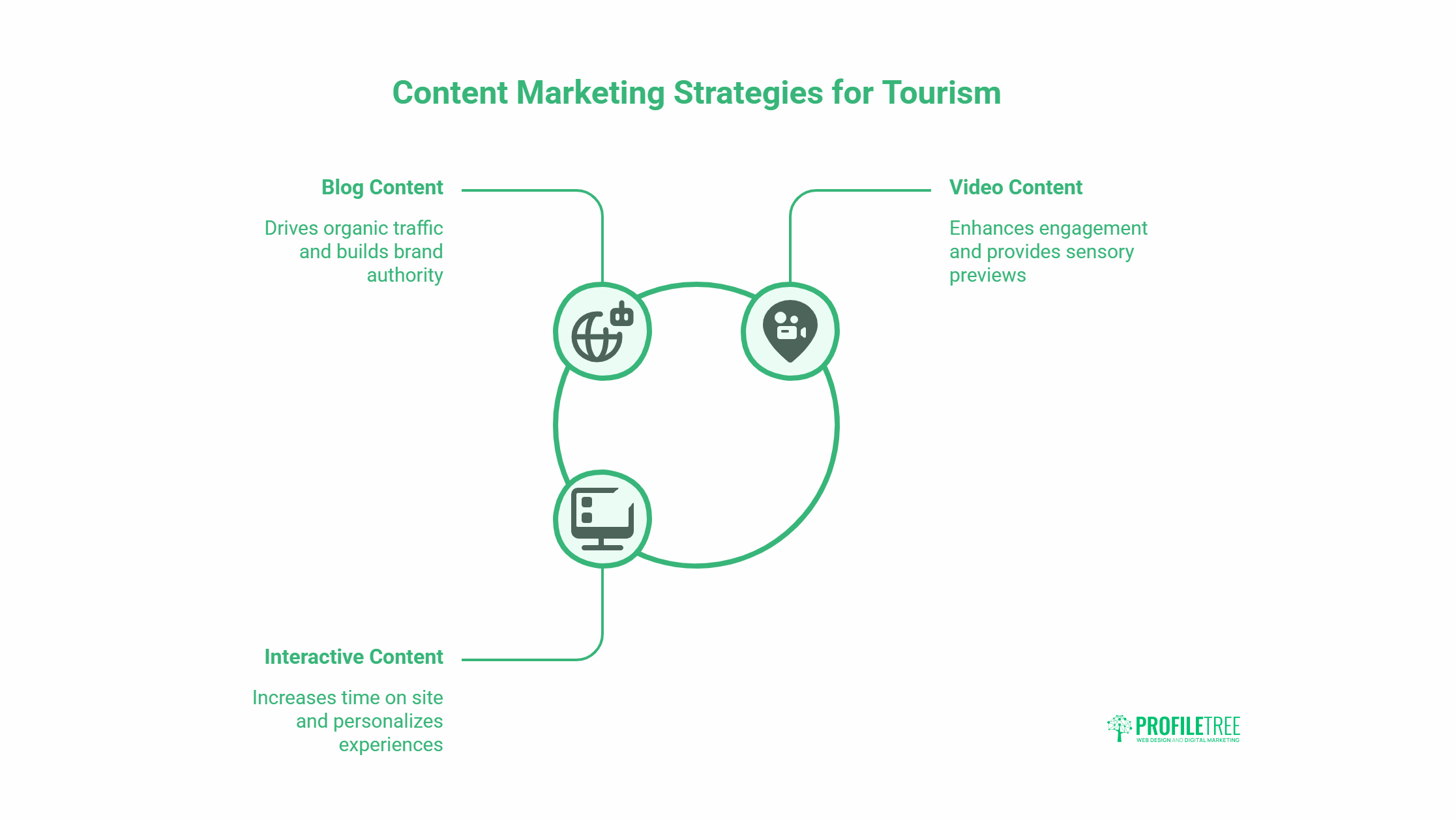
Tourism blog content performs a dual role: it drives organic search traffic and it builds the brand authority that converts browsers into bookers. Content that does both well is specific, genuinely useful, and written for a defined audience rather than a general one.
Destination guides, itinerary suggestions, “what to pack” articles, and comparison pieces (“lake district vs Yorkshire Dales for walking holidays”) all serve clear search intent. FAQ-style content that directly answers the questions travellers type into Google earns featured snippets and AI Overview citations.
ProfileTree’s content marketing services approach tourism content strategically: every article maps to a specific audience, intent, and commercial goal. The content earns traffic that would otherwise require paid advertising spend to reach.
Video Content for Travel Brands
Video is the highest-engagement content format in tourism. Destination videos, experience walkthroughs, and behind-the-scenes footage give potential visitors the kind of sensory preview that static images can’t match.
YouTube remains the second-largest search engine globally and a significant research platform for travel. Tourism businesses that invest in YouTube content build a channel that compounds over time: older videos continue to earn views and send traffic to booking pages long after the production cost has been recurred.
Short-form video (under 60 seconds) works across Instagram Reels, TikTok, and YouTube Shorts. Longer-form content (five to fifteen minutes) performs well on YouTube for travellers doing deeper research. The two formats serve different stages of the decision journey and work best when used together.
Interactive Content for Engagement
Interactive content increases the time visitors spend on your site and creates personalised pathways toward booking. Itinerary builders, destination quizzes, and cost calculators are particularly relevant for tourism because they help travellers answer “what’s right for me?” in a way that static content cannot.
These tools also generate data about visitor preferences, informing future advertising targeting without requiring third-party cookies.
Pay-Per-Click Advertising for Tourism
Paid search advertising places your brand in front of travellers at the exact moment they’re searching for what you offer. For tourism businesses with a clear booking funnel, Google Ads can generate immediate, measurable return.
The most effective PPC strategies for tourism target high-intent, specific queries rather than broad generic terms. “Book self-catering cottage Donegal” converts far better than “Ireland tourism” and costs less per click because fewer advertisers are competing for the specific query.
Remarketing campaigns (showing ads to visitors who have already browsed your site) are particularly valuable in tourism because the decision cycle is often long. A traveller who visited your accommodation page twice but didn’t book is a far warmer prospect than a cold audience, and remarketing lets you stay visible to them at a fraction of the cost of new customer acquisition.
Display and Programmatic Advertising
Display advertising builds visual brand awareness across travel planning sites, news publications, and content networks. For tourism, this includes placement on travel-specific platforms (TripAdvisor, Booking.com display networks, Google’s travel ecosystem) where audiences are already in a travel mindset.
Programmatic advertising automates the buying of display placements based on audience data, improving targeting accuracy and reducing wasted impressions. Tourism advertisers can layer demographic data, interest signals, and geographic targeting to reach relevant audiences across thousands of sites without managing each placement manually.
Online Reviews and Reputation Management
For many tourism businesses, online reviews on TripAdvisor, Google, and Booking.com drive more booking decisions than any paid advertising channel. A property with 200 reviews averaging 4.8 stars consistently outperforms a property with better photography and higher ad spend but fewer or lower-rated reviews.
Managing your review profile is therefore a core part of your online advertising strategy, not a separate customer service function. The volume of reviews matters because it signals to algorithms that the listing is active and credible. The recency of reviews matters because travellers weight recent experiences more heavily. The content of reviews matters because specific, detailed positive reviews address the questions future travellers are researching.
Building a Review Generation Process
Most tourism businesses receive fewer reviews than their guest satisfaction levels would support, simply because they don’t ask systematically. A post-stay email sent within 24 hours of checkout, with a direct link to your Google or TripAdvisor review page, significantly increases review volume without any incentivisation.
Responding to reviews, both positive and negative, demonstrates that the business is active and that feedback is taken seriously. Specific, personalised responses to negative reviews carry more weight with prospective guests than generic apologies. A thoughtful response to a critical review often converts a sceptical browser into a booker by showing how the business handles problems.
Email Marketing for Tourism Businesses
Email remains one of the highest-return channels in tourism marketing because you own the relationship. Unlike social media followers or paid traffic, an email subscriber has actively opted in and can be reached directly without algorithmic intermediaries or per-impression costs.
Building the list requires clear value exchange: a travel guide download, an exclusive subscriber discount, or early access to seasonal offers all give prospective travellers a reason to subscribe. The quality of the list matters more than the size: an email list of 2,000 people who genuinely want to hear from you outperforms a list of 20,000 who’ve forgotten they subscribed.
Segmentation and Personalisation
Tourism email marketing performs best when campaigns reflect where the subscriber is in the decision cycle. A cold subscriber who downloaded a destination guide needs different content from a past guest who hasn’t rebooked in two years, who needs different content from someone who abandoned a booking in the last seven days.
Segmentation by geography, travel type, and past booking behaviour allows this personalisation without requiring a complex technical setup. Most email marketing platforms (Mailchimp, Klaviyo, ActiveCampaign) support basic segmentation out of the box.
Post-stay sequences that invite past guests to rebook, share their experience, or refer a friend are among the highest-converting email campaigns in the sector. The cost per booking from a past guest is typically a fraction of the cost from a cold acquisition channel.
Smart Tourism Technologies
Artificial intelligence is now embedded in tourism advertising at every level. Google’s ad platforms use machine learning to optimise bids and placements in real time. Meta’s targeting algorithms adapt to user behaviour patterns that no human campaign manager could manually replicate. Chatbots handle initial enquiries and pre-booking questions 24 hours a day without staffing costs.
For tourism businesses, the most immediately applicable AI use cases are in personalisation and customer communication. AI-driven website tools can surface different content, offers, or calls to action based on a visitor’s geography, device, browsing history, or referral source. This increases conversion rates without increasing traffic.
ProfileTree’s AI transformation services help tourism businesses identify where AI tools can reduce costs, improve personalisation, and give their advertising activity a measurable performance advantage over competitors still operating on manual processes.
Augmented Reality and Immersive Previews
Augmented reality and virtual reality tools are increasingly practical for destination marketing. A 360-degree tour of an accommodation, a virtual walkthrough of a venue, or an AR experience that overlays destination information onto a live camera view all reduce the uncertainty that prevents bookings.
These tools don’t require specialist hardware. Most modern smartphones support AR overlays via the camera. Embeddable 360-degree virtual tours require a one-off production investment but continue to work on the page indefinitely, functioning as a persistent conversion asset.
Frequently Asked Questions
What is the most effective online advertising channel for tourism businesses?
There’s no single answer because it depends on the business type, audience, and budget. Search engine advertising (Google Ads and organic SEO) captures high-intent travellers who are actively looking. Social media advertising (Instagram, Meta, TikTok) builds awareness at the discovery stage. Email marketing retains and reactivates past guests at the lowest cost per booking. The most effective strategies use all three in a connected way, with budget allocated according to where the best return is coming from.
How much should a tourism business spend on online advertising?
Industry benchmarks suggest tourism businesses allocate between 5% and 12% of revenue to marketing, with a higher proportion in the digital channels relative to print and offline. For small tourism operators (under £500k revenue), spending £1,000 to £3,000 per month on a combination of paid search, social, and content will produce measurable results if the website and conversion pathway are in good shape. Larger operators need bespoke strategies based on seasonality, booking volumes, and competitive position.
How do online reviews affect tourism advertising performance?
Significantly. Reviews act as social proof that either validates or undermines the investment being made in paid advertising. A property spending £2,000 per month on Google Ads but carrying a 3.6-star average rating on TripAdvisor will see those ads underperform relative to a competitor with a 4.7-star average and lower ad spend. Improving review quality and volume is often the highest-return activity a tourism business can undertake before increasing advertising budget.
What role does content marketing play in tourism advertising?
Content marketing serves as the organic long-term engine that paid advertising cannot replicate. Well-written destination guides, itinerary suggestions, and FAQ content earn search rankings that send traffic without per-click costs. This content also builds the brand authority that makes paid advertising more effective when visitors arrive having already encountered the brand through organic content.
How should tourism businesses use social media for advertising?
Treat organic social and paid social as complementary rather than interchangeable. Organic content builds the brand and provides creative material to test before committing paid budget behind it. Paid social amplifies the content that organic engagement confirms is resonating. User-generated content from genuine guests should be incorporated into both, as it consistently outperforms brand-produced creative for conversion.
What are the best online advertising strategies for small tourism operators with limited budgets?
For small operators, the priority order should be: (1) a well-built, fast website with clear booking pathways; (2) optimised Google Business Profile for local search visibility; (3) a review generation process to build TripAdvisor and Google review volume; (4) basic content marketing targeting specific destination queries; (5) a small-budget paid search campaign targeting high-intent local queries. These five steps, done properly, outperform a larger budget spread thinly across every available channel.