
BuzzSumo for Small Business: A Budget-Conscious Playbook
Table of Contents
Small business owners rarely have time to guess what content their audience wants. BuzzSumo removes the guesswork by showing exactly what is already working: which topics earn the most shares, which competitors are earning backlinks, and which voices in your industry are worth connecting with. The catch is the price tag. At entry-level plans starting around £179 per month, it is a significant commitment for a lean team or sole trader.
This guide is for those who want to know whether BuzzSumo is worth it for their business and, if they do subscribe, how to use it in a way that delivers a clear return. It covers a practical 60-minute weekly workflow, how to configure filters for UK and Irish markets, what data to export before a trial ends, and which free tools can cover the gap if a paid plan is not viable right now.
Is BuzzSumo Worth It for Small Businesses?
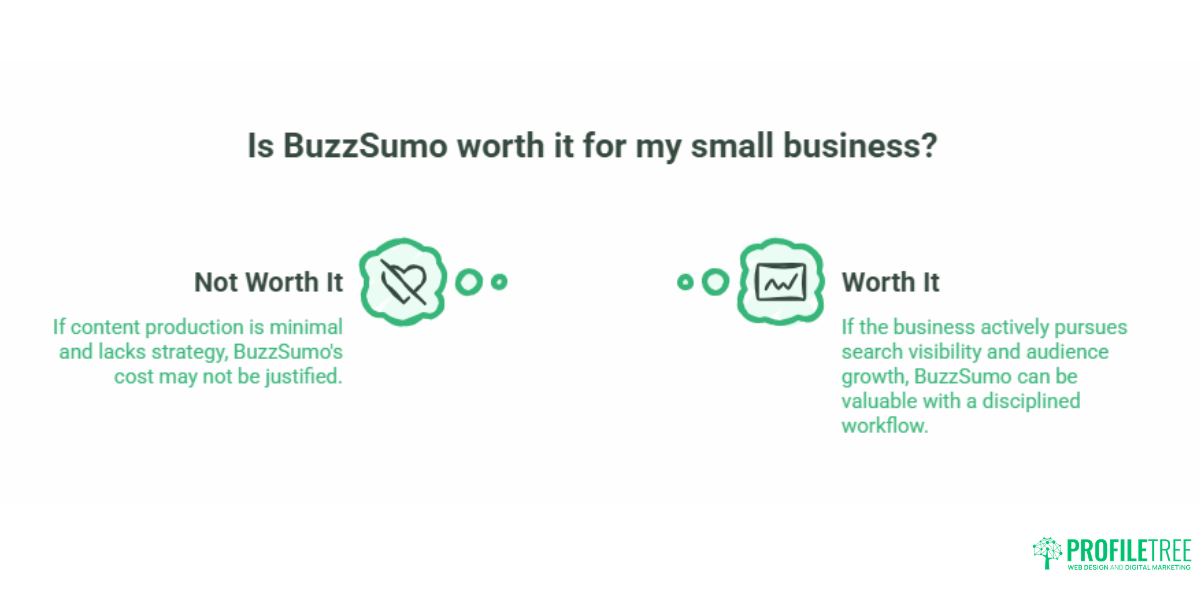
The honest answer depends on how structured your content process is before you sign up.
BuzzSumo is a content intelligence platform. Its core functions are content discovery, competitor analysis, influencer identification, and backlink tracking. For a business producing one or two blog posts a month with no defined strategy behind them, the tool will not deliver enough value to justify the cost. For a business actively trying to win search visibility, build an audience, or compete against better-resourced brands, it can be genuinely useful, provided the data is acted on, not just collected.
The Cost vs Value Dilemma for Small Teams
BuzzSumo’s pricing (as of mid-2026) starts at approximately £179 per month on a monthly contract for the Content Creation plan. Annual billing reduces this. There is no permanent free tier; the free trial runs for 30 days with limited daily searches.
For context, a solo marketer or small business owner running two or three targeted searches per week, exporting competitor content reports monthly, and using influencer data for one outreach campaign per quarter can extract meaningful value from the platform. The ROI question becomes: would a piece of content informed by BuzzSumo data outperform a piece written purely on instinct? For most businesses investing in content marketing properly, the answer is yes, but only if the workflow is disciplined.
“The businesses we work with at ProfileTree that get the most from content research tools are the ones who treat the data as an input to a clear plan, not as a substitute for one,” says Ciaran Connolly, ProfileTree Founder. “BuzzSumo shows you the opportunity. A content strategy is what turns that opportunity into something that actually ranks and converts.”
The 60-Minute Weekly BuzzSumo Workflow
Most guides on BuzzSumo assume the reader has hours to explore the platform. A typical business owner in Belfast, Dublin, or Leeds does not. This workflow is built around 60 minutes per week, split across three 20-minute blocks. Each block has a clear output, so you leave with something actionable rather than a screen full of data you have not processed.
Phase 1: Local Competitor Intelligence (20 Minutes)
Start with the Content Analyser. Enter a competitor’s domain (not yours) and filter results by the last three months. Sort by total engagements. Your goal is a list of their five best-performing pieces, by format and topic.
Note the following for each piece: the headline format they used, the content type (listicle, how-to, case study, original data), and which social platform generated the most shares. This is not about copying what they have done; it is about understanding which topics and formats your shared audience is responding to right now.
For UK and Irish businesses, it is worth filtering by country at this stage. Under the Filters panel, set Location to United Kingdom or Ireland, depending on your market. This removes the noise from US-centric results, which can skew social share data significantly for regional businesses operating in smaller, lower-volume markets.
Output: A shortlist of three to five content topics you have not covered but your competitors have, ranked by engagement.
Phase 2: High-Intent Content Ideation (20 Minutes)
Switch to the Question Analyser. Enter your primary service keyword, for example “web design northern ireland” or “content marketing for solicitors” and pull the questions people are asking across forums, Reddit, and Q&A sites.
Filter these by volume and select the five questions your existing content does not answer. These become your next five article briefs. The questions people type into forums are the same questions they type into Google; the overlap with search intent is direct.
Cross-reference your shortlist against BuzzSumo’s trending content for the same keyword. If a question has forum traction and existing content on that topic is earning shares, it is a confirmed content opportunity rather than a speculative one.
Output: A five-topic content pipeline, each brief grounded in real audience questions.
Phase 3: Finding High-Impact Micro-Influencers (20 Minutes)
Use the Influencer Search. Enter your topic or niche and set the filters to your relevant geography: the UK or Ireland. Sort results by engagement rate rather than follower count. A blogger with 4,000 followers and a 6% engagement rate is more useful for a regional business than a national account with 80,000 followers and 0.4% engagement.
For Northern Ireland and Ireland specifically, the platform’s data can be thinner than in larger markets. Where BuzzSumo returns limited results, supplement with manual LinkedIn searches and the Top Content filter; look at who is consistently sharing and commenting on content in your sector. These people are often better collaboration partners than the accounts BuzzSumo surfaces for smaller regional markets.
Output: A list of five to ten micro-influencers to engage with over the next month: comment on their content, share their posts, and, where relevant, suggest a collaboration or quote exchange.
Maximising the 30-Day Free Trial: Your Exit Strategy
If you are starting a BuzzSumo trial with the intention of assessing the tool before committing, plan your exports from day one. The trial gives you full access to data, but that access ends the moment the trial does.
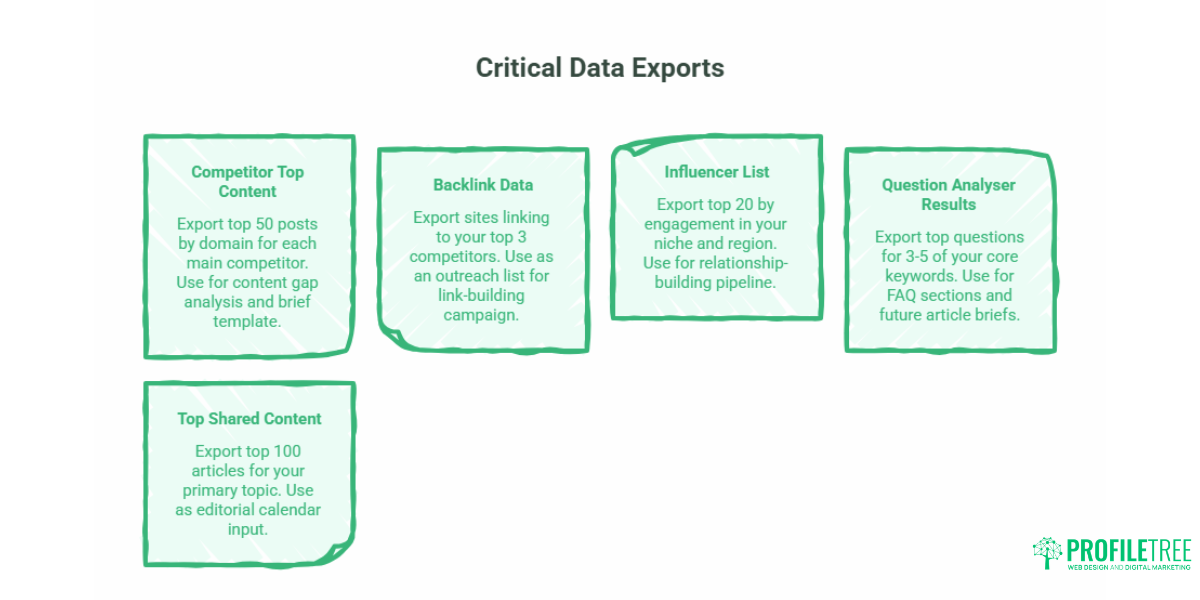
Critical Data Exports to Run Before Day 30
Run these exports in the final week of your trial. All are available as CSV files from the platform’s export function.
| Report | What to Export | How to Use It Post-Trial |
|---|---|---|
| Content gap analysis: brief template for next 3 months | Top 50 posts by domain for each main competitor | Content gap analysis: brief template for the next 3 months |
| Backlink data | Sites linking to your top 3 competitors | Outreach list for link-building campaign |
| Influencer list | Top 20 by engagement in your niche and region | Relationship-building pipeline |
| Question Analyser results | Top questions for 3-5 of your core keywords | FAQ sections; future article briefs |
| Top shared content by topic | Top 100 articles for your primary topic | Editorial calendar input |
Once exported, these CSVs retain their value for two to three months before the data becomes stale. A business working with a content agency, or a team that has completed digital marketing training, can turn these exports into a structured content plan that runs for a quarter without needing to return to the platform.
How to Filter BuzzSumo Data for UK and Irish Markets
This is the step most guides skip, and it is the one that makes the biggest practical difference for businesses operating in the UK and Ireland.
Sourcing Regional Trends and TLD Filtering
BuzzSumo’s default database is global, which means searches on broad topics return heavily US-weighted results. A Belfast-based solicitors’ firm or a Galway-based accountancy practice does not need to know which content about tax law is performing in Texas.
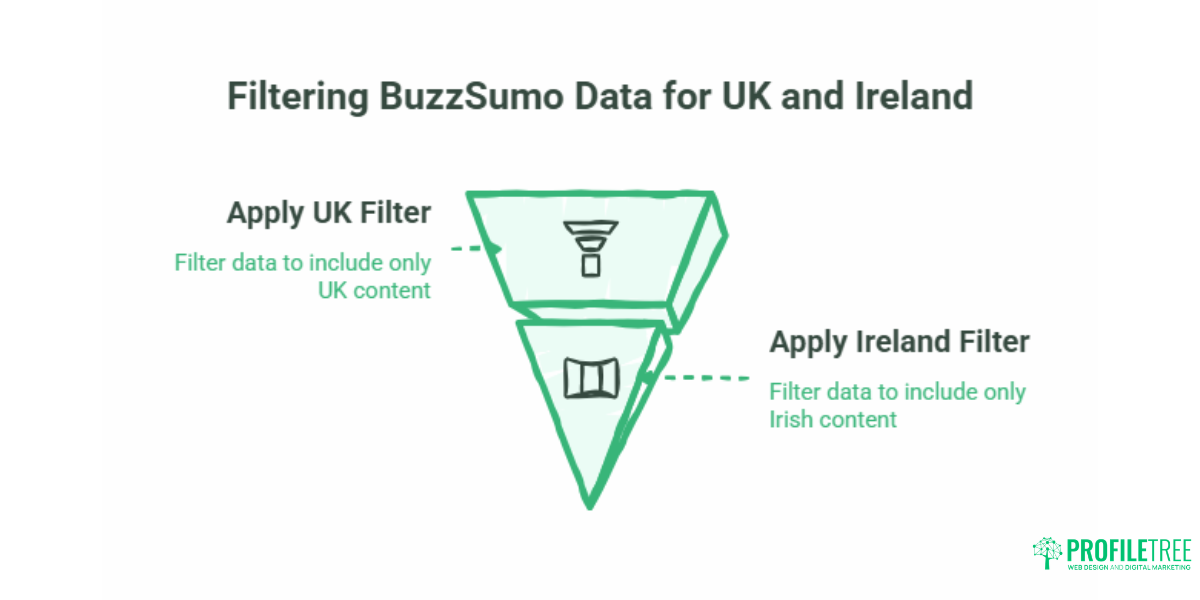
In the Content Analyser, use the Country filter to restrict results to the United Kingdom or Ireland. For searches where you want to target both markets, run two separate queries. The data volumes will be lower than global searches; this is expected in regional markets, but the relevance is significantly higher.
For TLD filtering, BuzzSumo allows domain-level searches. If you want to see what .co.uk or .ie domains in your sector are producing, enter the domain extension alongside your keyword in the domain search field. This surfaces regionally relevant competitors that global searches tend to bury.
For local SEO purposes, the content you discover through regional filters also informs your keyword strategy. Understanding what content earns links from .co.uk domains in your niche is directly actionable; those are the sites most likely to link to a well-produced piece of content from a UK-based business. A fuller picture of how that feeds into local search performance is covered in ProfileTree’s guide to content analysis and research methodology.
Best Budget-Friendly BuzzSumo Alternatives
If the BuzzSumo price point is not viable right now, the following free and low-cost tools cover its core functions at a fraction of the cost. No single tool replicates BuzzSumo’s full feature set, but used in combination, they address the main use cases.
| Tool | Starting Cost | Core Strength | Main Limitation for Small Businesses |
|---|---|---|---|
| AnswerThePublic | Free (limited) / ~£79/month Pro | Search intent mapping; question data | No social share data; no competitor domain search |
| Google Trends | Free | Trending topic data; regional filtering | No content-level data; limited historical depth |
| Feedly | Free (basic) / £8/month Pro | Content monitoring; topic feeds | No share data; no influencer search |
| Keyhole | From ~£79/month | Social listening; hashtag tracking | Limited content discovery; no backlink data |
| Semrush (Content Marketing Toolkit) | From £99/month | SEO + content data combined | Higher cost; steeper learning curve for beginners |
For a business that primarily needs topic ideas and competitor monitoring, combining Google Trends (free), AnswerThePublic (free tier), and Feedly (free tier) covers the majority of BuzzSumo’s content ideation function at zero cost. The gap is the depth of social share data and the influencer search, which have no genuine free equivalent.
Where BuzzSumo earns its price is the integration of all these data sources into one interface, the historical depth of its content database, and the quality of its backlink data, particularly useful for link-building campaigns run alongside an SEO programme.
Turning BuzzSumo Data into a Content Strategy
BuzzSumo tells you what is working. It does not produce the content, distribute it, or connect it to a wider plan. This is the gap many small businesses discover after subscribing: the tool identifies opportunities, but acting on them requires time, writing skills, and editorial consistency.
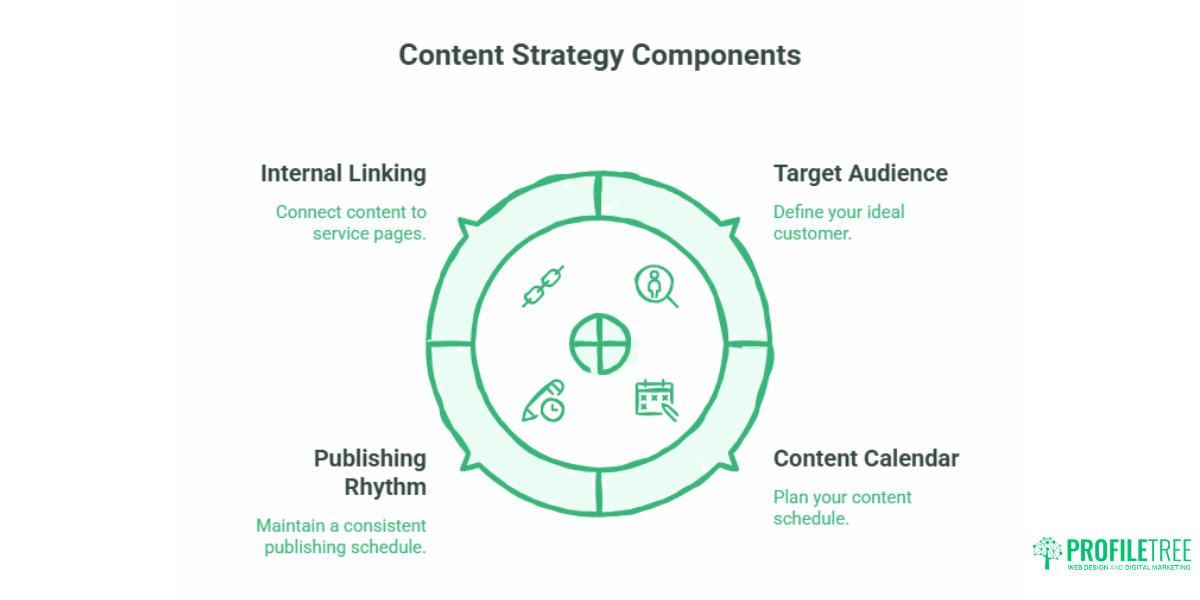
For SMEs in Northern Ireland, Ireland, and the UK that want to use content to generate leads rather than simply maintain a blog, the practical path is to treat BuzzSumo as one input in a broader content marketing process. That process typically includes a defined target audience, a content calendar aligned to commercial goals, a consistent publishing rhythm, and systematic internal linking to service pages.
ProfileTree’s content strategy guide for sustaining audience interest covers how to build that structure. For businesses that want support setting it up or want someone else to manage the execution, ProfileTree’s content marketing service handles everything from strategy and keyword research through to production and performance tracking.
Frequently Asked Questions
Is BuzzSumo free for small businesses?
BuzzSumo does not offer a permanent free tier. It provides a 30-day free trial that gives full access to the platform’s features. After the trial, a paid subscription is required to continue using the tool. The free trial is fully functional, so it is worth using it intensively from day one rather than treating it as a casual test drive.
How much does BuzzSumo cost in the UK?
BuzzSumo’s entry-level Content Creation plan starts at approximately £179 per month on a monthly contract as of mid-2026. Annual billing is typically available at a reduced rate. Prices are subject to exchange rate fluctuations as BuzzSumo bills in USD. VAT applies to UK customers, so factor this into any budget comparison.
Can I get similar data using free tools?
For content ideation, yes. Combining Google Trends, AnswerThePublic, and Feedly covers the core topic discovery function at no cost. For backlink tracking and competitor domain analysis, Ahrefs Webmaster Tools offers a free tier with limited data. The main gaps are social share data and influencer search, which have no reliable free equivalent. For businesses on tight budgets, starting with free tools and upgrading to BuzzSumo once content output is consistent is a sensible approach.
How does BuzzSumo help with local SEO in Ireland or the UK?
BuzzSumo’s country filter lets you restrict content searches to UK or Irish results, surfacing the topics and formats earning engagement in your specific market. This is directly useful for local SEO because it helps identify what content earns links from regional sites; earning links from .co.uk or .ie domains is one of the clearest signals of local relevance to Google. Knowing which regional competitors are earning those links tells you exactly who to study and, in time, who to outperform.
Can I export CSV files during the free trial period?
Yes. BuzzSumo’s export function is active during the 30-day trial. This means you can run full competitor content reports, backlink analyses, and influencer lists and download them as CSV files before the trial ends. These exports retain their value for several months and can form the backbone of a content plan even if you decide not to continue with a paid subscription.
Is BuzzSumo suitable for a solo marketer?
It can be, provided the workflow is tight. Solo marketers tend to get the most value from the Question Analyser (for content ideas) and the Content Analyser (for competitor monitoring). The influencer search and alerts features require more time to act on and are better suited to teams with a dedicated outreach function. The 60-minute weekly workflow outlined in this guide was designed specifically for time-poor individuals who want to extract consistent value without spending hours in the platform each week.
What to Do Next
BuzzSumo works best as part of a structured content marketing approach. If you are using it to inform article topics but have no clear process for producing, publishing, and promoting that content consistently, the tool’s value is limited. The data is only as useful as what you do with it.
If you want to build a content process that turns research like this into measurable business outcomes, ProfileTree’s content marketing services and digital training programmes are designed for SMEs across Northern Ireland, Ireland, and the UK who want practical support rather than another tool to manage on their own. Start with the free trial, follow the workflow above, and use the exports to map out your next quarter’s content before you decide whether to commit to a subscription.