
Reader Engagement: How to Build a Loyal Blog Audience
Table of Contents
Most blogs don’t have a traffic problem. They have a retention problem. Visitors land, skim the first few lines and leave within seconds, not because the topic is wrong, but because the page gives them no reason to stay. That is a reader engagement problem, and it is fixable.
Reader engagement measures how actively an audience interacts with content: how long they stay, how far they scroll, whether they share it, comment on it, or come back for more. For SMEs across Northern Ireland and the UK, engagement is not a vanity metric. It feeds directly into search rankings, conversion rates and the amount of trust a brand builds with its audience over time.
This guide covers what reader engagement actually means, how to measure it properly in GA4, and the practical changes that increase reader engagement on a typical SME blog. It closes with a look at distribution and the ethical line between earning attention and manipulating it.
What Is Reader Engagement
Reader engagement is not the same as reach. A page can attract thousands of visitors and still fail if none of them read past the first paragraph. Engagement is the behavioural evidence that content is actually working: dwell time, scroll depth, return visits, shares and comments.
The distinction matters because most SME reporting still treats a spike in visitors as a win on its own. A campaign that drives ten thousand impressions but produces no return visits, no shares and a bounce within seconds has generated exposure without building reader engagement. Exposure fades the moment the campaign budget stops; genuine reader engagement keeps people coming back long after.
The Four Types of Reader Engagement
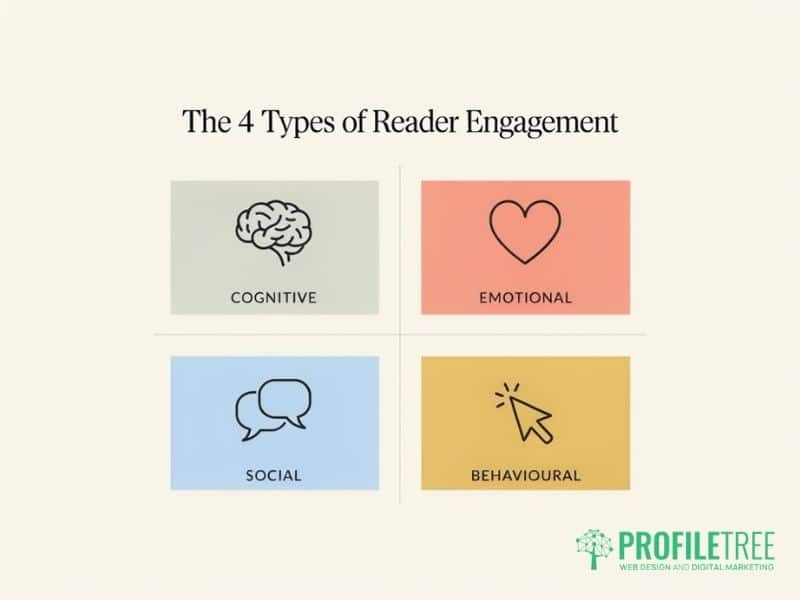
Most discussions of reader engagement stop at “time on page,” but there are four distinct dimensions worth separating out.
Cognitive engagement is whether someone is actually processing the content, following an argument, or working through a how-to guide step by step. Emotional engagement covers the reactions a piece provokes, whether that is agreement, frustration, or curiosity. Social engagement is the sharing, tagging and discussing that happens once someone has read something worth passing on. Behavioural engagement is the measurable action: a click, a scroll, a signup, a return visit.
A piece can score high on one dimension and low on another. A well-researched technical guide might generate strong cognitive engagement with almost no social sharing. A provocative opinion piece might do the opposite. Knowing which type of reader engagement a piece of content is built for helps set the right expectations before it’s published.
Reach vs Engagement: Why the Difference Matters
Impressions and clicks tell you whether people found the content. Engagement tells you whether it was worth finding. A page ranking on page one for a competitive term but losing 80% of visitors within ten seconds has a reach problem solved and an engagement problem unaddressed. Chasing more traffic to a page that can’t hold attention usually wastes budget rather than growing it.
This is also why fixing reader engagement is often cheaper than fixing rankings. Improving a headline, tightening an opening paragraph, or adding a genuinely useful table costs a fraction of what it takes to build the backlinks and authority needed to climb from position ten to position three. For most SME blogs, the reader engagement problem is the one worth solving first, and it doesn’t require a bigger budget to start.
How to Measure Reader Engagement in GA4
The move from Universal Analytics to GA4 changed how reader engagement is tracked, and a lot of SME reporting still uses the old framework out of habit rather than choice.
| Metric | Old approach (Universal Analytics) | Current approach (GA4) |
|---|---|---|
| Bounce rate | Primary indicator: high bounce meant poor content | Largely replaced by Engagement Rate; a GA4 “bounce” is a session under 10 seconds with no interaction |
| Time on page | Measured page load to next click; inflated by idle tabs | Replaced by Average Engagement Time, which measures active focus rather than passive dwell |
| Page views | Core performance metric | Still tracked, but read alongside Engaged Sessions for a fuller picture |
| Scroll depth | Needed a custom GTM setup; rarely tracked | Fires as a default event at 90% scroll depth |
| Return visits | Available but rarely actioned | A genuine engagement signal, worth tracking by content type |
Moving Beyond Bounce Rate to Engagement Rate
Engagement Rate in GA4 counts a session as engaged if it lasts more than 10 seconds, includes a conversion event, or spans two or more page views. For B2B blog content aimed at professional audiences, an engagement rate between 45% and 65% is a reasonable starting point, though this varies by industry and should be treated as indicative rather than a fixed target. Pages sitting well below 40% usually need a content review before anything else.
Tracking Scroll Depth and Average Engagement Time Accurately
Average Engagement Time measures how long a page actually had a user’s active focus, not how long a tab sat open in the background. For a long-form guide of 2,500 words or more, an average engagement time of three to five minutes suggests most readers are working through the bulk of the content rather than bouncing off the introduction.
Scroll depth fires automatically in GA4 at the 90% mark, which is enough to see which articles readers finish and which they abandon partway through. Cross-referencing scroll depth against exit points on the page usually reveals exactly where a piece loses its audience, whether that is a slow opening, a dense middle section, or a weak subheading that gives readers permission to leave.
Setting Up Custom Events for Newsletter Signups and Comments
Default GA4 events cover page views and scrolling, but signups and comments need custom event tracking to show up in reports. A newsletter signup form should fire its own event on submission, tagged separately from generic form completions, so it can be compared against the article that generated it. The same applies to comment submissions, which are often left completely untracked even on sites that value community engagement.
“Most SMEs track pageviews and stop there,” says Ciaran Connolly, founder of ProfileTree. “The real signal is whether someone finishes reading and comes back a second time. GA4 finally makes that visible without needing a separate analytics tool bolted on top.”
Businesses without in-house tracking expertise often benefit from getting GA4 event tracking set up properly from the start, rather than discovering months later that key actions were never being measured.
Practical Reader Engagement Strategies
Improving reader engagement usually comes down to a handful of structural changes rather than a single trick. The following areas cover the reader engagement techniques with the highest impact for SME blog content, roughly in the order they’re worth tackling.
Headlines That Actually Hold Attention
A headline is often the only chance to persuade someone to keep reading. The strongest headlines do one of three things: name a specific problem the reader has, promise a concrete and checkable outcome, or create genuine curiosity about something the reader didn’t know they needed to understand.
For SME audiences in the UK and Ireland, directness tends to outperform cleverness. A headline naming an actual situation a reader recognises will usually beat one built around a vague promise of “tips” or “secrets.” If a headline includes a number, that number has to match the article. A mismatch is one of the fastest ways to damage credibility with a reader who is counting.
A few structures reliably outperform generic phrasing. A problem-first headline names the exact situation a reader is in. An outcome-specific headline states what the reader will be able to do afterwards. A question format mirrors the way people actually search. Each works because it sets a precise expectation rather than a vague one, and precise expectations are what get a reader past the headline in the first place.
BLUF and Scannable Structure
Online readers scan rather than read in a straight line. Writing for engagement means putting the key point at the start of every section rather than building up to it, a structure often called Bottom Line Up Front, or BLUF. State the conclusion first, then follow with supporting details, examples and caveats.
Short paragraphs of two to four sentences increase time on page and reduce visual fatigue on a mobile screen. Sentence length matters too. A five-word sentence followed by a longer explanatory one creates the natural rhythm of human writing. Uniform sentence length, with every sentence running to roughly the same 18 to 20 words, is one of the clearest tells of generated copy, and readers notice the flatness even if they cannot name why.
Interactive Elements and Visuals
Passive content that simply informs tends to produce lower reader engagement than content that asks something of the reader. A short poll or quiz embedded in a long article increases scroll depth, particularly for diagnostic formats like “which approach suits your business,” because the personalised result gives readers a reason to keep going. A direct question at the end of a section, such as asking which point applies to the reader’s own situation, works almost as well and costs nothing to implement.
Images and video extend engagement only when they add information rather than decoration. A diagram explaining a process holds attention longer than a generic stock photograph, and an embedded video gives readers who prefer to watch a second route through the same material. ProfileTree’s video marketing services cover exactly this kind of supporting content for SME blogs that want a visual alternative to long blocks of text.
Internal Linking as a Reader Journey
A reader who finishes one article and finds an obvious next step is far more likely to stay on the site and eventually convert. The most effective internal links sit early in the content, not clustered at the bottom, and use descriptive anchor text that tells the reader exactly what they will find, rather than a generic “read more.”
Keyword research also plays a role here. Reader engagement problems often start with an audience mismatch, where a page ranks for a query it doesn’t actually answer well. Reviewing keyword research data against what a page actually delivers is a useful first check before assuming the content itself is at fault.
Distribution and Long-Term Retention
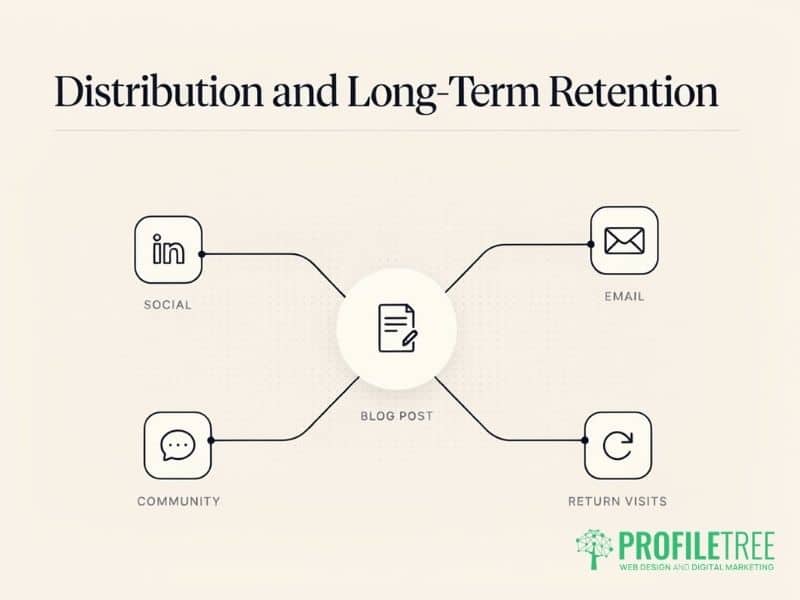
Writing content that earns reader engagement is one challenge. Getting it in front of the right readers consistently is another, and the two are often treated as separate problems when they shouldn’t be.
Social Media and Community Channels
Distribution channels have to match the platform rather than repeat the same post everywhere. LinkedIn rewards professional, opinion-led posts that name a specific problem before linking to the full article, and this consistently outperforms generic “new blog post” announcements. A clear social media content plan makes this kind of platform-specific posting realistic rather than an afterthought squeezed in after publication.
Community channels such as LinkedIn newsletters, WhatsApp groups and niche forums have picked up much of the conversation that used to happen in blog comment sections. For SME marketers, this means the blog article is often the starting point of a reader relationship rather than the end of one.
Email as a Retention Mechanism
An email list is one of the most reliable ways to drive repeat reader engagement, largely because it is a channel a business owns outright rather than rents from a platform algorithm. The most effective newsletters give subscribers something worth reading inside the email itself, then link out to the full article for depth, rather than functioning purely as a content aggregator. Choosing the right email marketing platform affects how easily this kind of segmented, value-led newsletter can actually be built.
Engagement Without Dark Patterns
Not every technique that increases a metric is worth using. Clickbait headlines, infinite pagination designed purely to inflate pageviews and interstitials that block content until a reader shares it all raise short-term numbers while damaging trust. UK and Irish audiences, used to the editorial standards of outlets like the BBC and RTE, tend to notice manipulative patterns quickly and penalise them with lower return visits. The sustainable version of reader engagement is earned through genuine value, not extracted through friction.
Building Reader Engagement as an Ongoing Practice
Reader engagement is not a problem solved once. It is a standard applied consistently across every headline, every internal link and every section structure. Slow pages, passive content with no invitation to participate and articles that bury the key information three paragraphs in are all fixable problems, and each one is a genuine barrier to the kind of engagement that compounds over time.
Businesses unsure where their own content is losing readers can start with a content audit to identify which specific pages are underperforming and why, rather than guessing at fixes across an entire blog at once.
None of this happens from a single overhaul. The businesses that build genuinely engaged audiences tend to review a handful of pages every month rather than rewriting the whole site once a year, checking scroll depth and return visits against what changed, and adjusting the next batch accordingly. Fix the fundamentals, measure what shifts, and repeat.
FAQs
1. What is reader engagement, and why does it matter for SEO?
Reader engagement is the extent to which visitors actively interact with content: staying on the page, scrolling, clicking through, sharing, or returning later. It matters for SEO because search systems use engagement signals as evidence that a page delivers genuine value. A page with deep impressions but very low engagement is unlikely to hold its ranking against a page whose visitors consistently read to the end.
2. What is a good engagement rate for a blog in GA4?
GA4 counts a session as engaged if it lasts more than 10 seconds, includes a conversion event, or spans two or more page views. For B2B blogs serving professional audiences, engagement rates between 45% and 65% are a reasonable starting point, though this varies by industry and should be treated as indicative rather than a fixed benchmark.
3. How do I increase engagement with readers on my blog?
Start with the opening paragraph. If the first 100 words do not give someone a clear reason to continue, most will not. Beyond that, use clear subheadings, keep paragraphs short, put the key point at the start of each section, include at least one specific example per article and link internally to genuinely related content.
4. Why is my blog getting traffic but no engagement?
The most common cause is an audience mismatch, where a page ranks for queries that attract readers with a different intent than the content serves. Checking which queries actually bring visitors to a page and whether the content matches that intent usually explains the gap faster than blindly rewriting.
5. Do blog comments still help with reader engagement and SEO?
Comments contribute in two ways: they signal an active conversation to new readers, and they add fresh user-generated content, which can act as a minor freshness signal. Their direct SEO impact is modest, but the indirect benefit of a more participatory, returning audience is worth cultivating. Asking a specific question produces far more responses than a generic invitation to comment.