
How to Build a Strategic Marketing Plan for Your Business
Table of Contents
A strategic marketing plan is a written document that outlines where your business is now, where you want to take it, and how marketing activity will get you there. It connects your commercial objectives to the channels, budgets, and timelines needed to achieve them.
Most UK and Irish SMEs skip this step entirely. They run social media posts, pay for Google Ads, and occasionally commission a new website, but without a plan that ties these activities to specific goals, the spending rarely adds up to growth. Tactics without strategy produce activity, not results.
“The businesses that come to us having already lost money on digital marketing nearly always share the same problem,” says Ciaran Connolly, founder of ProfileTree. “They were doing things, but they weren’t connected to anything. A strategic marketing plan is what turns isolated activity into a system that compounds.”
This guide outlines a practical, step-by-step approach to building a strategic marketing plan that works for small and medium-sized businesses in the UK and Ireland. It covers the frameworks, the questions to ask at each stage, how digital channels fit in, and where AI is now changing how smart businesses approach market analysis and campaign planning.
What is a Strategic Marketing Plan?
A strategic marketing plan is a structured document that aligns your marketing activity with your overall business goals. It differs from a tactical marketing plan (which focuses on specific campaigns) in that it sets the direction first: who you are targeting, why they should choose you, and how your marketing will build that position over a defined period.
The distinction matters. A marketing strategy plan defines the “why” and the “who.” A tactical plan covers the “what” and the “when.” Both are necessary, but many businesses build tactical plans without a strategic layer, which is why the same efforts produce inconsistent results.
Strategic marketing plan vs marketing plan: key differences
| Element | Strategic Marketing Plan | Tactical Marketing Plan |
|---|---|---|
| Timeframe | 12 to 36 months | 3 to 12 months |
| Focus | Direction, positioning, audience | Campaigns, channels, executions |
| Primary questions | Why are we marketing? To whom? | What will we do? When? |
| Outputs | Strategic framework, KPIs, budget envelope | Campaign calendar, content schedule, ad budgets |
| Who owns it | Senior leadership or agency partner | Marketing manager or agency team |
A complete strategic marketing plan typically covers six areas: situational analysis, objective setting, audience and positioning, channel strategy, budgeting, and measurement. The sections below step through each one using a widely used framework used by UK and Irish marketing professionals.
The SOSTAC Framework: A Practical Approach for UK SMEs
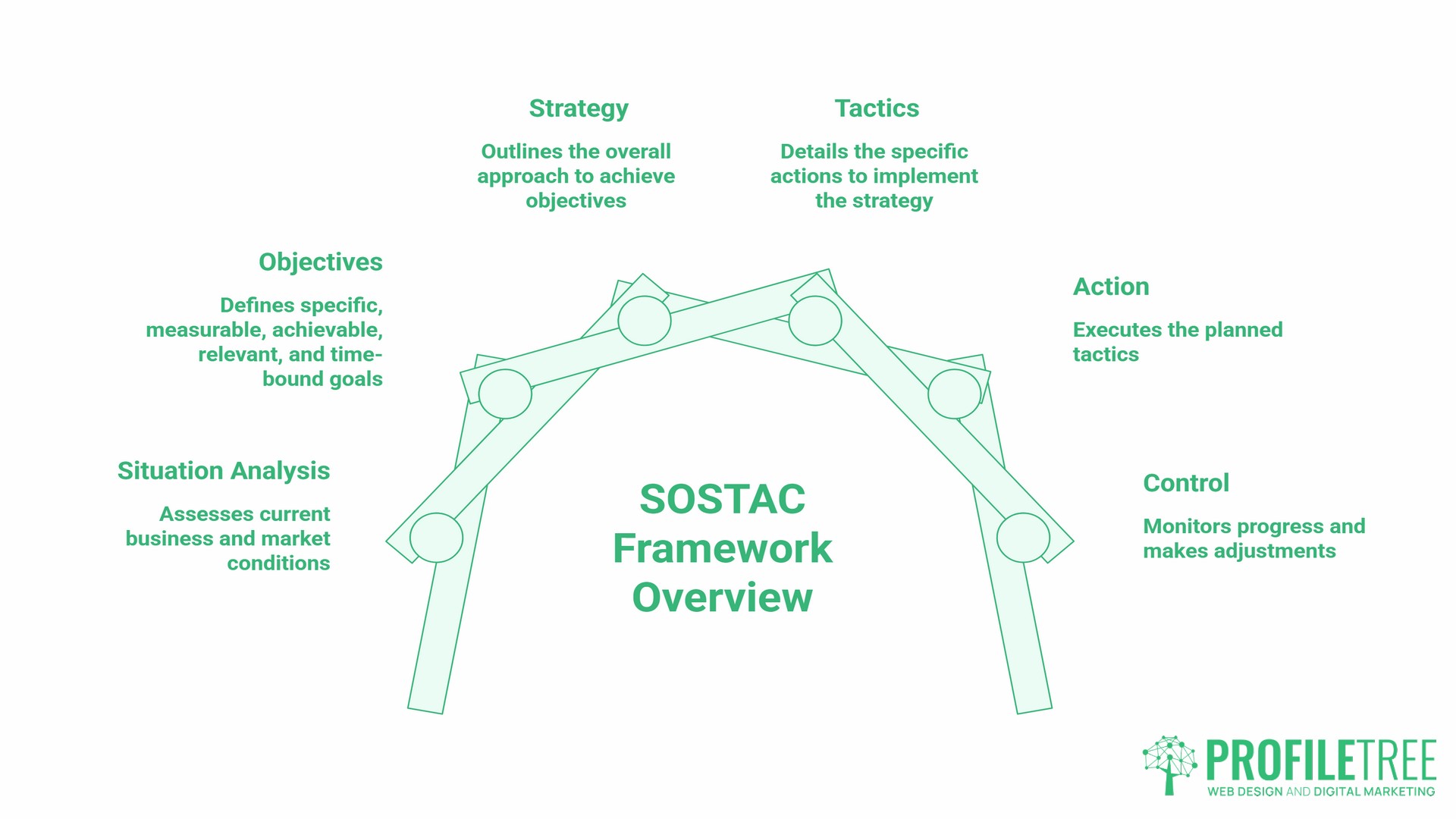
The SOSTAC framework (Situation, Objectives, Strategy, Tactics, Action, Control) was developed by PR Smith and is widely taught by the Chartered Institute of Marketing (CIM). It is one of the most widely used strategic marketing plan frameworks in the UK and Ireland, and it maps naturally onto how digital marketing actually works.
Situation: Where Are You Now?
The situation analysis is your starting point. It assesses the current state of your business, your market, and your digital presence.
SWOT analysis examines four dimensions:
- Strengths: what your business does well internally (strong local reputation, established client base, in-house expertise)
- Weaknesses: internal constraints (limited marketing budget, no dedicated team, outdated website)
- Opportunities: external factors you can take advantage of (growing demand in your category, competitors who are slow to digital, underserved audience segments)
- Threats: external risks (new competitors entering the market, regulatory changes, rising ad costs)
For UK businesses, the threat column should account for specific market conditions. The post-Brexit trading environment has affected supply chains and cross-border customer acquisition for businesses operating across the island of Ireland and into Great Britain. UK GDPR, enforced by the Information Commissioner’s Office (ICO), governs how you collect and use customer data for marketing purposes, particularly for email lists, remarketing audiences, and lead generation forms. Any strategic marketing plan for a UK or Irish business must factor in compliance as a structural requirement, not an afterthought.
A digital audit sits alongside the SWOT. Assess your current website performance (traffic, conversion rates, search visibility), your social media presence, your email database size, and your existing content assets.
Objectives: Where Do You Want to Go?
Marketing objectives must connect directly to business objectives. If the business goal is to grow revenue by 25% over 12 months, the marketing objective must specify the volume of leads, conversions, or repeat purchases required to achieve that target.
Use the SMART framework to define objectives:
- Specific: “Generate 80 qualified enquiries per month through organic search and paid channels” rather than “increase enquiries.”
- Measurable: Assign a numerical value to each objective.
- Achievable: Set targets based on current baseline performance and realistic growth rates.
- Relevant: Every marketing objective should map to a business outcome.
- Time-bound: Define the measurement period (quarterly milestones are practical for SMEs).
Example objectives for a Northern Ireland-based professional services firm:
- Increase organic website traffic by 40% within 12 months through SEO and content marketing
- Generate 60 qualified leads per month from digital channels by Q3
- Reduce the cost per acquisition from paid search by 20% within six months
Setting Your Audience and Market Positioning
A strategic marketing plan requires precision about who you are targeting. Broad audience descriptions produce weak strategies. The more clearly you define your audience segments, the more effectively you can allocate your budget.
Segmentation Approaches:
Demographics cover the basics: age, location, business size, sector, and decision-making role. For B2B businesses across Northern Ireland, Ireland, and Great Britain, sector and company size are often more predictive of buying behaviour than demographic factors.
Psychographics go deeper: what does your audience value, what concerns do they have about making a purchasing decision, and what would make them switch from a current provider?
Behavioural data from your existing CRM, Google Analytics 4, and social platforms can tell you which segments engage most, convert best, and retain longest. Building an audience strategy from actual data is more reliable than assumptions.
Buyer Personas
Translate segment data into working profiles. A persona for a Belfast-based accountancy firm targeting SME owner-managers might look like this:
- Business type: Owner-managed SME, 5 to 30 employees, professional services sector
- Decision-maker: Managing director or founder, aged 38 to 55
- Key concern: Time; they want trusted external partners who require minimal management
- Information sources: Professional referrals, LinkedIn, Google search
- Barriers to purchase: Price uncertainty, unclear ROI, previous bad experience with agencies
Unique Value Proposition (UVP)
Your UVP states what you offer, who it is for, and why it is better or different from alternatives. It should be expressed in plain language that your audience would use, not in internal jargon. A UVP that requires explanation to a client is not yet a UVP.
Choosing Your Digital Channels
Channel selection should follow audience research, not precede it. The question is not “should we be on Instagram?” but “where does our specific audience look when they are ready to make a decision like this?”
For most UK and Irish SMEs, the channel mix in a strategic marketing plan will draw on a combination of the following.
- Search Engine Optimisation (SEO) generates long-term organic traffic from people actively searching for what you offer. For businesses with a defined geographic service area (Belfast, Dublin, Manchester, or wider regions), local SEO is often the highest-return investment in the channel mix. Appearing in Google Maps results for relevant searches typically converts at a higher rate than almost any other digital channel. ProfileTree’s guide to SEO for businesses in the UK covers the technical and content requirements for competitive organic visibility.
- Content marketing builds authority, supports SEO, and moves prospective customers through the awareness and consideration stages of their journey. A strategic marketing plan should define the content types (articles, videos, case studies, guides), the publishing cadence, and the specific audience questions each piece will answer. Producing content without a strategic framework is one of the most common causes of wasted marketing budget. ProfileTree’s digital marketing strategy guide sets out how content fits within a broader integrated strategy.Video marketing is now a primary channel for B2B and B2C businesses alike. UK consumers spend an average of 100 minutes per day watching online video. Video content generates engagement rates consistently higher than static formats across LinkedIn, YouTube, and website landing pages. For businesses in Northern Ireland and Ireland, video is also a practical way to demonstrate expertise and personality in a market where trust and relationships remain central to purchasing decisions. ProfileTree’s video marketing services are built specifically for SMEs who want professional-quality production without broadcast budgets.
- Paid digital advertising (Google Ads, LinkedIn Ads, Meta Ads) amplifies reach and can produce faster results than organic channels, but it requires a clear strategy for targeting, messaging, and budget allocation. Without strategic underpinning, paid advertising typically produces high spend and inconsistent returns. Paid channels work best as part of a wider strategic marketing plan, not as a standalone solution.
- Email marketing remains one of the highest-returning digital channels for businesses with an existing database. A strategic marketing plan should define the role email plays in customer acquisition, conversion, and retention, and set out the compliance requirements under UK GDPR for list management and consent.
The video below covers how ProfileTree approaches digital marketing strategy for SMEs across Northern Ireland and the UK:
Integrating AI into Your Strategic Marketing Plan
AI tools have moved from optional add-ons to practical components of how forward-thinking businesses conduct market research, produce content, and analyse campaigns.
Within a strategic marketing plan, AI is most useful at three points:
- Situation analysis: AI tools can process large volumes of competitor content, customer review data, and search query patterns to identify gaps and opportunities that manual research would miss. Using an LLM to synthesise themes from competitor Google reviews, for example, can surface unmet customer needs faster than traditional market research methods.
- Persona development: AI-assisted analysis of your existing CRM data, website behaviour, and social engagement can produce audience segment profiles that are grounded in actual data rather than assumptions. This produces more precise targeting at the strategy stage.
- Performance reporting: AI-powered tools reduce the time spent aggregating data from Google Analytics 4, paid platforms, and CRM systems, allowing small marketing teams to spend more time on decision-making and less on data aggregation.
For SMEs without in-house expertise to implement AI tools effectively, ProfileTree’s AI training programmes for businesses provide practical guidance on where AI genuinely adds value in a marketing workflow and where it does not.
The broader opportunity is treating AI as a strategic input rather than a production shortcut. Businesses that build AI into the planning stage of their marketing strategy, not just the execution stage, will develop a structural advantage over competitors still using AI only to generate social media captions.
Budgeting for Your Strategic Marketing Plan
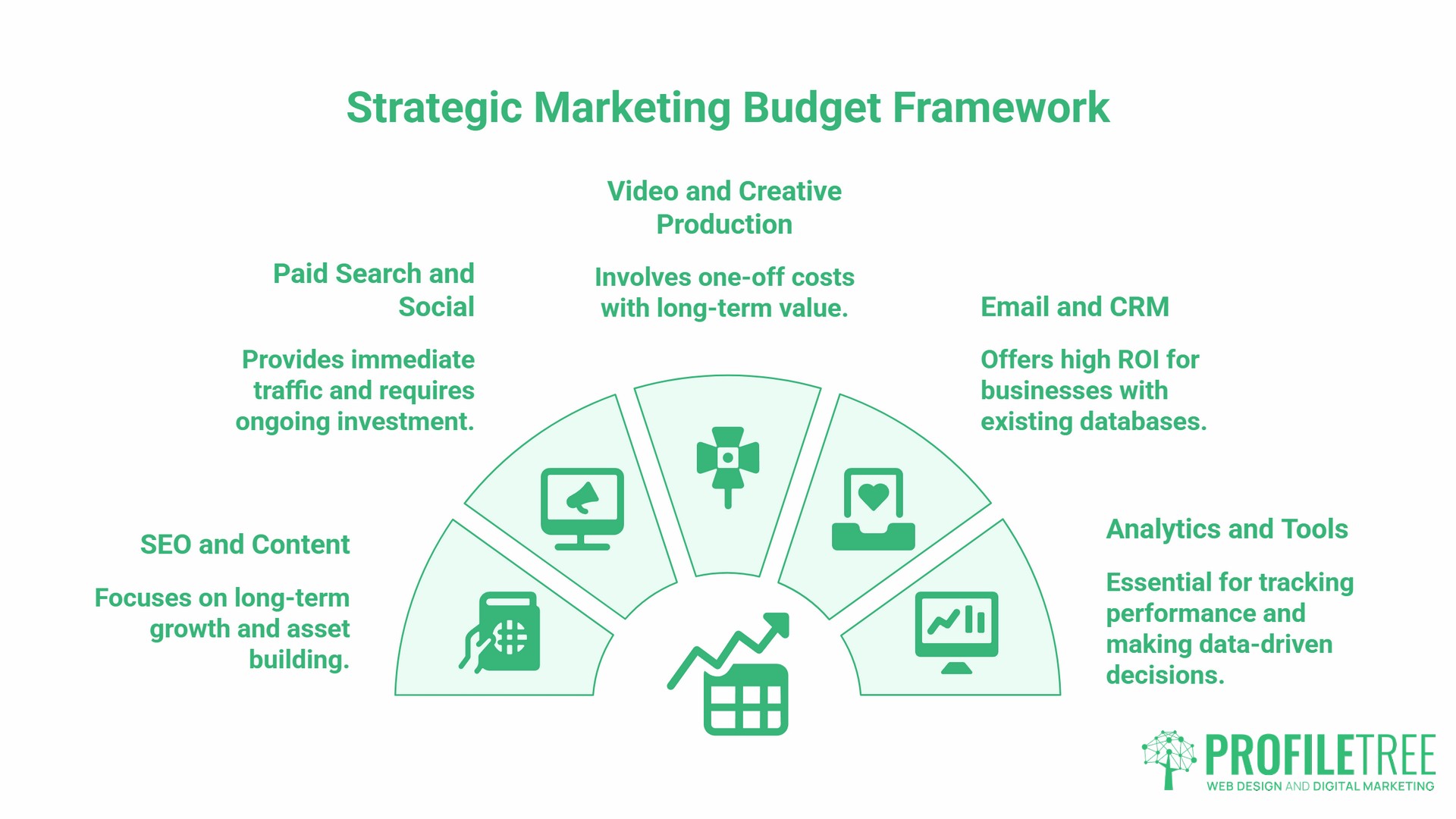
Budget allocation is where strategy meets reality. A strategic marketing plan that ignores resource constraints is not a plan; it is a wishlist.
UK SMEs typically allocate between 6% and 12% of revenue to marketing, though this varies significantly by sector, growth stage, and competitive environment. Businesses in highly competitive categories (such as financial services, law, and recruitment) often need to sit at the upper end of this range to gain traction.
A practical budget framework for a small team or owner-managed business:
| Channel | Allocation | Notes |
|---|---|---|
| SEO and content | 30 to 40% | Long-term asset; returns compound over time |
| Paid search and social | 25 to 35% | Immediate traffic; requires ongoing investment |
| Video and creative production | 15 to 20% | One-off production costs with long shelf life |
| Email and CRM | 5 to 10% | High ROI for businesses with existing databases |
| Analytics and tools | 5 to 10% | GA4, CRM, reporting platforms |
These are indicative percentages. Your actual allocation should reflect your audience’s behaviour (a B2B firm targeting senior buyers may weight LinkedIn and content heavily; a local retail business may prioritise local SEO and Google Ads), your competitive landscape, and your current baseline performance.
The most common budgeting mistake in strategic marketing plans is treating digital advertising as the primary channel when SEO and content would produce better long-term returns at lower cost. Paid media stops working the moment you stop paying. SEO, content, and email build assets that continue to generate value.
Measurement and Control
A strategic marketing plan requires a measurement framework to determine whether objectives are being met and where adjustments are needed.
Key metrics by objective type:
| Objective | Primary KPI | Secondary KPIs |
|---|---|---|
| Increase organic traffic | Organic sessions (GA4) | Keyword rankings, pages per session |
| Generate leads | Qualified enquiries | Form completions, call tracking |
| Improve conversion | Conversion rate | Bounce rate, session duration |
| Build brand awareness | Branded search volume | Social reach, direct traffic |
| Reduce acquisition cost | Cost per acquisition | ROAS, customer lifetime value |
Quarterly reviews are the practical minimum for SMEs. A monthly dashboard covering your core KPIs, reviewed against the targets set in your strategic marketing plan, allows you to identify what is working before too much budget is committed to underperforming channels.
Google Analytics 4 is the standard analytics platform for web performance. Set up conversion events (form submissions, phone clicks, purchase completions) during the planning stage, before campaigns go live, rather than retrospectively.
The control phase of SOSTAC closes the loop: findings from measurement feed back into the situation analysis, and the plan is updated accordingly. A strategic marketing plan is not a static document. It should be reviewed quarterly and rebuilt annually.
FAQs
What are the 7 steps of a strategic marketing plan?
The steps vary by framework, but a practical sequence for UK SMEs is: (1) situational analysis using SWOT and digital audit, (2) define target audience and buyer personas, (3) set SMART marketing objectives, (4) develop your positioning and UVP, (5) select channels and build tactical plans, (6) allocate budget, (7) establish measurement framework and review cadence.
How is a strategic marketing plan different from a marketing plan?
A strategic marketing plan sets the direction: who you target, why they should choose you, and what you are trying to achieve over a 12 to 36-month period. A marketing plan (or tactical plan) covers the specific campaigns, channels, and activities you will use to execute that strategy. You need both. The strategic plan comes first.
How often should an SME update their strategic marketing plan?
Review it quarterly against your KPIs and rebuild it annually. The structure and audience positioning may stay largely stable year to year, but channel allocations, budget splits, and specific objectives should be updated as you learn what is working.
How does UK GDPR affect my marketing strategy?
UK GDPR (administered by the ICO) affects every part of your marketing strategy that involves collecting or using personal data. This includes email list building (you need a valid lawful basis for processing, typically consent or legitimate interest), remarketing audiences (cookie consent and privacy notices are required), and lead generation forms (data processing must be disclosed at point of collection). Build compliance into the strategy stage, not as an amendment after campaigns are live.
Do I need a large budget to build a strategic marketing plan?
The plan itself costs nothing beyond time. What requires budget is execution. A realistic strategic marketing plan for a small UK business might start with £1,500 to £3,000 per month in total marketing spend, weighted toward SEO and content in the early stages, where asset-building delivers better long-term returns than paid advertising.
Can AI write my strategic marketing plan?
AI tools can assist with research, data analysis, and drafting sections of a plan, but the strategic judgements, including which markets to prioritise, how to position against competitors, and how to allocate a finite budget, require human expertise and knowledge of your specific business. AI works best as a research co-pilot in the planning process, not as the primary author.
What is the most important part of a strategic marketing plan?
The audience definition and the UVP. If you are unclear about who you are targeting and why they should choose you over alternatives, no amount of tactical activity will make up for it. Everything else in the plan flows from getting those two elements right.