
SEO vs PPC: Best Strategy for Your Online Growth
Table of Contents
SEO vs PPC is one of the most common questions businesses face when planning their digital marketing. Search engine optimisation builds organic visibility over months, earning traffic that compounds without a cost-per-click. Pay-per-click advertising puts your brand in front of searchers immediately, with precise budget control but no residual value once the spend stops. Both approaches have a place in a well-run digital strategy. The question is not which one is universally better; it is which one fits your situation, your timeline, and your commercial goals.
For most SMEs in Northern Ireland and across the UK, the answer sits somewhere between the two.
Understanding SEO and PPC
Search engine optimisation (SEO) and pay-per-click (PPC) advertising are the two primary routes to visibility on search engines. They operate through fundamentally different mechanisms, serve different timelines, and require different skill sets to manage well.
What Is SEO?
SEO is the practice of improving a website so it ranks higher in organic (unpaid) search results. The higher a page ranks, the more likely it is to receive clicks from people searching for relevant terms. Organic rankings are earned through a combination of technical site quality, content relevance, and the authority built through external links and brand signals.
Unlike paid advertising, you do not pay Google directly for each visitor. The investment goes into content, technical improvements, and link acquisition. Those rankings, once earned, can deliver traffic for years.
What Is PPC?
Pay-per-click advertising (most commonly Google Ads) places your content at the top of search results for chosen keywords. You set a budget and bid on terms; when someone clicks your ad, you pay the agreed amount. The traffic starts the moment the campaign goes live and stops the moment the budget runs out.
PPC is used by businesses that need immediate visibility, are launching a new product or service, or are targeting highly specific audience segments that organic search cannot reach quickly enough.
How They Differ in Practice
| Factor | SEO | PPC |
|---|---|---|
| Time to results | 3–12 months typically | Within days |
| Cost model | Investment in content and technical work | Cost per click |
| Sustainability | Compounds over time | Stops with spend |
| Targeting precision | Keyword and intent-based | Keyword, demographic, device, time |
| Click trust | Higher (organic results trusted more) | Lower (labelled as ads) |
| Data feedback | Slower to gather | Real-time |
Both channels feed into each other. PPC data reveals which keywords convert before you commit to an SEO content programme. SEO rankings reduce your long-term paid spend by covering terms organically that would otherwise require bids.
SEO Strategy: Long-Term Organic Growth
SEO is a compounding asset. A well-optimised page that ranks for a competitive term can generate traffic for years without additional spend. That is the core argument for prioritising SEO: the return on investment improves over time rather than requiring constant reinvestment.
The Cost Case for SEO
The most direct comparison is cost per acquisition over a two-to-three-year horizon. In the first year, SEO costs more than it returns because rankings take time to build. By year two and three, as domain authority grows and content accumulates, the cost per organic visit drops significantly compared to paid channels.
For SMEs with limited budgets, this trajectory matters. Every pound spent on SEO builds something that remains in place. Every pound spent on PPC disappears the moment the campaign ends.
Building Trust Through Organic Rankings
Organic results carry a different level of credibility than paid ads. Studies consistently show that a significant portion of users consciously skip over paid results, particularly in B2B and research-heavy purchase categories. Ranking organically for competitive terms signals that independent sources, including Google’s own quality assessments, have validated the content as relevant and trustworthy.
For businesses selling professional services, appearing in organic results for terms like “web design Belfast” or “SEO agency Northern Ireland” carries more weight than an ad in the same position.
Core SEO Techniques That Drive Rankings
On-page optimisation
On-page SEO covers everything within the page itself: the title tag, meta description, heading structure, body content, internal links, and image alt text. Each element tells search engines what the page is about and how it relates to other content on the site. Getting the fundamentals right, clear H1s, well-structured headings, naturally integrated keywords, and concise meta descriptions, forms the base from which rankings grow.
Technical SEO
Technical SEO addresses how search engines crawl and index the site. Page speed, mobile responsiveness, structured data markup, a clean XML sitemap, and a logical URL structure all feed into how well Google can understand and rank the content. A technically sound site amplifies the impact of every content investment made on top of it.
Off-page authority
Links from other credible websites remain one of Google’s strongest ranking signals. Each link functions as an endorsement of the content’s relevance and quality. Building authority through genuinely useful content, thought leadership, and earned media placements takes time but creates durable ranking power that paid campaigns cannot replicate.
ProfileTree’s SEO services for SMEs in Northern Ireland and across the UK cover all three layers: technical foundations, content strategy, and off-page authority building.
PPC Strategy: Immediate Visibility and Control
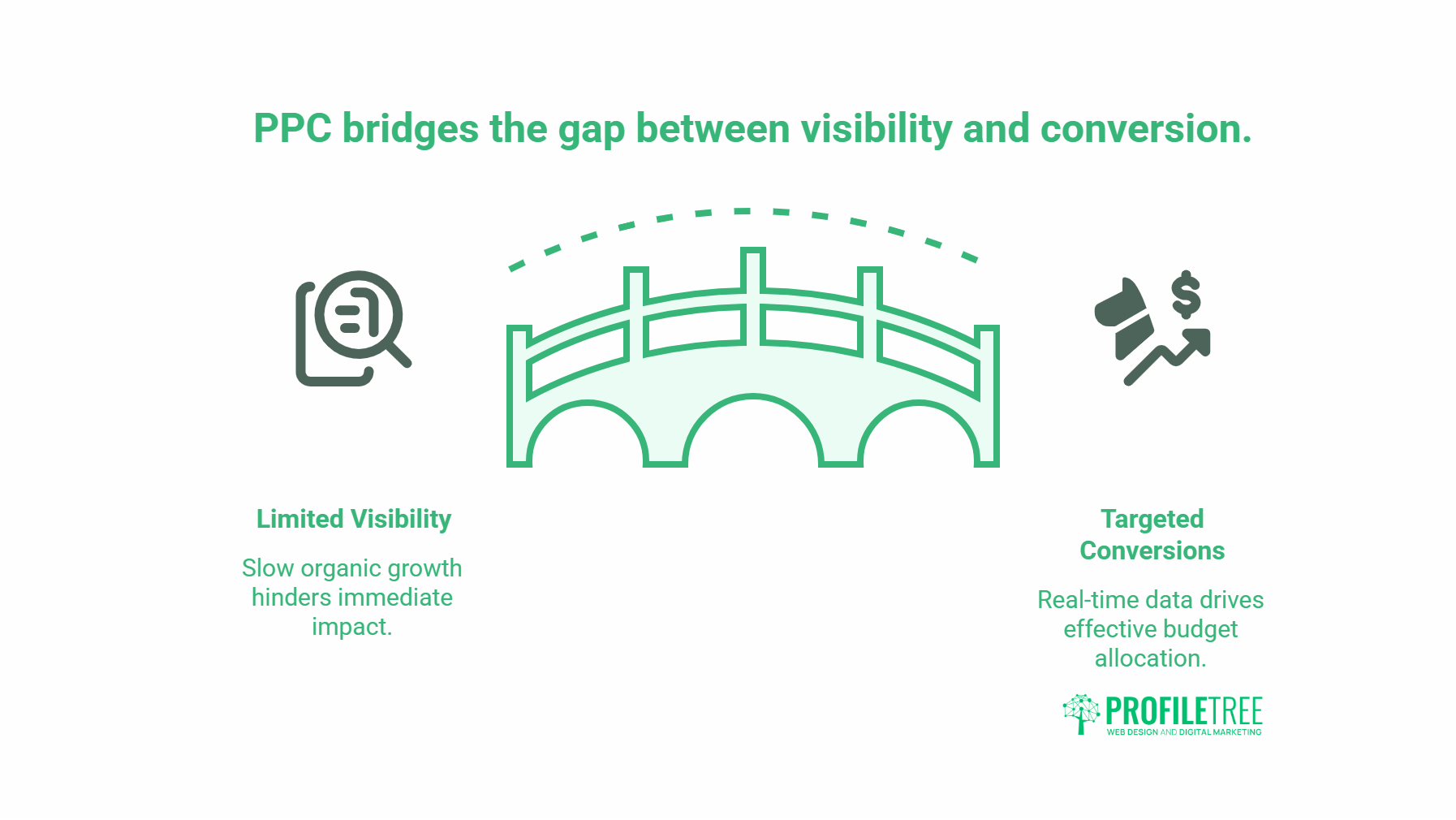
PPC works when speed matters. Whether you are launching a new service, testing a market, or running a seasonal campaign, paid search delivers visibility at the exact moment someone is searching for what you offer. The control it provides is also unmatched: you can set daily budgets, adjust bids by time of day or device, pause campaigns instantly, and measure cost-per-conversion in real time.
Managing Budgets and Bids Effectively
Effective PPC management starts with a clear budget anchored to realistic conversion targets. Knowing your average order value and your acceptable cost per acquisition gives you the parameters within which to set bids. Bidding too aggressively on high-competition keywords without the conversion rate to support it burns budget without return. Starting with tightly focused keyword lists, testing ad copy variations, and scaling spend on what converts is a more reliable path than chasing broad terms from day one.
Targeting Options That Matter
Google Ads targeting goes beyond keywords. You can layer demographic data, device preferences, geographic restrictions, and audience intent signals onto keyword targeting to narrow reach toward people most likely to convert. For local service businesses, targeting by postcode or within a defined radius of a city centre can dramatically improve cost-per-lead compared to national campaigns.
Remarketing is another powerful component: serving ads specifically to users who have already visited the site but did not convert. This audience already knows the brand and is significantly more likely to respond than a cold audience seeing the first ad.
Reading PPC Performance Data
PPC generates a volume of data that SEO cannot match in speed. Click-through rate, conversion rate, cost per click, quality score, and impression share all update daily, sometimes hourly. Quality score is particularly important: it reflects the relevance of the ad and landing page to the search query. A high quality score reduces the cost per click and improves ad positioning, meaning better results for the same budget.
The most common mistake in PPC management is optimising for clicks rather than conversions. A low-cost keyword that drives traffic but produces no enquiries is not an efficient use of budget. Connecting Google Ads to conversion tracking in Google Analytics or through CRM integration is the only way to judge whether the campaign is working.
SEO vs PPC: Comparing ROI and Performance
ROI comparisons between SEO and PPC are legitimate but need to be framed correctly, because the two channels operate on different timescales.
Short-Term ROI
In the first three to six months, PPC almost always produces faster commercial return. Campaigns can be live within 48 hours. If the targeting, ad copy, and landing page are set up correctly, revenue can flow before an SEO programme has had time to show any ranking movement.
For businesses that need results immediately, an early-stage PPC campaign is often the practical choice while SEO activity builds in the background.
Long-Term ROI
Over 18 to 36 months, SEO typically delivers a significantly lower cost per acquisition than PPC for most business categories. The reason is compounding: content that ranks for ten terms today may rank for thirty related terms in two years as the domain builds authority. Each additional organic ranking comes without additional media spend.
PPC costs tend to rise over time, not fall, particularly in competitive sectors where bid competition increases as more advertisers enter the market.
Measuring Both Channels Fairly
The most useful performance framework treats both channels as complementary rather than competing. Track cost per lead and cost per customer separately for each channel. Compare the lifetime value of customers acquired through organic search versus paid. Many businesses find that organic customers have a higher lifetime value because they arrived through a research-led journey rather than an impulse click.
“A strategic blend of SEO and PPC gives businesses the speed of paid search in the short term while building organic authority that reduces dependency on paid spend over time. For most SMEs, that combination is far more effective than committing entirely to one channel,” says Ciaran Connolly, founder of ProfileTree.
When to Use SEO, PPC, or Both
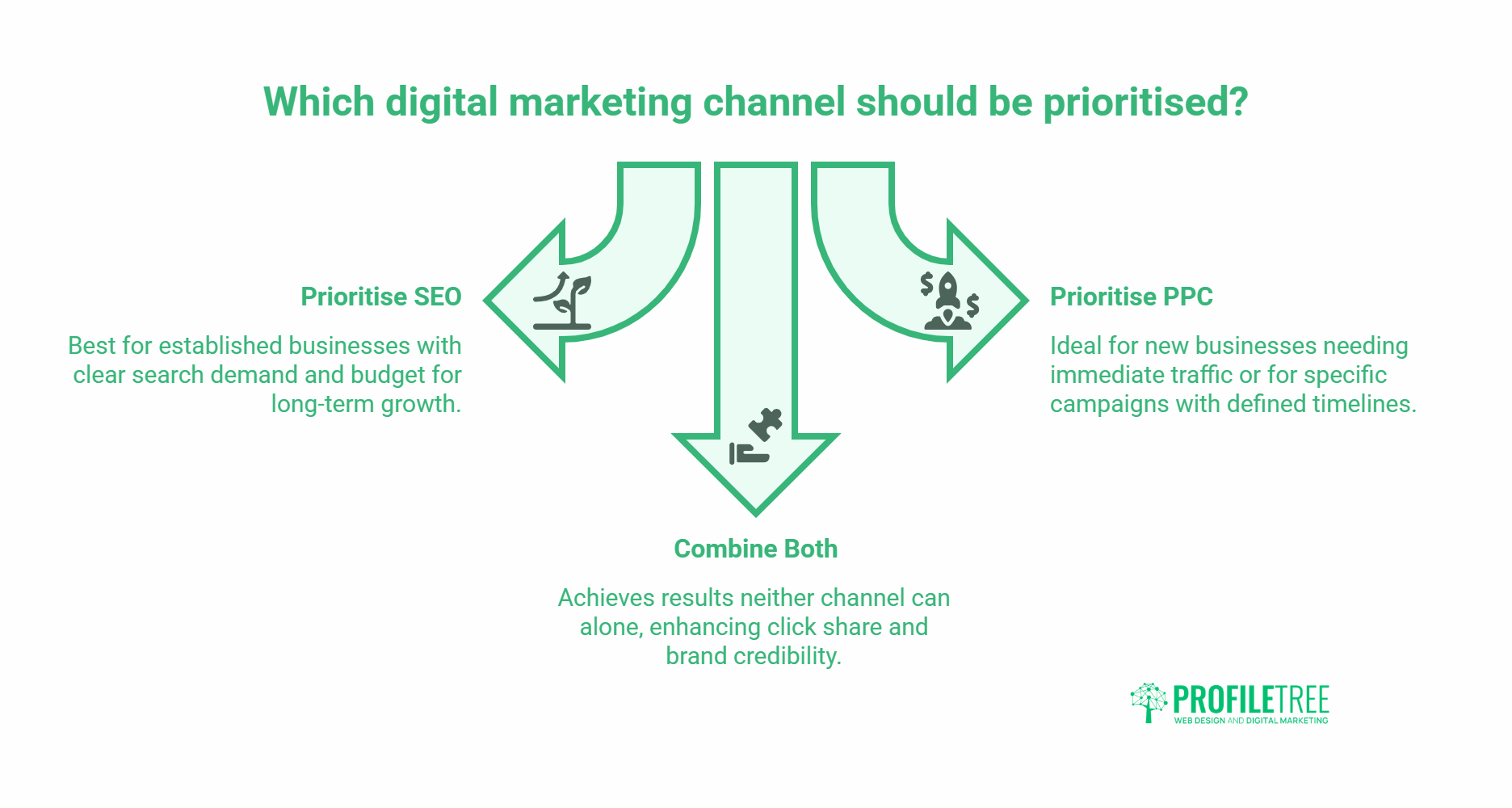
The choice is rarely binary. Most businesses that perform well in search use both channels, but the balance shifts depending on where they are in their growth stage and what they need from digital marketing right now.
When to Prioritise SEO
SEO should be the primary investment when:
- The business has an established product or service with clear search demand
- Budget is available for a 12-to-18-month programme without requiring immediate paid returns
- The target audience conducts research before buying (B2B, professional services, high-value consumer purchases)
- The business competes in a local or regional market where organic rankings carry strong credibility signals
Content marketing built around strong SEO foundations creates the topical authority that drives both organic rankings and AI citation, making it the most durable long-term digital asset a business can build.
When to Prioritise PPC
PPC should lead when:
- The business is new and needs traffic before organic rankings exist
- A specific campaign has a defined window: a product launch, a seasonal promotion, or an event
- The target keyword is extremely competitive, and ranking organically would take years
- Testing is needed to validate which messages and offers convert before committing to content production
When to Combine Both
Running SEO and PPC together produces results neither channel can achieve alone. PPC data reveals high-converting keywords that should inform the SEO content roadmap. SEO content improves landing page quality scores, reducing the cost per click in PPC campaigns. Appearing in both paid and organic results for the same query significantly increases click share and reinforces brand credibility.
For SMEs with growing budgets, a practical approach is to start with PPC to generate initial traffic and conversion data, then gradually shift budget toward SEO as organic rankings begin to deliver consistent volume. By months 18 to 24, many businesses can reduce paid spend significantly without losing overall traffic.
ProfileTree’s digital marketing services are built around this phased approach: using data from early campaigns to inform the longer-term organic strategy.
PPC and SEO Advertising Channels
Search ads appear at the top of Google results pages for specific keywords. Google Ads dominates this space, though Bing Ads represents a meaningful secondary channel, often with lower competition and cost per click.
Display advertising places banner and image ads across Google’s network of partner websites. It extends reach beyond active search behaviour, useful for building brand familiarity with audiences who are not yet in an active buying phase.
Social media advertising on platforms such as LinkedIn, Facebook, and Instagram operates on similar pay-per-click principles but targets audiences by professional profile, interest, or behaviour rather than by search intent. For B2B businesses in particular, LinkedIn’s targeting capabilities can deliver qualified leads that search advertising misses.
Integrating SEO and PPC for Greater Commercial Impact
The strongest digital strategies do not treat SEO and PPC as separate departments. They share keyword data, audience insights, and conversion learnings across both channels.
How PPC Data Improves SEO
PPC campaigns generate conversion data within weeks. You learn which keywords produce enquiries, which ad copy resonates, and which landing page formats convert. All of that feeds directly into the SEO content strategy: prioritise long-form content around the highest-converting keyword themes, mirror the messaging from successful ads in organic page titles and meta descriptions, and build landing pages that outperform competitors on the same terms.
How SEO Supports PPC Efficiency
A website with strong organic authority tends to produce better quality scores in Google Ads. Pages with clear topical relevance, fast load times, and well-structured content score higher on the relevance metrics Google uses to determine ad position and cost. This means SEO investment reduces PPC cost over time, even for campaigns targeting different keywords.
Well-designed web pages that convert sit at the centre of both channels: a technically sound, fast-loading site improves organic rankings and reduces cost per click in paid campaigns simultaneously.
AI-driven search and its implications for both channels
AI-powered search tools, including Google AI Overviews, ChatGPT, and Perplexity, are changing how traffic reaches websites. Pages cited in AI answers tend to be long-form, structured around specific questions, and built on clear entity signals. This favours SEO content that is built with AI visibility in mind: self-contained answer sections, data tables, and FAQ coverage of sub-questions. PPC does not appear in AI-generated answers, which makes organic content investment increasingly valuable for top-of-funnel visibility.
ProfileTree’s AI transformation services include guidance on structuring content for AI citation alongside traditional SEO and PPC strategies.
Conclusion
SEO and PPC are not competing choices. They are different tools that serve different stages of the customer journey and different phases of a business’s growth. SEO builds the organic presence that compounds over the years; PPC delivers the speed and precision that organic search cannot match. For most SMEs, the most effective digital marketing strategy uses both: starting with paid activity to generate early traffic and data, then shifting emphasis toward organic as content and authority build.
If you want to understand which combination makes sense for your business, talk to the ProfileTree team about a digital marketing strategy that aligns with your goals and budget.
FAQs: SEO vs PPC
What is the main difference between SEO and PPC?
SEO earns visibility through organic search rankings built over time through content quality, technical site health, and external authority. PPC buys visibility through paid ads that appear immediately for chosen keywords and stop when the budget ends. SEO has no cost per click; PPC charges every time someone clicks on an ad. The two serve different timelines and are most effective when used together.
Which is more cost-effective, SEO or PPC?
For long-term traffic acquisition, SEO typically produces a lower cost per visitor over a two-to-three-year horizon because rankings, once earned, continue to deliver traffic without ongoing media spend. PPC is more cost-effective in the short term when speed of results matters, or when targeting a specific keyword where organic ranking would take years to achieve. Most businesses find a phased approach delivers the best overall return: PPC for immediate traffic, SEO for sustainable growth.
How long does SEO take to show results?
Most SEO programmes produce meaningful ranking movement within three to six months for less competitive terms, and six to twelve months for competitive commercial keywords. The timeline depends on the current state of the website, the level of competition for target keywords, and the volume and quality of content being produced. Highly competitive sectors can take 18 months or more to rank on page one.
Does PPC help SEO rankings?
PPC activity does not directly improve organic rankings; Google does not factor ad spend into its organic ranking algorithm. The indirect benefits are real, however. PPC data identifies high-converting keywords to prioritise in the SEO content roadmap. PPC traffic to a well-structured landing page can generate engagement signals that correlate with ranking performance. The two channels share infrastructure, including landing pages and conversion tracking, in ways that make each more effective.
What is a good budget split between SEO and PPC?
This depends on the business stage and competitive environment. Early-stage businesses with no organic presence typically invest more in PPC until SEO builds traction, perhaps 70% paid and 30% organic content in year one. Established businesses with good organic rankings can shift to a 50/50 split or higher toward SEO. The long-term goal for most SMEs is to reduce PPC dependency as organic channels mature, while retaining paid campaigns for high-value or time-sensitive keywords.
Can small businesses compete with larger companies in both SEO and PPC?
Yes, with focus. Small businesses cannot outbid large competitors on high-volume generic terms. The effective approach is to target long-tail keywords with clearer commercial intent and lower competition: specific services, specific locations, specific audience segments. Local SEO is particularly effective for small businesses serving a defined geographic area; it is a space where a well-optimised local presence consistently outperforms larger national competitors who are not focused on that market.
What metrics should I track for SEO and PPC performance?
For SEO: organic sessions, keyword rankings, click-through rate from search, time on page, and organic conversion rate. For PPC: impressions, click-through rate, cost per click, quality score, conversion rate, and cost per acquisition. The most important shared metric is cost per customer acquired, tracked separately by channel, which tells you where your marketing budget is producing the best commercial return.