
SEO for Recruitment Agencies: How to Attract Candidates and Clients
Table of Contents
When someone searches for a job or a company needs to hire, they search online. “Marketing jobs Belfast,” “recruitment agency near me,” “IT staffing”, these searches happen constantly, and the recruitment agencies appearing in results connect with candidates and clients while invisible competitors miss opportunities.
Recruitment SEO operates in a uniquely dual-sided market. You need visibility to attract both candidates seeking jobs and employers seeking staff. These audiences search differently, need different information, and evaluate you on different criteria. Effective recruitment SEO serves both sides simultaneously.
The recruitment industry is intensely competitive. Major job boards, Indeed, LinkedIn, Reed, Totaljobs, dominate job search traffic. But specialist agencies, local recruiters, and niche players can absolutely compete in their specific sectors and geographies through focused SEO strategies.
ProfileTree works with professional service businesses across Northern Ireland, Ireland, and the UK to build search visibility that generates quality enquiries. For recruitment agencies, that means appearing when candidates search for opportunities, when employers search for staffing solutions, and establishing expertise in your specialist sectors.
SEO for Recruitment Agencies: Why Search Visibility Matters
The recruitment market has distinct characteristics that shape SEO strategy.
The Dual Audience Challenge
Recruitment agencies serve two distinct audiences:
Candidates:
- Searching for job opportunities
- Researching recruitment agencies to register with
- Looking for career advice and market insight
- Evaluating whether to work with recruiters
Employers:
- Searching for recruitment support
- Researching agency options
- Looking for staffing solutions
- Evaluating specialist expertise
Effective SEO must attract and serve both audiences, often through different content and targeting strategies.
The Job Board Challenge
Major job boards dominate candidate search traffic:
- Indeed captures enormous job search volume
- LinkedIn dominates professional recruitment
- Reed, Totaljobs, CV-Library compete
- Specialist boards serve specific sectors
Competing head-to-head for “jobs in [location]” is rarely practical. But you can compete for:
- Specialist sector searches
- Agency searches and comparisons
- Career advice and guidance searches
- Employer-focused recruitment searches
- Local market expertise searches
Trust and Expertise
Both candidates and clients need confidence:
Candidates want:
- Quality opportunities, not spam
- Professional representation
- Industry understanding
- Career guidance
Clients want:
- Quality candidates quickly
- Sector expertise
- Understanding of their needs
- Professional service
Your online presence must demonstrate expertise in your sectors and build trust with both audiences.
Sector Specialism
Many successful agencies focus on specific sectors:
- IT and technology recruitment
- Finance and accounting
- Healthcare recruitment
- Engineering and manufacturing
- Legal recruitment
- Executive search
Sector focus creates SEO opportunity, you can own searches in your specialism even if you can’t compete broadly.
“Recruitment agencies face a unique SEO challenge, serving two distinct audiences with different needs. Candidates searching for jobs and employers searching for staffing solutions both need to find you. Sector expertise and local market knowledge become your competitive advantages against the major job boards.” — Ciaran Connolly, ProfileTree
Google Business Profile for Recruitment Agencies
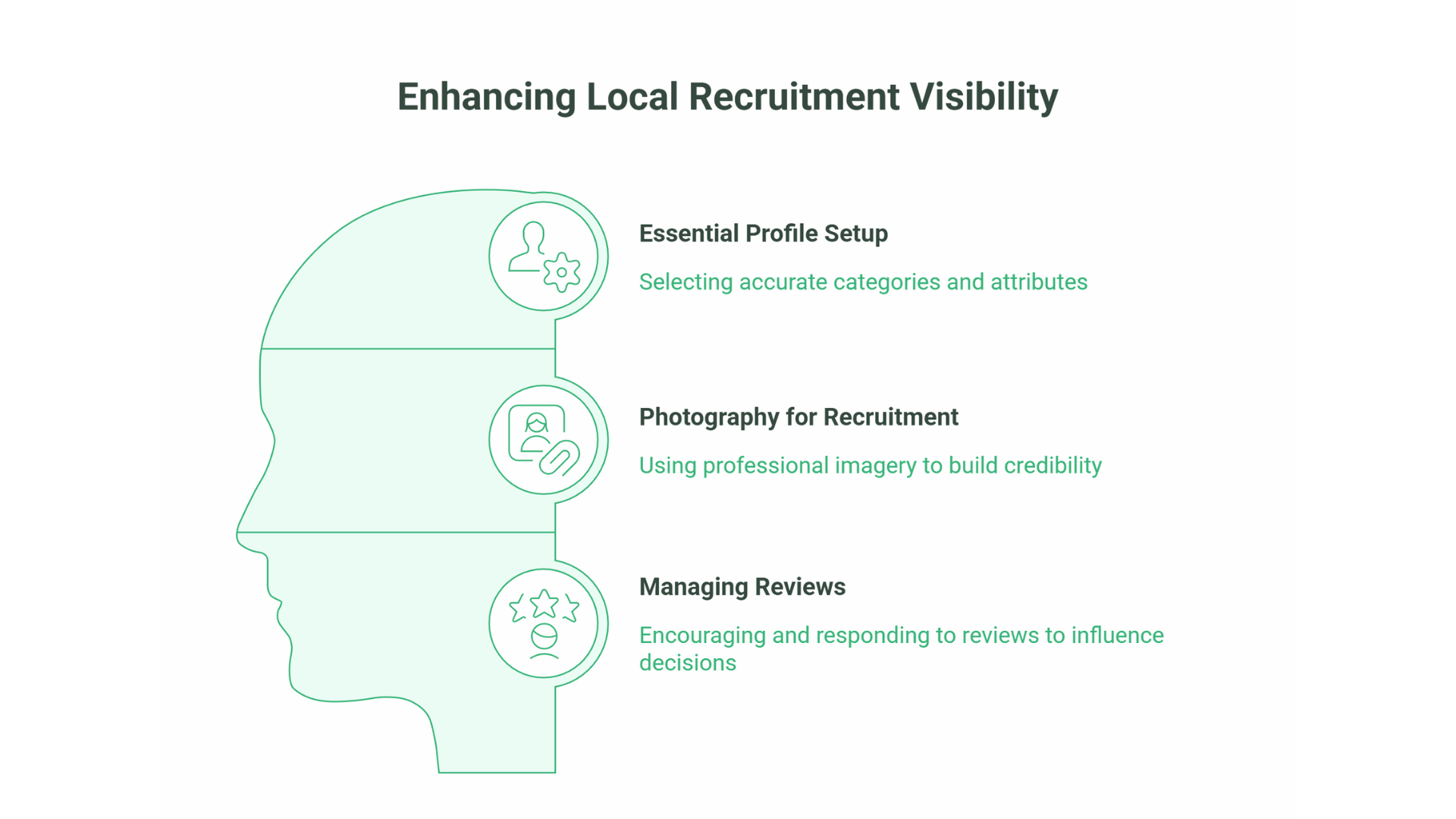
Your Google Business Profile is important for local recruitment visibility, particularly for employer searches.
Essential Profile Setup
Categories: Select accurate categories:
- Employment Agency (primary for most)
- Staffing Agency
- Temp Agency
- Executive Search Firm
- Human Resource Consulting
Choose your primary category based on main focus. Add secondary categories for additional services.
Attributes: Complete relevant attributes:
- Online appointments available
- Appointment scheduling
- In-person consultations
Business description: Communicate:
- Sectors you specialise in
- Types of roles you fill
- Geographic coverage
- Candidate and client services
- Your approach and values
Photography for Recruitment
Professional imagery builds credibility:
- Office environment: Professional, welcoming workspace
- Team photos: Consultants and support staff
- Client interactions: Professional meeting environments
- Branding: Consistent brand presentation
- Events: Career fairs, industry events, team activities
Managing Reviews
Reviews influence both candidate and client decisions:
Encouraging reviews:
- Ask placed candidates after successful starts
- Request reviews from satisfied clients
- Acknowledge that not all placements lead to reviews
- Never offer incentives
What to encourage people to mention:
- Quality of service and communication
- Successful placement outcomes
- Professionalism and expertise
- Understanding of requirements
Responding to reviews:
- Respond to every review professionally
- Thank candidates and clients for feedback
- Address concerns carefully
- Show commitment to service quality
Website Strategy for Recruitment Agencies
Your website serves candidates seeking jobs and employers seeking recruitment support.
Essential Website Elements
Job listings: Current opportunities:
- Searchable job database
- Clear job descriptions
- Easy application process
- Alert signup for new roles
Sectors/specialisms: Your areas of expertise:
- Detailed sector pages
- Understanding of each industry
- Relevant experience and case studies
- Typical roles you fill
For candidates:
- Registration/CV upload
- Career resources and advice
- Market insights
- Why work with your agency
For employers:
- Services offered
- Recruitment process
- Why choose your agency
- Case studies and testimonials
About your agency:
- History and background
- Team introductions
- Values and approach
- Industry memberships
Contact:
- Easy enquiry for both audiences
- Consultant contact details
- Office locations
Job Pages: Candidate SEO Foundation
Individual job listings offer significant SEO opportunity:
Page optimisation:
- Clear, searchable job titles
- Location prominently featured
- Comprehensive job descriptions
- Salary information where possible
- Easy application
Technical considerations:
- Schema markup for job postings
- Fast loading pages
- Mobile-friendly applications
- Proper indexing management
Content quality:
- Unique, detailed descriptions
- Avoid thin, duplicate content
- Include company and role context
- Clear requirements and benefits
Sector Pages: Expertise Demonstration
Create comprehensive pages for each specialism:
- /it-recruitment/: IT and technology recruitment expertise
- /finance-recruitment/: Finance and accounting specialism
- /healthcare-recruitment/: Healthcare sector focus
- /engineering-recruitment/: Engineering recruitment services
Each sector page should include:
- Your expertise in this sector
- Types of roles you fill
- Understanding of sector challenges
- Current opportunities
- Relevant case studies
- Consultant specialisms
Location Pages
Target geographic searches:
- /recruitment-agency-belfast/: Belfast recruitment services
- /jobs-in-derry/: Derry/Londonderry opportunities
- /recruitment-northern-ireland/: Regional coverage
These pages capture location-specific searches from both candidates and employers.
Technical Foundations
Basic technical SEO supports visibility:
- Speed: Fast job search and application experience
- Mobile: Many job searches happen on mobile
- HTTPS: Security for applications and client data
- Schema markup: JobPosting schema for all listings
Our guide at profiletree.com/seo-basics/ covers technical fundamentals.
Candidate-Focused SEO Strategy
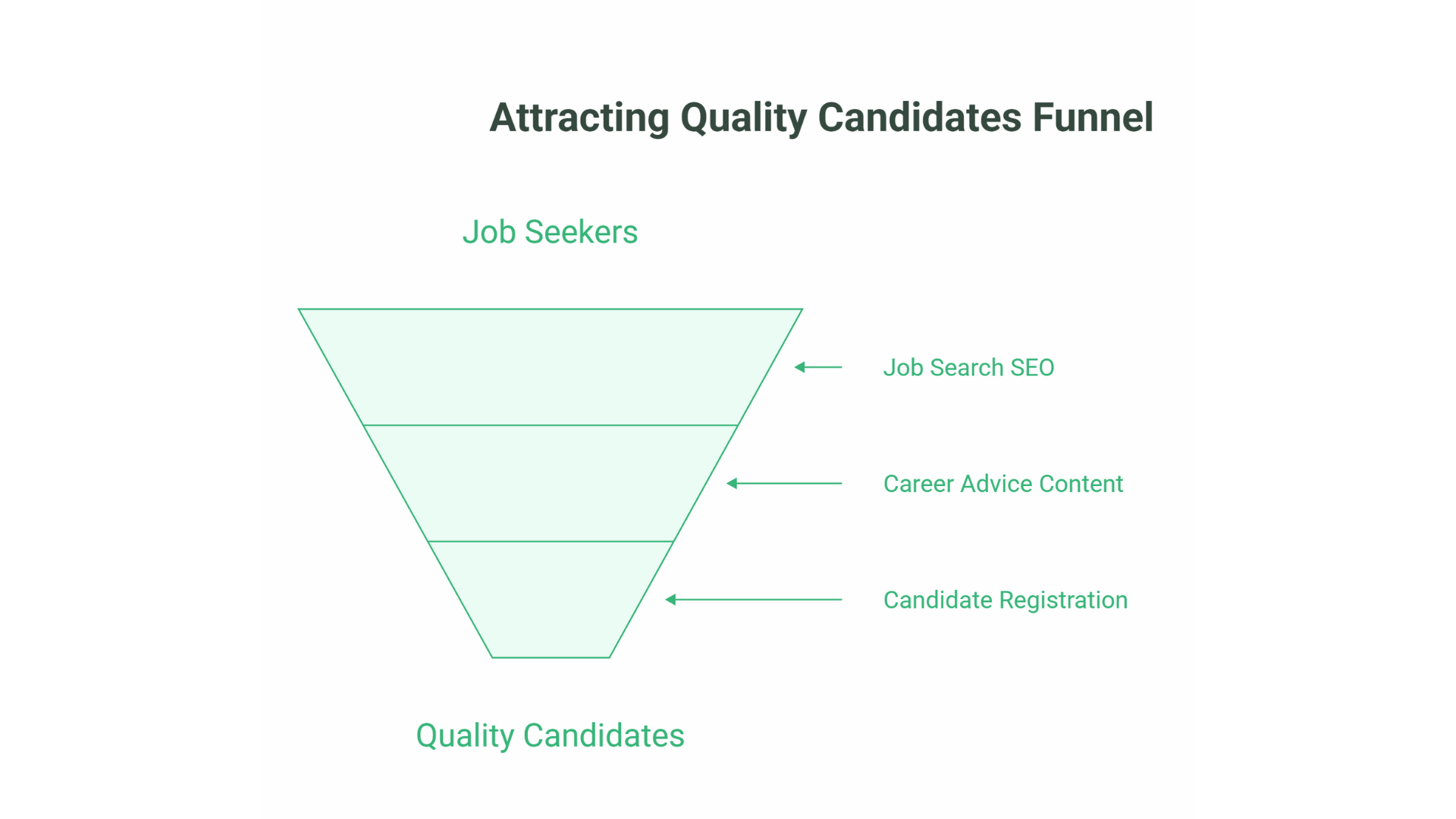
Attracting quality candidates requires specific approaches.
Job Search SEO
Target job seekers searching for opportunities:
Keyword patterns:
- “[Job title] jobs [location]”
- “[Sector] jobs near me”
- “[Company type] vacancies”
- “[Skill] jobs”
Competition reality:
- Major boards dominate broad searches
- Specialist and local searches are winnable
- Long-tail, specific searches offer opportunity
Strategy:
- Focus on your specialist sectors
- Target specific role types you excel in
- Emphasise location for local roles
- Use specific job titles and skills
Career Advice Content
Content that attracts job seekers:
- Job search guides: “How to write a CV,” “Interview preparation tips,” “Job search strategies”
- Career development: “Career progression in [sector],” “Skills for [industry],” “Qualifications guide”
- Market insight: “Salary guide [sector] [year],” “[Industry] job market outlook,” “In-demand skills”
- Practical resources: “CV templates,” “Cover letter examples,” “Interview questions”
This content captures candidates researching their job search and career development.
Candidate Registration
Make registration easy and valuable:
- Simple CV upload process
- Clear benefits of registering
- Job alert functionality
- Profile management
- Privacy and data use clarity
Employer-Focused SEO Strategy
Attracting client business requires different approaches.
Recruitment Service SEO
Target employers searching for staffing support:
Keyword patterns:
- “Recruitment agency [location]”
- “[Sector] recruitment [location]”
- “Staffing agency near me”
- “[Job type] recruiter”
Employer searches:
- Often location-focused
- Sector-specific where specialist need
- Problem-focused (hard to fill, urgent, volume)
- Service-type focused (temp, perm, executive)
Service Pages
Create clear service descriptions:
- /permanent-recruitment/: Permanent placement services
- /temporary-staffing/: Temp and contract solutions
- /executive-search/: Senior-level recruitment
- /volume-recruitment/: High-volume hiring support
- /rpo-services/: Recruitment process outsourcing
Each page should explain:
- Service description
- How it works
- Who it’s suitable for
- Your approach and process
- Client testimonials
- Clear enquiry path
Client-Focused Content
Content that attracts employers:
- Hiring guides: “How to write effective job descriptions,” “Interview best practices,” “Onboarding new employees
- Market intelligence: “Salary benchmarking guide,” [Sector] hiring trends,” “Candidate availability report”
- HR resources: “Employment law updates,” “Recruitment compliance,” “Diversity in hiring”
- Problem-solving content: “Reducing time to hire,” “Improving candidate quality,” “Solving skills shortages”
Local SEO Strategy for Recruitment
Many recruitment agencies serve specific geographic markets.
Local Keyword Targeting
Understand local search patterns:
Candidate searches:
- “Jobs in [location]”
- “[Sector] jobs [location]”
- “Employment agencies near me”
Employer searches:
- “Recruitment agency [location]”
- “[Sector] recruiters [location]”
- “Staffing agency near me”
Your Google Business Profile and location pages should target these patterns.
Building Recruitment Citations
Directory listings reinforce presence:
Recruitment directories:
- REC (Recruitment and Employment Confederation)
- APSCo members
- Industry-specific directories
Business directories:
- Yell.com
- Thomson Local
- Local business directories
Professional directories:
- Chamber of Commerce
- Local business networks
Ensure consistent Name, Address, and Phone across all listings.
Local Link Building
Local links strengthen visibility:
- Partner with local businesses
- Connect with local training providers
- Build relationships with local colleges and universities
- Participate in local business events
- Join local employment initiatives
- Support local career fairs
Sector-Specific SEO Strategy
Sector specialism creates competitive advantage.
IT and Technology Recruitment
Target searches:
- “IT recruitment [location]”
- “Software developer jobs”
- “Tech recruiters”
- Specific technology searches (Java, Python, DevOps)
Content approach:
- Technology trend content
- Salary guides for tech roles
- Skills in demand analysis
- Developer career paths
Finance and Accounting Recruitment
Target searches:
- “Accountancy recruitment [location]”
- “Finance jobs”
- “Qualified accountant vacancies”
- Specific qualification searches (ACA, ACCA, CIMA)
Content approach:
- Qualification guidance
- Finance salary surveys
- Career progression content
- Industry regulation updates
Healthcare Recruitment
Target searches:
- “Healthcare recruitment [location]”
- “Nursing jobs”
- “Medical staffing”
- Specific role searches
Content approach:
- Healthcare career guides
- Sector challenges content
- Compliance and registration
- NHS vs private opportunities
Engineering and Manufacturing
Target searches:
- “Engineering recruitment [location]”
- “Manufacturing jobs”
- “Technical recruitment”
- Specific discipline searches
Content approach:
- Engineering sector trends
- Skills shortage analysis
- Qualification requirements
- Industry developments
Content Strategy for Recruitment Agencies
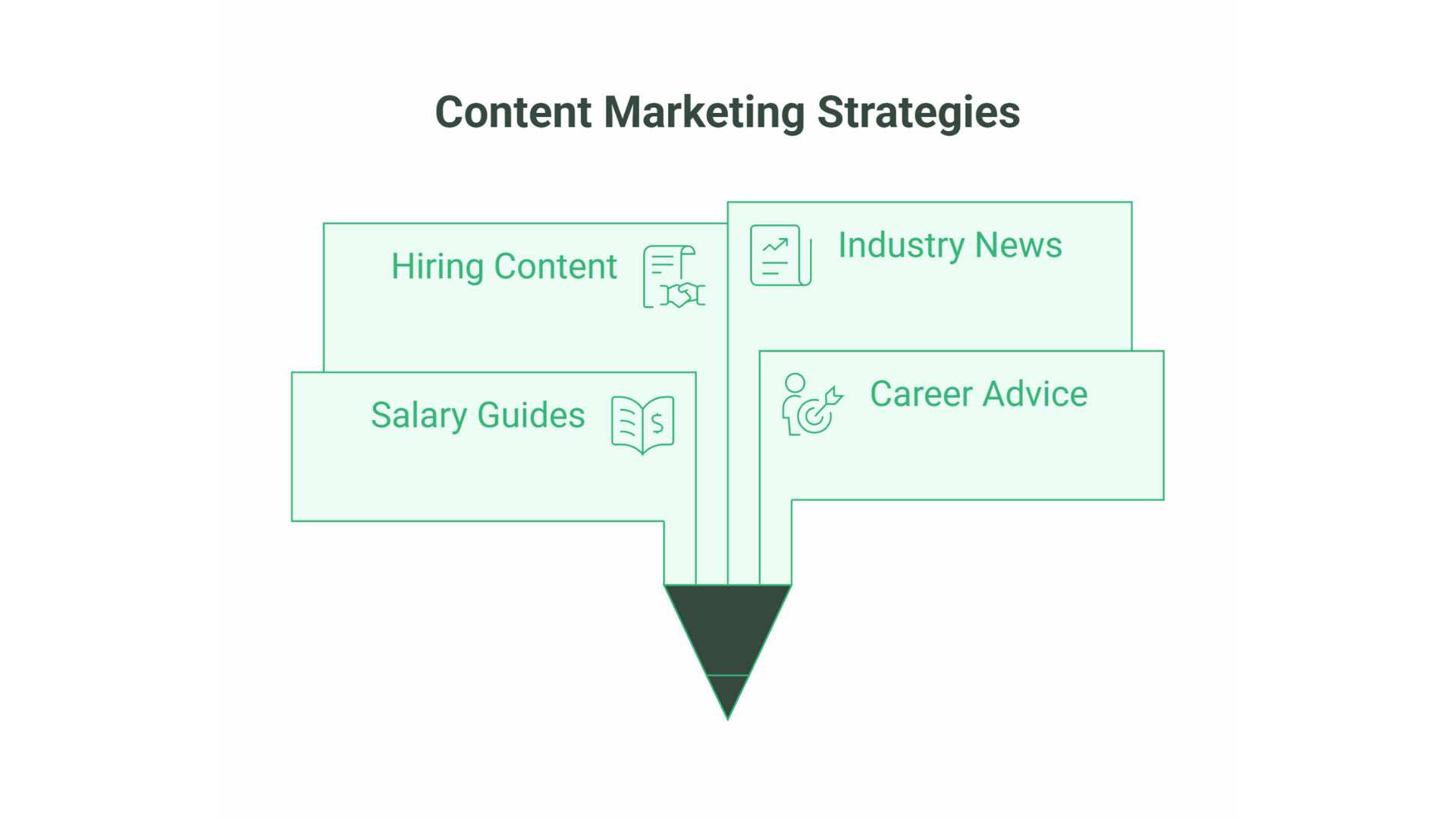
Content marketing builds visibility with both candidates and clients.
Salary Guides and Market Reports
High-value content that attracts both audiences:
- Annual salary guides: Comprehensive salary benchmarking by sector, role, and location
- Market reports: Quarterly or annual hiring trend analysis
- Specific reports: Focused reports on particular sectors or role types
Why it works:
- Highly searchable and shareable
- Demonstrates market expertise
- Attracts media and backlinks
- Valuable to candidates and employers
Career Advice and Job Search Content
Content for candidates:
- CV and application content: Writing tips, templates, examples
- Interview content: Preparation guides, common questions, techniques
- Career development: Progression paths, skill development, qualification guidance
- Job search strategy: Search techniques, networking, using recruiters effectively
Hiring and HR Content
Content for employers:
- Recruitment guides: Best practices, process improvement, legal compliance
- Market intelligence: Availability, salary expectations, competitor analysis
- HR resources: Employment law, onboarding, retention strategies
- Problem-solving: Addressing specific hiring challenges
Industry News and Insight
Demonstrate sector expertise:
- Industry updates: News and developments in your specialist sectors
- Trend analysis: What’s changing and what it means
- Expert commentary: Your perspective on industry issues
- Event coverage: Industry events and conferences
Measuring Recruitment SEO Success
Track metrics for both candidate and client acquisition.
Candidate Metrics
Visibility:
- Job page traffic
- Organic search visibility for job searches
- Career content engagement
Engagement:
- Job applications from search
- CV registrations from search
- Job alert signups
- Career content engagement
Outcomes:
- Quality of applications from search
- Placements from search-acquired candidates
- Candidate satisfaction
Client Metrics
Visibility:
- Employer-focused page traffic
- Organic search visibility for recruitment searches
- Service page engagement
Engagement:
- Client enquiries from search
- Contact form submissions
- Proposal requests
Outcomes:
- New clients from search
- Revenue from search-acquired clients
- Client retention
Content Performance
Track content contribution:
- Most visited content
- Content driving registrations
- Content driving client enquiries
- Salary guide downloads
- Report engagement
Common Mistakes Recruitment Agencies Make
Avoid these frequent errors:
- Thin job descriptions: Minimal content copied across many listings. Unique, detailed descriptions perform better.
- Ignoring employer SEO: Focusing only on candidates while neglecting client acquisition.
- No sector focus: Trying to compete broadly instead of owning specific niches.
- Poor candidate experience: Difficult application processes, slow websites, no mobile optimisation.
- Incomplete Google Business Profile: Missing information, few photos, unmanaged reviews.
- No market content: Missing opportunity to demonstrate expertise through salary guides and reports.
- Outdated jobs: Old listings remaining visible, damaging credibility.
- Generic content: Content that could describe any agency without showing specific expertise.
- Ignoring reviews: Not requesting reviews or responding to feedback.
- Technical issues: Slow job search, poor mobile experience, indexing problems.
Getting Started with Recruitment SEO
If you’re beginning SEO or reviewing existing efforts:
Immediate priorities:
- Claim and complete Google Business Profile
- Ensure job pages are optimised
- Display sector specialisms clearly
- Make registration easy
First month:
- Respond to all existing reviews
- Create or improve sector pages
- Verify consistent information across directories
- Implement review request process
First three months:
- Build citations in recruitment directories
- Create market insight content (salary guide, market report)
- Add career advice content
- Improve technical foundations
Ongoing:
- Regular market content updates
- Fresh job content
- Reviews from placed candidates and clients
- Monitor and improve based on results
FAQs
How do we compete with major job boards like Indeed?
You can’t compete for broad job searches, but you can win in your specialist sectors, local markets, and for people specifically seeking agency services. Focus on expertise demonstration and niche ownership.
Should we focus on candidate or client SEO?
Both matter. Without candidates, you can’t serve clients. Without clients, you have no jobs to fill. Balance your efforts, but recognise that candidate attraction often requires more content volume.
How important are salary guides for recruitment SEO?
Very important. Salary guides attract both candidates and employers, demonstrate market expertise, earn backlinks, and capture valuable searches. They’re worth the investment to create well.
What content works best for candidate attraction?
Career advice and job search guidance capture candidates throughout their search. Salary information helps with negotiation. Market insight demonstrates expertise. Job listings drive applications.
How do we handle expired job listings?
Remove or update promptly. Expired listings waste candidate time and damage trust. Consider redirecting to similar current roles or related content rather than showing 404 errors.
Should we create content for every sector we recruit for?
Prioritise your strongest sectors where you have genuine expertise. Generic content about sectors you barely work in won’t perform and may dilute your positioning. Depth beats breadth.
How important are reviews for recruitment agencies?
Important for both audiences. Candidates want to know they’ll be treated professionally. Employers want evidence of successful placements. Request reviews from both placed candidates and satisfied clients.
Can specialist agencies compete with generalist recruiters?
Yes, often more effectively. Sector expertise creates competitive advantage. Specialists can own their niche searches even without the resources of large generalist agencies.
How do we measure candidate quality from SEO?
Track application-to-interview and interview-to-placement ratios by source. Compare search-acquired candidates against other channels. Monitor client satisfaction with candidates from search.
Should we invest in video content?
Video can work well for recruitment, market updates, career advice, consultant introductions, office culture. Video builds personality and trust with both candidates and clients.
Building Long-Term Recruitment Success
Recruitment SEO rewards sector expertise and dual-audience focus. The fundamentals are clear: complete Google Business Profile, comprehensive sector pages, quality job listings, market insight content, and genuine reviews.
Agencies executing these basics attract candidates and clients from competitors who don’t. The opportunity isn’t competing with Indeed, it’s owning your specialist sectors and local markets.
The agencies building strong pipelines aren’t necessarily the largest. They’re the ones visible when the right candidates and clients search, credible when both audiences research, and easy to engage when people are ready to act. Make sure your agency is one of them.
If you’re ready to improve your recruitment agency’s search visibility and attract more candidates and clients, ProfileTree’s team works with professional service businesses across Northern Ireland, Ireland, and the UK. We understand both the technical requirements of effective SEO and the dual-audience challenges of recruitment marketing. Get in touch to discuss how we can help your agency grow through search.