
Choosing Between an SEO Consultant and an SEO Agency
Table of Contents
Choose an SEO consultant if your business already has people who can write content and make changes to the website, and what you lack is senior direction. Choose an SEO agency if nobody in-house has the time or the skills to carry out the work. The deciding question is who will implement the recommendations once the strategy exists.
ProfileTree is a Belfast web design and digital marketing agency, founded in 2011 and based at the McSweeney Centre. We work in both ways: as a strategy-only adviser for teams that build in-house, and as a full delivery team through our SEO Belfast service, which is also where local businesses can request our free audit. This guide sets out how the two models differ, where each one tends to go wrong, and how to test any provider before you sign a contract.
SEO Consultant or Agency: The Practical Difference Is Who Does the Work
An SEO consultant diagnoses problems and sets direction, and your own team or your own freelancers carry out the changes. A typical engagement covers a technical and content audit, a prioritised plan, keyword targeting, briefs for writers, specifications for developers and a regular review of whether the work is landing. An SEO agency provides the same strategy and then does the work as well, with writers, developers and outreach staff producing the content, fixing the site and reporting on the results.
The labels overlap more than most buyers expect. Plenty of agencies sell consulting, and plenty of consultants bring in freelancers when a client needs delivery. The title on the proposal therefore matters less than three plain facts in the contract: what you will receive each month, who will produce it, and who is answerable when the numbers do not move.
How the Two Models Compare
One difference rarely appears in comparison articles, and it is the one we see cause the most friction. With a consultant, accountability is split. If rankings stall, it can be hard to tell whether the advice was wrong or the implementation never happened, and both sides can blame the other with some justification. With an SEO agency, one party owns both the plan and the delivery. The cost is some visibility over who is actually doing your work, and on a larger account that may be a junior member of staff rather than the senior person who pitched.
| Factor | SEO consultant | SEO agency | Recommendation |
| Who implements the work | Your team or your freelancers | The agency’s own staff | Consultant if you have a writer and a developer; agency if you have neither |
| Seniority on your account | Usually the senior person you hired | Varies; ask who works on the account day to day | Agency only if the named team is in the contract |
| Capacity for content and development | Limited to what your team can produce | Scales with the retainer | Agency where you need several pages a month |
| How fees are structured | Day rate, fixed-fee audit or advisory retainer | Monthly retainer across disciplines, plus project fees | Compare total cost, including your own staff time |
| Accountability for results | Shared between adviser and implementer | Sits with one provider | Agency if you want one party answerable |
| Speed of starting | Quick, often within a week or two | Slower, with onboarding across a team | Consultant for an urgent diagnosis or second opinion |
Headline Fees Are Not Comparable
Cost deserves a closer look because the headline fees are not comparable. A consultant’s invoice will almost always be smaller than an SEO agency retainer, but it buys advice only. A fair comparison adds up three costs on the consultant side: the consultant’s fee, the hours your own staff spend implementing, and any freelance writing or development. That total is what you set against the agency’s retainer.
For a business with a capable marketing manager and a developer already on the payroll, the consultant route usually wins on cost. For a business where the owner would end up writing the content in the evenings, it rarely does. If you are comparing proposals from local providers, our guide to choosing an agency in Belfast explains what a fair proposal should include, including the costs and contract terms to check.
A Consultant Suits Teams That Can Already Deliver
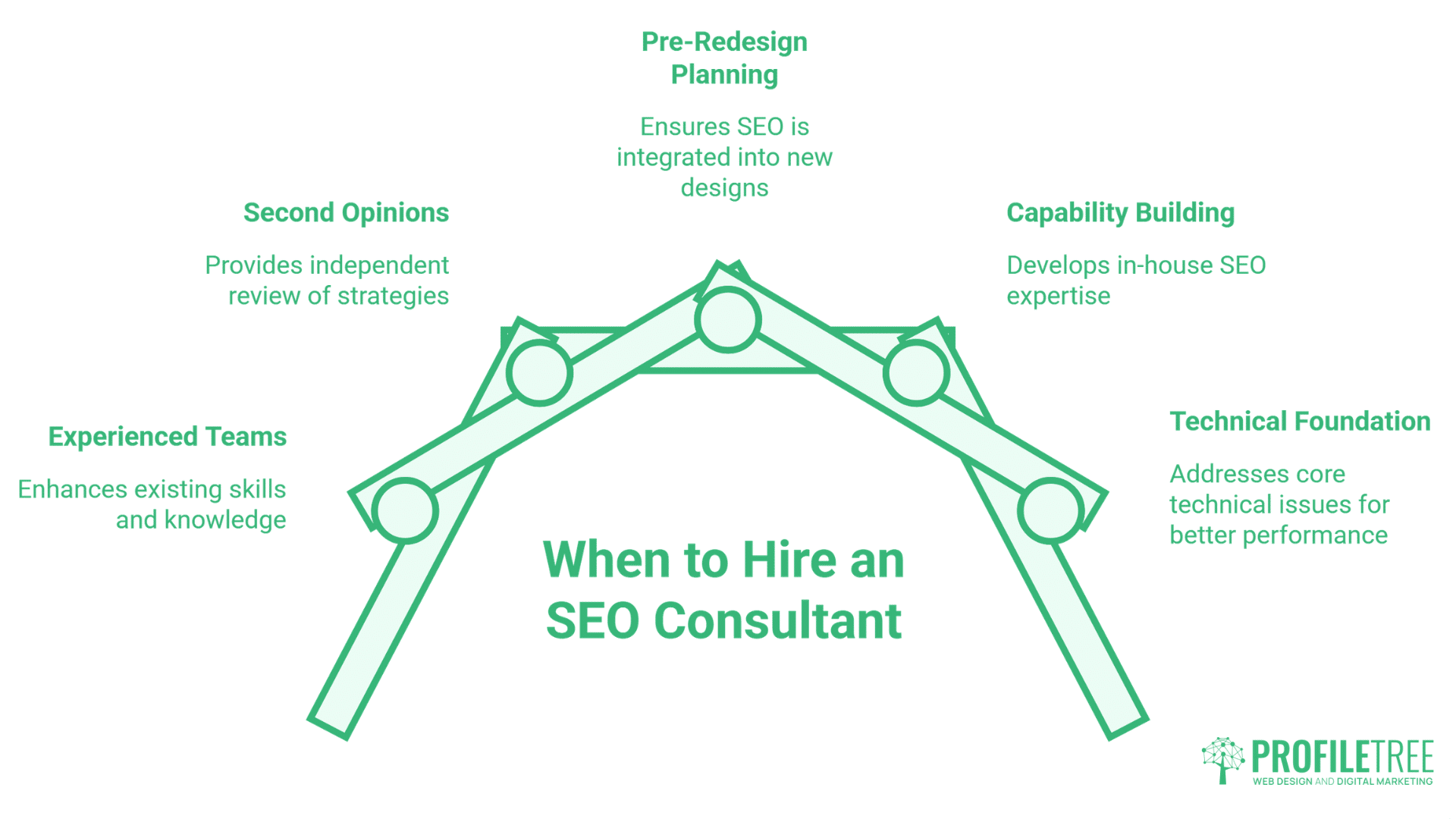
An SEO consultant is the stronger choice when the people who will carry out the work already exist and what is missing is experience. That is common in businesses with an in-house marketing manager who understands the basics but has never run a site migration. The same applies if nobody on the team has had to untangle two pages competing for the same search term, or work out why Google has crawled a page and declined to index it.
Second opinions are another good use of a consultant. You may be about to sign a 12-month SEO agency contract, or you may have been with an agency for a year without seeing what has changed. In either case, a short independent audit tells you whether the plan is sound before you commit more budget. The audit should give you realistic estimates of improvement and of the work involved, which is also what Google’s own guidance on hiring an SEO tells site owners to expect.
Bring a Consultant in Before a Redesign
Timing matters as much as the model. Google’s guidance recommends bringing in SEO help when you are planning a redesign or a new site, and the earlier the better. URL changes and structural decisions made without search input can lose years of ranking history in a single launch. A consultant who reviews the sitemap and the redirect plan before the build starts is one of the cheapest forms of insurance a website project can buy.
Consultants also suit businesses that want the skills to stay in-house. Some engagements are mostly coaching. The consultant holds a monthly session to review what the team has done and set the next priorities, so the business needs less outside help each quarter. ProfileTree also runs this kind of capability building as structured training for business teams.
Ciaran Connolly, Founder of ProfileTree, sets out the priority for any consultant engagement plainly: “The businesses that get the most from an SEO consultant are the ones willing to fix the boring technical problems first, before they worry about content or links. A fast, crawlable, well-structured site is what everything else gets built on, and skipping that step is where most SEO budgets get wasted.”
An SEO Agency Suits Businesses Without the People to Implement
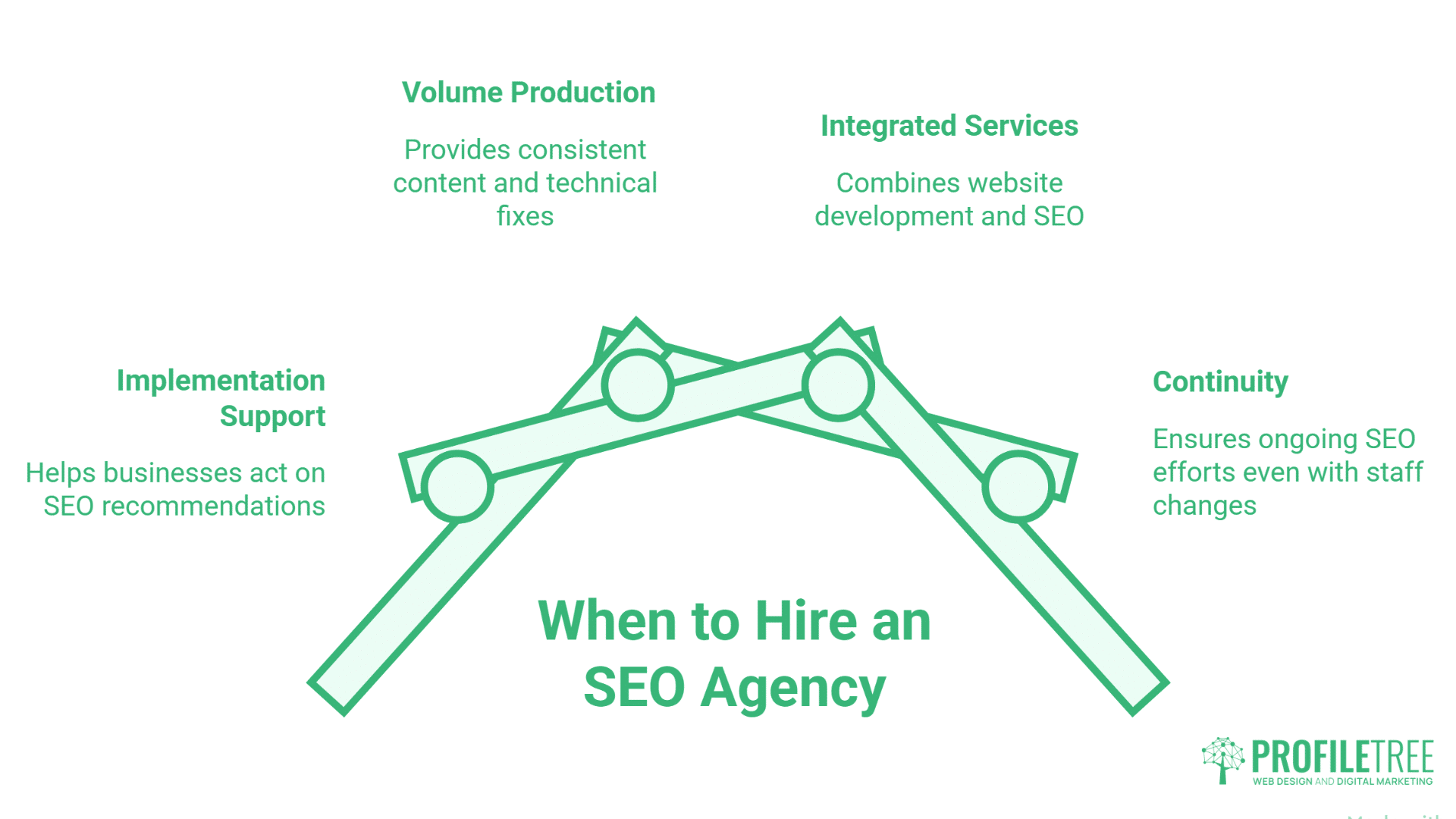
An agency makes more sense when the recommendations would otherwise lie in a document that nobody has time to act on. We have seen businesses pay for an excellent audit, agree with every line of it and then implement almost none of it. The only person who could have done the work was already running sales and day-to-day operations. If that sounds familiar, the advice was never the bottleneck, and paying for more of it will not change the outcome.
Volume is the next test. Ranking for competitive commercial terms usually needs a steady supply of new and improved pages, technical fixes that a developer has to schedule, and links earned from other websites over months rather than weeks. One consultant cannot produce that volume alone, and an internal team that is already stretched rarely can either. Where the gap is mainly written content, a specialist SEO copywriting service can supply the pages while your own team or a consultant handles the technical side.
An agency also suits projects where the website and the search work cannot be separated. If you are rebuilding a WordPress site, using one provider for both the build and the SEO means the page structure, the internal links and the redirect map are planned together. They do not have to be reconciled after launch. The same applies to businesses serving several towns or regions, where each location page needs its own local content and the ongoing work described in our local SEO guide for Northern Ireland businesses continues every month.
Continuity is the last consideration, and it is easy to overlook. A sole consultant who falls ill, takes on a large new client or changes career leaves you starting again, whereas an SEO agency has other people who already know your account.
Many Businesses Combine The Two Models
The choice between an SEO consultant or agency is less binary than the comparison suggests, and some of the most effective arrangements we see use both. A business with a strong in-house content team might keep a consultant for strategy and quarterly reviews while its own writers produce the pages. Another might use an agency for day-to-day SEO and bring in a specialist consultant for a single technical problem. That problem might be migrating from one platform to another or recovering from a manual action.
The reverse path is common too. A business may start with an SEO agency because it has no internal capacity, hire a marketing manager after a year or two, and then move to a lighter advisory arrangement once that person is trained. If you think that is where you are heading, say so at the start. A good provider will plan the handover from the first month and will not resist it.
AI Search Has Raised the Bar for Both Models
Whichever model you choose, the provider now needs to understand how AI systems find and cite businesses. Google’s AI Overviews, Copilot in Bing, ChatGPT and Perplexity now answer many questions directly, often before anyone clicks a result. Google’s documentation on AI features in Search states that no special optimisation is required for these features and that the same SEO fundamentals apply. In practice, that means a page that meets Google’s technical requirements, follows its search policies and offers helpful, reliable content written for people.
The practical test is simple to apply in an interview. Ask the SEO consultant or agency how they check whether your business is mentioned in AI answers for the questions your customers ask, and what they change when it is not. A provider who can show you that process is working with search as it is now. Our AI SEO service explains how we include this in ordinary SEO delivery instead of selling it as a separate product.
What the First Six Months Should Look Like
The first six months follow a similar pattern under either model, so you can use this sequence to judge whether an engagement is on track. The difference is who carries out each stage: under an SEO consultant, your team does the fixing and writing; under an SEO agency, the agency does.
| Timeframe | Typical focus | What you should see |
| Month 1 | Technical, content and backlink audit, plus a review of the search results you compete in | A written, prioritised plan with owners for each task |
| Month 2 | The highest-impact technical fixes with the least effort | Indexing and crawl problems closing in Search Console |
| Months 3 to 4 | New and rewritten pages for the gaps found in month one, with internal links to the right pages | Pages published, not just briefed |
| Months 5 to 6 | Refinement based on what is performing, and link building where authority is the barrier | Early movement on lower-competition terms and a monthly report tied to enquiries |
If six months pass with no technical progress, no content published, and no report that connects the work to enquiries, raise it directly. Under a consultant, check first whether the recommendations were actually implemented; under an agency, ask to see the work log.
SEO Consultant or Agency: Questions That Test Any Provider Before You Sign
A short interview filters out most of the risk, and the same questions work for an SEO consultant or agency. Google’s guidance adds some warnings worth taking seriously. Be wary of SEO providers who contact you out of the blue, and never agree to link to a provider as a condition of their service. Understand exactly what they plan to do because the site owner remains responsible for the actions of anyone they hire.
- Ask who will work on your account each week, by name, and whether that is written into the contract.
- Ask how they measure success, and expect an answer that includes enquiries or sales from organic search as well as rankings.
- Ask what happens if results have not arrived within the timeframe they quote, and how the contract can be ended.
- Ask whether your Google Search Console, Google Analytics and content stay in accounts you own, so nothing is lost if you part company.
- Treat any guarantee of a specific ranking position as a reason to walk away, because no provider controls how Google ranks pages.
It is also fair to search for the provider’s own core service in the place they operate and see where they appear. A provider who asks about your business goals, your customers and your existing team before proposing anything is usually a better sign than one who opens with a fixed package.
Talk to ProfileTree About Which Model Fits Your Business
If you are still unsure which route suits you, we can review your site and your team’s capacity and tell you honestly whether you need advice, delivery or a mix of both. You can read more about our Belfast office and team at the McSweeney Centre, or call 028 9568 0364 or email agency@profiletree.com to arrange a conversation.
FAQs: SEO Agency or Consultant
Is an SEO consultant cheaper than an SEO agency?
An SEO consultant’s fee is usually lower than an agency retainer, but it only covers advice. Once you add the time your staff, freelancers or developers spend carrying out the plan, the gap often narrows. An SEO consultant tends to be cheaper for a business that already has a capable marketer and a developer, and an agency tends to be better value where nobody in-house can implement the work. Compare the total cost of getting the work done, not the headline fee.
Can an SEO consultant or agency guarantee first-page rankings?
No legitimate consultant or agency can guarantee a specific position in Google. Rankings depend on a very large number of signals, competitors are improving their own sites, and core updates can shift results without warning. A guarantee usually means overselling or risky tactics. Ask instead what the provider will report on each month, such as pages indexed, positions for agreed terms and enquiries from organic search, and when the first formal review will take place.
How long does SEO take to show results?
In our experience, technical fixes can show movement within one to three months, new content usually takes three to six months to rank, and competitive commercial terms can take six to twelve months or longer. The pace depends on your market, the state of your site and how consistently the work is done. With a consultant, progress also depends on how quickly your team acts on the recommendations.
Should I start with a one-off audit before choosing?
An audit is a sensible first step if you are unsure why the site is underperforming or which model you need. It gives you a baseline and a realistic view of how much work is involved, which shows whether your team could handle it. A useful audit ranks each recommendation by commercial impact and effort and names who should carry it out. If most of the list needs skills you do not have in-house, an agency is likely to suit you better.
What should I own when the engagement ends?
You should own everything: your Search Console and Google Analytics accounts, your Business Profile, your domain, your website and its content, and any reports you have paid for. Providers should be added as users on your accounts and should not set them up in their own name. Put this in the contract before work starts, so that changing provider never costs you years of search data.
Can I move from an SEO agency to a consultant later?
Yes, and it is a common step for growing businesses. Once an in-house marketer can carry out routine work, a lighter advisory arrangement can reduce cost while keeping senior oversight. Ask the agency to document the strategy, the technical history of the site and the content plan, and agree on a transition period, so your team takes over tasks gradually rather than all at once.
About the author: Ciaran Connolly founded ProfileTree in 2011 and is the agency’s director. ProfileTree is a Belfast web design and digital marketing agency, founded in 2011 and based at the McSweeney Centre, and has completed more than 1,000 projects for businesses across Northern Ireland, Ireland and the UK.