
Search Psychology and User Intent: An SME Guide
Table of Contents
Search psychology is the study of the cognitive and emotional processes that drive a person to type a query into a search engine. For SMEs trying to rank and convert, it is one of the most underused lenses in digital strategy. Most SEO work focuses on keywords and technical signals. Search psychology asks the question that those tools cannot answer: why did the person search for this, and what do they expect to find?
That question matters more now than it did three years ago. Google’s ranking systems model intent and semantic relevance rather than matching keywords to page content. At the same time, AI-powered search tools such as Google’s AI Overviews and Bing Copilot are changing how people interact with results altogether. The psychology of search is shifting with them, and so is the psychology of search intent itself.
This guide covers the science behind search behaviour, the four types of user intent, the emotional triggers that shape clicks, how AI-driven search has changed searcher psychology, the regional nuances of searching in the UK and Ireland, and what all of this means in practice for a business trying to build an effective digital presence.
What Is Search Psychology?
Search psychology examines the mental journey a person takes from recognising a need to either finding what they were looking for or giving up. It draws on cognitive science, behavioural psychology and UX research to explain why people click on some results and ignore others, why they reformulate a query, and why they trust one source over another.
The relevance for SEO is direct. A page that contains the right keywords but misreads the intent behind a query will struggle to rank and will struggle even more to convert visitors once they arrive. Understanding user intent lets a business design content, page structure and calls to action around what a person actually needs at that moment, not just around the phrase they typed.
A Belfast accountancy firm might have a service page for self-assessment tax returns, well optimised for a transactional keyword. But many potential clients are still at the research stage: they are searching “do I need an accountant for self-assessment” or “what does a tax return service include”. If those informational queries go unanswered on the site, that audience never arrives, and the transactional page never gets the chance to convert them.
The Science: Information Foraging and Information Scent
One of the most useful models for understanding this behaviour is Information Foraging Theory, developed by Peter Pirolli and Stuart Card at Xerox PARC in the 1990s. The theory proposes that people search for information using the same cost-benefit logic that animals use when foraging for food. Users follow what the theory calls “information scent”: cues that suggest a page will satisfy their need. They abandon quickly when those cues are weak or misleading.
A weak page title, a vague meta description or an opening paragraph that buries the point can all destroy information scent before a visitor has scrolled past the first screen. Google’s own documentation on AI features in Search makes a related point: clear, well-structured content that answers a question directly is what both traditional ranking systems and AI summarisation tools are built to reward. Search engines and their users are, in that sense, looking for the same signal: a fast, reliable indication that the content ahead is worth the time.
For SMEs, the practical takeaway is that the meta title and opening line do most of the psychological work. A page with strong content but a generic title still loses the click, because the scent was never there to follow. Reviewing this is a routine part of the technical checks ProfileTree runs during an SEO audit: comparing what a page promises in its title and snippet against what it actually delivers once the visitor lands.
Related psychological principles show up across marketing more broadly, not just in search. ProfileTree’s guide to psychological principles in marketing covers several of the same cognitive shortcuts from a broader content and advertising angle.
The Four Types of Search Intent
Search intent, sometimes called user intent or user intention, is the classification layer sitting beneath every query. Understanding user intent is the starting point for any content or SEO strategy that aims to do more than generate page views. Most SEO resources describe three types of intent. The framework used in Google’s Quality Rater Guidelines and most current practitioner literature recognises four.
| Intent Type | What the User Wants | Example Query | Content Type That Matches |
|---|---|---|---|
| Informational | To learn something | “what is search intent” | Guide, explainer, FAQ |
| Navigational | To find a specific site or page | “ProfileTree Belfast” | Brand page, homepage |
| Transactional | To complete an action or purchase | “book an SEO audit Belfast” | Service page, landing page |
| Commercial Investigation | To research before deciding | “how to choose an SEO agency Northern Ireland” | Comparison, decision-support content |
The common mistake on SME websites is treating every page as transactional. Service pages that read like brochures, filled with features and calls to action, rarely satisfy informational or commercial investigation intent. The result is a page that ranks poorly, attracts little organic traffic and converts even less of what it does attract. Matching content format to intent, rather than defaulting to a sales pitch everywhere, is one of the simplest fixes available to a small marketing team without extra budget.
The Emotional Layer: FOMO, Urgency and Social Proof
Search behaviour is not purely logical. Emotional triggers sit alongside cognitive ones, and they show up clearly in click behaviour. Fear of missing out pushes people towards results that signal scarcity or time pressure. Analysis paralysis, the sense of being overwhelmed by too many similar-looking options, pushes people towards results that reduce choice rather than expand it: a clear recommendation, a simple comparison, a “how to choose” framework.
Social proof works alongside these triggers. Review counts and star ratings in a rich snippet, a recognisable domain and consistent, specific claims all reduce the emotional friction of choosing an unfamiliar business over a familiar one. This is where transparency does more work than persuasion. ProfileTree’s piece on transparency in content marketing looks at why specific, verifiable claims tend to outperform vaguer promotional language, a pattern that holds just as true in search snippets as it does in the body of a page.
For an SME, this means a review count, a project total or a years-in-business figure earns more trust in a title tag or meta description than a superlative ever will. It also means that social proof needs to be genuine and up to date. A five-star badge with no visible review count reads as a claim rather than evidence, and sceptical searchers, particularly in the UK, tend to notice the difference. Businesses building out their social proof strategy across search and social channels get more consistent results when the same specific, evidence-led claims appear in both places.
Cognitive Biases That Shape Clicks and Conversions
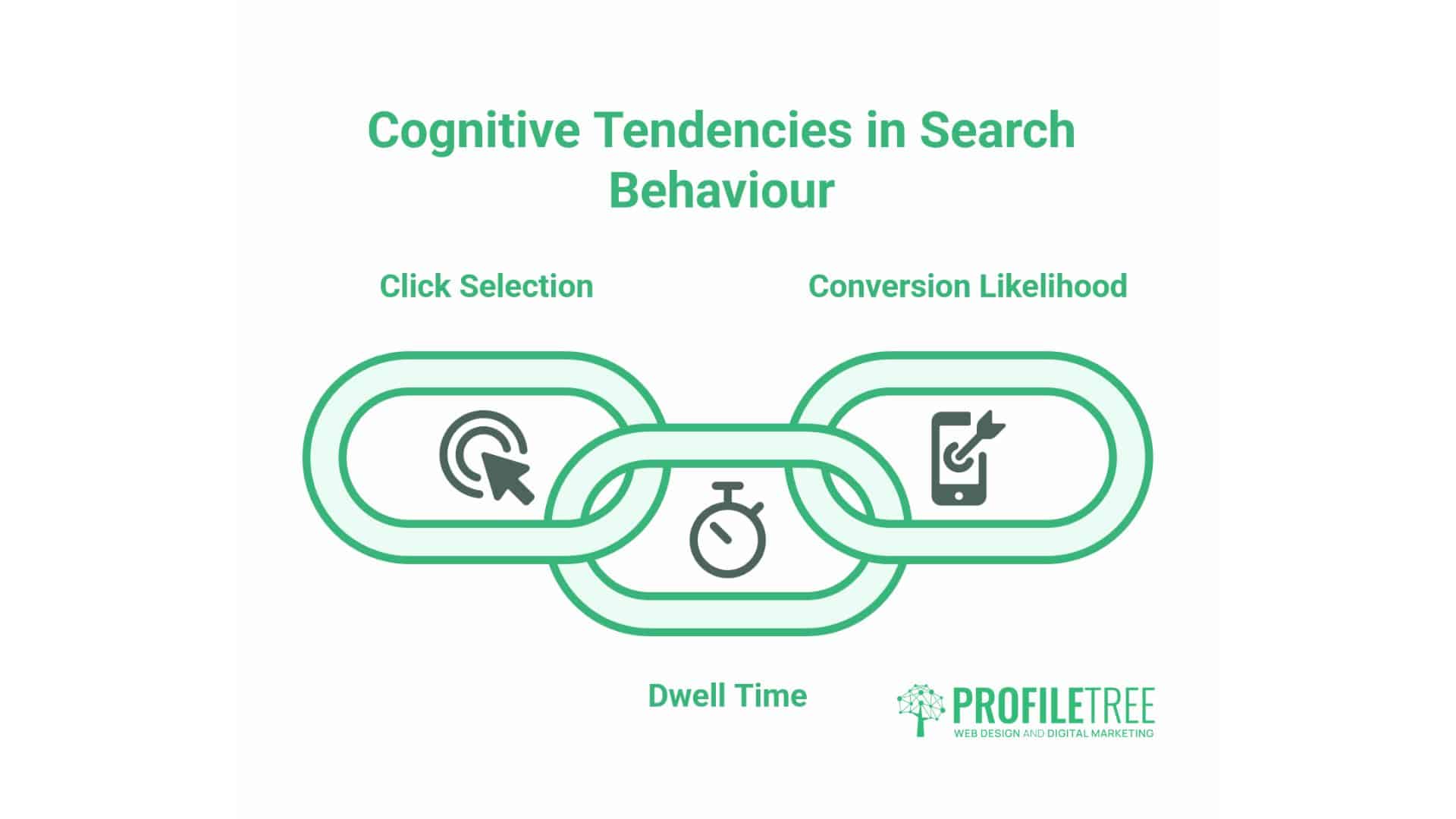
Beyond intent and emotion, search behaviour is governed by well-documented cognitive tendencies that affect which result a user clicks, how long they stay, and whether they convert.
Anchoring and the featured snippet effect. Anchoring bias describes the tendency to give disproportionate weight to the first piece of information encountered. In a search context, the Featured Snippet or AI Overview at the top of the page functions as an anchor. A confident, clearly structured answer in that position is more likely to be accepted as authoritative, even when a lower-ranked result would better serve the user. For content strategy, this means structured, direct answers at the start of each major section are not just good writing practice; they are the mechanism by which content gets extracted into AI Overviews and Featured Snippets in the first place.
The framing effect and meta titles. The framing effect describes how presenting the same facts differently changes a person’s response. “Tax Returns for Sole Traders in Belfast” and “Belfast Tax Returns From £150, No Hidden Fees” describe the same service, but the second removes a source of uncertainty, price, and so reduces the cognitive friction of clicking through during the research stage.
Cognitive load and the path of least resistance. People have a limited capacity to process information and consistently choose the path that demands the least mental effort. Pages with clear heading hierarchies, short opening paragraphs that state the key point immediately and a logical section flow reduce that load and support a better search user experience overall. Pages that bury conclusions or run long, unbroken paragraphs increase it, and high cognitive load correlates with higher bounce rates, which in turn feeds back into ranking signals. ProfileTree’s look at the psychology of user interaction goes into more depth on how these micro-decisions play out once a visitor is on the page, rather than still on the results screen.
These structural decisions are far easier to get right at the design stage than to retrofit into an existing site. A rebuild through web design and development is often the point at which an SME can bake information scent, clear hierarchy and low cognitive load into the site’s foundations, rather than patching them onto templates that were never built with intent.
How AI Overviews and Conversational Search Have Changed the Psychology of Search
The emergence of AI-powered search has introduced a genuinely new psychological shift, and it is the area where most existing search psychology content is furthest behind.
The Authority Bias in AI Overviews. When Google’s AI Overview or Bing Copilot synthesises an answer from several sources and presents it above the results, users tend to apply a form of authority bias: they accept the summary as reliable because it carries the implicit endorsement of the search engine itself. The source links beneath the generated text receive less scrutiny than traditional organic results. For content creators, this shifts the target. Ranking in the top three is no longer the whole goal; being cited within the AI-generated answer is. Pages that get cited tend to have self-contained sections that answer a specific sub-question clearly, without filler.
Zero-click psychology. A growing share of searches end without a click at all. The user gets enough from the snippet or AI Overview to satisfy the immediate need and never visits a page. This is psychologically distinct from a failed search: the person feels satisfied, the click simply never happened. For informational content, this is a real constraint. A query fully answerable in three sentences, such as “what is search intent”, carries low traffic value, however well it’s targeted. A query that needs depth or local specificity, such as how a Northern Ireland solicitor’s firm should structure content for commercial investigation searches, is much harder to satisfy in a snippet, which is exactly where SME-specific content holds a competitive advantage over generic guides.
The prompting mindset and conversational search. People who use tools like ChatGPT or Perplexity regularly develop a different search psychology from those who rely purely on keyword search. They expect a dialogue rather than a list of links, ask fuller questions, and refine queries through follow-up prompts, habits that carry over when they switch back to a traditional search engine. Voice search shows a related pattern: typed queries tend to be short and keyword-focused (“SEO agency Belfast”), while spoken queries tend to be full questions (“which digital marketing agency in Belfast works with small businesses?”). The intent is often identical; only the syntax changes. Content that mirrors a question-and-answer structure, and anticipates the obvious follow-up question, is better positioned for both voice retrieval and AI citation than dense, keyword-matched prose.
This is also where AI implementation work has a direct line back to search psychology rather than being a separate technical project. Understanding how AI is changing user behaviour and running a proper cost-benefit analysis of AI implementation both start from the same question: how are the people a business wants to reach actually behaving now, not five years ago? ProfileTree’s digital training work with SMEs increasingly includes this shift in the conversation, because the change is psychological before it’s technical.
Search Psychology in the UK, Ireland and Northern Ireland
Search behaviour is not culturally neutral. UK and Irish users bring specific expectations and trust frameworks to a search that differ meaningfully from the US-centric patterns that dominate most published research on the topic.
Language as a trust signal. British English spelling in page content and metadata, optimise rather than optimise, behaviour rather than behaviour, colour rather than colour, is processed subconsciously by UK users as a local credibility signal. It signals the content was written for them, not adapted for them, which matters because most AI writing tools default to American English unless corrected.
Scepticism towards promotional copy. UK consumers show measurably higher resistance to superlative claims than US audiences. “Northern Ireland’s leading digital agency” tends to reduce trust rather than build it. A specific, factual claim, such as that a VAT-registered agency based in Belfast has served SMEs across Northern Ireland since 2011, carries more weight because it’s verifiable rather than asserted.
Cross-border nuance. For a business serving both Northern Ireland and the Republic of Ireland, there’s a genuine consideration in search psychology around geographic identity. Users in the Republic sometimes filter by currency, £ versus €, by regulatory context, UK GDPR versus Irish data protection law, or simply by domain extension. Addressing both audiences explicitly rather than defaulting entirely to one removes a friction point that a lot of competitors ignore, and it’s a strategic gap that a properly built digital marketing strategy can close deliberately rather than by accident.
How to Optimise for the Searcher’s Mindset: A Practical Framework
Understanding search psychology only matters if it changes what gets published. The following steps are relevant whether an SME manages its own content or works with an agency.
“Most of the SME websites we audit have a version of the same problem: the content was written around what the business wants to say, not around what the customer came to find,” says Ciaran Connolly, founder of ProfileTree. “Fixing that intent mismatch is usually the highest-return SEO improvement available, and it costs nothing except a clear-eyed look at your Search Console data.”
Map content to intent before writing. Classify the intent a piece of content should serve before briefing or writing it. Informational content builds awareness and earns AI citations. Commercial investigation content supports decisions at the research stage. Transactional content converts. Each needs a different structure, a different call to action, or none at all, and a different success metric. Using a single template for every content type is a common mistake, one that produces informational articles too salesy to rank for awareness queries and service pages too explanatory to convert transactional intent. This kind of intent-based planning is core to how ProfileTree approaches content marketing for SME clients.
Audit existing pages for intent mismatch. Check what intent a page was written to serve, then check what queries Search Console shows it actually receives. A mismatch usually shows up as reasonable impressions with a low click-through rate: the title and description promise a different experience than the page delivers, so users either don’t click or bounce straight away. This kind of audit is a standard part of the SEO work ProfileTree carries out when reviewing a site’s search performance, and it’s consistently one of the highest-return fixes available.
Use analytics to validate intent alignment. Search Console shows which queries drive traffic to a page. Analytics shows what those people do once they arrive. Pairing the two reveals alignment problems: a page with good traffic but a high bounce rate and low time on page is almost always serving the wrong intent, or the right intent delivered badly. ProfileTree’s guide to using Google Analytics for content marketing covers this pairing in more detail, including which specific signals are worth acting on rather than just monitoring.
Bring in a video that reduces cognitive load. Video can carry a complex explanation faster than a wall of text, particularly for a topic like this one, where the underlying theory benefits from a worked example. ProfileTree’s own content on video marketing strategy covers where video fits into a wider content plan, and a short explainer video embedded partway through a long guide is a practical way to reduce bounce on exactly the kind of page most likely to cause readers to lose focus to cognitive overload.
What This Means for Your Website
Search psychology shifts the question from what people are searching for to why they’re searching. Get that right, and the technical SEO work becomes more purposeful: content maps to genuine need, page structures reduce friction, and the gap between ranking and converting narrows.
The practical starting point is intent classification. Audit the pages that matter most against the four intent types, check Search Console for mismatch signals, and prioritise the fixes that align the highest-traffic pages with what visitors actually came to find. Most SME teams don’t have the time to run this kind of audit alongside everything else on their plate, which is where a specialist agency earns its place: not by treating SEO as a technical checklist, but by applying the same psychological framework to strategy, content and design at once.
FAQs
What is the most common psychological trigger for a search?
A gap between what someone knows and what they need to know, sometimes called an “anxiety of the unknown”. Urgency, cost concern and social proof all shape the result that feels safe enough to click.
Does search psychology differ between B2B and B2C searches?
Broadly, yes. B2B searchers show greater risk aversion, researching longer and weighing credentials before converting. B2C searchers respond more to immediate gratification and emotional triggers such as urgency or scarcity.
How do AI Overviews affect click-through rates?
They reduce clicks on queries that the summary fully answers, a pattern known as zero-click search. The practical response is to focus less on ranking and more on being cited within that summary.
What is “information scent” in SEO?
The cues, a title, a snippet, an opening line, that signal whether a page will satisfy a searcher’s need. It comes from Information Foraging Theory; weak or misleading scent causes people to abandon a result.