
SGE & AI-Driven SERPs: How UK & Ireland SMEs Can Adapt
Table of Contents
Search engines no longer simply list ten results and leave the decision to you. Google AI Overviews now synthesise answers directly at the top of the page, pulling from multiple sources and presenting a consolidated response before a user ever sees a traditional organic listing. For businesses in Belfast, Dublin, London, and beyond, that shift has real consequences for how content is written, how websites are built, and how SEO strategies need to change.
This guide explains what SGE and AI-driven SERPs actually mean for small and medium-sized businesses in the UK and Ireland, what has changed since Google rebranded its Search Generative Experience, and what practical steps your team can take to remain visible in a world where SGE and AI-driven SERPs increasingly determine which businesses get seen first.
“AI Overviews challenge the notion that users always click to read full articles. Sites must now present content in ways AI can interpret, but still give visitors a genuine reason to go further,” says Ciaran Connolly, founder of ProfileTree.
What Are SGE and AI-Driven SERPs?
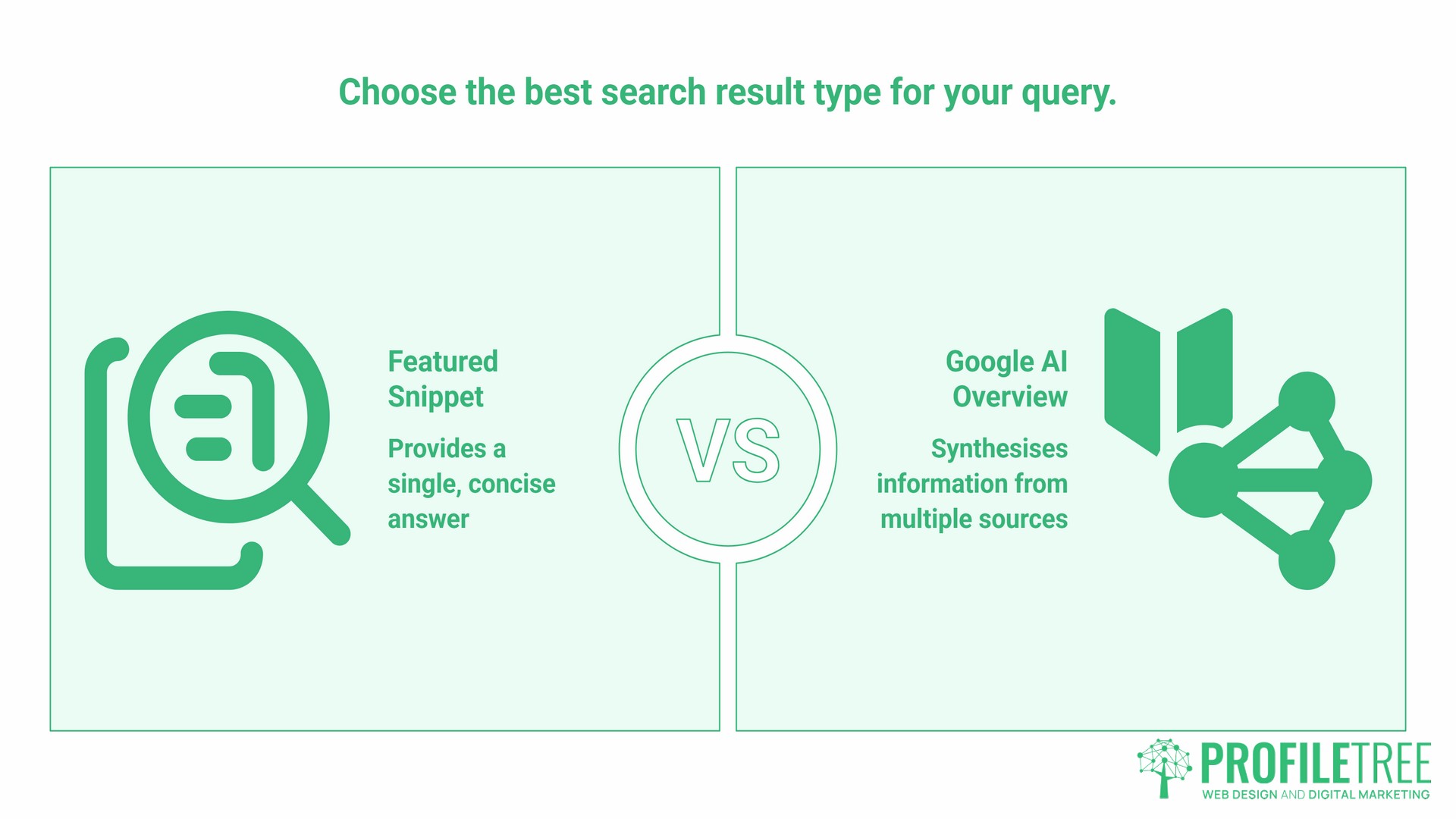
Google AI Overviews, previously known as the Search Generative Experience (SGE), are the AI-generated summary blocks that appear above traditional organic results for many search queries. Where a standard featured snippet draws from a single source, an AI Overview synthesises information from several pages and presents it as a cohesive answer, usually accompanied by cited links.
From SGE to AI Overviews: What Changed
Google began testing SGE in the United States in May 2023. By May 2024, the product was rebranded as AI Overviews and rolled out more broadly, including to the UK market. The underlying technology is the same: a large language model processes the top-ranked results for a query and generates a summary, which then appears above the traditional organic listings.
The practical impact on SGE and AI-driven SERPs is that the page of results a user sees looks fundamentally different from what it did two years ago.
How AI Overviews Differ from Standard Snippets
| Feature | Featured Snippet | Google AI Overview |
|---|---|---|
| Sources used | Single domain | Multiple domains |
| Appears for | Specific factual queries | Broad and informational queries |
| Click required | Often not | Rarely for basic answers |
| Cites sources | No | Yes, with linked carousels |
| Rewards | Clear, concise answers | Structured, authoritative content |
How AI Overviews Affect Traffic for UK and Ireland Businesses
The traffic question is the one most SME owners actually care about when considering SGE and AI-driven SERPs. The honest answer is: it depends on the type of queries your site currently ranks for.
Informational Queries Take the Biggest Hit
Simple “what is” and “how does” queries have always driven high-volume but low-intent traffic. AI Overviews now answer most of those directly in the SERP, reducing the number of clicks that flow through to individual pages. A Belfast accountancy firm that ranked well for “what is corporation tax in the UK” may find that the query generates fewer visits than before, because the answer is now visible without a click.
Seer Interactive’s September 2025 study, covering 25.1 million organic impressions, found that organic click-through rates on queries with AI Overviews fell 61% between mid-2024 and September 2025. Specifically, that decline is real and measurable.
This is not necessarily a loss worth mourning. Visitors who clicked on a basic definition query rarely converted into clients. The more consequential traffic has always come from higher-intent searches.
Transactional and Local Intent Remains Relatively Protected
Queries with local or transactional intent behave differently. A search for “web design company Belfast” or “SEO agency Northern Ireland” still returns a local pack, paid ads, and organic results alongside any AI-generated content. Google’s own documentation confirms that AI Overviews are less likely to trigger for queries where the user is clearly looking to purchase or contact a specific business.
That said, the local pack itself now often sits below an AI Overview for queries with an informational element, such as “how much does a website cost in Ireland?” This pushes organic results further down the page, even when a business does rank well.
Understanding how SGE and AI-driven SERPs interact with local search is covered in more depth in our guide to AI for local SEO and city-level search visibility.
The Zero-Click Trend Is Accelerating
Zero-click searches were already increasing before AI Overviews arrived. A 2024 study by SparkToro and Datos found that 59.7% of EU and UK Google searches ended without a click to any external site, with only 374 clicks going to the open web for every 1,000 searches. SparkToro’s 2026 research shows that the figure has continued to worsen, with fewer than one in three Google searches now resulting in a click outside Google’s own properties. AI Overviews accelerate this trend for informational content while leaving commercial and navigational intent relatively intact.
The implication for SMEs is not to panic about declining traffic to definition pages, but to invest more heavily in content that serves commercial intent and builds brand recognition directly within SGE and AI-driven SERPs.
“AI Overviews highlight the best authoritative content. If you rank among the sources cited, your brand benefits from AI-driven mentions even when users do not click through,” says Ciaran Connolly, founder of ProfileTree.
The Three Pillars: Content, Technical SEO, and Web Development
Adapting to SGE and AI-driven SERPs is not a single-channel problem. It requires changes to how content is written, how pages are technically structured, and how websites are built. ProfileTree works across these three areas for clients across Northern Ireland, Ireland, and the UK who want to stay visible as SGE and AI-driven SERPs continue to evolve.
Pillar One: Content Strategy and Information Gain
AI Overviews pull from content that is structured, factually clear, and genuinely useful. Pages that repeat the same generic points as ten competitor sites are unlikely to be cited. Pages that offer a distinctive perspective, original analysis, or local specificity are more likely to appear as sources.
The concept Google uses internally is “information gain,” and it is worth taking seriously. If your article about VAT registration for new businesses in Ireland says exactly what the Revenue Commissioners website says, there is no information gain. If it adds a worked example drawn from actual client experience, or addresses a common misunderstanding specific to the Irish market, it offers something the AI can draw from that other sources do not.
Practically, this means:
- Leading each major section with a direct, concise answer (40 to 60 words) before expanding with evidence
- Structuring content around real questions your customers ask, not keyword variations of the same phrase
- Writing for a specific audience, such as service businesses in Northern Ireland, rather than a generic global reader
- Including a properly formatted FAQ section at the end of every article
Our guide to building a digital marketing strategy covers how content planning connects to broader business objectives.
Pillar Two: Technical SEO and Structured Data
Structured data is the technical layer that helps Google understand what your content is about without needing to infer it from prose. FAQ schema, Article schema, and HowTo markup all increase the probability that your content will be parsed correctly and considered for an AI Overview citation.
For SMEs, the most accessible starting points are:
- FAQ schema on any page with a question-and-answer section
- Article schema with accurate author, publisher, and date fields
- LocalBusiness schema on your homepage and contact page, with consistent NAP (name, address, phone) data matching your Google Business Profile
- Breadcrumb schema to reinforce site structure for crawlers
Core Web Vitals remain a threshold filter. A slow-loading, unstable page may contain excellent content, but Google is less likely to cite it if the technical experience is poor. For businesses on older WordPress themes or shared hosting, page speed improvements often have the most immediate impact. Our website development services include technical SEO implementation as part of the build process.
If you want to understand how the current Google SEO framework applies to your site, our SEO guide covering Google’s quality updates explains the underlying principles.
Pillar Three: Web Development and AI Parsability
The way a website is built determines how easily AI systems can extract structured information from it. Clean HTML5 semantics, correct heading hierarchies, and clearly separated content sections all help.
Specific development decisions that affect AI parsability:
- Using
<article>,<section>, and<h2>tags correctly rather than relying on<div>containers for everything - Ensuring page content is rendered server-side or at least accessible before JavaScript executes, since AI crawlers do not always process client-side rendered content reliably
- Keeping mobile performance metrics strong, Google uses mobile-first indexing, and AI Overview sources are drawn from the same index
- Maintaining an up-to-date XML sitemap and submitting it through Google Search Console after significant content changes
For businesses whose sites were built on older frameworks or by developers who prioritised visual design over semantic structure, a development audit often reveals structural issues that are holding back both traditional SEO and AI citation potential.
E-E-A-T and Why Brand Authority Is Now a Competitive Moat
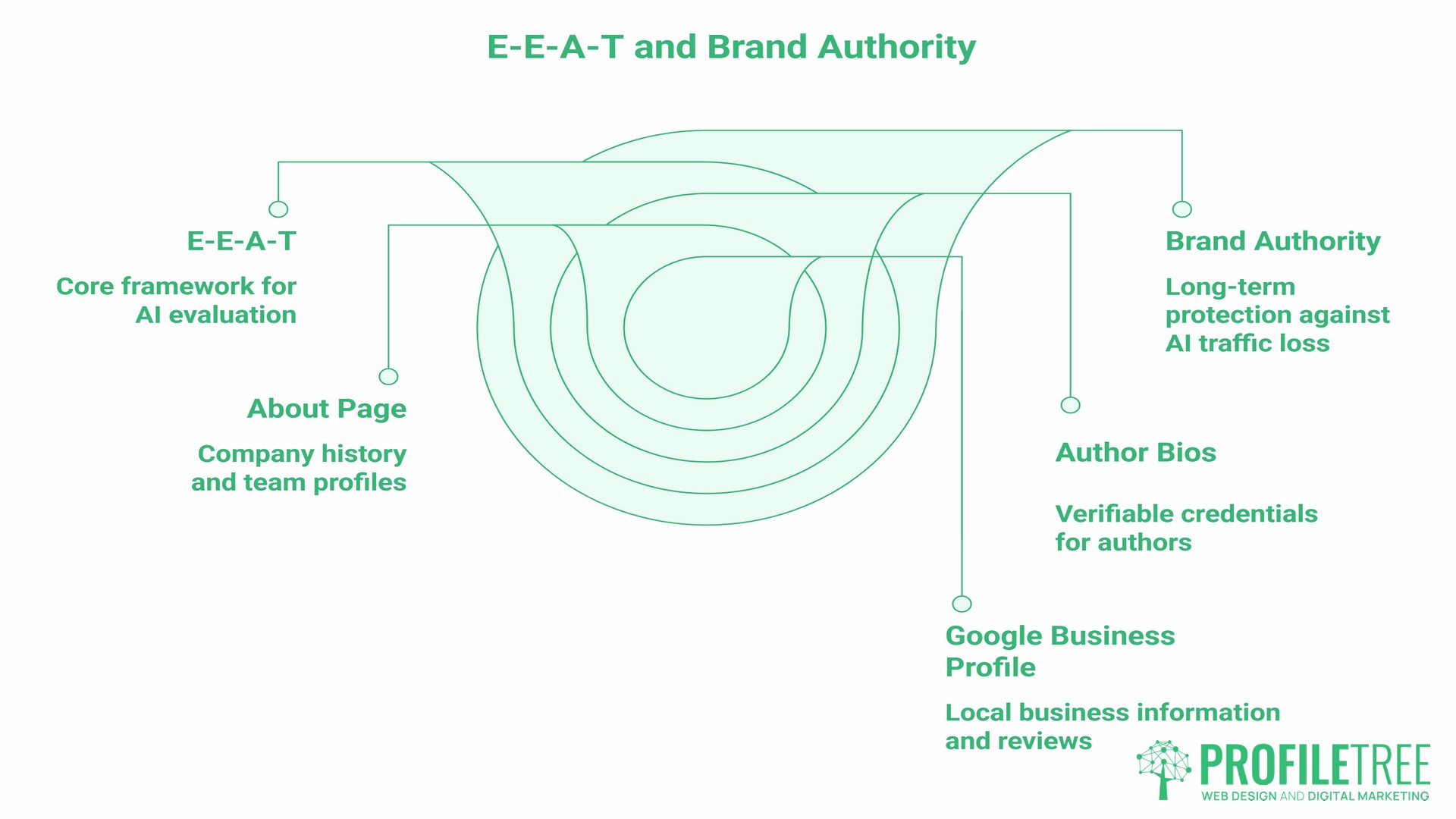
Google’s E-E-A-T framework (Experience, Expertise, Authoritativeness, Trustworthiness) has become the primary filter through which AI Overviews evaluate whether a source is worth citing. In the context of SGE and AI-driven SERPs, this matters more now than at any previous point in Google’s history, because AI Overviews act as a gatekeeper: if your site is not considered authoritative, your content will not appear in the AI summary, regardless of how well it is structured.
What E-E-A-T Actually Means for a Belfast or Dublin SME
For large global publishers, E-E-A-T is partly about domain authority accumulated over years of backlink acquisition. For an SME in Northern Ireland or Ireland, the more accessible signals are:
- Author bios with verifiable credentials linked from every article
- A detailed About page with real team profiles, company history, and proof points such as years in business or project counts
- Google Business Profile completeness, including recent reviews and accurate category data
- External references, such as industry body memberships, media mentions, podcast appearances, or speaking engagements
- Consistent factual accuracy across all published content, with sources cited for non-obvious claims
Google treats authors as entities within its Knowledge Graph, a finding confirmed by the 2024 Google documentation leak, which revealed that author data is stored and associated with content. A named author with a verifiable professional history, whose profile and credentials appear consistently across platforms, is treated differently from an anonymous post or a generic “team” byline.
Building Brand Recognition as a Long-Term Defence
The deepest protection against AI-driven traffic loss is not technical. It is building a brand that people search for by name. When a user sees a business cited in an AI Overview and then directly searches for that brand, they are already past the zero-click problem entirely. Branded search volume is one of the clearest signals of genuine authority in the context of SGE and AI-driven SERPs, and it compounds over time.
“Doubling down on uniqueness and consistent updates is the surest route to stand out in an AI-summarised search environment,” says Ciaran Connolly, founder of ProfileTree.
For many SMEs, the practical version of this is: publish genuinely useful content consistently, be specific about who you serve and where, and make sure your credibility signals are visible on every page. Our digital training programmes include modules on building AI-ready content strategies for in-house marketing teams.
A Practical Roadmap for SME Marketing Managers
The following steps are sequenced by impact for businesses navigating SGE and AI-driven SERPs. Start with the ones most likely to produce visible results within 90 days.
Step One: Audit Which Pages Are Vulnerable to Zero-Click Loss
Log in to Google Search Console and filter for pages that drive significant impressions but low clicks. These are the pages most exposed to the effects of SGE and AI-driven SERPs, and most likely to be serving informational queries that AI Overviews are now answering directly. Flag any page where the primary content is definitional, “what is” focused, or replicates widely available information without a distinctive angle.
These pages are not necessarily candidates for deletion, but they do need updating with original analysis, local context, or depth that goes beyond what an AI summary can capture. The question to ask for each page is: what does this article offer that an AI cannot summarise in four sentences?
Spotting whether your content has been detected as AI-generated is a related issue. Our guide to AI content detection explains how these systems work and what they flag.
Step Two: Add or Improve Structured Data
Check whether your site has the FAQ schema on articles that contain Q&A sections. If not, this is the highest-return technical change available to most SMEs. The FAQ schema increases the likelihood of appearing in the “People Also Ask” section and makes content more parseable for AI Overview extraction.
If your site is on WordPress, the FAQ schema can be added via Rank Math or Yoast SEO without developer involvement. For more complex implementations, or for sites where the schema is currently absent or incorrectly structured, a development review is worth commissioning.
Step Three: Rewrite Your Highest-Traffic Informational Pages for Information Gain
Take the five most visited informational articles on your site and ask honestly whether they contain anything that a competitor or a generic AI summary could not replicate. If the answer is no, prioritise rewriting them with:
- A specific UK or Irish business context
- A worked example drawn from actual experience
- Data that is sourced, attributed, and recent
- A clear answer to the primary question within the first 100 words
Longer articles are not automatically better, but content of fewer than 1,500 words rarely competes for informational queries at page one in 2026.
Step Four: Build or Refresh Your E-E-A-T Signals
Check that every article has a named author with a working bio link. Check that your About page credibly presents the company’s experience, track record, and team. Check that your Google Business Profile has been updated within the last 30 days and that NAP data is consistent across all directories.
Step Five: Train Your Marketing Team
Many of the changes described above require content decisions to be made differently at the brief stage, not fixed in editing. If your in-house team is writing content that prioritises keyword stuffing over factual depth, or publishing articles without structured data or proper author attribution, no amount of technical optimisation will close the gap. ProfileTree’s digital training programmes are designed for marketing teams in Northern Ireland, Ireland, and the UK that want to build sustainable organic visibility.
“AI Overviews act as a filter that removes mediocre content. The businesses that treat that filter as a quality standard, rather than a threat, are the ones that will come out ahead,” says Ciaran Connolly, founder of ProfileTree.
If your business is at the stage where you need a structured plan rather than incremental fixes, the ProfileTree contact page is the right starting point.
Frequently Asked Questions
What is the difference between SGE and AI Overviews?
SGE (Search Generative Experience) was the name Google used during its testing phase, which began in the United States in 2023. In May 2024, Google rebranded the feature as AI Overviews and began a broader rollout. The functionality is the same: AI-generated summaries appear at the top of the search results page for qualifying queries. When people refer to SGE and AI-driven SERPs, they are describing the same underlying shift in how Google presents information.
Are Google AI Overviews live in the UK and Ireland?
Yes. Google launched AI Overviews in the UK on 15 August 2024, as part of a multi-country expansion that included India, Japan, Brazil, Mexico, and Indonesia. Ireland was included in a further global expansion in October 2024, when Google extended AI Overviews to more than 100 countries. The feature does not appear for every query; it is most likely to be triggered for informational, research-oriented, and multi-step queries rather than for local, transactional, or navigational ones. UK and Irish users can see AI Overviews in standard Google Search on desktop and mobile.
Will AI Overviews reduce my website traffic?
For pages that rank primarily for basic informational queries, a reduction in traffic is very likely. A September 2025 study by Seer Interactive, analysing 25.1 million organic impressions across 42 organisations, found that organic click-through rates for queries with AI Overviews fell 61%, from 1.76% to 0.61%, between mid-2024 and September 2025. A separate December 2025 Ahrefs analysis across 300,000 keywords found that AI Overviews were associated with a 58% lower average CTR for the top-ranking position. However, traffic driven by local intent, transactional queries, and brand searches is much less affected. The net impact depends heavily on the nature of your current rankings. Sites with strong local SEO, well-developed service pages, and genuine brand authority tend to be more resilient.
Do I need to change my website’s code to appear in AI Overviews?
You do not need to make wholesale changes, but structured data implementation significantly improves your chances of being cited. FAQ schema, Article schema, and LocalBusiness schema all help Google parse your content accurately. Alongside structured data, clean heading hierarchy and fast page load times are the most impactful technical factors. Most WordPress sites can add the most important schema types through existing SEO plugins without custom development.
Does AI search affect my Google Business Profile?
Yes, positively. Google Business Profile data is a primary source for AI Overviews on local queries. An accurate, complete, and recently updated profile, with strong review signals and consistent NAP data, increases the probability that your business will appear in AI-generated responses to local search queries. This is one of the most accessible optimisation actions for any SME.
How do I get my website cited in an AI Overview?
There is no direct opt-in mechanism. Google selects sources based on perceived authority, content structure, and relevance to the query. The most reliable factors within your control are: structured content with clear heading hierarchies, FAQ sections with direct answers, strong E-E-A-T signals including named authors and verifiable credentials, factual accuracy with sourced claims, and consistent publication of genuinely useful content for a well-defined audience. Appearing in AI Overviews is a byproduct of being a credible source, not a separate optimisation target.
Can I stop my site from appearing in AI Overviews?
Yes. Adding a nosnippet A meta tag on a page instructs Google not to use its content in snippets or AI summaries. However, this also prevents the page from appearing in featured snippets and reduces overall SERP visibility. For most businesses, the trade-off is not worth making unless there is a specific reason to keep certain content out of AI-generated responses, such as legal or commercial sensitivity.