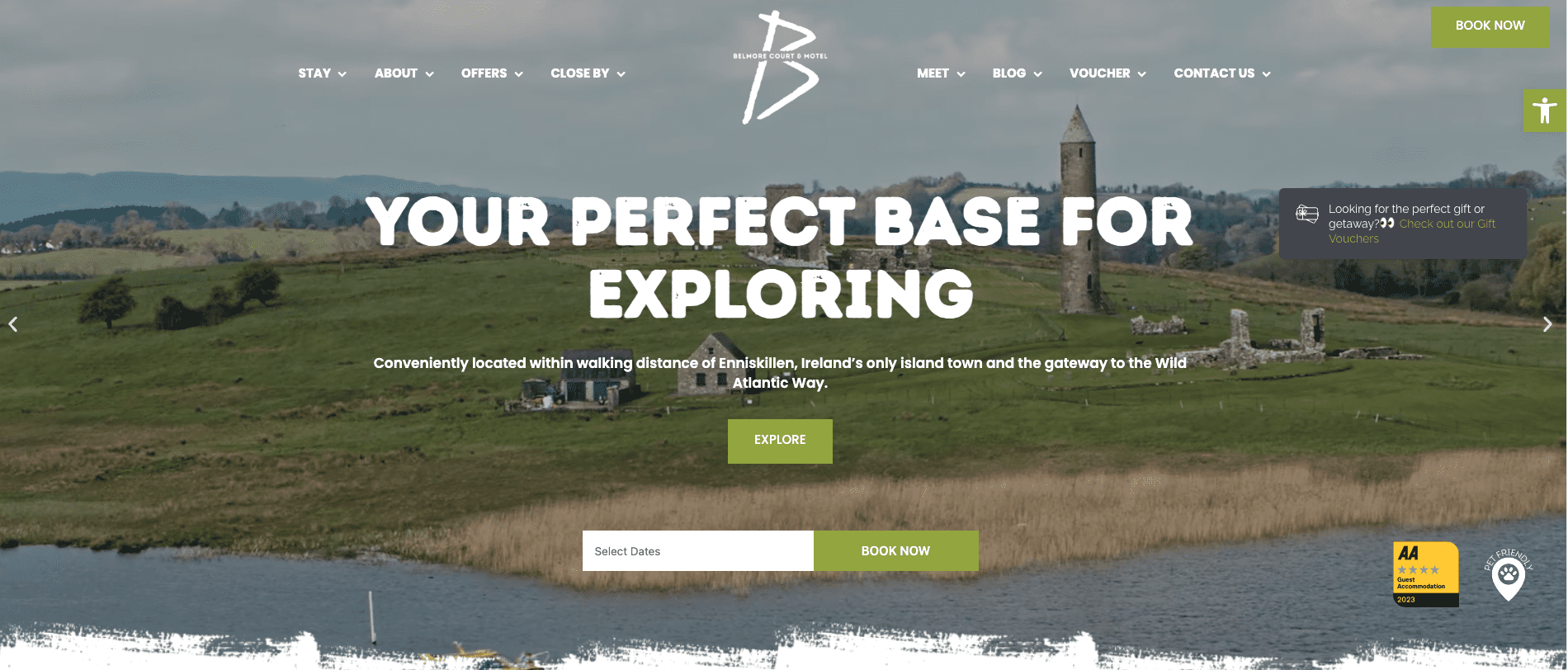
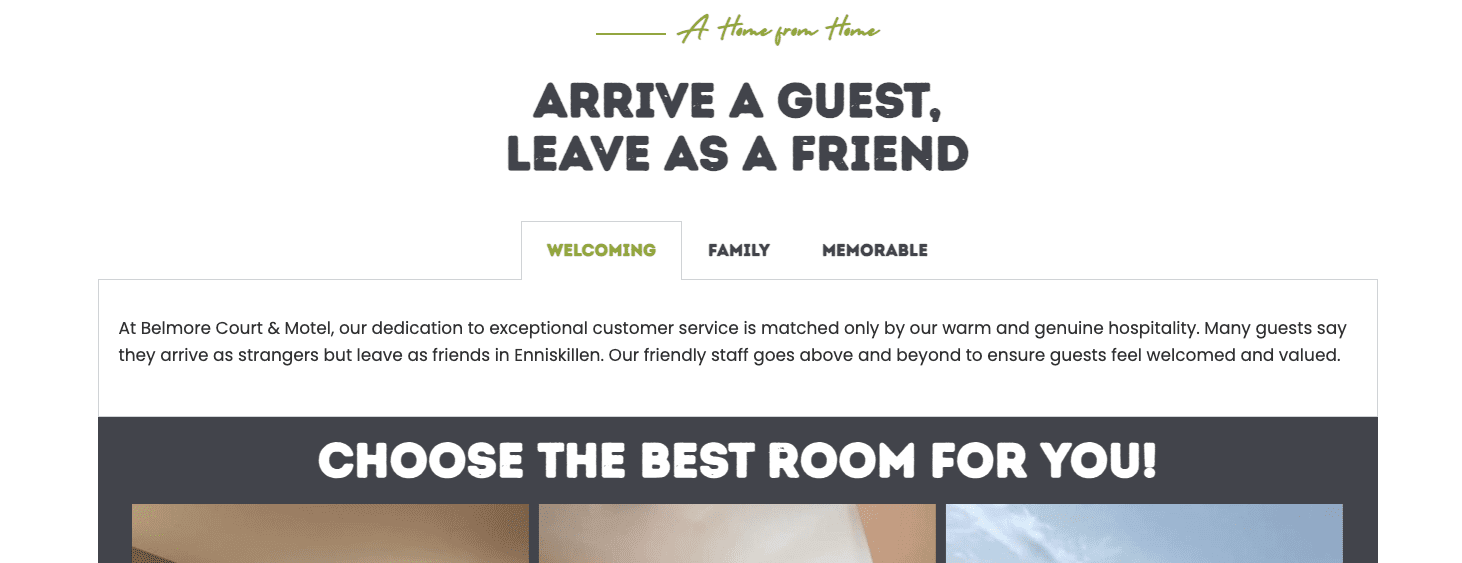
ProfileTree, a Belfast-based web design and digital marketing agency, redesigned the website for Belmore Court & Motel in Enniskillen, Northern Ireland. This hotel website design project addressed outdated infrastructure, poor mobile experience, and heavy reliance on third-party booking platforms, resulting in more than 1,000 organic visitors per month and measurable growth in direct bookings.
The hospitality businesses ProfileTree works with across Northern Ireland share a set of recurring problems that go well beyond aesthetics. Most of the hotels and accommodation providers we encounter are losing direct revenue not because of poor service, but because their websites make it too difficult for guests to book.
The pattern is consistent: an older website, built without mobile users in mind, is slow to load, hard to navigate, and offers no clear path to booking. Visitors land on the page, struggle to find room rates or availability, and leave to book through an OTA like Booking.com instead. The property completes the reservation, but pays a commission of between 15% and 25% for the privilege.
The second issue is SEO. Hotel websites frequently have no internal linking structure, missing or duplicated metadata, and content that tells Google very little about who the property serves or where it is located. That combination makes it almost impossible to rank for local accommodation searches, which is where the highest-intent traffic comes from.
A well-executed hotel website redesign case study does not start with design choices. It starts with understanding where the bookings are being lost and building back from there.
About Belmore Court and Motel: The Project
Belmore Court & Motel is a well-established accommodation provider in Enniskillen, County Fermanagh, serving leisure and business guests travelling through the Fermanagh Lakelands area of Northern Ireland.
When they approached ProfileTree, their existing site had not kept pace with how guests research and book accommodation. The design was dated, the booking process was friction-heavy, and the site performed poorly on mobile devices. The property relied heavily on third-party platforms for reservations, which was sustainable in the short term but costly. The brief was clear: build a hotel website that earns its keep by generating direct bookings.
What We Did: The Hotel Website Design Approach
Rebuilding this site required work across several areas simultaneously. Design, technical performance, booking system integration, and content structure all needed attention before any meaningful improvement in traffic or conversions was possible.
Integrating the Net Affinity Booking System
One of the most commercially significant decisions in this project was the integration of the Net Affinity booking system directly into the new site. Rather than redirecting guests to an external platform to complete a reservation, the new website allowed users to check availability, view rates, and book without leaving the property’s own site.
This had two effects. First, it reduced friction at the point of conversion, which is where a large proportion of direct bookings are lost. Second, it meant the property could capture guest data directly, rather than having it held by a third-party platform.
Responsive Design and Mobile Optimisation
More than 65% of travel research now happens on smartphones. The previous site had no responsive framework, which meant mobile visitors were navigating a desktop layout on a small screen. That is a booking killer in any sector; in hospitality, where guests are often searching while commuting, on holiday, or making last-minute decisions, it is especially costly.
The rebuilt site was designed mobile-first. Layout, button sizing, imagery, and load times were all tested and optimised for mobile performance before the desktop version was finalised.
Navigation and Layout Overhaul
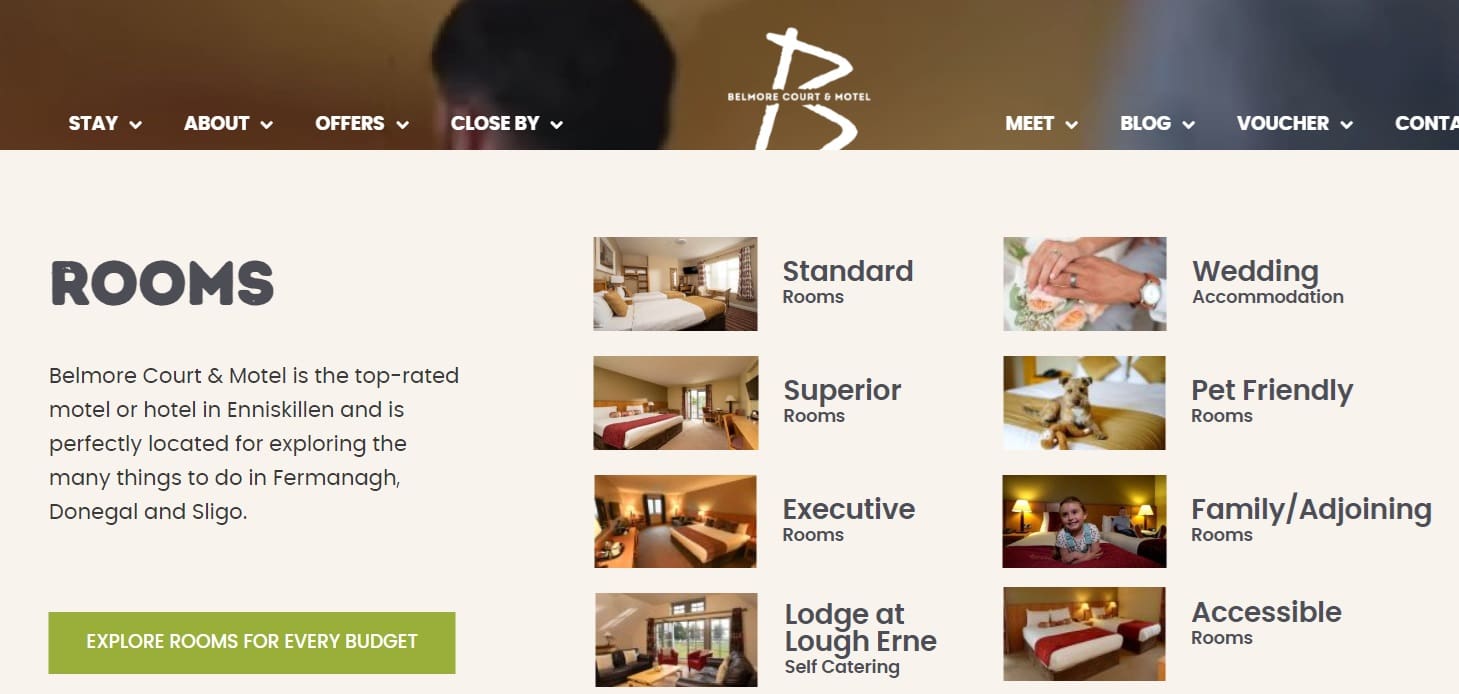
The original site’s navigation was not structured around the decisions guests actually need to make: rooms, rates, location, and booking. ProfileTree rebuilt the site architecture around that journey, introducing a mega menu that gave users clear access to the information they needed without hunting through multiple layers of pages.
This change reduced bounce rates and increased the average number of pages visited per session, both of which contributed to the SEO improvements that followed.
Results: Hotel Website Design
The rebuilt hotel website delivered measurable outcomes across all the key metrics that matter commercially.
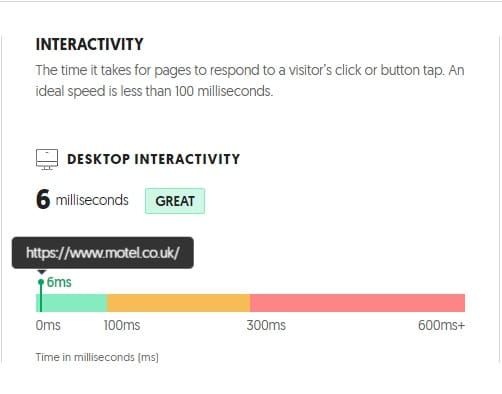
Organic traffic grew to more than 1,000 visitors per month as the site began ranking for targeted accommodation searches in the Fermanagh and Enniskillen area. Page speed improvements contributed both to better user experience and improved search rankings, as Google gives preference to fast-loading sites in its mobile results.
Direct booking volume increased, and the client’s dependence on third-party platforms reduced accordingly. Given commission rates on those platforms, the shift to direct bookings represented a meaningful improvement in net revenue per reservation, not just headline booking numbers.
How ProfileTree Approaches Hotel Website Design
“The most common mistake we see with hotel websites is treating the redesign as a cosmetic exercise,” says Ciaran Connolly, founder of ProfileTree. A hotel website design project should start with the booking funnel. Where are guests dropping off? What is the path from search to confirmed reservation? Get that working, and the design choices follow naturally.”
ProfileTree’s approach to hotel website design for direct bookings follows a consistent process. We begin with a technical and content audit to identify what is actively working against rankings and conversions. From there, we build the site architecture around the guest decision journey rather than around the property’s internal structure.
Content is written to target local accommodation searches with genuine specificity: the area, the property type, the guest, and the occasion. That specificity is what earns rankings for high-intent queries rather than broad generic terms.
For hospitality businesses considering a website project, the case for acting is straightforward. Every month that passes with a slow, poorly converting site is a month of commission payments to OTA platforms that a better-performing direct site would have recovered. Our web design services for hospitality businesses are built around that commercial argument.
Hotels and accommodation providers across Northern Ireland can review our hotel internet marketing portfolio to see how this approach has been applied across different property types and locations.
FAQs About Hotel Website Design
How long does a hotel website redesign take?
Most hotel website redesign projects take between eight and fourteen weeks from briefing to launch, depending on the scope of work. Sites requiring custom booking system integrations or significant content development typically sit at the longer end of that range. ProfileTree works to an agreed project timeline with defined milestones throughout.
What should a hotel website include to generate direct bookings?
A hotel website designed for direct bookings needs a fast-loading, mobile-responsive framework, a straightforward booking engine integrated directly into the site, clear room and rate information without requiring a login or redirect, and a content structure that ranks for local accommodation searches. Social proof, such as review scores and guest photography, also plays a measurable role in conversion.
How does hotel website design affect SEO rankings?
Site speed, mobile responsiveness, internal linking structure, and content relevance all feed directly into how a hotel website ranks in organic search. A slow, poorly structured site will struggle to appear in local accommodation searches regardless of how well the property is reviewed offline. Technical SEO improvements made during a redesign typically produce ranking gains within three to six months of launch.
Is hotel website design for direct bookings worth the investment compared to OTA platforms?
For most independent hotels and accommodation providers, yes. OTA commission rates range from 15% to 25% per booking. A well-built direct booking website typically pays for itself within twelve to eighteen months through recovered commission costs alone, before accounting for the long-term value of ranking in organic search.
What makes ProfileTree’s approach to hotel website design different?
ProfileTree brings together web design, technical SEO, and content strategy within a single project. Rather than treating the website as a standalone deliverable, we build it as part of a connected digital presence. Every hotel website project we deliver includes an internal linking strategy, SEO-structured content, and performance benchmarks tied to bookings rather than just traffic.
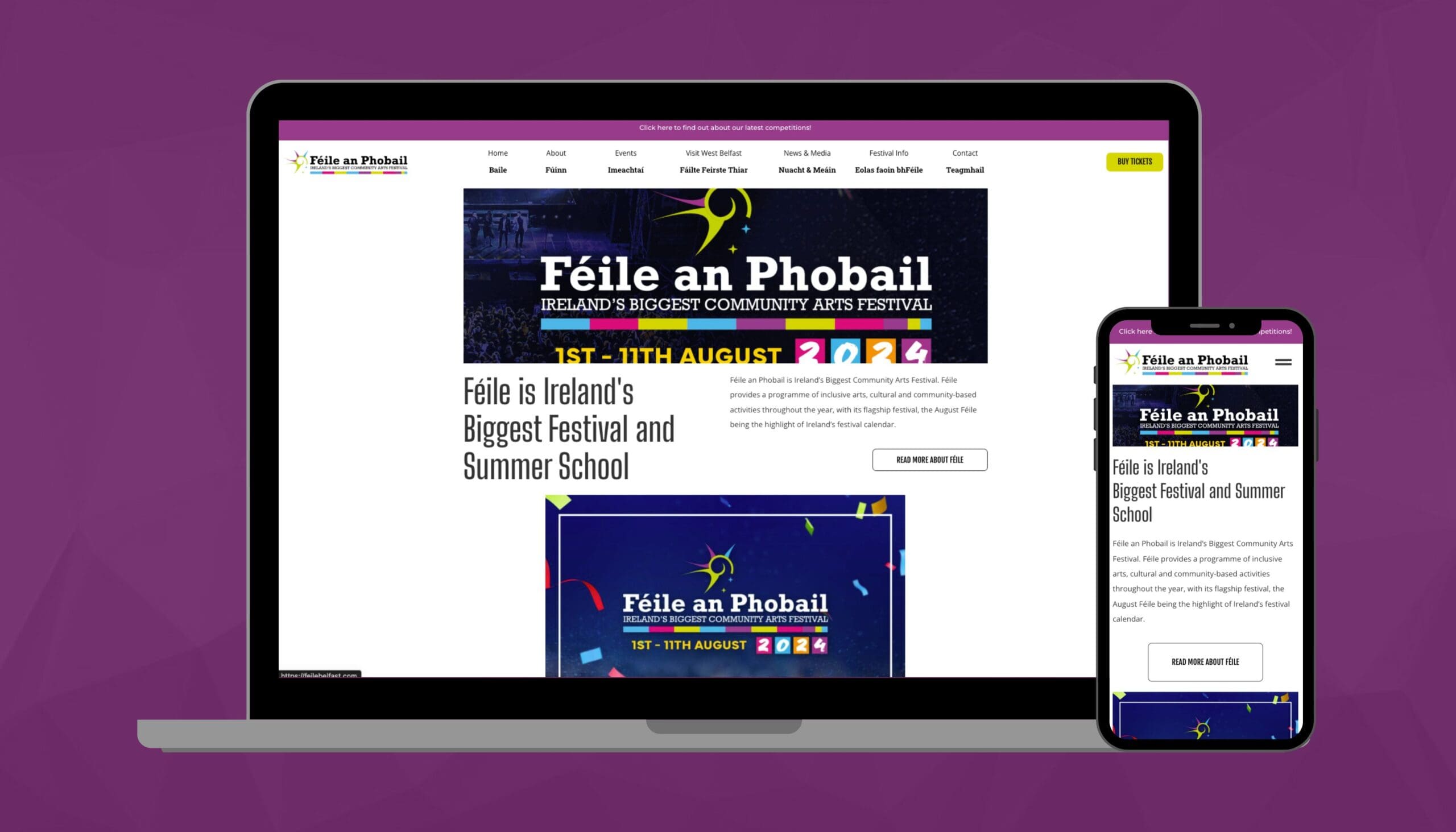
ProfileTree is a Belfast-based website design and digital marketing agency that has worked with arts and community organisations across Northern Ireland and Ireland. This case study covers a full custom WordPress build for Féile...
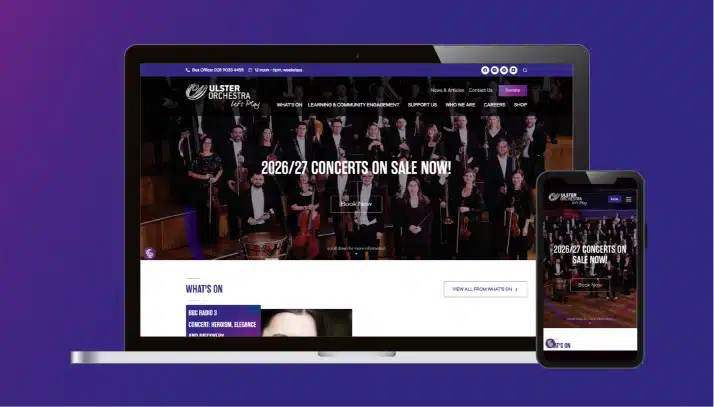
ProfileTree, a web design and digital marketing agency based in Belfast, builds websites for arts organisations, venues and cultural charities across Northern Ireland and the UK. This case study covers two phases of work...
Navigate the digital landscape with a marketing strategy. Our team crafts comprehensive plans that resonate with your target audience, drive engagement, and boost conversions.
Elevate your digital proficiency. Our in-depth training sessions equip your business with cutting-edge digital marketing techniques to outperform competitors and thrive online.
Captivate and grow your social following. We create tailored social media strategies that ignite engagement, amplify your brand's online presence, and foster lasting connections.
Harness the power of your mailing list. Our precision-targeted email marketing campaigns are engineered to nurture relationships and drive tangible business outcomes.
Elevate your brand with our content marketing mastery. From thought-provoking blogs to eye-catching infographics, we craft content that captivates, informs, and converts your ideal audience.
Bring your brand's story to life with authenticity. We craft compelling narratives that strike a chord with your audience, forging a powerful emotional bond with your brand.
Empower your business with AI expertise. Our tailored training demystifies AI, equipping your team with the knowledge to leverage its potential for growth and innovation.
Transform customer service with AI chatbots. We develop sophisticated chatbots that elevate user experience, streamline interactions, and deliver unparalleled efficiency.
Transform your reach with AI-driven marketing. Harness data-driven insights for laser-targeted campaigns that captivate, engage, and convert your audience.
Optimise your operations with cutting-edge AI tools. We integrate intelligent solutions that streamline processes, enhance efficiency, and support data-driven decision-making.
Join Our Mailing List
Grow your business with expert web design, AI strategies and digital marketing tips straight to your inbox. Subscribe to our newsletter.