
Personalisation Strategies for Online Retail: A Practical Guide for UK SMEs
Table of Contents
Shoppers have changed. A customer who visited your WooCommerce store last week and browsed your winter coats range does not want to land on your homepage next time and start from scratch. They want the coat. They want it in their size. They want to know whether it’s back in stock.
That expectation that a website should remember, adapt, and respond is what e-commerce personalisation delivers. For UK SMEs selling online, getting this right is no longer a competitive advantage. It is increasingly the baseline.
This guide covers what personalisation actually means in practice, which tools make it achievable on a realistic budget, how your website and digital marketing strategy need to work together to deliver it, and what to measure to know whether it is working.
What is E-commerce Personalisation?
E-commerce personalisation is the process of using data about a visitor’s behaviour, preferences, location, or purchase history to show them content, products, or offers that are more relevant to them than a generic page would be.
At its simplest, it is the “customers who bought this also bought” row on a product page. At its most sophisticated, it is a homepage that rebuilds itself in real time depending on who is viewing it, what they have previously purchased, and where they are browsing from.
The gap between those two levels is where most UK SMEs currently sit and where the biggest opportunities are.
Online Retail Personalisation vs Generic E-commerce
The distinction worth making is between an online shop that exists and one that actively responds to its visitors. A generic e-commerce site shows every visitor the same homepage, the same featured products, and the same promotional banners. A personalised one adjusts each of those elements based on data it has already collected.
The technology to do this is no longer limited to enterprise retailers. WooCommerce, Shopify, and most mid-market platforms either include basic personalisation features natively or connect to affordable third-party tools that add them.
Why Personalisation Matters for UK Online Retailers
The UK has one of the highest rates of online shopping in Europe. That density of competition means that the quality of the shopping experience, not just the product, increasingly determines whether a first-time visitor becomes a repeat customer.
Customer data behaviour supports this. Visitors who are shown relevant product recommendations are more likely to add to the basket. Customers who receive segmented email follow-ups based on their browsing history convert at higher rates than those who receive generic broadcast emails. Neither of these outcomes requires a large technology budget; they require the right setup.
For SMEs specifically, the strategic argument for personalisation is straightforward: you cannot outspend Amazon on paid acquisition, but you can out-serve individual customers in ways a platform of that scale cannot match.
The Data Foundation: What You Need Before You Start
Personalisation only works if you have data to personalise with. Before investing in any tool or plugin, it is worth being clear about what data you are actually collecting and whether it is structured in a way that is useful.
First-Party Data and Why It Matters Now
First-party data is information your customers have directly shared with you or generated through their behaviour on your own site. It includes purchase history, browsing behaviour, email engagement, account preferences, and any information gathered through forms or loyalty schemes.
This is the data that personalisation runs on, and it is data you own. Third-party cookie deprecation, the gradual removal of cross-site tracking tools that digital marketing has relied on, makes first-party data more valuable, not less. SMEs who have built solid first-party data sets through their websites and email lists are in a stronger position now than those who relied entirely on rented audience targeting.
GDPR and Personalisation
UK online retailers must comply with UK GDPR when collecting and using customer data for personalisation. The practical requirements are: clear consent for cookie-based tracking, transparent privacy policies that explain how data is used, and accessible opt-out mechanisms.
Personalisation based on purchase history for existing customers generally falls under the legitimate interest basis. Behavioural tracking of new visitors requires explicit consent. Getting this right is not just a compliance issue; customers who understand how their data is used and see genuine value returned for it are more likely to engage with personalised features than those who feel surveilled.
Personalisation Tools for WooCommerce and Shopify
The tool landscape for ecommerce personalisation has matured significantly. SMEs no longer need custom development to implement meaningful personalisation — the right plugins and third-party integrations handle the heavy lifting.
| Tool | Platform | What It Does | Approximate Cost |
|---|---|---|---|
| Clerk.io | WooCommerce, Shopify | AI-powered product recommendations, search personalisation | From ~£50/month |
| Nosto | Shopify, Magento, BigCommerce | Personalised product recommendations, pop-ups, segmentation | Performance-based pricing |
| Klaviyo | WooCommerce, Shopify | Segmented email and SMS based on behaviour and purchase data | Free tier available |
| WooCommerce Product Recommendations | WooCommerce | Rule-based and algorithm-based recommendations | ~£80/year |
| Omnisend | WooCommerce, Shopify | Email and SMS automation with segmentation | Free tier available |
The right choice depends on your platform, your traffic volume, and how much of your personalisation strategy sits in on-site experience versus email. For most small retailers starting out, a behavioural email tool like Klaviyo or Omnisend, combined with a basic recommendation plugin, gives the best return for the lowest setup cost.
The website build itself matters here. A WooCommerce site built with personalisation in mind, using a well-structured product taxonomy, clean customer account data, and the right plugin stack from the outset, is significantly easier to personalise than one built without that consideration. This is one of the reasons that web design and ecommerce strategy need to be treated as the same conversation, not separate ones.
On-Site Personalisation: Where Your Website Does the Work
On-site personalisation refers to changes made to your website based on visitor data. These range from the straightforward to the genuinely sophisticated.
Product Recommendations
Product recommendations are the most widely implemented form of on-site personalisation and the most immediately measurable. They typically appear as:
- “Customers who bought this also bought” blocks on product pages
- “Recently viewed” carousels on category pages and the homepage
- “Complete the look” or “frequently bought together” suggestions at checkout
For WooCommerce stores, the WooCommerce Product Recommendations plugin handles rule-based and algorithm-based recommendations without requiring custom development. For Shopify merchants, native features cover the basics, with Nosto or LimeSpot adding more sophisticated logic.
Dynamic Homepage Content
A more advanced implementation involves the homepage itself adapting based on visitor segments. A returning customer who previously browsed your footwear range sees a homepage led by new footwear arrivals. A first-time visitor sees your bestsellers or a brand introduction.
This requires a more capable personalisation platform and, typically, a website built with that flexibility in mind. It is not a standard out-of-the-box feature on most SME stores, but it is achievable with the right setup.
Personalised Search Results
On-site search is one of the most underused personalisation opportunities for ecommerce SMEs. A customer searching for “blue jacket” at a store that knows they have previously bought women’s clothing should see women’s blue jackets first. Standard WooCommerce search does not do this. Tools like Clerk.io or SearchPie add that layer of personalisation to search results.
Email and Content Personalisation
On-site personalisation captures a visitor while they are on your website. Email personalisation re-engages them after they leave, which is where a significant portion of ecommerce revenue is won or lost.
Segmented Email Flows
The most effective personalisation in email marketing is not putting a customer’s first name in the subject line. It is sending different emails to different segments based on what they have actually done.
Practical segments for a UK SME ecommerce business include:
- Customers who browsed a category but did not purchase (product-specific browse abandonment)
- Customers who added to the basket but did not complete checkout (cart abandonment — one of the highest-converting sequences in ecommerce email)
- Customers who purchased once but have not returned within a defined window (win-back sequences)
- Customers who purchase frequently and spend above a threshold (VIP treatment and early access)
Tools like Klaviyo and Omnisend build these flows visually and trigger them automatically based on customer behaviour synced from your store. A digital marketing strategy that incorporates segmented email alongside standard broadcast campaigns consistently outperforms one that treats all customers identically.
Content Marketing and Personalisation
If your ecommerce business produces blog content, buying guides, or video content, and those assets genuinely support the buying decision, personalisation extends to surfacing the right content to the right visitor.
A customer who has been browsing hiking boots should be shown your guide to choosing trail footwear. A customer who just purchased a coffee machine should see your article on getting the best from it. This kind of content personalisation is most easily implemented through your email sequences, recommendation widgets, and related posts blocks, rather than requiring complex dynamic content systems.
ProfileTree’s content marketing work for ecommerce clients often starts with this connection: identifying which content assets already exist, which gaps need filling, and how the website and email stack need to be configured to connect visitors to the right content at the right stage of their journey.
Omnichannel Personalisation: Connecting Online and Offline
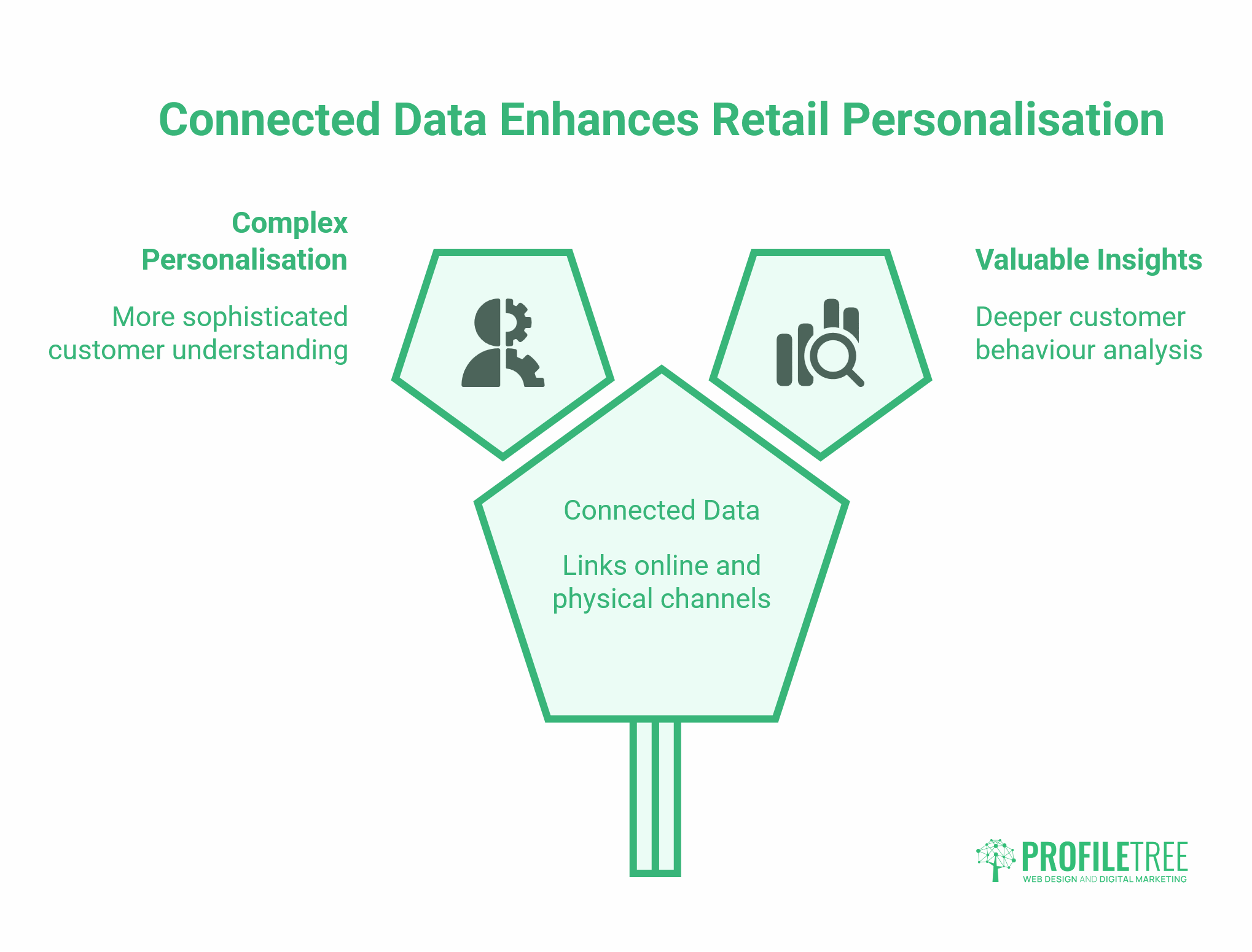
For retailers who operate both online and physically, whether that is a shop, a market stall, or events, personalisation becomes more complex and more valuable when data from both channels is connected.
A customer who regularly buys from your Belfast shop and has also placed online orders should not receive a “first order discount” email. A loyalty scheme that tracks purchases across both channels and a CRM that holds a unified customer record prevent those friction points and enable genuinely relevant communication.
Ciaran Connolly, founder of ProfileTree, notes: “The retailers who are building durable customer relationships are the ones treating every transaction online or offline as a data point that helps them serve that customer better next time. The technology to do this is now accessible to SMEs. The barrier is usually the setup, not the cost.”
This is worth flagging for review and approval before publication.
Personalisation and AI: What Is Actually Available to SMEs
Artificial intelligence in ecommerce personalisation is not a future promise; the tools listed earlier in this guide already use machine learning to power their recommendation engines and segmentation logic. What has changed is that AI is now accessible at price points that make sense for businesses well below enterprise scale.
ProfileTree’s AI implementation work with SMEs frequently starts with ecommerce applications: recommendation engines, automated segmentation, and customer journey mapping. The technology exists; the work is in connecting it to the right data sources and configuring it against the specific shape of a business’s customer behaviour.
The more realistic conversation for most SMEs is not “should we use AI for personalisation?” but “which AI-powered tools suit our platform and budget, and what data do we need in place before we can use them effectively?” That is a practical question with practical answers, and it starts with the website setup.
Measuring Personalisation Performance
Personalisation is only worth doing if you can measure its effect. The metrics worth tracking depend on which personalisation tactics you have implemented.
| Metric | What It Measures | Tool |
|---|---|---|
| Recommendation click-through rate | Whether product suggestions are relevant | Recommendation plugin analytics |
| Cart abandonment rate | Baseline for abandoned cart email opportunity | Google Analytics 4 / platform reports |
| Email segment conversion rate | Whether segmented sequences outperform broadcasts | Klaviyo / Omnisend |
| Repeat purchase rate | Whether personalisation is building loyalty | GA4 / ecommerce platform |
| Average order value | Whether cross-sell recommendations are working | GA4 / platform reports |
A meaningful measurement approach compares performance before and after implementing a personalisation change, rather than looking at absolute numbers in isolation. If your cart abandonment email sequence is new, compare its conversion rate with that of your previous broadcast recovery email. If you have added product recommendations, compare the average order value in sessions where a recommendation was clicked versus those where it was not.
Google Analytics 4 is the foundation for most of this reporting, and setting it up correctly with ecommerce tracking, conversion events, and audience segments is a prerequisite for meaningful personalisation measurement. If your GA4 implementation is missing events or incorrectly configured, the data you are measuring is unreliable.
How to Start: A Practical Checklist for SMEs
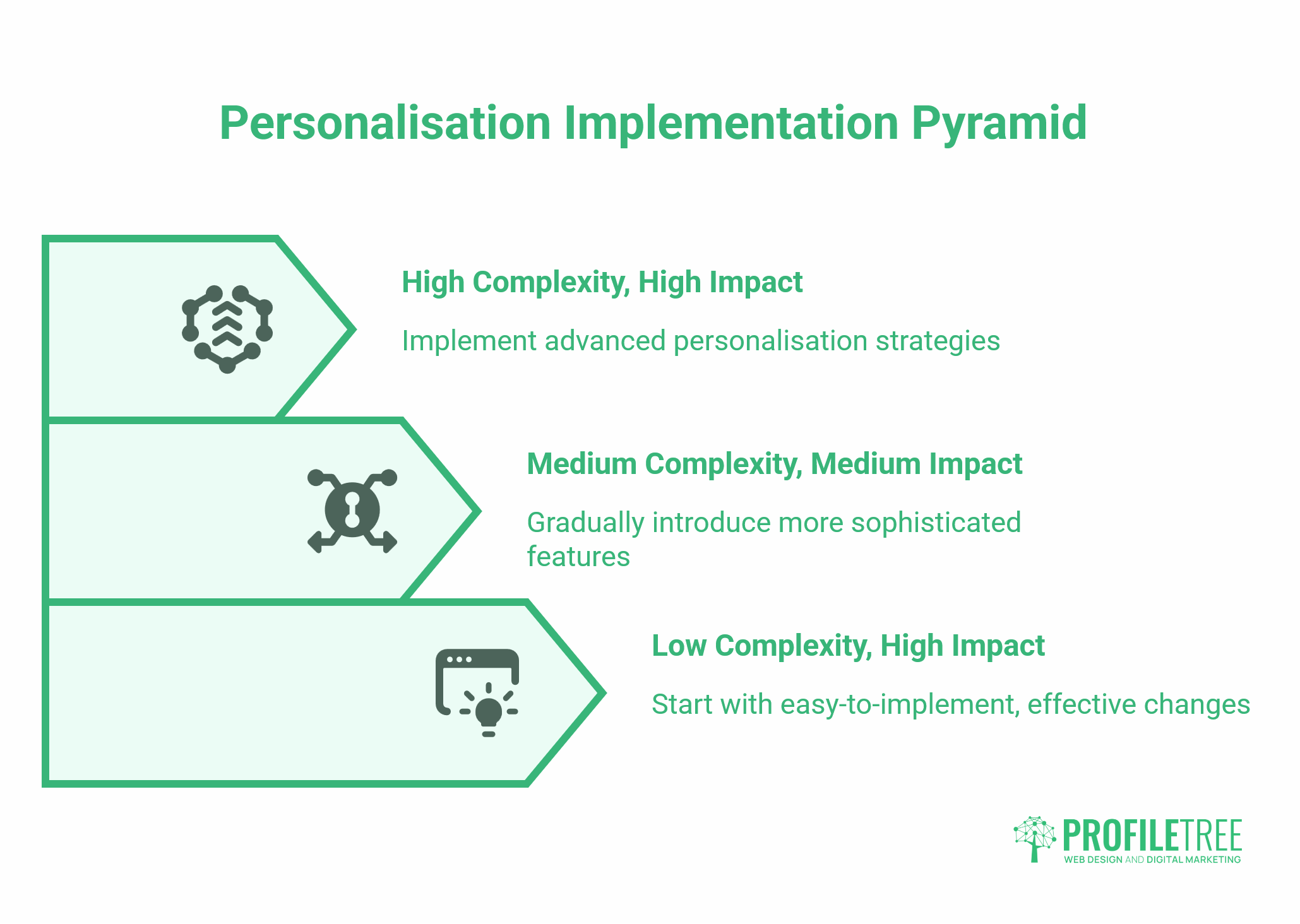
Personalisation does not have to be implemented all at once. A staged approach, starting with the highest-impact and lowest-complexity changes, is more practical for most SMEs than attempting a full platform overhaul.
Stage one — foundation:
- Ensure your website is collecting first-party data correctly (account creation, purchase history, browse tracking with consent)
- Set up GA4 ecommerce tracking with proper event configuration
- Implement cart abandonment email with a tool like Klaviyo or Omnisend
Stage two — on-site recommendations:
- Add a product recommendations plugin suited to your platform
- Configure “recently viewed” and “customers also bought” blocks on product and cart pages
- Review your on-site search and consider a personalised search tool if search drives meaningful traffic
Stage three — segmentation:
- Build at least three email segments based on purchase behaviour (new customers, repeat customers, lapsed customers)
- Create separate email flows for each segment
- Begin testing subject lines and content variations across segments
Stage four — advanced:
- Consider dynamic homepage content based on returning visitor segments
- Explore AI-powered personalisation tools suited to your traffic volume
- Connect offline and online data if you operate across multiple channels
Conclusion
Personalisation is not a feature you bolt on after launching an online store; it is a decision that runs through how your site is built, how your customer data is collected, and how your marketing is structured. For UK SMEs, the tools are there, and the entry point is lower than most assume. Start with the basics: cart abandonment email, product recommendations, and three or four meaningful customer segments. Measure what moves, then build from there. If you want help connecting your website, data, and marketing into a personalisation setup that works for your business, talk to the ProfileTree team.
FAQs
What is ecommerce personalisation?
Ecommerce personalisation uses data about a visitor’s behaviour, preferences, and purchase history to show them more relevant products, content, and offers than a generic page would. It ranges from basic product recommendations to fully dynamic homepages that adapt to the individual viewer.
Does personalisation work for small online retailers?
Yes. Cart abandonment emails, segmented follow-up sequences, and product recommendations are available to SMEs on standard platforms and deliver measurable results without an enterprise-level investment.
What is the difference between personalisation and segmentation?
Segmentation divides your customer base into groups based on shared characteristics. Personalisation uses those segments and, in more sophisticated setups, individual-level data to deliver tailored experiences. Segmentation is the foundation; personalisation is what you build on top of it.
Is ecommerce personalisation GDPR-compliant?
It can be. Personalisation based on purchase history for existing customers generally falls under the legitimate interest basis. Tracking new visitors’ behaviour requires explicit consent under the UK GDPR. Clear privacy policies and accessible opt-out mechanisms are required.
Which personalisation tools work with WooCommerce?
Solid options include WooCommerce Product Recommendations for on-site suggestions, Klaviyo or Omnisend for segmented email automation, and Clerk.io for AI-powered recommendations and search personalisation. The right combination depends on your traffic volume and budget.