
KPMG Marketing Strategy: A Professional Services Case Study
Table of Contents
KPMG is one of the Big Four professional services firms, operating across audit, tax, and advisory in more than 140 countries. Its KPMG marketing strategy is worth examining not just as an academic case study, but because the principles behind it apply to any B2B organisation trying to build authority in a trust-sensitive market. This article covers how KPMG positions its brand, structures its marketing mix, builds digital visibility, and adapts its approach to the UK and Ireland, with practical takeaways for SMEs and agency clients throughout.
Three takeaways up front: thought leadership content drives more qualified enquiries than advertising when your sales cycle is long; employer branding and client marketing are increasingly the same function; and regional specificity matters far more than most professional services firms assume.
The Evolution of KPMG’s Brand Identity
To understand the KPMG marketing strategy today, it’s worth tracing how the brand has changed. The firm built its reputation on rigorous audit and tax compliance, but it has repositioned itself as a multi-disciplinary consultancy with capabilities in management consulting, digital transformation, and AI advisory. That shift was driven by pressure from management consultancies moving into assurance work, and by client demand for joined-up advice rather than siloed services.
The brand has followed that trajectory. KPMG’s tone of voice has moved from authoritative-and-distant to authoritative-and-accessible. Research content is now designed to be shared on LinkedIn rather than filed in PDF archives. That distinction matters: it reflects an understanding that the buying journey for professional services branding now starts in digital channels, even when it ends in a boardroom.
For B2B firms in Northern Ireland and across the UK, that’s a direct lesson. If your brand was built for a world where referrals and relationships did all the work, it probably needs an equivalent shift. Digital credibility and in-person credibility now reinforce each other rather than substitute for each other.
Segmentation, Targeting, and Positioning (STP) Analysis
Understanding who KPMG markets to, and how it positions itself for each audience, is central to analysing the KPMG marketing strategy. The STP framework reveals a firm that targets precisely, positions deliberately, and avoids trying to be everything to everyone.
Targeting the C-Suite and High-Value Decision-Makers
KPMG’s primary audiences are chief financial officers, chief risk officers, audit committee members, and senior procurement teams at large organisations. These are long-consideration buyers with high stakes and deep scepticism of promotional content. KPMG’s marketing reflects this: it’s almost entirely educational, research-led, and credentialled rather than promotional.
KPMG also targets talent, and this is where many professional services firms miss an opportunity. Employer brand marketing and client marketing use the same channels and often the same content. A well-regarded research piece on digital transformation attracts both a CFO considering advisory services and a graduate analyst weighing career options. The content works twice for the price of one piece.
Positioning: The Clear Choice for Complexity
KPMG’s positioning centres on the idea that complex problems require integrated expertise. The differentiator isn’t low cost or speed; it’s the ability to bring audit, tax, and advisory thinking together in service of a single client challenge. That positions the firm against boutique specialists and against generalist consultancies, occupying the space where regulatory credibility meets strategic scope.
For UK and Ireland clients, KPMG emphasises its understanding of local regulatory environments, from Companies House requirements to Invest Northern Ireland funding frameworks. That regional specificity is deliberate; it responds directly to clients who’ve been poorly served by global firms that didn’t understand local conditions.
The Marketing Mix: The 7Ps of KPMG
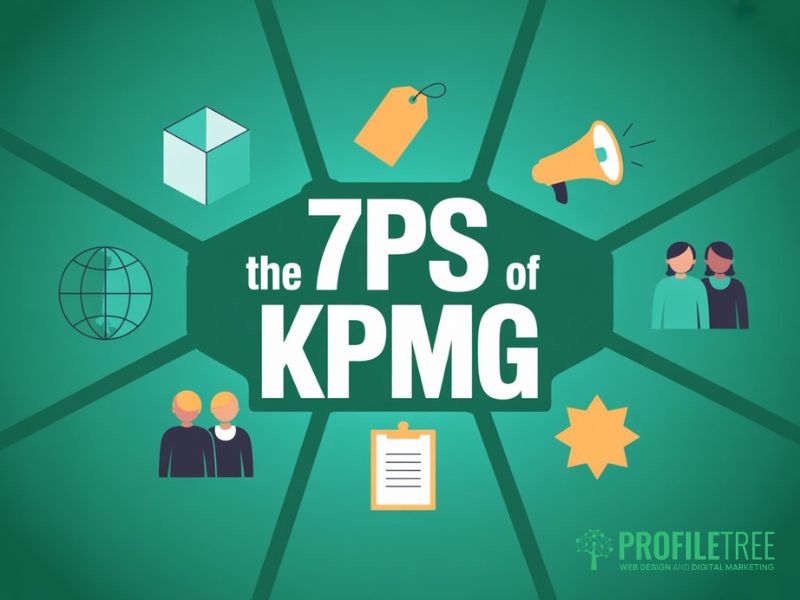
The 7Ps framework is one of the clearest tools for analysing the KPMG marketing strategy in full. It’s particularly useful for professional services because it shifts the question from what a firm does to how the client experiences what it does. Each element below contributes to a coherent buyer experience rather than a fragmented set of tactics.
| Marketing P | KPMG Application |
|---|---|
| Product | Audit, tax, advisory, digital transformation, and AI consulting services packaged into sector-specific packages for finance, technology, healthcare, public sector, and consumer markets. |
| Price | Value-based and project-specific pricing, not published. Premium positioning reflects the complexity of engagements rather than standard hourly rates. |
| Place | Global delivery model with strong regional hubs. UK offices in London, Manchester, Birmingham, Edinburgh, and Belfast serve national and cross-border clients. |
| Promotion | Thought leadership reports, the KPMG Insights content platform, LinkedIn-led social strategy, event sponsorships, and targeted employer brand campaigns. |
| People | Partner-led client relationships. Individual partners function as brand ambassadors; their personal LinkedIn profiles and public speaking records contribute directly to business development. |
| Process | Structured engagement models with defined milestones, reporting cadences, and sign-off procedures. Process transparency is itself a differentiator in high-stakes regulated work. |
| Physical Evidence | Published research, awards, regulatory accreditations, industry rankings, and client case studies serve as proxies for quality in an intangible service. |
The 7Ps framework reveals that the KPMG marketing strategy isn’t built around promotion in the traditional sense. It’s built around demonstrating expertise before a client ever makes contact. KPMG invests heavily in the People and Process elements because those are what clients carry forward when the engagement ends. A strong deliverable delivered through a chaotic process still damages the client relationship.
Digital Strategy and Content Marketing Leadership
The KPMG marketing strategy in the digital channel is built on a content-first model. Rather than spending marketing budget on paid search or display advertising, the firm invests in producing research that the market genuinely wants to read. It’s an approach that earns organic visibility, media coverage, and AI search citations rather than buying them, and it’s one of the most transferable elements of KPMG’s approach for smaller firms.
Thought Leadership: The KPMG Insights Engine
The KPMG Insights platform publishes research across industry verticals: CEO outlook surveys, CFO sentiment indices, consumer confidence trackers, and sector-specific deep dives. These pieces serve multiple functions at once. They create media hooks for earned coverage, give sales teams concrete conversation starters, position individual partners as experts, and generate inbound traffic from decision-makers searching for industry data.
The key discipline is consistency. KPMG runs the same research programmes year on year, which means the data becomes comparable over time and the firm becomes the default source for those benchmarks. Any B2B company building authority in a topic area can apply the same principle: pick two or three questions your market genuinely wants answered, publish the findings on a regular cycle, and own the conversation. That’s professional services branding through substance rather than through positioning statements.
Social Media Strategy: LinkedIn Over Broadcast
KPMG’s social strategy prioritises LinkedIn over other platforms, which reflects where its buyers spend professional time. The firm’s LinkedIn presence is built around research previews that drive traffic to full reports, partner commentary on regulatory and market developments, and employer brand content aimed at graduate and experienced-hire audiences.
Personal branding is central to this. Senior partners with active LinkedIn profiles generate measurably more engagement than corporate posts. KPMG invests in helping its partners build personal brands because the business development returns are real. A managing partner commenting on a piece of legislation is more credible to a prospective client than a banner advertisement making the same claim.
Regional Focus: KPMG’s Marketing Footprint in the UK and Ireland
One of the most overlooked elements of the KPMG marketing strategy is how much it varies by region. Global brand guidelines don’t fully account for the distinct characteristics of the UK and Ireland markets, and KPMG’s regional teams adapt their positioning considerably to local conditions. That regional adaptation is worth examining in detail because it’s where the strategy delivers the most measurable results.
Strategic Sponsorships and Community Presence
In Ireland, KPMG’s sponsorship of the KPMG Women’s Irish Open golf tournament is the most visible example of regional brand building. Running for more than a decade, the sponsorship delivers consistent media coverage, brand association with elite sport, and a platform for client entertaining. In Northern Ireland, KPMG’s Belfast office participates in local business networks, social mobility programmes, and graduate recruitment partnerships with Queen’s University Belfast and Ulster University.
These are deliberate investments in the local entity associations that build trust with clients who care about where their advisory partner is actually rooted. A firm that sponsors local talent and employs locally is a different proposition from one that sends consultants in from London for a project and leaves. That distinction matters in Northern Ireland’s business community, which is relationship-driven in ways that differ from larger UK markets.
Marketing to Belfast’s Tech Sector and Northern Ireland SMEs
Belfast has developed a credible technology cluster, with particular strength in fintech, cybersecurity, and data analytics. KPMG’s Belfast office positions itself as a partner for that community, offering services from R&D tax credits to digital transformation advisory that speak directly to the growth stage of technology businesses.
For SMEs across Northern Ireland, the model points to something important: professional services branding built around local specificity carries more weight than generic national messaging. ProfileTree’s experience working with over 1,000 clients across Northern Ireland, Ireland, and the UK reflects the same principle. Businesses that speak clearly to local markets, with a genuine understanding of local conditions, convert at much higher rates than those leading with global credentials. Our digital marketing services are built around that insight.
ESG as a Brand Differentiator
ESG credentials have moved from optional commitments to active purchasing criteria in professional services marketing. Large organisations now require their advisory partners to demonstrate environmental, social, and governance commitments as a condition of tender, and the KPMG marketing strategy has incorporated this shift more deliberately than most of its Big Four peers.
KPMG was among the early movers in making ESG central to its brand narrative, publishing net-zero commitments, social mobility benchmarks, and supply chain transparency reports that go beyond regulatory compliance. The commercial logic is clear: when two firms offer comparable technical expertise, the client chooses the one whose values align with their own. For listed companies with investor pressure on ESG performance, working with an advisory partner that demonstrably shares those commitments reduces reputational risk.
For B2B firms in Northern Ireland and across the UK, this is an increasingly practical consideration. Public sector contracts now routinely include social value scoring, and SMEs that can demonstrate community investment, apprenticeship programmes, or measurable environmental commitments are differentiating themselves in procurement processes where they’d otherwise compete on price alone. Our content marketing services include developing the kind of transparent, evidence-based narratives that build genuine credibility with procurement teams.
SWOT Analysis of KPMG’s Current Market Standing
A SWOT analysis of the KPMG marketing strategy reveals the pressures the firm is navigating and the principles that translate to other professional services contexts. It’s worth noting that several of the threats KPMG faces are relevant to any firm whose business model depends on human expertise that technology is beginning to replicate.
| Factor | Detail |
|---|---|
| Strength: Global reach with local depth | Offices in 143 countries with regional teams that understand domestic regulatory environments. The combination of global capability and local presence is difficult to replicate. |
| Strength: Proprietary research platforms | Annual reports such as the CEO Outlook and CFO Sentiment Index create recurring media coverage and position KPMG as an authoritative source on executive confidence data. |
| Strength: Employer brand | Consistent ranking as a top graduate employer creates a self-reinforcing talent pipeline. Strong graduate intake strengthens client delivery and deepens sector expertise over time. |
| Weakness: Brand perception gap | KPMG ranks behind Deloitte and McKinsey in advisory brand recognition despite comparable capabilities, partly a legacy of being seen primarily as an audit firm. |
| Weakness: Price sensitivity in mid-market | Technology firms, including Accenture and IBM, are winning advisory mandates previously exclusive to the Big Four, competing on delivery capability rather than credentials alone. |
| Opportunity: AI advisory demand | Growing demand for AI strategy, implementation, and governance work plays directly to KPMG’s strengths in technology consulting and regulated-industry credibility. |
| Opportunity: Northern Ireland and Ireland growth | Belfast’s technology cluster and Dublin’s status as a European financial hub create organic growth opportunities for regional offices with strong local positioning. |
| Threat: Non-traditional competitors | Technology firms including Accenture and IBM are winning advisory mandates previously exclusive to the Big Four, competing on delivery capability rather than credentials alone. |
| Threat: AI disintermediation | AI tools are beginning to automate elements of tax compliance and audit work that previously required substantial professional input, compressing margins in KPMG’s legacy service lines. |
Lessons for B2B Marketers from the KPMG Marketing Strategy
The KPMG marketing strategy isn’t directly transferable to a 20-person advisory firm, but the principles behind it are. The firm’s success in building authority in a trust-sensitive market comes down to a small number of consistent decisions made over a long period. Each of the following lessons can be applied at almost any scale.
Content preceded brand awareness. KPMG didn’t become well-known and then start publishing research. It published research that made it well-known. For any B2B firm trying to build visibility, the question isn’t “how do we raise brand awareness?” but “what do we know that our market genuinely wants to understand?”
Regional specificity amplifies national credibility. KPMG’s UK and Ireland professional services marketing performs better when it speaks to local conditions than when it applies global messaging templates. The same holds for SMEs in Northern Ireland. Businesses that demonstrate a specific understanding of local markets, funding environments, and regulatory conditions convert at higher rates than those positioning for a generic national audience.
The buying journey is now digital, even in professional services. Clients who eventually sign contracts with KPMG have typically read research, watched videos, and followed partners on LinkedIn long before a formal conversation begins. Firms with no visible digital presence are invisible for the first half of that journey, however strong their in-person reputation.
ProfileTree works with professional services firms, consultancies, and B2B businesses across Northern Ireland and the UK to build the kind of digital presence that supports long-cycle sales. Our approach to search engine optimisation and digital strategy is built for businesses where trust and credibility are the primary commercial assets.
FAQs
1. What is KPMG’s primary marketing strategy?
KPMG’s primary marketing strategy is relationship-based B2B marketing supported by thought leadership content. The firm invests in research publications, sector-specific reports, and individual partner brand-building on LinkedIn rather than traditional advertising. The goal is to be the first firm a C-suite executive thinks of when they’re facing a complex audit, tax, or advisory challenge, and to have already earned trust before that conversation begins.
2. Who is KPMG’s target audience?
KPMG markets primarily to large organisations across the public sector, financial services, technology, consumer markets, and healthcare. Within those organisations, the primary targets are chief financial officers, audit committee members, chief risk officers, and senior procurement teams. A secondary audience is graduate and experienced-hire talent, addressed through an active employer brand marketing programme that runs on the same channels as client marketing.
3. What are the 7Ps of KPMG’s marketing mix?
KPMG’s 7Ps cover: Product (sector-specific audit, tax, and advisory services); Price (value-based and premium, not published); Place (global delivery with regional hubs including Belfast, London, and Dublin); Promotion (thought leadership content, sponsorships, LinkedIn); People (partner-led client relationships with active personal branding); Process (structured engagement models with clear reporting); and Physical Evidence (research publications, accreditations, and Big Four status). Together, they explain why KPMG’s professional services branding feels coherent rather than fragmented across touchpoints.
4. How does KPMG use social media for marketing?
LinkedIn is KPMG’s primary social channel, reflecting where its decision-maker audiences spend professional time. The firm’s strategy combines previews of research reports, driving traffic to full publications, partner commentary on regulatory developments, and employer brand content for recruitment. Individual partner profiles generate measurably more engagement than corporate posts, so KPMG invests in helping senior staff build personal brands alongside the corporate account.
5. How does KPMG’s marketing differ in the UK and Ireland?
KPMG’s UK and Ireland teams apply global brand guidelines with substantial regional adaptation. In Ireland, the KPMG Women’s Irish Open golf sponsorship is the most visible regional brand asset. In Northern Ireland, KPMG’s Belfast office focuses on the local technology cluster and graduate partnerships with Queen’s University Belfast. Across the UK, regional teams tailor their professional services marketing to local economic conditions, funding environments, and regulatory requirements rather than applying a single national template.