
Behavioural Economics in Digital Marketing for SMEs
Table of Contents
Behavioural economics explains why people make the choices they do online, and why those choices are rarely as rational as we would like to think. For SMEs across Northern Ireland, Ireland and the UK, this isn’t an academic exercise. It shapes how your website is structured, how your pricing is presented and whether a visitor converts or leaves.
This guide covers the core principles of behavioural economics in digital marketing, how to measure whether they’re working and where the ethical line sits under current UK consumer protection rules.
What Is Behavioural Economics in Digital Marketing?
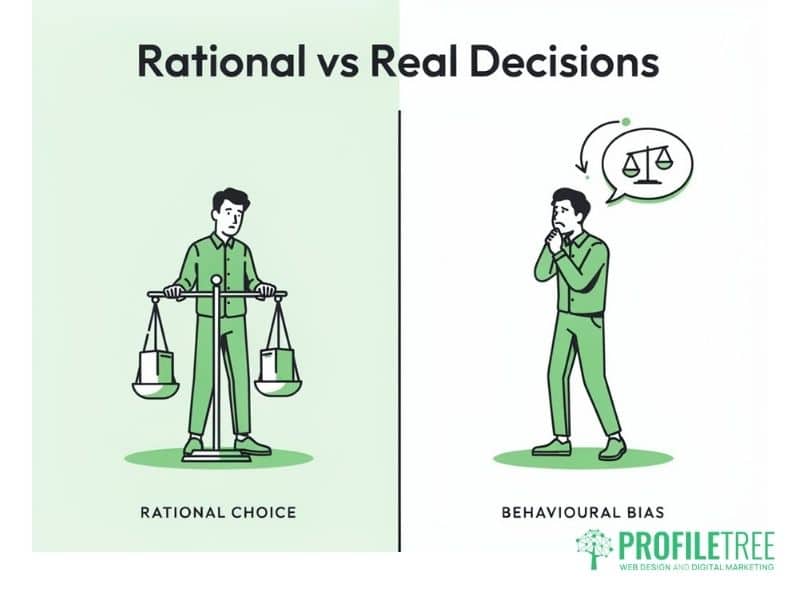
Traditional economics assumes people weigh their options logically and choose the best one. People take shortcuts. They’re influenced by how choices are framed, by what they stand to lose, by what others around them are doing and by information presented early in the decision process.
Psychologists describe two modes of thinking that explain why this happens. System 1 is fast, automatic and runs on instinct: it decides in seconds whether a homepage looks trustworthy. System 2 is slow and deliberate: it compares prices, reads the small print and weighs trade-offs. Most web browsing happens in System 1. A cluttered page, a confusing price table or a form with too many fields forces a visitor into System 2 thinking earlier than they want to be there, and many simply leave rather than do the work. Good behavioural design keeps System 1 comfortable for as long as possible, then supports System 2 with clear facts when a visitor is ready to decide.
Herbert Simon’s concept of bounded rationality explains why this happens. People don’t have unlimited time, information or mental energy to weigh up every option in full, so they settle for the first choice that clears a “good enough” bar rather than hunting for the objectively best one.
Economists call this satisficing. On a cluttered homepage or a pricing page with eight tiers, a visitor doesn’t compare every option properly; they scan for the first one that looks acceptable and either pick it or give up. A confusing form or an unclear price table raises the effort needed to reach that “good enough” point, and many visitors leave rather than do the extra work. Good behavioural design lowers the effort required to reach a satisfactory decision, so visitors settle on your preferred option rather than abandoning the page.
In digital marketing, every element of your website, every email subject line, every pricing table is already influencing how visitors feel and decide, whether you’ve designed it that way or not. Behavioural economics gives you a framework to make those influences deliberate and honest, rather than accidental.
The Core Principles and What They Mean in Practice
Seven principles account for most of the behavioural economics you’ll see applied on SME websites and in SME campaigns. Each one translates into a specific design decision.
Social Proof
Social proof is one of the most visible applications of behavioural economics in digital marketing. People look to others when they’re uncertain. Online, this means reviews, ratings, client counts, and testimonials carry disproportionate weight in a buying decision. A service business in Belfast that displays genuine Google reviews on its website is applying social proof. A professional services firm that shows client logos on its homepage is doing the same.
The simplest implementation for an SME is ensuring your Google review score is visible on key service pages, not buried in a footer. It should sit near your primary call to action, where it does the most work. Reviews also feed directly into local search visibility, since your Google Business Profile score influences click-through rates in the map pack as well as trust once a visitor lands on the page.
Anchoring
Anchoring is a core behavioural economics concept for anyone setting prices online. The first number a visitor sees on a pricing page sets a reference point against which everything else is judged. If a visitor sees a £5,000 package first, a £1,500 package feels accessible. If they see £1,500 first, the same package feels expensive by comparison.
This anchoring effect is why many professional service websites present packages in descending order, with the premium tier shown first. Done honestly, this is framing that reflects the genuine value of each tier, not deception. The ethical check for UK businesses is whether the anchor price is real. A crossed-out price that was never actually charged is a dark pattern and, under current UK Competition and Markets Authority guidance, a potential trading standards issue.
Loss Aversion
Loss aversion is arguably the most quoted finding in behavioural economics. The pain of losing something is roughly twice as powerful as the pleasure of gaining an equivalent thing. Loss aversion shows up in legitimate ways: trial periods, free audits and genuine limited-availability messaging all tap into the fear of missing out.
For SMEs running paid campaigns, this principle is most useful in ad copy and landing page headlines. A headline reading “Stop losing website visitors to slow load times” tends to outperform “Get a faster website”, because the first activates loss aversion and the second doesn’t. The implied loss must be real. A countdown timer that resets when the page reloads is false urgency, and it’s addressed directly by the CMA’s Online Choice Architecture guidance.
The Decoy Effect
The decoy effect is a lesser-known but powerful behavioural economics tool for pricing pages. Add a third option positioned between two existing choices, and it can shift buyers towards the higher-value option without changing either price. The decoy makes one option look significantly better by comparison.
For service businesses with tiered packages, this is a structural pricing decision rather than a marketing tactic. A web design agency might offer a starter, a growth and a full-service package. If the growth tier is priced so the full-service option looks like a strong value next to it, that is the decoy effect at work.
Mental Accounting
Mental accounting is one of Thaler’s central contributions to behavioural economics. His research showed that people categorise spending differently depending on how it is framed, even when the financial outcome is identical. A business owner might resist a £500 monthly retainer but readily approve a £6,000 annual contract, because one category feels like a recurring cost and the other feels like an investment.
This affects how you package and present services. “A website that pays for itself in three new client enquiries” frames the cost as an investment rather than an overhead. For SMEs cautious about digital spending, this framing, when backed by honest figures, is both more persuasive and more accurate than a bare price.
Cognitive Load and Choice Overload
Cognitive load is the behavioural economics principle most directly tied to web usability. When people face too many options, they often choose nothing. This is choice overload, and it’s one of the most common conversion killers in web design. A navigation menu with thirty items, a pricing page with eight packages, a contact form with twelve fields: all of these raise cognitive load and lower the odds that a visitor takes the action you want.
The behavioural economics fix here is simplification. On websites built for SMEs, this usually means cutting navigation to the five or six most commercially important sections, limiting service tiers to three and reducing contact forms to the minimum fields needed to qualify a lead. The aim is to make the decision feel easy rather than effortful.
Reciprocity
Reciprocity closes out the seven principles of behavioural economics most relevant to SME marketing. When someone gives you something of value, you feel a degree of obligation to return the gesture. In content marketing, this is the principle behind free guides, audits, tools and webinars. Useful free content builds goodwill and positions a business as the obvious choice once the reader is ready to buy.
For SMEs, applying this behavioural economics principle doesn’t require expensive production. A one-page guide to a common industry problem, a checklist, or a short video answering a question customers regularly ask is enough to activate the principle. Content built around the questions an audience is already asking tends to outperform content written mainly to promote a service, because it earns attention before it asks for anything.
Where Theory Meets the Page
Applying behavioural economics well depends on knowing exactly where it touches a live website. Four areas of a typical SME website carry most of the weight.
Pricing page structure applies anchoring and the decoy effect. The order packages appear in, the visual weight given to each tier and how benefits are described all influence which option a visitor picks. A digital marketing strategy built around clear tier logic, rather than a flat list of services, tends to convert more consistently.
The homepage layout applies social proof and cognitive load principles together. A homepage crowded with every service, logo and award a business has ever collected often performs worse than one with a single clear value proposition, a handful of trust signals and one primary call to action.
Form design is a direct application of cognitive load theory. Every additional field reduces completion rates. A website design review should always include an audit of form length and friction on contact and enquiry pages, since this is one of the cheapest conversion fixes available.
Call-to-action copy can apply loss aversion, curiosity or reciprocity depending on the phrase. “Book your free audit before Friday” activates scarcity. “See how your website compares” activates curiosity. “Get your free consultation” activates reciprocity. None of these needs deception; they need an understanding of what motivates a specific audience.
B2B Versus B2C Applications
Behavioural economics in digital marketing is usually illustrated with consumer examples, but the principles hold for business buyers too. Most behavioural economics examples come from e-commerce and subscription services, where the purchase decision is fast, and the stakes are relatively low. B2B decisions work differently, and the same principles apply with a different weight.
A Northern Ireland manufacturer evaluating a new website or a marketing contract isn’t making an impulse decision. Loss aversion matters more than scarcity in a B2B context because business buyers are highly motivated to avoid a visible mistake in front of colleagues. Social proof from comparable businesses, same industry, similar size, similar geography, carries far more weight than a large aggregate review count. Reciprocity, in the form of a useful free audit or a detailed proposal, is a more effective conversion mechanism than urgency.
B2B web design and content marketing informed by behavioural economics tends to prioritise authority signals, peer-level social proof and low-risk first steps, such as a free consultation rather than a direct purchase, over the urgency tactics that perform well with consumers.
The Ethical Line: Nudging Versus Manipulation
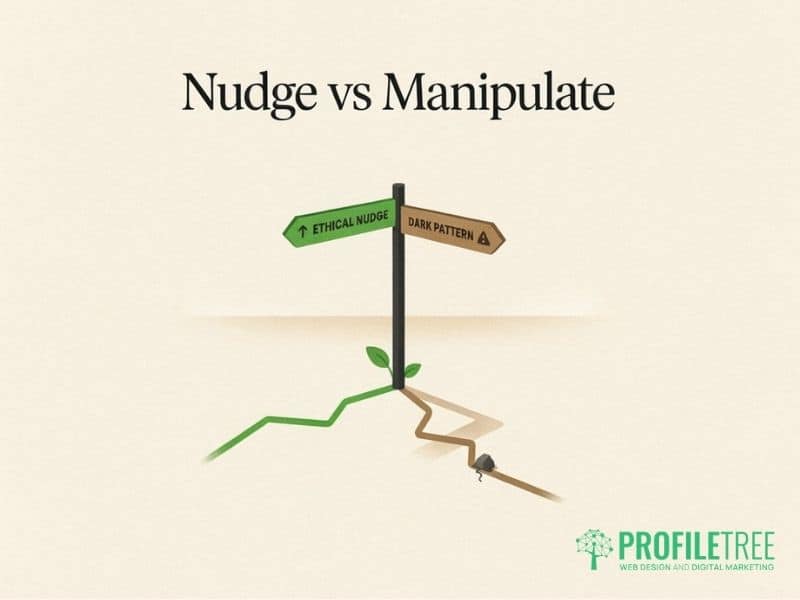
Applying behavioural economics responsibly means understanding exactly where regulators draw the line. The UK Competition and Markets Authority published its Online Choice Architecture report in 2022, identifying design practices it considers harmful to consumers. The Irish Competition and Consumer Protection Commission has raised similar concerns. Both regulators draw the same distinction behavioural economists draw: a nudge helps someone make a decision that genuinely serves their interests, while a dark pattern manipulates them into a decision that serves the seller at the buyer’s expense.
Common dark patterns that undermine honest behavioural economics and that UK businesses should avoid include countdown timers that reset when a page reloads, availability claims that are not real, such as “only two left” when stock is plentiful, pre-ticked consent boxes, deliberately confusing unsubscribe flows and drip pricing, where the full cost only appears at the final stage of checkout.
The practical test is simple: would you be comfortable if a customer saw exactly how a design decision was made and why? If yes, the principle is being applied honestly. If not, it has crossed the line.
Ciaran Connolly, founder of ProfileTree, puts it this way: “The same bias that works brilliantly for a budget airline can backfire completely on a premium brand. A countdown timer suits an impulse purchase; it looks cheap on a service that sells trust. Context decides whether a nudge builds confidence or destroys it.”
For SMEs, this goes beyond legal risk. Dark patterns erode trust. A customer who feels manipulated doesn’t come back, doesn’t refer others and is more likely to leave a negative review. The long-term cost outweighs any short-term gain in conversions.
Measuring Impact: A Framework for Testing Behavioural Changes
A behavioural economics change is only worth keeping if you can prove it worked. Most SMEs skip measurement entirely and rely on instinct, which makes it impossible to separate a genuine improvement from a coincidence.
A simple three-step framework keeps this honest. First, run a bias audit: pick one page and identify where anchoring, cognitive load or social proof is weak or missing, using the checklist in the next section as a starting point. Second, write a specific hypothesis rather than a vague hope, for example: “Moving the review score above the fold on the pricing page will increase form completions.” Third, test the change against a clear metric in Google Analytics 4, such as a scroll-depth event, a form-start event or the actual conversion event, rather than judging by traffic alone.
Run one change at a time where possible. Testing anchoring and social proof together on the same page makes it impossible to tell which change moved the number. For low-traffic SME sites, a full statistical A/B test often isn’t practical; a before-and-after comparison over a matched period, checked against seasonal trends, is a reasonable substitute as long as the limitation is acknowledged rather than ignored.
A Simple Behavioural Audit for Your Website
A short audit is the fastest way to spot where behavioural economics is missing from your own site. Before commissioning a full review, a business owner or marketing manager can run a light audit using five questions.
On your homepage: is there a single dominant call to action, or are visitors being asked to do three or four things at once? This is the cognitive load test.
On your pricing or services page, does the order in which options appear reflect how you want visitors to think about value? This is the anchoring test.
On any page with a form: what is the minimum information you actually need to qualify the enquiry? Any field beyond that minimum is reducing your conversion rate. This is the friction test.
On your testimonials or reviews section, are your strongest social proof elements visible near the points where visitors are most likely to decide? If they sit in the footer, they’re doing very little work. This is the placement test.
On any urgency or availability messaging: is it real? If availability changed last quarter and the message was never updated, the page has a trust problem, not a conversion mechanism. This is the ethical test.
Turning Principles Into Practice
Behavioural economics in digital marketing works best as a framework for understanding why visitors behave the way they do on your website and in your campaigns, used to design experiences that make the right decision feel like the easy one. Applied honestly, the same principles that improve conversion rates also improve trust and long-term retention.
A simple fix, such as moving social proof above the fold or trimming cognitive load from a form, costs little and rarely backfires. Businesses that treat this as a design discipline, rather than a set of manipulation tricks, tend to keep the customers they win. If you want a second opinion on where your own site is losing visitors to friction rather than genuine disinterest, get in touch with ProfileTree for a straightforward review.
FAQs
1. What is behavioural economics in the context of digital marketing?
Behavioural economics applies psychological research on decision-making to the design of websites, campaigns and pricing. It recognises that buying decisions are rarely fully rational and works with, rather than against, the shortcuts and biases that shape human judgement.
2. Is nudge theory ethical in advertising?
Nudge theory is ethical when it helps someone make a decision that genuinely serves their interests, and unethical when it manipulates them into a decision they would not make with full information. The UK CMA’s Online Choice Architecture guidance sets out specific practices that cross the line, and UK and Irish businesses should be familiar with them for both compliance and reputational reasons.
3. What is a dark pattern in web design?
A dark pattern is a deliberate design choice that pressures a user into doing something they didn’t intend, typically to benefit the seller at the user’s expense. Common examples include fake countdown timers, hidden costs revealed only at checkout, pre-ticked opt-in boxes and obstructive cancellation flows.
4. How does behavioural economics apply to B2B marketing?
In B2B contexts, the most relevant principles are loss aversion, since business buyers are highly motivated to avoid a visible mistake, peer-level social proof from comparable businesses, authority signals such as credentials and published expertise and reciprocity through free audits or proposals. Scarcity and urgency tactics that work in consumer contexts are often counterproductive in professional service sales.
5. How do you measure whether a behavioural change actually worked?
Set a specific hypothesis tied to one change, then track it against a defined event in Google Analytics 4, such as a form-start or conversion event, rather than overall traffic. Change one variable at a time and compare a matched before-and-after period where a full A/B test isn’t practical due to traffic volume.