
Twitch Marketing Strategy: Brand Engagement on Live-Streaming
Table of Contents
Twitch attracts more than 30 million daily visitors and over 9 million unique broadcasters each month. For brand managers and marketing teams across the UK and Ireland, weighing up where to allocate paid social and content budgets, that scale makes it worth understanding properly. This guide covers what the platform offers brands, how the main promotional formats work, and what a grounded Twitch marketing strategy looks like for a business that has never streamed before.
The audience skews young and engaged. Around 41% of Twitch users are aged 16-24, with a further 32% aged 25-34, according to Twitch’s published demographic data. Average daily viewing time exceeds 90 minutes, a figure that consistently outperforms passive social media formats. Understanding those numbers is the first step toward deciding whether Twitch deserves a place in a broader digital marketing campaign.
It sits within a broader live-streaming landscape that includes YouTube Live and emerging competitors. Where it differs is in the community. Chat, emotes, subscriber loyalty, and real-time interaction create a depth of audience engagement that pre-recorded content rarely matches. That same culture, however, demands a different approach from brands used to controlling the message entirely.
What Is Twitch?
Twitch is a live-streaming platform that launched from the gaming-focused service Justin.tv. Amazon acquired it in 2014, and it has since diversified well beyond gameplay into content categories including music, art, talk shows, cooking, and “Just Chatting” streams where creators engage their audiences without a game in the frame.
The platform’s core mechanic is real-time interaction. Viewers watch a live broadcast and communicate simultaneously via chat, using text, emotes, and platform-specific features such as Bits, a form of virtual currency used to cheer streamers. Streamers can respond to chat directly during a broadcast, creating a two-way relationship that distinguishes Twitch from most other content channels.
That interactivity is also what makes it both an opportunity and a challenge for brands. Viewers on Twitch are practised at identifying and rejecting forced promotion. Campaigns that feel authentic to the streamer’s content and community tend to perform. Campaigns that feel bolted on rarely do.
UK and Irish Audience Context
While Twitch’s largest audiences are in the United States, Germany, Russia, and South Korea, per Twitch’s published data, the UK and Irish gaming and entertainment markets are meaningful. The UK is consistently among Europe’s largest gaming markets by revenue. For brands targeting 18 to 34-year-olds in the UK and Ireland, Twitch offers access to an audience that is genuinely difficult to reach through traditional broadcast channels.
The UK’s Online Safety Act 2023 is also relevant for any brand operating a Twitch channel directly. Brands running their own channels are not platform operators for the purposes of the Act, but any brand-commissioned content must still comply with Twitch’s community guidelines, ASA/CAP Code rules on advertising disclosure, and standard UK consumer protection requirements around sponsored content.
Twitch Demographics and Audience Insights
The demographic data below comes from it’s own published figures and should be treated as indicative rather than precise, given that platform-reported data tends to reflect active registered users rather than total viewership.
| Audience Segment | Twitch Data | Implication for Brands |
|---|---|---|
| Age 16-24 | ~41% of users | Strong fit for youth-skewing product categories; requires authentic brand voice |
| Age 25-34 | ~32% of users | Purchasing power increases; responds to value-driven messaging |
| Gender split | ~65% male, growing female base (Twitch) | Skewed but broadening; female viewership strongest in non-gaming categories |
| Daily viewing time | Over 90 minutes average | High dwell time creates repeat brand exposure opportunities |
| Monthly broadcasters | Over 9 million unique | Wide range of micro-community niches to match almost any target demographic |
The platform’s audience actively chooses to spend time there, which is meaningfully different from passive social media scrolling behaviour. That opt-in attention is why brands in gaming, consumer electronics, food and drink, and lifestyle categories have found it a productive channel. It also explains why non-endemic brands, those with no obvious gaming connection, can still build a presence, provided the content they bring genuinely serves the community.
Why Real-Time Engagement Matters for Brand Strategy
The live nature of Twitch creates opportunities that scheduled content cannot replicate. A brand sponsoring a stream can respond to viewer reactions in real time, adapt messaging based on chat feedback, and build associations with the streamer’s community over multiple broadcasts rather than a single campaign window. For brands working with a social media marketing strategy, that depth of engagement data is worth factoring into channel planning.
Types of Brand Promotions
Brands can reach Twitch audiences through several distinct formats. Each carries different cost structures, creative requirements, and audience responses. Understanding the differences matters before committing the budget.
Sponsorship of Streamers
Sponsoring individual streamers is the most widely used brand route on Twitch. Streamers with established communities promote a brand’s product during their broadcasts, typically through verbal mentions, on-screen placement, or product use. The arrangement works best when the product genuinely fits the streamer’s content, because Twitch audiences are alert to endorsements that feel transactional rather than genuine.
Selection is the most important decision in a sponsorship campaign. Micro-influencers, typically defined as streamers with audiences of 1,000-100,000 followers, often deliver higher engagement rates per follower than high-profile partners. For UK brands working within tighter budgets, a targeted group of micro-sponsorships across relevant communities often outperforms a single high-cost partnership. This mirrors the approach outlined in any well-constructed influencer marketing strategy.
ASA/CAP Code compliance is non-negotiable: any sponsored content on Twitch must be clearly disclosed as advertising. Brands commissioning UK-based streamers are responsible for ensuring that disclosure is handled correctly.
Twitch Advertising Formats
Twitch’s managed advertising offering provides three main placement types.
Pre-roll ads play automatically before a stream begins. They capture full attention but are also the format most likely to trigger viewer friction.
Mid-roll ads run during the stream and work best when coordinated with the streamer so they fall at natural pause points rather than interrupting action.
Display ads appear around the stream layout as static or video placements. Less intrusive, but also lower attention.
Twitch advertising is bought through Amazon Advertising, which allows audience targeting using Amazon’s first-party shopping and intent data. For brands already running Amazon ad campaigns, that integration offers meaningful cross-channel consistency.
Creating Branded Channels
Brands can establish their own Twitch channels and broadcast directly, taking full control of content and messaging. Product launches, Q&A sessions, tutorials, and behind-the-scenes content all translate reasonably well to the format. Building a following from scratch requires consistency and genuine audience investment, which, in practice, means regular scheduling and active participation in chat.
The production requirements for a credible branded channel are often underestimated. Twitch audiences compare brand streams against experienced individual creators whose setups have been refined over the years. Audio quality, lighting, graphics overlays, and on-screen presentation all affect perception. For brands without in-house video marketing capabilities, working with a video marketing specialist before launching a branded channel is advisable. Poor production is difficult to recover from once a channel has been established.
Content produced for a branded Twitch channel does not have to live exclusively on Twitch. Stream highlights, clip compilations, and repurposed VOD content can be directly uploaded to a YouTube channel, extending the lifespan and reach of what was produced live. This Twitch-to-YouTube pipeline is worth planning before the first broadcast, not after.
Twitch Extensions
Twitch Extensions are interactive overlays built into the stream layout. Brands can use extensions to run polls, quizzes, product browsers, or gamified interactions that let viewers engage with brand content without leaving the stream. Extensions are among the more technically involved options, typically requiring developer input to build or configure, but they offer a non-interruptive engagement mechanic that standard advertising cannot match.
Twitch Drops
Twitch Drops are time-based viewer rewards: viewers who watch a stream for a defined period receive a digital reward, such as an in-game item, a discount code, or exclusive content. The format drives both viewership duration and viewer account linking, which generates first-party data as a by-product.
Drops work particularly well for gaming brands, where in-game items carry real perceived value for the audience. For non-gaming brands, the mechanism still functions if the reward is genuinely appealing, but the threshold for what motivates a viewer to watch for an extended period is higher.
Event Sponsorships
Twitch hosts high-audience events, including Twitch Rivals, a competitive gaming series featuring established streamers, and charity marathons such as Extra Life, a fundraising stream. Sponsoring these events provides brand visibility at scale, with dedicated placement across broadcast graphics, verbal mentions, and interstitial segments.
Event sponsorship requires advance planning and direct engagement with Twitch’s brand partnerships team. It is generally the highest-investment Twitch marketing route and best suited to brands with objectives focused on broad awareness rather than targeted community building.
Twitch Ad Formats at a Glance
| Format | Typical Use | Audience Disruption | Best For |
|---|---|---|---|
| Pre-roll ad | Broad awareness | High | High-reach campaigns with simple messages |
| Mid-roll ad | Brand recall | Medium | Campaigns where streamer coordination is possible |
| Display ad | Background brand presence | Low | Supplementing other Twitch activity |
| Extensions | Interactive engagement | None (viewer-initiated) | Brands with technical resource and strong creative concepts |
| Drops | Viewership and data acquisition | None (incentive-driven) | Gaming brands and reward-based promotions |
| Streamer sponsorship | Community trust and brand fit | None when authentic | Brands with technical resources and strong creative concepts |
| Event sponsorship | Mass awareness | None (integrated into event) | Large brands with broad awareness objectives |
Crafting a Twitch Marketing Strategy
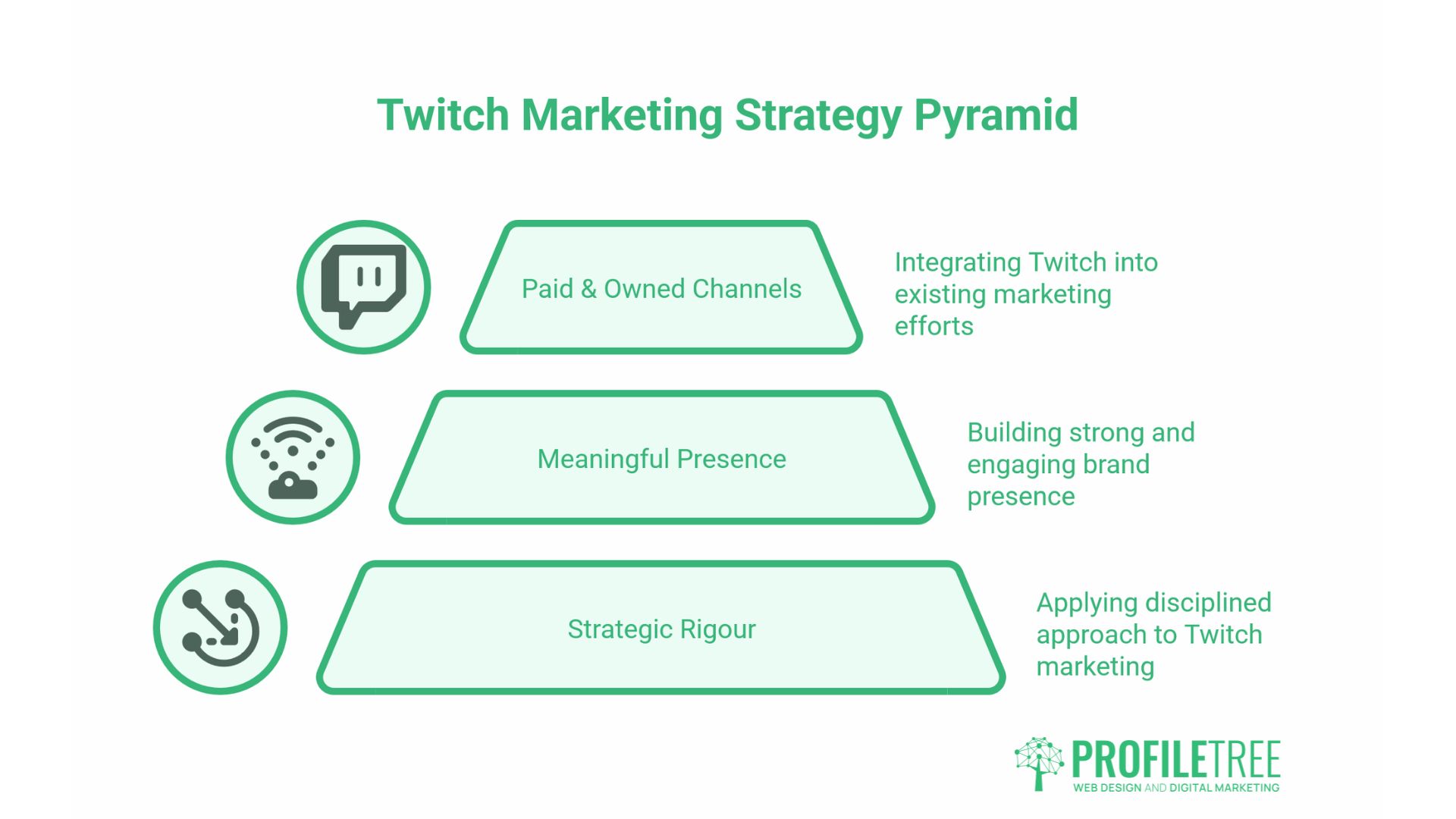
Twitch is not a channel that rewards ad hoc investment. The brands that build meaningful presence on the platform approach it with the same strategic rigour they apply to any other paid or owned channel.
Defining Clear Campaign Goals
The goal shapes everything else. Brand awareness campaigns are better served by event sponsorships or high-reach streamer partnerships. Community-building goals are better served by micro-sponsorships and consistent branded channel activity. Conversion-focused objectives require careful tracking setup, given it’s attribution is less straightforward than paid search or display.
Most UK SMEs approaching Twitch for the first time are best served by treating it as a brand awareness and audience-building channel rather than a direct response vehicle, at least initially. Setting realistic expectations at the outset prevents premature abandonment of what can be a slow-burn but genuinely high-engagement channel.
Choosing the Right Streamers
Beyond audience size, the relevant evaluation criteria for a streamer partnership include audience demographics, engagement rate, content category fit, community tone, and the streamer’s own track record with sponsored content. Concurrent viewers relative to follower count is a reasonable proxy for genuine engagement. A streamer who handles sponsorships poorly reflects on the brand, not just on themselves.
For brands targeting the UK market specifically, UK-based streamers carry practical advantages: time zone alignment for live activation, shared cultural references, and more straightforward contractual arrangements under UK law. The Northern Irish and Irish gaming communities, while smaller in absolute terms, are tightly connected and highly engaged.
Developing Authentic Content
The most common failure mode in Twitch brand marketing is promotional content that violates the community’s expectations of authenticity. Twitch viewers have developed a sophisticated sense of when a sponsorship feels genuine and when it’s been scripted by a marketing team unfamiliar with the platform’s culture. Giving streamers creative latitude, within agreed brand parameters, consistently produces better results than tightly scripted integrations.
This applies equally to branded channels. A brand channel that streams polished corporate video content will struggle to build an audience. A brand channel that genuinely participates in Twitch culture, responds to chat, and provides content its audience actually wants to watch has a credible path to community growth.
Engaging with the Audience Directly
Twitch’s live chat is a direct line to viewers during a broadcast. Brands with personnel able to monitor and respond to chat during streamer sponsorship activations, or during their own branded streams, build community recognition significantly faster than those who treat the chat as background noise. This active engagement is also where social media marketing translates directly into commercial outcomes: genuine conversations in chat create brand recall that passive advertising cannot.
Placing Twitch Within a Wider Channel Mix
Twitch is most effective as part of a multi-channel strategy rather than a standalone investment. A brand running Twitch sponsorships alongside YouTube content, paid social, and organic SEO creates multiple touchpoints with its audience. Content produced on Twitch, including clips, highlights, and stream recordings, can be repurposed across those other channels, reducing the effective cost per asset.
For UK businesses building out a broader digital presence, understanding how Twitch fits into a full digital marketing strategy is as important as understanding the platform’s mechanics. A Twitch campaign that exists in isolation rarely delivers the compounding returns that a joined-up content and channel approach can.
Ciaran Connolly, founder of ProfileTree, puts it plainly: “The brands that get results on Twitch aren’t the ones who spend the most. They’re the ones who understand the community first and build their presence around what that community actually values.”
Measuring Campaign Effectiveness
Twitch provides channel analytics covering concurrent viewership, follower growth, chat activity, clip performance, and ad metrics. For sponsorship campaigns, brands should establish tracking parameters with the streamer in advance, including agreed reporting on peak concurrent viewers during brand integrations, unique viewers over the campaign period, and any click or conversion data from promotional links.
Comparing Twitch performance against other channels requires some adjustment. Twitch’s strength is in attention and community engagement, metrics that do not map directly onto cost-per-click or cost-per-acquisition benchmarks. Brands that evaluate Twitch solely on direct-response metrics often undervalue what the channel actually delivers in terms of brand equity and audience relationship-building.
Case Studies: Successful Brand Campaigns on Twitch
Three widely referenced examples illustrate different approaches to Twitch brand activation. In each case, the transferable principle is more useful than the brand name it carries.
KFC and the “Gamer Gauntlet”
KFC built a Twitch event around competitive gaming challenges, hosted by established streamers and integrated with the brand’s product in a deliberately light-hearted way. The format worked because the brand leaned into the platform’s entertainment culture rather than against it. The lesson for UK brands is that Twitch campaigns built around entertainment and community participation, rather than product messaging, tend to earn audience goodwill rather than resistance.
Nike’s Gaming Content Strategy
Nike created a branded channel and worked with gaming streamers to present the brand as relevant to gaming culture without misrepresenting what Nike actually is. The approach required the brand to accept a supporting role, letting the streamers and gaming content carry the entertainment and placing the brand in that context rather than at the forefront. For brands with strong visual identities, Twitch’s overlay and extension capabilities allow that brand presence to exist without dominating the content.
Gillette’s Streamer Partnerships
Gillette partnered with streamers across gender demographics and gave them latitude to discuss the products in their own voice. Streamers shared personal grooming routines and offered discount codes. The campaign performed because the disclosure was clear, the integration was conversational, and the product was relevant to the audience’s daily life outside gaming. The discount code mechanic also provided a conversion tracking mechanism that is otherwise difficult to achieve on Twitch.
Challenges of Twitch Marketing
Twitch brand marketing has genuine barriers that brands should understand before committing resources. Awareness of these challenges is not a reason to avoid the platform, but it is a reason to plan carefully.
Balancing Authenticity and Promotion
Twitch’s audience has a low tolerance for overt advertising presented without genuine context. Brands that brief streamers too tightly or attempt to control a sponsorship’s creative execution too closely frequently produce content that alienates the very community they are trying to reach. The best Twitch brand marketing operates more like a genuine product endorsement than a traditional ad placement.
This balance is also a practical challenge for in-house marketing teams accustomed to tightly controlling brand messaging. Working with an agency that understands content marketing transparency and audience trust dynamics can help teams calibrate the level of creative freedom that produces the best outcomes.
Navigating Community Guidelines and UK Compliance
Twitch’s community guidelines cover what streamers can and cannot broadcast. Any brand-commissioned content must comply with those guidelines, and brands carry reputational risk if a sponsored streamer violates them during a campaign. Establishing clear contractual parameters, including content standards and disclosure requirements, before any campaign goes live is not optional.
For UK-based campaigns, ASA guidance on influencer advertising applies to Twitch sponsorships in the same way it applies to Instagram or YouTube brand partnerships. The requirement to disclose paid partnerships clearly and prominently is a legal obligation, not a stylistic choice. Brands unfamiliar with the UK influencer advertising rules should review the ASA/CAP Non-broadcast Code before commissioning any sponsored content.
Finding the Right Audience Fit
It’s community diversity is both a strength and a challenge for its brand strategy. A brand that enters the platform without understanding which communities are relevant to its audience can spend significantly without reaching the right people. The planning work required to identify suitable streamers, evaluate community demographics, and select content categories is not trivial, and it requires genuine familiarity with the platform rather than a surface-level audit.
For brands that lack internal Twitch expertise, the planning phase is often where digital marketing campaign support makes the biggest practical difference. Getting the streamer and community selection right at the outset matters far more than any individual creative decision made later in the process.
Production Quality for Branded Channels
Brands that underinvest in production when launching their own Twitch channels rarely recover. The platform’s audience evaluates stream quality instinctively: audio, lighting, graphics, scene transitions, and overlay design all contribute to whether a viewer stays or leaves within the first few minutes. For brands planning a channel strategy, professional video production input during the setup phase is significantly more cost-effective than remedying a poor first impression.
On-camera presence in a live, interactive environment is a distinct skill that most marketing professionals have not had cause to develop. Investing in digital skills development for the team before going live typically produces better content and more confident streamer-audience interaction from day one.
Is Twitch Right for Your Business?
Not every brand belongs on it, and the platform’s unique audience dynamics mean that a decision to invest should be based on an honest evaluation rather than its headline statistics.
Twitch is likely worth serious consideration if the target audience overlaps with 18 to 34-year-olds, if the brand has something genuine to offer within an entertainment or community context, and if there is budget and appetite for a medium-term investment in community building. It is less likely to deliver returns for brands seeking fast, measurable direct response outcomes with limited creative flexibility.
For UK and Irish SMEs, the platform’s value is greatest when it connects to a wider social media marketing strategy rather than operating as a standalone experiment. Twitch content that feeds into YouTube, clips that perform on TikTok, and sponsorship activations that build email list audiences all extend the return on what is produced on the platform. Thinking about Twitch as a content source as much as a distribution channel changes the economics considerably.
The platform continues to evolve. Its audience has broadened beyond gaming substantially over the past four years, and its advertising infrastructure has matured as Amazon has integrated its own targeting capabilities. For brands that invest the time to understand it properly, Twitch offers access to an engaged, attentive audience that is genuinely difficult to reach anywhere else.
Conclusion
Twitch rewards brands that approach it on its own terms: authentic streamer relationships, realistic production standards, and genuine community participation rather than broadcasting to an audience.
For UK and Irish SMEs, the most practical entry point is a micro-influencer sponsorship with a UK-based streamer whose audience already resembles your target customer. Content produced on Twitch feeds into YouTube, social clips, and email acquisition, turning a single live activation into a multi-channel asset.
Start with clear goals, select streamers on community fit rather than follower count, and build ASA disclosure requirements into every campaign brief from the outset.
FAQs
How much does Twitch influencer marketing cost for a UK brand?
Micro-influencer sponsorships can start from a few hundred pounds per stream. Mid-tier partnerships typically range from £1,000 to £5,000 per activation. All figures are indicative; negotiate rates directly with streamers or their management.
What is the difference between Twitch and YouTube for brand marketing?
Twitch is live-first, built around real-time community interaction. YouTube is VOD-first, with content that remains searchable and discoverable long after publication. Many brands use both, producing live content on Twitch and repurposing highlights for YouTube.
Do Twitch sponsorships need to be disclosed in the UK?
Yes. The ASA/CAP Code requires clear and prominent disclosure of any paid partnership in content aimed at UK audiences. Brands commissioning UK-based streamers are responsible for ensuring that disclosures are made correctly on every stream.
What types of UK brands have used Twitch successfully?
Consumer electronics, energy drinks, gaming peripherals, fast food, and streaming services have the most established presence. Brands in sports, clothing, and food have also run credible campaigns, typically through streamer sponsorships rather than branded channels.