
Integrating a CDP into Your MarTech Stack: A Practical SME Guide
Table of Contents
Most SMEs evaluating their MarTech stack ask the wrong question first. They ask “which CDP should we use?” before they have answered whether they need one. The result is expensive software that sits largely unused, bolted onto a MarTech stack that was never prepared to receive it.
A Customer Data Platform sits at the centre of a modern MarTech stack, pulling data from your website, CRM, email platform, and ad channels into a single, unified customer profile. That profile then feeds your campaigns, your content, and increasingly your AI tools. When it works, it turns fragmented signals into coherent customer journeys. When it fails, it usually does so for the same reason: the data going in is not clean enough to produce anything useful.
This guide is written for marketing managers and business owners at UK and Irish SMEs who are assessing MarTech stack integration as a practical decision, not a theoretical one. It covers what a CDP actually does, how to integrate it in five structured phases, and what to do before you spend a penny on the software.
Does Your SME Actually Need a CDP?
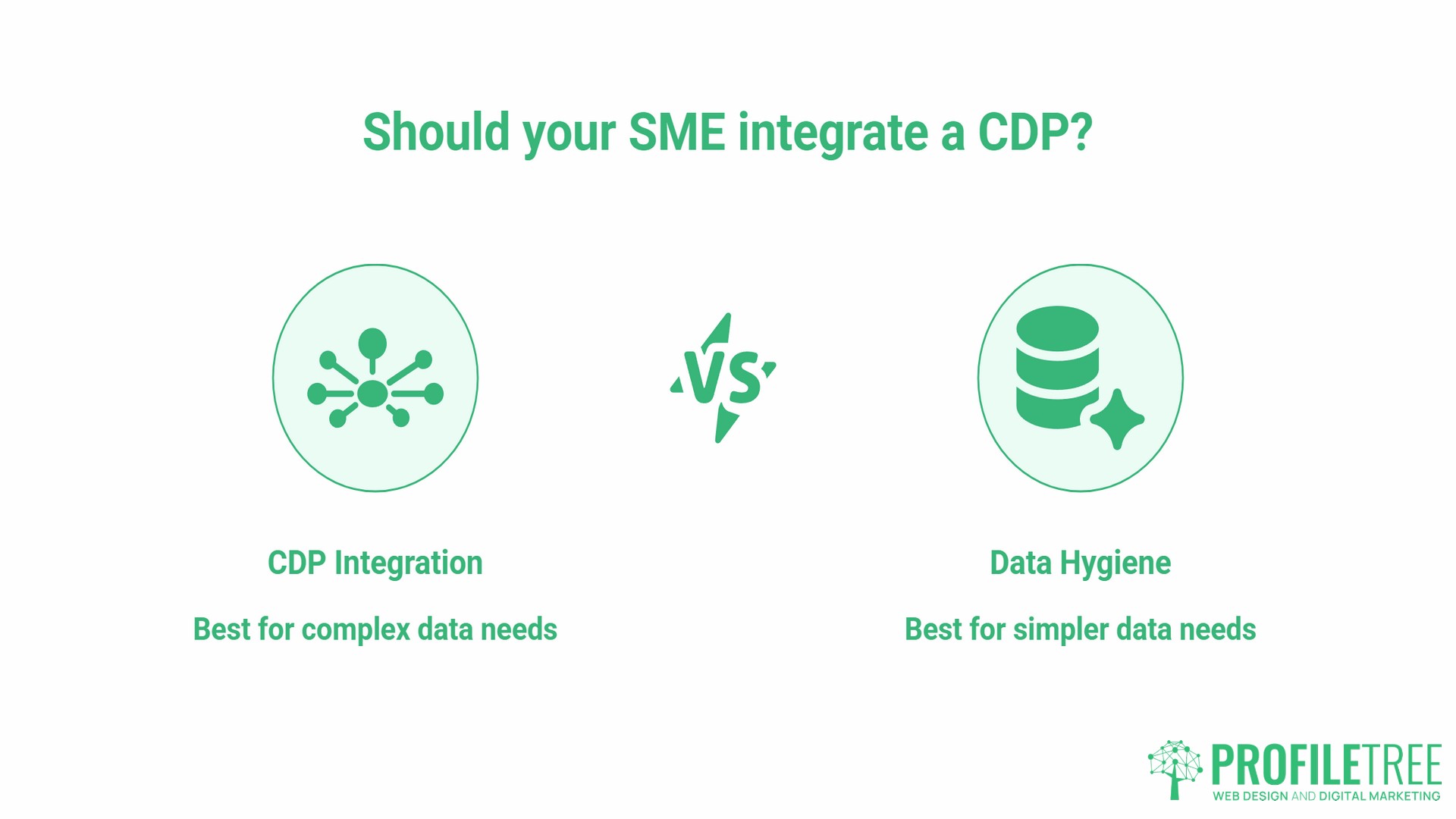
The honest answer for many SMEs is: not yet. A CDP is most valuable when you already have data coming from multiple sources and no reliable way to connect them. If your website, email platform, and CRM are all reporting different things about the same customers, that is the problem a CDP is built to solve.
Before committing to CDP integration within your MarTech stack, work through this quick assessment:
- You have at least two active data sources (website analytics, email platform, CRM, e-commerce) that currently operate independently
- You are running segmented campaigns, but cannot connect behaviour across channels (a customer who clicked an email and then visited your pricing page looks like two different people in your current tools)
- You are moving toward AI-assisted marketing or personalisation at scale, which requires clean, unified input data
- You have someone in-house, or a digital strategy partner, who can manage the integration and ongoing governance
If fewer than three of those apply, fixing your tracking and data hygiene is the more productive investment right now. A CDP built on poor-quality data does not solve the problem; it replicates it at scale. According to CDP.com, a CDP is unlikely to be the right investment if you have fewer than 50,000 customers and two to three data sources, as simpler tools may deliver the same outcomes with less complexity.
CDP vs CRM: Understanding the Data Hierarchy
These two tools are frequently confused, and the distinction matters before any MarTech stack decision.
| Feature | CRM | CDP |
|---|---|---|
| Primary purpose | Manages sales relationships and pipeline | Unifies behavioural and transactional data across all touchpoints |
| Data input | Mostly manual (sales team entries) | Automated (web events, app activity, email engagement) |
| Who uses it | Sales and account management teams | Marketing and data teams |
| Data scope | Known contacts with explicit records | Known and anonymous users, stitched by identity resolution |
| AI readiness | Limited without additional data layers | Designed as a feed layer for predictive and AI tools |
A CDP does not replace your CRM. The two work together: the CDP enriches customer profiles with behavioural data, and that enriched data flows back into your CRM, giving sales teams a fuller picture of each contact.
The SME Data Gap
The majority of guidance on CDP MarTech integration is written for enterprise teams with dedicated data engineers. UK and Irish SMEs face a different set of constraints: smaller budgets, smaller teams, and legacy tools that were never designed to talk to each other. Many businesses across Northern Ireland and Ireland are running a mix of WooCommerce or Shopify, Mailchimp or Klaviyo, and Google Analytics 4, with no event tracking layer connecting them.
That gap, between collecting data and being able to act on it across channels, is exactly what CDP integration addresses within a MarTech stack. The question is not whether the technology exists to bridge it. It does. The question is whether the business has the data foundation and internal resources to make integration worthwhile.
The 5-Step CDP Integration Roadmap
Competitors in this space frequently publish vague timelines or avoid the question of how long MarTech stack integration takes. According to CDP Institute research, packaged CDPs typically take two to four months for an initial pilot deployment. The breakdown below maps to a phased structure that reflects a realistic timeline.
Phase 1: Data Audit and Governance (Weeks 1 to 4)
Start with a complete audit of your existing MarTech stack. List every tool that collects or uses customer data: your website analytics platform, email marketing tool, CRM, e-commerce platform, and any paid media accounts. For each tool, document what data it collects, in what format, and how it identifies a user.
This audit will surface the inconsistencies that cause CDP integration to fail. Common findings include mismatched identifier fields (email address stored differently across platforms), missing consent records, and tracking gaps where key conversion events are not being captured at all.
UK GDPR compliance applies from this point forward. Any data flowing into a CDP must have a lawful basis for processing under the UK GDPR and the Data Protection Act 2018. For most SMEs, this means checking that your consent management platform is capturing explicit consent for marketing data use and that your privacy policy accurately describes how data is used. The ICO’s guidance on data minimisation is directly relevant here: a CDP should receive only the data it genuinely needs for the identified use cases.
If you are working with a CDP vendor whose servers are hosted outside the UK, confirm that data residency can be configured to a UK or EU region, and review the vendor’s data processing agreement for details on international transfer mechanisms. This is a non-negotiable compliance step for any business processing personal data about UK or EU residents, and one that many US-centric CDP guides fail to address.
Phase 2: Choosing Your Architecture (Weeks 2 to 3, overlapping)
SMEs broadly have two architectural options for their MarTech stack: a packaged CDP or a composable CDP.
| Packaged CDP | Composable CDP | |
|---|---|---|
| What it is | Pre-built platform (e.g. Segment, Tealium, Bloomreach) | Built on your existing data warehouse using Reverse ETL tools |
| Cost | Higher SaaS licence fee; faster to deploy | Lower software cost; higher internal resource requirement |
| Time to value | 2 to 4 months for initial pilot (CDP Institute) | Limited to the vendor’s integration library |
| Technical resource needed | Marketing manager with some technical literacy | Data analyst or development support required |
| Flexibility | Limited to vendor’s integration library | Highly flexible; connects to any tool via API |
| Best for | SMEs that want speed and simplicity | SMEs with an existing data warehouse and technical support |
For most SMEs in Northern Ireland and Ireland that do not have a dedicated data team, a packaged CDP with a strong pre-built connector library is the faster path to value. The composable approach is worth considering if you already use BigQuery or a similar cloud data warehouse and have development resources available, because it avoids a large recurring SaaS fee and gives you full control over your data model.
“The most common mistake we see is businesses selecting a platform before they have defined their use cases,” says Ciaran Connolly, founder of ProfileTree. “A CDP should be chosen to solve a specific data problem in your MarTech stack, not because it appeared in a vendor comparison.”
Phase 3: Technical Implementation (Weeks 5 to 8)
Technical implementation within your MarTech stack involves three core tasks: connecting data sources, configuring identity resolution, and setting up activation pathways.
- Connecting data sources typically uses a combination of APIs, SDKs (code libraries embedded in your website or app), and webhooks (automated event notifications). Most packaged CDPs provide prebuilt connectors for common tools such as Shopify, WooCommerce, Salesforce, Mailchimp, and GA4. For tools without pre-built connectors, you will need API documentation from both the source tool and the CDP to build a custom connection.
- Identity resolution is the process by which the CDP determines that the same person visited your website anonymously, then signed up to your email list, and then completed a purchase. It stitches these events into a single profile using deterministic matching (exact match on email address or phone number) and probabilistic matching (device fingerprinting, behavioural patterns). The quality of your identity resolution directly determines the accuracy of everything the CDP produces downstream.
- Activation pathways define which tools in your MarTech stack receive data from the CDP and in what form. A common setup for a UK SME might send enriched segments to Klaviyo for email, to Meta Ads for custom audience matching, and to Google Ads for customer match campaigns.
Phase 4: Data Migration and Ongoing Syncing (Weeks 6 to 9)
Moving historical data into the CDP follows a standard ETL (Extract, Transform, Load) process. Extract data from each source system in a consistent format, transform it to match the CDP’s data model (typically by standardising field names, date formats, and identifier fields), then load it into the CDP, with verification checks at each stage.
For composable CDP configurations within a MarTech stack, the process runs via Reverse ETL: data is enriched in the warehouse and then pushed out to operational tools (email platforms, ad platforms) on a scheduled or real-time basis.
Ongoing syncing should be configured as close to real-time as your use cases require. Event-triggered campaigns (abandoned cart, post-purchase sequences) need near-real-time data. Weekly newsletter segmentation can run on a daily batch sync.
Phase 5: Activation across Marketing Channels
Activation is where the CDP MarTech stack integration produces measurable results. The most common SME use cases at this stage include:
- Behavioural email triggers. A customer who repeatedly visits a specific product page without purchasing can receive a targeted email sequence based on that behaviour, without a sales team member manually identifying it.
- Cross-channel audience suppression. Customers who have already converted are automatically excluded from paid acquisition campaigns, reducing wasted ad spend. This is frequently the fastest and most directly measurable ROI from a CDP deployment.
- Content personalisation. Website content or product recommendations are adjusted based on a visitor’s segment, previous behaviour, or stage in the customer journey. ProfileTree’s content marketing work frequently draws on this kind of segmentation data to inform which content formats and topics to prioritise for specific audience groups.
- Paid media custom audiences. CDP segments sync directly to Meta or Google Ads, replacing broad demographic targeting with audience lists built on actual purchase intent signals from your own first-party data. This MarTech stack integration is consistently cited as one of the highest-ROI applications of a CDP for SMEs.
How a CDP Powers AI in Your Marketing
A well-integrated CDP is the foundational layer for AI-assisted marketing. Language models and predictive tools require clean, structured, unified data to function reliably. A CDP provides exactly that within a MarTech stack.
The practical connection works in two directions. First, CDP data feeds predictive models: which customers are most likely to churn, which products a given segment is most likely to purchase next, and which send time produces the highest engagement for a specific cohort. These predictions are only as good as the data behind them.
Second, AI tools generate outputs (personalised copy, product recommendations, dynamic pricing) that need to be delivered to the right person at the right time through the right channel. The CDP’s activation layer within the broader MarTech stack enables that delivery.
For SMEs beginning their AI implementation journey, the data audit in Phase 1 is frequently where the work begins. If the data infrastructure is not in place to reliably feed AI tools, the tools themselves will underperform regardless of how capable they are. ProfileTree’s AI implementation work with UK and Irish businesses typically starts with this infrastructure question before any platform selection is made.
Preparing Data for Predictive Analytics
For CDP data to produce meaningful predictive outputs, you need consistent user identification across touchpoints, sufficient behavioural history to establish meaningful patterns, clearly defined conversion events, and segmentation that reflects real differences in customer behaviour rather than relying solely on demographic proxies.
A CDP integration that has completed Phases 1 through 4 will generally meet these requirements. The ongoing governance work ensures the data remains reliable as your MarTech stack changes over time.
Common Integration Pitfalls
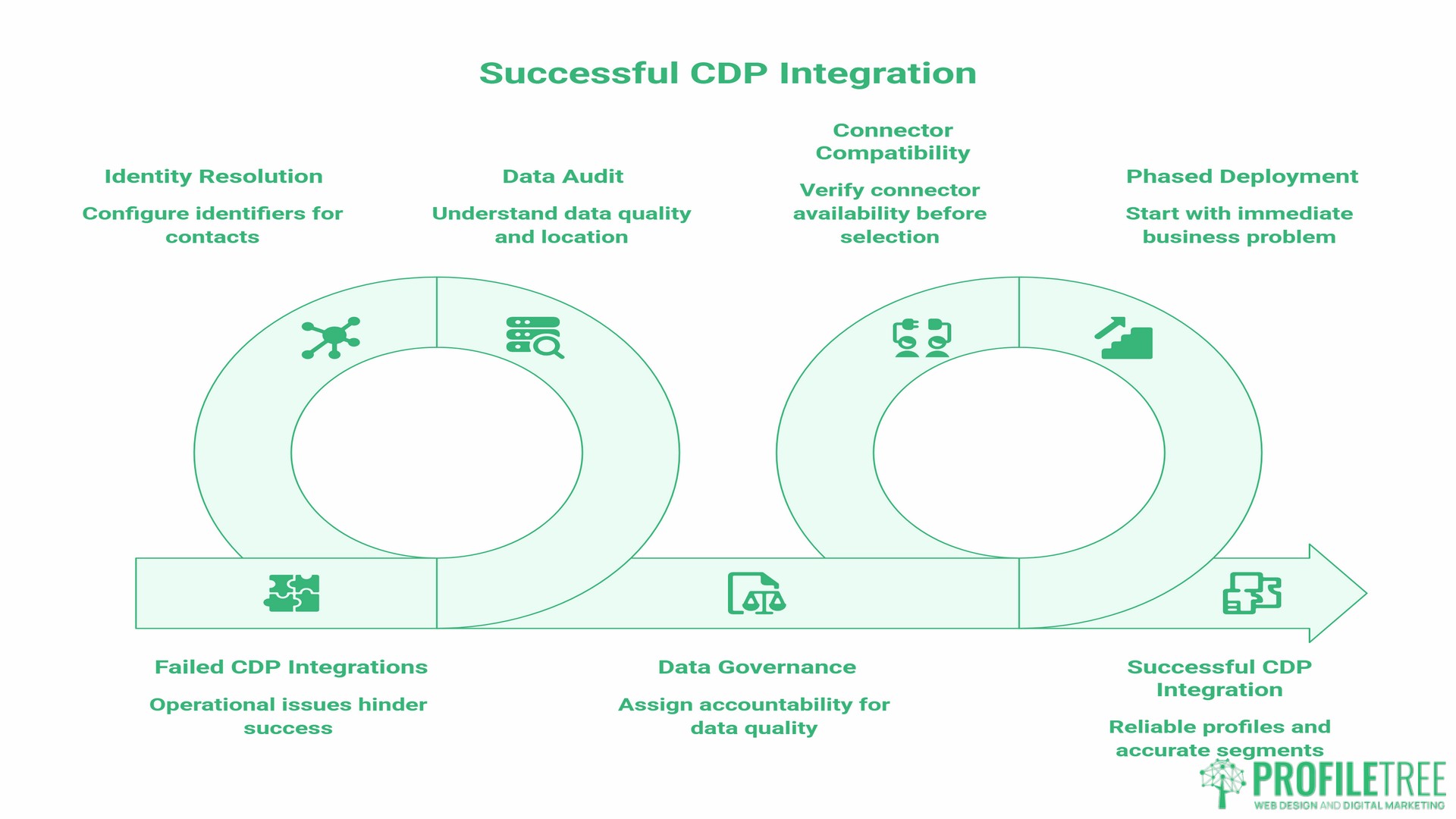
Most CDP MarTech stack integrations that fail do so for operational rather than technical reasons. The technology works. The preparation does not.
- Skipping the data audit. Starting with platform selection before understanding what data you have, where it lives, and how clean it is, is the most consistent cause of failed integrations. A CDP configured on top of fragmented, inconsistent data will produce unreliable profiles and inaccurate segments.
- Underestimating identity resolution complexity. If your email platform, CRM, and website analytics use different identifiers for the same contact, identity resolution requires deliberate configuration. It does not happen automatically.
- No data governance owner. A CDP requires someone accountable for data quality, consent records, and schema changes. In SME settings, this is often a marketing manager with support from a development partner. Without clear ownership, data quality degrades over time, and the CDP’s outputs become increasingly unreliable.
- Over-engineering the first deployment. A composable CDP architecture that serves as a future state for the business is not the right starting point if the team cannot yet manage a packaged CDP. Start with the integration that solves the most immediate business problem within your MarTech stack. Expand the architecture once that use case is stable.
- Ignoring MarTech stack connector compatibility. A CDP that cannot connect to your email platform or ad accounts without significant custom development is not the right fit for your current stack. Verify connector availability before vendor selection, not after.
Measuring CDP Impact and ROI
Justifying CDP investment to a board or business owner requires moving beyond platform capabilities and focusing on measurable business outcomes.
The KPIs most directly influenced by CDP MarTech stack integration are:
| Metric | What it measures | Typical signal of CDP impact |
|---|---|---|
| Customer acquisition cost (CAC) | Cost to acquire a new customer | Decreases as paid media targeting improves using first-party data |
| Customer lifetime value (CLV) | Revenue from a customer over their full relationship | Increases as retention campaigns become more targeted |
| Email engagement rate | Opens and clicks relative to send volume | Improves as segmentation replaces broadcast sending |
| Paid media ROAS | Revenue per pound of ad spend | Improves as custom audiences replace demographic targeting |
| Conversion rate | Percentage of visitors or leads that convert | Increases as personalisation aligns content to user intent |
A realistic timeline for seeing measurable movement: according to Lexer, paid media efficiency improvements are typically visible within 30 to 60 days of activation, while email and SMS campaign lift is measurable within 60 to 90 days with proper control-group design. The first 60 to 90 days of a deployment focus on data integration and identity resolution, which, in itself, does not produce visible campaign results. Stakeholders should be briefed accordingly before go-live.
On the question of longer-term return: Tealium’s State of the CDP report, which surveyed over 1,200 professionals, found that three-quarters of companies reported realising value from their CDP within the first year of deployment, with 89% reaching ROI within 18 months. These are useful reference points for the board conversation, though outcomes vary significantly depending on data quality at the outset and the extent to which use cases are activated.
For a total cost of ownership assessment, SME CDP budgets typically range from $15,000 to $50,000 per year in software licence costs for entry-level and mid-market platforms, according to Dot Analytics. Enterprise-grade platforms carry significantly higher fees. Set the licence cost against the projected reduction in wasted ad spend from audience suppression and the revenue impact of improved retention, to arrive at a realistic payback calculation for your specific situation.
How ProfileTree Supports CDP and MarTech Integration
For SMEs without an in-house data team, CDP and MarTech stack integration typically requires external support at the data audit stage, during technical implementation, and for ongoing governance. The alternative is to integrate a platform without proper preparation, which is where most failures occur.
ProfileTree’s digital strategy and AI implementation work covers the full range of this support: from initial MarTech stack audit and platform selection through to technical integration, team training, and the content marketing and campaign activation work that follows. For businesses in Northern Ireland, Ireland, and across the UK, the starting point is usually an honest assessment of what data infrastructure is already in place and what would need to change before a CDP investment makes sense.
The digital training element is particularly relevant for marketing managers who will own the CDP day-to-day once it is in place. Understanding how the platform works, how to build and maintain segments, and how to interpret the data it surfaces is an ongoing capability, not a one-time onboarding task, and it determines whether the MarTech stack investment delivers long-term value.
FAQ
How is a CDP different from a CRM?
A CRM manages your sales relationships, primarily through manual data entry by a sales team. A CDP collects behavioural and transactional data automatically from every digital touchpoint, building a unified customer profile without manual input. The two tools work together within a MarTech stack: the CDP enriches the CRM with behavioural context, giving sales teams a fuller picture of each contact.
Do I need a data scientist to manage a CDP?
Not for most packaged CDP deployments. Modern no-code CDPs are designed to be operated by marketing managers with basic technical literacy. Composable CDP configurations built on a data warehouse do require more technical resources, either in-house or through a development partner.
What does CDP integration typically cost for a UK SME?
Entry-level and mid-market CDP platforms typically cost $15,000 to $50,000 per year in licence fees for SMEs, according to Dot Analytics. Total first-year costs, including implementation, are higher once internal resource time and any consultancy support are factored in. Enterprise platforms carry significantly higher fees. Costs vary considerably by platform, data volume, and the number of integrations required, so requesting quotes from multiple vendors and comparing the total cost of ownership rather than headline licence fees is advisable.
Can I integrate a CDP with a legacy on-premise database?
Yes, via middleware or API connectors. Most packaged CDPs support custom API connections, which allow data from legacy SQL databases or on-premise ERP systems to be included in the unified profile. The complexity and cost of this connection depend on whether the legacy system has a documented API.
Is a CDP necessary if I am already using GA4?
GA4 is a measurement tool. It tells you what happened on your website. A CDP acts on that data across other platforms in your MarTech stack: your email tool, your CRM, your ad accounts. GA4 data can feed into a CDP as one source among many, but the two serve different functions and neither replaces the other.
Where is my data stored in a CDP?
This is a material compliance question for UK and Irish businesses. Under the UK GDPR and the EU GDPR, transfers of personal data outside the UK or the EU require either an adequacy decision or an appropriate safeguard, such as Standard Contractual Clauses. When selecting a CDP vendor, review the data processing agreement carefully and confirm whether a UK or EU data residency option is available. Geographic region selection alone does not fully resolve international transfer obligations where the vendor is a US-based entity, so legal review of the vendor’s transfer mechanisms is advisable before sign-off.
What is the difference between a packaged and a composable CDP?
A packaged CDP is a pre-built platform you subscribe to. A composable CDP is assembled from existing tools, typically using your data warehouse as the central store and a Reverse ETL tool to push data to operational platforms. Packaged CDPs are faster to deploy and easier to manage without technical resources. Composable CDPs offer greater flexibility and lower recurring software costs but require more internal capability to build and maintain. For most SMEs adding a CDP to their MarTech stack for the first time, a packaged platform is the lower-risk starting point.