
MarTech Stack Security and Compliance: UK SME Guide
Table of Contents
Most marketing managers build their MarTech stack tool by tool: a CRM here, an email platform there, a social scheduler when needed. The result is a set of connected systems, each holding a slice of customer data, with very few people in the business able to say with confidence how that data moves, who can see it, or whether every tool actually meets UK GDPR obligations.
That gap is a compliance risk and a commercial one. A stack that handles data badly can trigger ICO enforcement action, damage customer trust, and quietly waste money on tools nobody fully uses.
What Is a MarTech Stack and Why Does Security Matter?
MarTech, short for marketing technology, refers to the software and platforms that marketing teams use to plan, run, measure, and optimise campaigns. A MarTech stack is the specific combination of those tools a business has assembled for its own use.
A typical stack for a UK SME might include a CRM (HubSpot, Salesforce, or Pipedrive), an email marketing platform (Mailchimp, Dotdigital, or ActiveCampaign), a website CMS (usually WordPress), an analytics layer (Google Analytics 4 or a privacy-first alternative such as Plausible), and some form of social or advertising management tool. Businesses working with ProfileTree’s digital marketing strategy team usually arrive with three or four of these already in place, often bought separately over a couple of years without a plan for how they’d work together.
Key MarTech Terms Explained
Before going further, it helps to define the building blocks:
| Term | What It Means |
|---|---|
| CRM | Customer Relationship Management. Stores contact and sales data. |
| CMS | Content Management System. Runs the website (WordPress, for most UK SMEs). |
| CDP | Customer Data Platform. Centralises customer data pulled from multiple tools. |
| SaaS | Software as a Service. Cloud-based software paid for on subscription. |
| API | Application Programming Interface. The connection that lets two tools share data. |
| DPA | Data Processing Agreement. A contract required with any third party processing personal data. |
| ROPA | Record of Processing Activities. A GDPR-required log of what data you hold and why. |
| PECR | Privacy and Electronic Communications Regulations. Governs email, SMS, and cookie consent. |
MarTech vs AdTech: Why the Distinction Matters for Compliance
MarTech and AdTech are often used loosely, but the compliance implications differ.
| MarTech | AdTech | |
|---|---|---|
| Data source | First-party (your CRM, email list, site visitors) | Often third-party (ad networks, data brokers) |
| Billing model | Subscription (SaaS) | Pay-per-click, pay-per-impression |
| Primary goal | Manage and nurture owned relationships | Acquire attention and reach on paid channels |
AdTech relies more heavily on third-party data, which is why it comes under greater scrutiny from both UK GDPR and PECR. A CRM holding data you collected directly is a different compliance problem to a retargeting pixel sharing that data with an ad exchange. Is a CRM a MarTech tool on its own? Broadly, yes, but the moment its data feeds an advertising platform, it starts to touch AdTech territory too, and the compliance obligations shift with it.
The security issue underneath both is structural. Each tool stores or processes personal data, names, email addresses, browsing behaviour, purchase history, phone numbers, and each one connects to others through APIs or data integrations. Every connection point is a potential exposure if access controls, data handling settings, or vendor compliance aren’t properly managed. This is one reason website development and marketing strategy can’t really be treated as separate disciplines any more; the technical build determines what the stack can and can’t do safely.
For UK businesses, this sits in a specific regulatory context. UK GDPR is the retained and amended version of the EU regulation that has applied since Brexit. It places legal obligations on the collection, storage, sharing, and security of personal data. Not knowing the rules isn’t a defence if something goes wrong.
UK GDPR, PECR and Your MarTech Stack
UK GDPR isn’t primarily a technical standard; it’s a set of legal obligations about how personal data is processed. Those obligations have direct technical consequences for every tool in your stack.
Lawful basis for processing. Every piece of personal data your MarTech tools hold must be processed lawfully. For marketing activities, this is usually either consent (the person actively agreed) or legitimate interests (a documented balancing test). If you can’t identify the lawful basis for data sitting in your CRM or email platform, that data shouldn’t be there.
Data minimisation. Collect only what you need for a defined purpose. If your website form asks for 10 fields but your marketing team only uses 3, the other 7 are an unnecessary risk sitting in your database. This is where GDPR-aware web design makes a practical difference: forms built with compliance in mind from the start collect less, and collect it more deliberately.
Third-party processors. Every tool in your stack that handles personal data is a data processor, and you’re required to have a Data Processing Agreement with each one. Most major platforms, such as HubSpot, Mailchimp, and Google, provide these, but smaller tools often don’t make them easy to find. Checking this for every vendor is a task most marketing managers have never actually done.
Data residency. Where your data physically sits matters under UK GDPR. Many US-headquartered MarTech vendors store data in US data centres by default. Standard Contractual Clauses or the UK Addendum to SCCs must be in place for any transfer of personal data outside the UK to a country without an adequacy decision.
The right to erasure. If a contact asks to be removed from your marketing database, you need to be able to delete their data across every connected system: CRM, email platform, retargeting audience lists, and anywhere else it’s been synced. If your tools aren’t integrated in a way that allows this, that’s a compliance gap, not a technical inconvenience.
PECR sits alongside UK GDPR and adds specific rules for electronic marketing, covering email, SMS, and cookies. Consent under PECR for direct marketing emails has to be freely given, specific, informed, and unambiguous. Bought-in lists almost never meet that standard, whatever the vendor selling them claims.
Understanding the legal side of digital marketing here isn’t a side exercise that sits apart from strategy; it shapes which tools you can use and how.
The UK GDPR MarTech Compliance Checklist
Before assessing individual tools, map your current stack against these questions:
- Does each tool have a signed Data Processing Agreement in place?
- Do you know where each tool stores data geographically?
- Can you delete a contact’s data across all connected tools within 30 days?
- Does your consent management platform log consents with timestamps?
- Have you completed a Record of Processing Activities covering your marketing data flows?
- Are your email lists documented with a lawful basis for each segment?
- Do your web forms collect only the data you can justify retaining?
- Have you identified which tools handle Special Category Data (health, political opinion, ethnic origin) and applied extra controls?
If you can’t answer yes to most of these, the compliance gaps in your stack are real rather than theoretical. The ICO’s own guidance is worth reading directly rather than relying on secondhand summaries, including this one.
Building a Secure and Compliant MarTech Stack
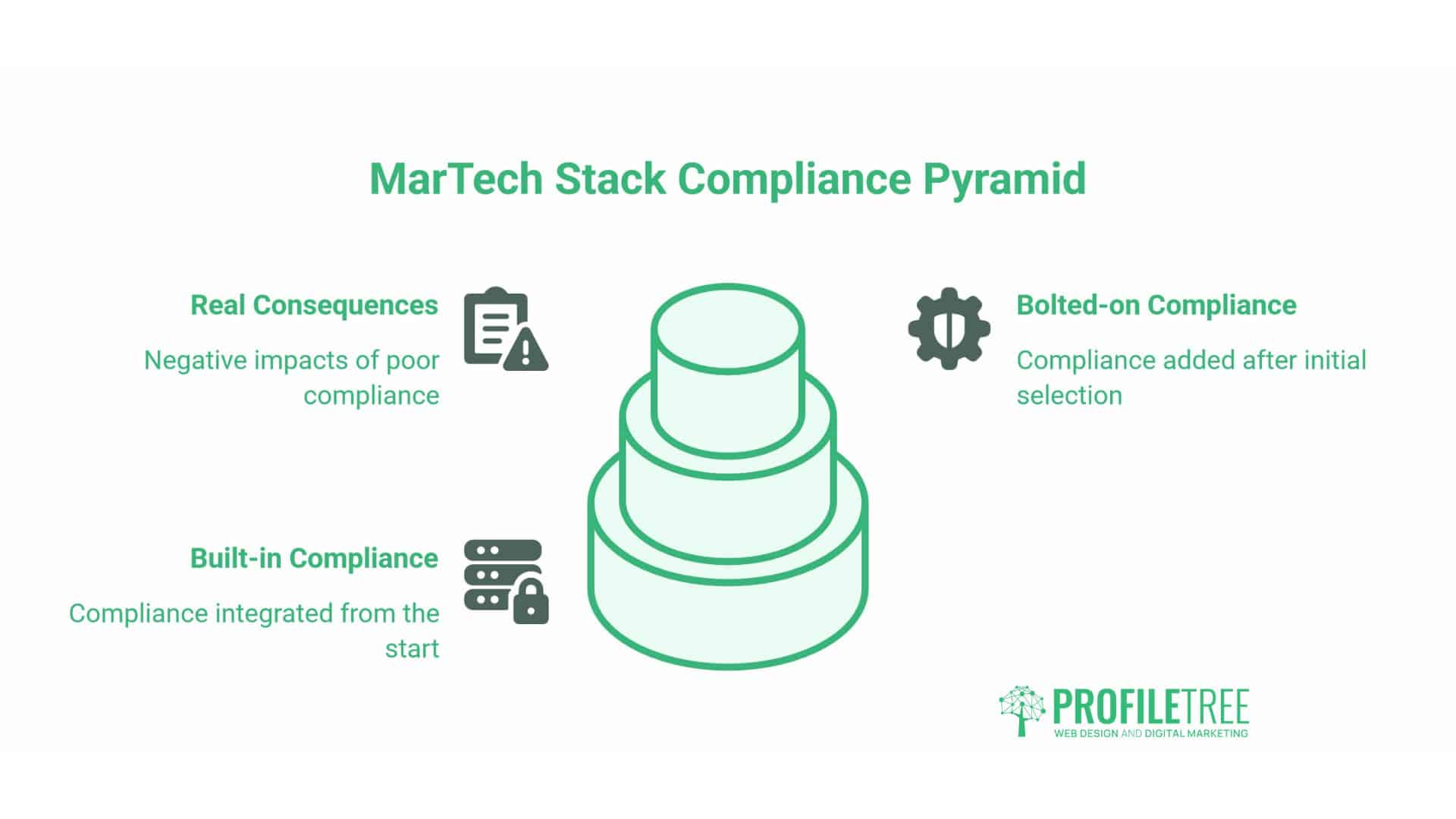
Vendor selection is where compliance either gets built in or bolted on afterwards, and the difference has real consequences.
Evaluating MarTech Vendors
When assessing a new tool, security and compliance questions should sit alongside functionality and price:
- Data residency. Where is data stored by default? Is UK or EU storage available, and what is the cost difference?
- Certifications. Does the vendor hold ISO 27001 or SOC 2 Type II? Not a guarantee, but a signal that security is taken seriously.
- Breach notification. What’s the vendor’s process for telling you about a data breach? UK GDPR requires eligible breaches to be reported to the ICO within 72 hours; a slow vendor makes that impossible.
- Data Processing Agreement. Can you get one immediately, without a sales call? If not, that’s a warning sign.
- Sub-processors. Who does the vendor share your data with? You should be able to find this list.
- Encryption. Is data encrypted in transit and at rest, and to what standard?
- Access controls. Does the platform support role-based access to restrict who can see, edit, or export data?
For UK SMEs without a dedicated data protection officer, this checklist can feel disproportionate for a £30-a-month tool. It isn’t. One poorly chosen tool handling personal data outside UK GDPR terms puts the whole business at risk, not just the marketing budget.
Practical Security Measures
Compliance addresses the legal framework. Security addresses the technical reality of keeping data safe day-to-day. They overlap, but they’re not the same thing.
Access control and least privilege. Everyone with access to your CRM, email platform, or analytics tools should have only the permissions their role needs. A content writer doesn’t need export rights to the full contact database. Most platforms offer role-based access; the gap is usually that nobody’s turned it on.
Multi-factor authentication. MFA should be mandatory across the entire stack. If a vendor doesn’t offer it, treat that as a significant red flag rather than a minor inconvenience.
Audit trails. Enterprise-tier plans on most platforms log who accessed what data and when. Worth enabling even for a standard SME, not just regulated industries.
Regular access reviews. When someone leaves the business, their access to every MarTech tool needs to be removed promptly, not just their email account. This is often overlooked in favour of tools that the IT team doesn’t manage day-to-day. A review every six months, checking active users against current staff, is a manageable control.
API key management. Most integrations run on API keys, which should be treated like passwords: documented, rotated periodically, revoked when no longer needed. Hardcoded API keys in website code or casually shared in Slack messages are a common and entirely avoidable source of exposure. This is squarely a web development concern rather than a marketing one, which is part of why the two functions need to communicate.
Customer Data Platforms. If your stack includes a CDP, a system that centralises customer data from multiple sources, the security controls around it need particular attention. CDPs provide the richest picture of customer behaviour across every channel, making them high-value targets. Encryption, strict access controls, and regular audits are the minimum, not the ceiling.
The Role of Your Website
Your website is the front door of your MarTech stack. It’s where consent is captured, where data first enters your systems, and where most compliance obligations begin.
A cookie consent management platform and the banner visitors see on arrival need to do more than appear on screen. They need to block third-party tracking scripts until consent is given, log consent decisions with timestamps and identifiers, allow people to withdraw consent as easily as they gave it, and avoid pre-ticked boxes or dark patterns that pressure people into agreeing.
Getting the technical side of a CMP right takes web developers, not just a plugin installation. How the consent layer interacts with your analytics tags, advertising pixels, and CRM integration scripts determines whether your data collection is actually lawful, not just visually compliant. This isn’t something a marketing manager can assess on their own, and it’s a large part of why ProfileTree’s web design and development work usually includes consent management as a technical requirement rather than a checkbox added at the end.
“Strategy first, tool second is the principle that matters most here,” says Ciaran Connolly, founder of ProfileTree. “We see businesses across Northern Ireland and the UK paying for tools they don’t fully use, holding data they can’t justify keeping, and then wondering why marketing costs keep rising while results stay flat. The stack should follow the strategy, not the other way round.”
The audit starting point is simple: map every tool in the current stack, identify what data each one holds, document how data moves between them, and check whether each transfer is necessary and recorded. This exercise rarely takes less than a day for a business that’s added tools gradually over time, but the clarity is worth the afternoon it costs. It’s also the kind of groundwork covered in the audit stage of a structured digital marketing strategy engagement, before any new tool gets added to the mix.
Lean MarTech for UK SMEs
Not every SME needs an enterprise stack. A smaller business with a CRM, an email platform, and a well-built website with proper consent management is often in a stronger compliance position than a larger one running fifteen loosely connected tools. The goal isn’t maximum tooling; it’s a stack where every piece has a documented purpose and nobody’s guessing where a customer’s data actually lives.
AI, Consolidation and the Future of Your MarTech Stack
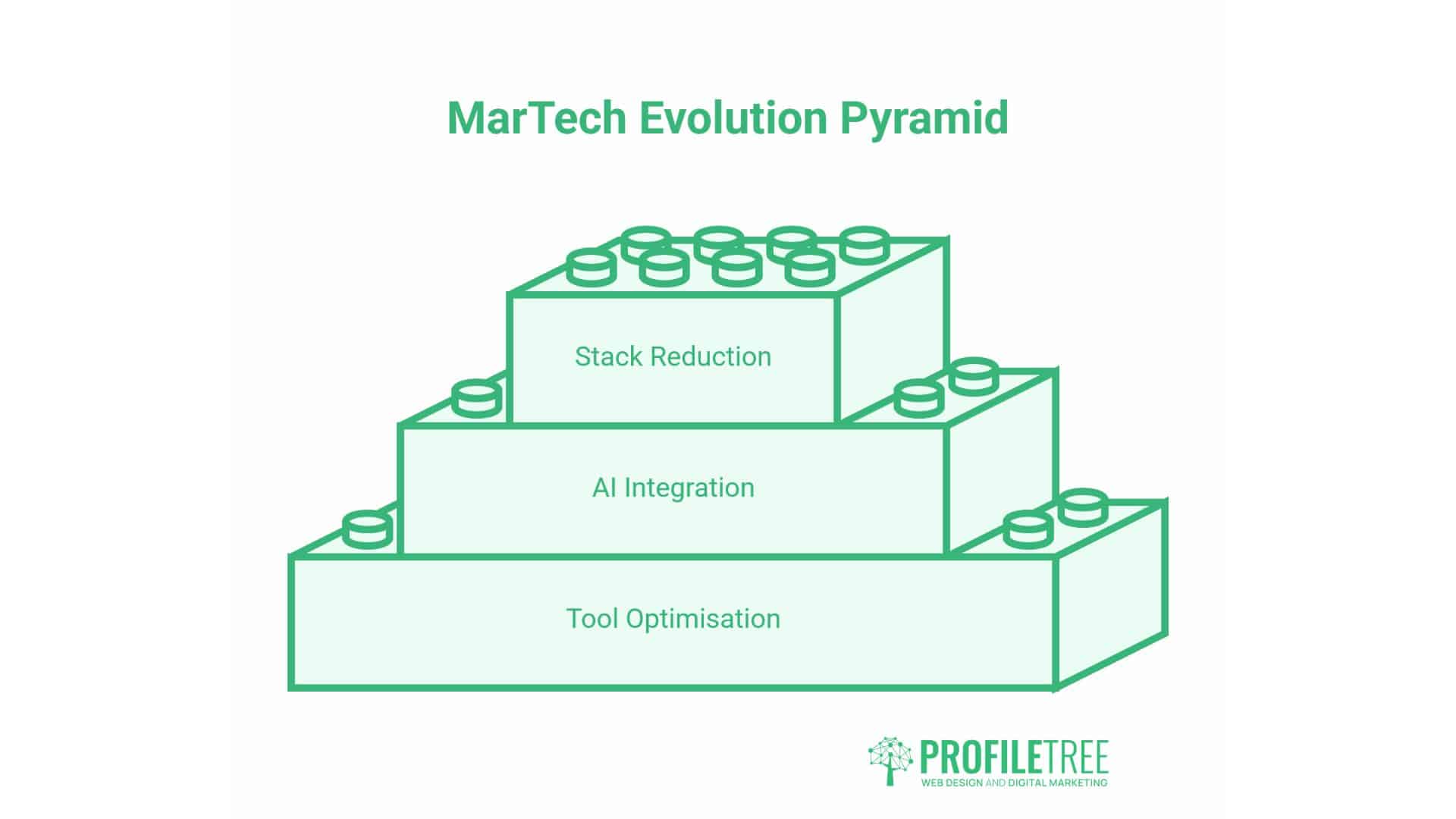
The next phase of MarTech isn’t about adding more tools. It’s about making the ones already in the stack work harder and safer, while AI changes what “compliant” actually means. This section looks at where AI adds new obligations, and where trimming the stack down does more for security than any new platform would.
AI-Powered MarTech: The New Compliance Layer
AI tools in MarTech stacks add a compliance layer that most standard frameworks have yet to fully address.
AI marketing tools, whether for content generation, predictive lead scoring, personalisation, or campaign optimisation, often process large volumes of customer data to function. What training data these systems use, where outputs are stored, and whether data is shared with the AI vendor’s own model training processes are questions that need answers before deployment, not after.
UK GDPR Article 22 is directly relevant here. Automated decision-making that produces legal or similarly significant effects on individuals needs specific transparency, a lawful basis, and, in some cases, a right to human review. AI-driven lead scoring that determines whether a prospect receives follow-up contact, or dynamic pricing that adjusts what a customer is offered, may fall within that scope.
Work in this area, including ProfileTree’s AI implementation and training with SMEs across Northern Ireland and the UK, tends to start with a mapping exercise: what does this AI tool actually do with data, where does that data go, and does that create new obligations? The answer shapes whether and how the tool gets deployed, not just whether it’s technically capable of the job.
Digital training for the team on AI tools and their data implications is increasingly part of the preparation to use these tools responsibly, rather than adopting them first and asking questions later. A short training session that walks a marketing team through what their AI tools actually do with customer data tends to prevent far more problems than a policy document nobody reads.
MarTech Consolidation: Solving Tool Sprawl
Most guidance on MarTech focuses on what to add next. Fewer businesses ask what to remove. Tool sprawl, where a business ends up paying for several platforms that overlap in function, is both a cost problem and a compliance one: more tools mean more places personal data can sit, more DPAs to track, and more accounts to review when someone leaves the business.
A practical consolidation process looks like this:
- List every tool currently in use, including ones bought by individual team members outside a formal procurement process.
- Map overlaps. Are two tools doing the same job because nobody checked before buying the second one?
- Check usage, not just cost. A tool at 20% of the list price still costs 100% of the compliance overhead if it holds personal data.
- Retire what’s unused or redundant, closing accounts properly rather than leaving them dormant with live API keys.
- Document the decision so the next audit doesn’t start from scratch.
This is worth treating as a recurring exercise rather than a one-off clean-up. Stacks accumulate tools quietly; nobody sets out to end up with three overlapping email platforms, it just happens one hire and one free trial at a time.
Budgeting for Security and Compliance
Compliance and security aren’t free. The question isn’t whether to invest but how to allocate the budget sensibly.
For most UK SMEs, the meaningful costs fall into three categories:
Vendor upgrades. Many security features, audit logs, advanced access controls, and custom retention settings sit behind higher-tier plans. Weigh the compliance value against the cost before upgrading, but don’t assume the free or entry-level tier is sufficient for a business handling significant volumes of personal data.
Implementation and integration work. Getting consent management, API integrations, and data deletion workflows to actually work takes time to develop. This is often where compliance breaks down in practice: the settings are in place, but the implementation doesn’t enforce their promises.
Training. Marketing teams that understand their data obligations make better decisions daily, about which fields to collect, which contacts to email, and how long to retain data. The case for digital training is strongest when it’s framed as risk reduction rather than a skills nice-to-have.
Some industry commentary puts MarTech spend at somewhere around a quarter to a third of total marketing budget, though figures like this vary widely by sector and business size and should be treated as a rough benchmark rather than a target. The more useful question for most SMEs is narrower: is each tool in the stack actually used, and is it earning its place?
Making the Stack Work for the Business
A MarTech stack that handles data well isn’t just a compliance exercise; it tends to be a more efficient and more trustworthy way to run marketing generally. Most of the gaps that create risk also create drag: data in the wrong places, tools nobody owns, integrations nobody documented. Fixing them improves both the legal position and the day-to-day marketing performance.
For many SMEs, the honest starting point isn’t a new tool at all. It’s an afternoon spent mapping what’s already there, conducting a website audit to check that consent management actually works as intended, and having a conversation about which three tools are doing the heavy lifting versus which ones are quietly costing money and adding risk for no real return. That’s a smaller project than it sounds, and it’s usually the one that pays off fastest.
If you want a second opinion on how your current stack handles data, or want to build one properly from the ground up, get in touch with ProfileTree.
FAQs
What is a MarTech stack?
A MarTech stack is the combination of software tools a marketing team uses to plan, run, and measure its activity: typically a CRM, email platform, CMS, analytics tools, and social or advertising management systems, along with the integrations between them.
Does UK GDPR apply to my MarTech tools?
Yes. Any tool in your stack that processes the personal data of UK residents, including email addresses, names, or browsing behaviour, falls under UK GDPR. That covers not just the tools themselves but how they’re configured, what data is collected, and who can access it.
What is the difference between MarTech and AdTech?
MarTech covers tools for owned channels: CRM, email, CMS, and analytics. AdTech covers paid advertising infrastructure, including demand-side platforms, ad servers, and real-time bidding. The compliance distinction matters because AdTech relies more heavily on third-party data, which attracts greater scrutiny under the UK GDPR and PECR.
Is a CRM a MarTech tool?
Broadly, yes. A CRM is usually considered the foundation of a MarTech stack because it holds the customer data that everything else builds on. Where it gets more nuanced is when a CRM’s marketing features feed directly into paid advertising platforms, at which point it overlaps with AdTech, too.