
Marketing Plan vs Marketing Strategy: Key Differences
Table of Contents
The distinction between a marketing plan vs marketing strategy is one of the most misunderstood topics in business planning. Most teams know they need both, but treat them as the same document, use the terms interchangeably, or skip the strategy entirely and jump straight to tactics. That habit is expensive.
A marketing strategy defines where you are going and why: your target audience, competitive positioning, and value proposition. A marketing plan and strategy are separate documents that work together: the plan details the campaigns, timelines, budgets, and channels required to execute the strategy. Marketing strategy and planning are two distinct disciplines, and getting that separation right is what turns a list of activities into a coherent commercial direction.
It’s also worth clarifying what this guide doesn’t cover. A business plan vs marketing plan is a different comparison entirely: a business plan covers the whole enterprise, including finance, operations, and legal structure, while a marketing plan focuses specifically on how the business will attract, convert, and retain customers. We’re focused here on the marketing planning layer only.
For UK and Irish SMEs, this distinction determines whether you build competitive advantage deliberately or stumble into it by accident. This guide breaks down both documents clearly, explains the handoff between them, and gives you a practical framework for building one from the other.
Marketing Strategy vs Marketing Plan: The Core Distinction
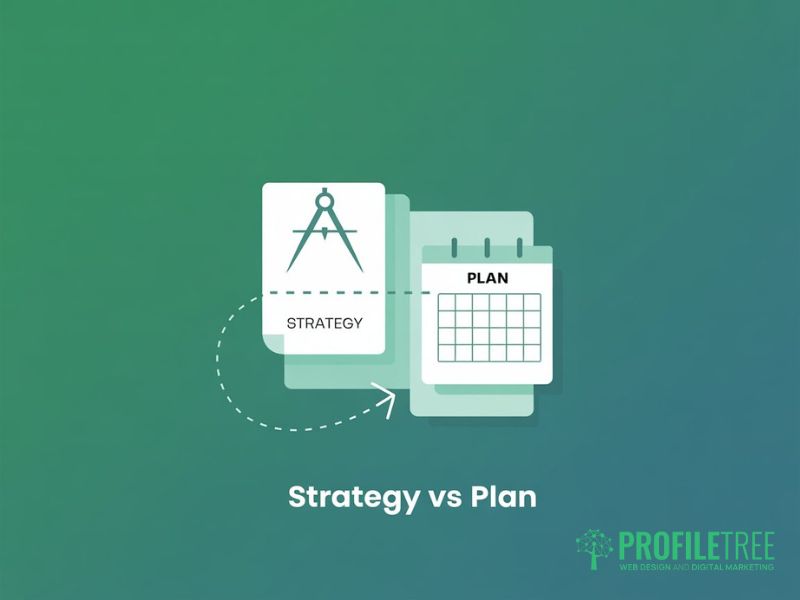
Before comparing them side by side, it helps to define each term independently. The two documents operate at different levels of abstraction and serve different audiences within the business. Mixing them up leads to planning sessions where nobody can agree on what’s actually being decided.
What Is a Marketing Strategy?
A marketing strategy is the foundational document that answers the big questions: who are you selling to, what problem are you solving for them, and why should they choose you over the competition? It sets your target market, defines your brand positioning, and identifies the competitive advantages you’ll build the business around.
Strategy typically operates over a one-to-three-year horizon. It doesn’t specify which Facebook ads to run or what to post on Tuesday; those belong in the plan. Strategy is the blueprint from which all tactical decisions should flow. Without it, your marketing plan and strategy relationship becomes one-directional: the plan drives itself rather than serving a defined commercial goal.
Core elements of a sound marketing strategy include a clearly defined ideal customer profile, a unique value proposition, market positioning relative to competitors, and the primary channels through which you’ll reach your audience. Answering these questions rigorously before planning anything tactical prevents wasted spend and inconsistent messaging across channels.
What Is a Marketing Plan?
A marketing plan translates the strategy into action. It specifies what campaigns you’ll run, when they’ll go live, who’s responsible, and how much budget is allocated to each activity. Where the strategy says we’ll target owner-managed businesses in Northern Ireland through content marketing and organic search, the plan says we’ll publish two optimised articles per week, allocate a fixed monthly budget to paid promotion, and review performance every four weeks.
There are different types of marketing plans depending on context: an annual plan sets high-level goals for the full year; a campaign plan covers a specific launch or promotional period; a channel plan focuses on a single medium, such as email or paid search. Choosing the right type keeps the planning effort proportionate to the decision being made.
Marketing plans typically cover six to eighteen months and require regular updates based on performance data. They’re operational documents: practical, detailed, and built for execution by the team. The best marketing plans include measurement frameworks that define success before a campaign launches, not after it finishes.
ProfileTree works with SMEs across Northern Ireland, Ireland, and the UK to build both. If you need structured support moving from strategy to execution, our digital marketing services cover the full planning and delivery process.
10 Key Differences Between a Marketing Plan and Marketing Strategy
Understanding the marketing plan vs marketing strategy distinction in practice helps clarify when you need each document and how they support each other. It also makes clear why you can’t skip the strategy and go straight to marketing planning. The table below maps the most important differences across ten dimensions.
| Feature | Marketing Strategy | Marketing Plan |
|---|---|---|
| Scope | Long-term vision, competitive positioning, and audience definition | Short-to-medium-term tactical execution and resource allocation |
| Primary question | Why are we marketing, and to whom? | How, when, and with what budget? |
| Duration | Typically 1 to 3 years | Usually 6 to 18 months; reviewed quarterly |
| Ownership | Senior leadership and marketing directors | Marketing managers, campaign leads, operational teams |
| Flexibility | Stable; evolves slowly in response to market shifts | Regularly updated based on performance data |
| Key document | Strategy brief or positioning document | Campaign plan, editorial calendar, budget sheet |
| Success metrics | Market share, brand perception, revenue growth | Leads generated, cost per acquisition, conversion rates |
| Starting point | Business goals and competitive analysis | Approved marketing strategy |
| Risk if skipped | Tactics without direction; wasted budget | A strategy that never gets executed |
| Analogy | The architectural blueprint | The construction schedule and materials list |
The most consequential difference in practice is ownership. Strategy decisions belong to senior leadership because they commit the business to a direction. Planning decisions belong to the marketing team because they determine how resources are deployed week to week. Conflating the two creates a situation where operational managers make positioning decisions they’re not equipped to make, and senior leaders approve Instagram captions they don’t have context to judge.
It’s also worth noting how this differs from the business plan vs marketing plan distinction. A business plan is a company-level document covering financials, operations, and legal structure. A marketing plan sits inside it but focuses exclusively on customer acquisition, retention, and revenue from marketing activity. The two documents are not interchangeable, but the marketing plan’s objectives must always align with the financial targets in the business plan.
Bridging the Gap: Turning Your Marketing Strategy into an Actionable Plan
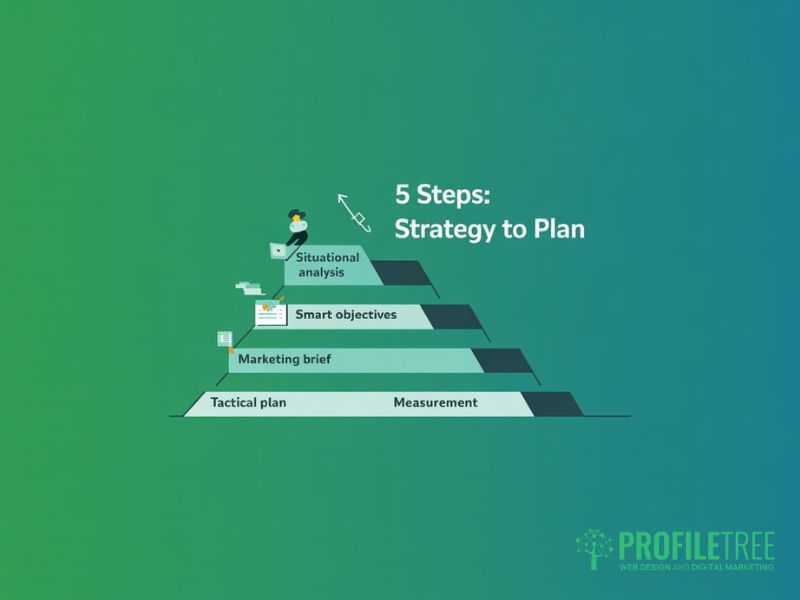
Defining strategy and plan separately is the easy part. The harder challenge is the handoff between them. This is where marketing strategy and planning break down for most businesses: the strategy exists as a slide deck that nobody looks at, while the plan is rebuilt from scratch each quarter with no strategic anchor. The five steps below give you a structured approach that works for SMEs without a corporate-scale planning team.
Step 1: Conduct a Situational Analysis
Before any marketing planning begins, you need an honest picture of where the business stands. A SWOT analysis, competitive benchmark, and performance review form the foundation. For UK businesses, factor in GDPR compliance and ASA guidelines from the outset.
Internal analysis covers current traffic, lead sources, conversion rates, and customer acquisition costs. External analysis covers competitor positioning, keyword gaps, industry search trends, and market dynamics. This data informs the strategic priorities you’ll plan around in subsequent steps.
Step 2: Define SMART Objectives
Marketing objectives must connect directly to business goals. For example, if the business goal is to grow revenue by 25%, the marketing objective might be to increase qualified leads by a proportionally higher figure to account for conversion variance. Each objective should be Specific, Measurable, Achievable, Relevant, and Time-bound.
Avoid objectives like “increase brand awareness” without attaching a measurable proxy. Vague objectives make it impossible to judge whether the plan worked and prevent meaningful accountability. Every objective in your marketing plan and strategy framework needs a named owner and a review date.
Step 3: Write the Marketing Brief
The marketing brief is the connective document that sits between the strategy and the plan. It translates strategic priorities into planning instructions: which audiences to prioritise, which channels to invest in, what messages to lead with, and what constraints the team is working within. Without it, marketing planning defaults to whatever was done last quarter rather than what the strategy actually requires.
The brief answers: what is the marketing plan vs marketing strategy telling us to focus on this period, and what are the guardrails? It prevents planners from making positioning decisions above their remit and stops senior leadership from second-guessing execution choices they have delegated. This is where most marketing strategy and planning processes either succeed or quietly fall apart.
Step 4: Build the Tactical Plan
With the brief in place, you can build the right types of marketing plan for the situation: an annual plan to govern the full year, campaign-level plans for specific launches, and channel plans for ongoing activity like SEO or email. Each initiative should be traceable back to a strategic objective in the brief.
For SMEs with lean teams, prioritise channels that compound over time. Organic search, email marketing, and content-driven social media typically offer better long-term returns than paid-only approaches. The marketing planning effort you put into owned channels pays dividends for years rather than stopping when the budget runs out.
Our content marketing services are built around this principle, designed to create content assets that serve both search visibility and lead generation simultaneously.
Step 5: Set a Measurement and Review Cadence
Plans without review schedules drift. Build a simple reporting cadence into the plan from the outset: weekly operational metrics (traffic, leads, spend), monthly performance reviews, and quarterly strategic check-ins to assess whether the plan is still aligned with the strategy. Marketing strategy and planning must remain connected even after the documents are written.
Key performance indicators should be set before campaigns launch, not after. Decide what success looks like at the campaign level (cost per lead, click-through rate, conversion rate) and at the strategic level (market share, revenue contribution). They’re different measures; neither should be tracked in isolation.
Using AI for Marketing Strategy and Planning: A Practical Framework
AI tools are now part of most marketing workflows, but they’re not equally useful at every level. The distinction between strategy and planning matters here too: using AI for strategic decision-making without the right inputs produces confident-sounding but directionless output, while using AI for execution without a clear brief wastes the tool’s real strengths.
The table below separates AI applications by phase. Strategy AI tasks require contextual judgement, business-specific input, and human validation. Plan AI tasks are better suited to volume, speed, and iteration. Marketing planning at the execution level is where AI delivers the clearest return on investment for most SME teams.
| Strategy AI (analysis and positioning) | Plan AI (execution and production) |
|---|---|
| Competitor and market research prompts | Content brief and copywriting prompts |
| Ideal customer profile and persona generation | Social media post scheduling and batching |
| Trend analysis and search intent mapping | Email sequence drafting and A/B variant creation |
| SWOT and gap analysis synthesis | Ad copy generation and creative testing |
| Value proposition and positioning refinement | SEO meta descriptions and title tag variations |
| Long-range scenario planning and forecasting | Weekly reporting summaries and dashboard commentary |
At the strategy level, AI is most useful as a research accelerator and sounding board. Feed it competitor positioning data, customer interview notes, and industry reports, and use it to synthesise patterns you might miss manually. At the marketing planning level, AI excels at drafting, scaling, and testing content across channels quickly.
ProfileTree delivers structured AI training for business teams across Northern Ireland and the UK, covering practical applications at both the strategic and operational levels. If your team needs to build AI capability into the marketing planning process, this is the right starting point.
UK and Ireland Business Context: What Changes Locally
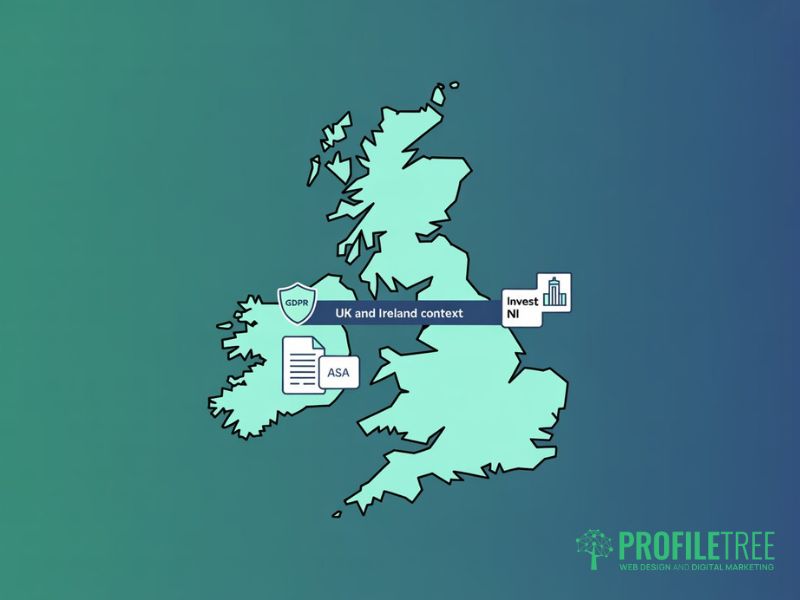
Most marketing strategy and planning frameworks are built for American corporate contexts and assume budget scales, team sizes, and regulatory environments that don’t apply to most UK and Irish SMEs. Several factors genuinely change how you should approach both documents in this market.
GDPR and First-Party Data Strategy
Any marketing plan and strategy that relies on data collection must be built around GDPR compliance from the outset. This affects strategic decisions about which data you can collect, how you can use it, and what consent mechanisms must be in place before a campaign goes live.
In practice, this makes first-party data more valuable in the UK and Irish market than in less-regulated jurisdictions. Email lists, organic search traffic, and direct referrals are assets that compound without regulatory risk. Build them into your plan from the start.
ASA Guidelines and Advertising Standards
The Advertising Standards Authority governs marketing claims in the UK. Any plan that includes advertising must comply with ASA guidelines on truthfulness, substantiation, and targeting restrictions. Strategy-level positioning claims need to be stress-tested against ASA standards before they reach the planning stage, not after a campaign has already run.
This is particularly relevant for financial services, health and wellness, and training providers, where claim substantiation is more stringent. Building compliance checks into the strategy brief prevents expensive campaign revisions and reputational risk down the line.
SME Planning Realities in Northern Ireland and Ireland
Most UK and Irish SMEs don’t have dedicated strategy teams. The MD or marketing manager typically owns both documents, which creates a real risk of conflating them. The practical fix is to treat them as separate documents with separate review cadences: the strategy reviewed annually or when market conditions shift materially, the marketing plan reviewed monthly and updated quarterly.
There are also local funding structures worth factoring in: Invest NI programmes, InterTradeIreland supports, and Digital Boost initiatives, all of which affect what is feasible in the plan. Build these into your strategic thinking before the marketing planning phase begins.
ProfileTree has been working with SMEs across Northern Ireland, Ireland, and the UK since 2011. Our digital strategy service is built for businesses that need structured strategic input without a full-time strategy team. We also offer digital training for marketing managers who want to build in-house planning capability.
Building Marketing Plans That Drive Business Growth
The marketing plan vs marketing strategy distinction isn’t a technicality. It determines how decisions get made, who makes them, how resources are allocated, and whether individual activities build toward something commercially meaningful or simply consume budget without direction.
Get the strategy right first. Define your audience, your positioning, and your competitive advantage before planning a single campaign. Then build the marketing plan and strategy as connected documents: the plan executes the strategy, with clear objectives, measurable KPIs, and a review cadence that keeps it honest. If you are still resolving a business plan vs marketing plan question, do that first: marketing objectives must align with the financial projections in the business plan.
For UK and Irish SMEs, GDPR compliance and ASA standards mean that both documents need to reflect local regulatory realities from the outset. Build first-party data assets and compliant advertising practices into the strategy phase, and the marketing planning work that follows will be faster, cheaper, and more defensible.
If you need support building either document, ProfileTree’s digital strategy service and digital marketing services are built for businesses that need structured, practical support without a corporate-scale team.
FAQs
1. Which comes first: the marketing strategy or the marketing plan?
The strategy must always come first. Without it, you’re allocating budget without knowing whether those activities serve the right audience or support the right positioning. Marketing planning without a strategy is what practitioners call random acts of marketing: campaigns that generate activity but don’t compound into competitive advantage.
2. Can you have a marketing plan without a marketing strategy?
Technically, yes, and many businesses do. But a marketing plan and strategy need each other to deliver real commercial results. Without a strategy as the anchor, campaigns get built around what’s trending rather than what the business needs to achieve, making it harder to hold a price premium or build a recognisable market position over time.
3. What is the difference between a business plan vs marketing plan?
A business plan covers the entire enterprise: financial projections, operational structure, and legal formation. A marketing plan sits within it and focuses specifically on how the business will attract, convert, and retain customers. The business plan vs marketing plan distinction matters most when raising funding: investors expect the marketing objectives to be consistent with the revenue targets in the business plan.
4. What are the different types of marketing plans?
The main types of marketing plan businesses use are: an annual marketing plan (high-level goals and budget allocation for the full year), a campaign plan (detailed execution for a specific product launch or promotional period), a channel plan (focused on a single medium such as email, paid search, or content), and a launch plan (for new products or markets). Choosing the right type depends on your planning horizon and the level of operational detail the team needs to execute.
5. How do marketing strategy and planning connect to business goals?
Marketing strategy and planning should both trace directly back to business goals. The strategy translates those goals into marketing objectives, defining which markets and audiences will deliver growth. The marketing plan then specifies the campaigns, channels, and budgets required to hit those objectives, so every pound of spend has a clear line of sight to a business outcome.