
How to Overcome Procrastination: 8 Steps to Boost Productivity
Table of Contents
Most people think of procrastination as laziness. It is not. Behavioural science consistently shows it is an emotional regulation problem: when a task triggers anxiety, boredom, or self-doubt, the brain seeks immediate relief by avoiding it. Understanding that distinction changes how you approach the fix.
This guide covers why procrastination happens, what types exist, and eight practical steps to break the pattern — whether you are a solo trader in Belfast, a manager running a team in Dublin, or a business owner trying to get your digital strategy off the ground.
What is Procrastination?
Procrastination is the act of voluntarily delaying a task despite knowing the delay will create negative consequences. The keyword is voluntary — it is not forgetting, prioritising, or rescheduling with good reason. It is avoidance in disguise.
The term has roots in the Latin procrastinare (to put off until tomorrow) and the Greek concept of akrasia — acting against your own better judgment. When you know you should update your website, send that proposal, or record that video for your business channel, and you choose to do something far less important instead, that is procrastination at work.
A delay becomes procrastination only when it incurs a cost: a missed deadline, a deteriorating project, or the compounding stress of an undone task.
Why We Procrastinate: The Emotional Root
Understanding why procrastination happens is the first step toward dismantling it. Most productivity advice skips straight to tactics, which is why so much of it fails. The actual mechanism is emotional, not logistical, and the strategies that work are the ones that address that root.
It is an Emotion Problem, Not a Time Problem
The most common mistake people make when trying to overcome procrastination is treating it as a scheduling issue. They add the task to a to-do list, block time in a calendar, and then still find themselves doing something else entirely when the time comes.
That is because the blocker is not a lack of time — it is a negative emotional association with the task itself. The brain’s limbic system, which governs emotional responses, fires ahead of the prefrontal cortex, which handles planning and decision-making. When a task feels threatening or uncomfortable, the limbic system pushes for avoidance before your rational brain can argue otherwise.
The Role of Self-Doubt and Fear
Fear of failure is one of the most consistent drivers of procrastination. A business owner putting off their website redesign for six months is rarely doing so because they are busy. More often, there is an underlying anxiety: what if it still does not generate enquiries? What if it looks wrong? What if competitors are doing it better?
Low self-efficacy — the belief that you are not capable of completing something well — produces the same avoidance cycle. The bigger and more visible the task, the stronger the pull toward delay.
Perfectionism as Avoidance
Perfectionism is procrastination in disguise. The all-or-nothing mindset — “if it cannot be done perfectly, I won’t start” — is not a high standard. It is a mechanism for avoiding the discomfort of imperfect output. A business owner who waits for the “right time” to start their content marketing, launch their YouTube channel, or build out their SEO strategy is almost always experiencing this pattern.
The 4 Types of Procrastinators
Not everyone procrastinates for the same reason, and applying the wrong solution to the wrong type tends to make things worse rather than better. The four-type framework below is a useful diagnostic starting point — most people recognise a primary type clearly, often with elements of a second.
The Perfectionist delays because the output might fall short of an internal standard. They over-prepare and under-execute.
The Worrier avoids tasks because they generate anxiety about outcomes. They focus on what could go wrong rather than what needs to be done.
The Defier resists tasks that feel externally imposed. They procrastinate as a form of passive rebellion against obligations they did not choose.
The Crisis-Maker performs best under pressure and unconsciously delays until urgency compels them to act. This pattern feels productive in the short term but accumulates long-term risk.
Identifying your type helps you choose the right counter-strategy in the steps section below.
The Effects of Procrastination on Business Performance
Procrastination is not a neutral habit. In a professional context, it creates a specific and compounding damage pattern: the task remains undone, the associated anxiety increases, the delay creates real consequences, and the weight of the undone task makes starting feel even harder. For business owners, that cycle has a direct commercial cost.
For small business owners across Northern Ireland and the wider UK, this pattern is particularly visible in digital tasks. Website updates, SEO improvements, content production, and social media strategies are among the most commonly delayed business activities — not because owners lack the intent, but because these tasks carry a combination of unfamiliarity, visibility risk, and no immediate hard deadline.
Procrastination and the Digital Skills Gap
A significant proportion of business procrastination around digital tasks stems from uncertainty rather than laziness. When an owner is not confident that they understand SEO, or does not know how to brief a video production, or is unsure whether their website is performing well, avoidance becomes the path of least resistance.
Structured digital training for business owners addresses this at the source: when you understand what you are doing and why, the psychological barrier to starting drops considerably. ProfileTree’s digital training programmes are designed specifically for SMEs across Northern Ireland, Ireland, and the UK who need to build practical digital skills rather than wade through generic theory.
Digital Procrastination: The Algorithm Trap
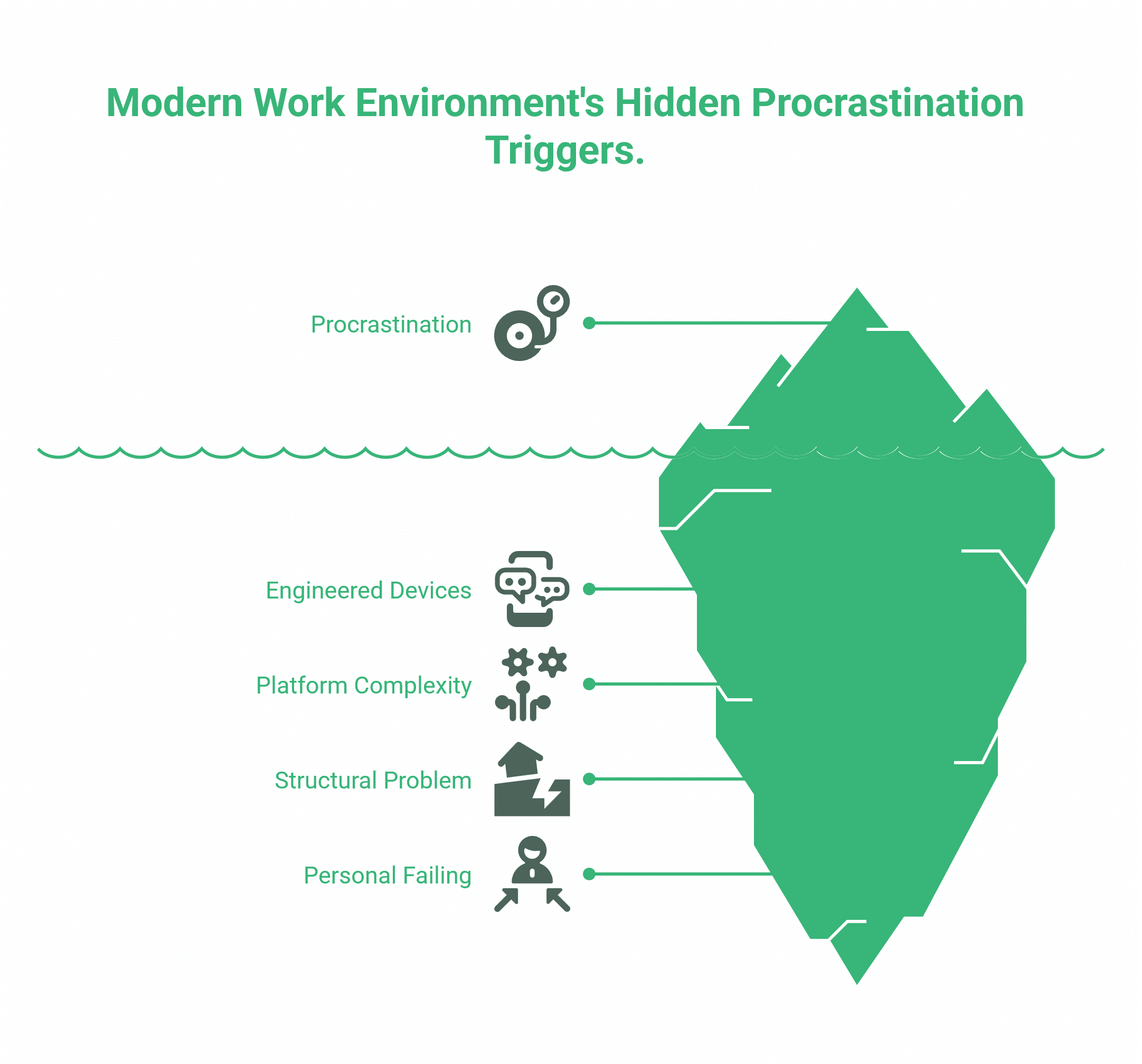
The modern work environment has added a layer of complexity that older advice about procrastination simply did not account for. The devices and platforms we use to do our work are also engineered, at significant expense, to keep us from doing it. Recognising this as a structural problem — not a personal failing — changes how you approach it.
Doomscrolling and the Infinite Scroll
Social media platforms, news feeds, and short-form video are engineered to capture attention through variable-reward mechanisms. The same dopamine loop that makes scrolling feel productive — you are always about to find something interesting — makes it one of the most effective procrastination vehicles ever designed.
Research into attention and digital behaviour shows that habitual social media use fragments concentration cycles, making it harder to sustain focus on complex, cognitively demanding tasks. Our own analysis of attention span data in the digital age highlights just how significantly this has shifted in recent years.
Remote and Hybrid Work in the UK Context
The shift to hybrid working patterns across the UK and Ireland has removed many of the social cues that naturally regulate work behaviour in office environments. Without visible colleagues, scheduled meetings as rhythm anchors, and the implicit accountability of shared physical space, self-directed work requires a level of internal structure that most people were never trained to build.
This has made procrastination more prevalent, not less, particularly in self-employed and micro-business contexts. Recognising this as a structural problem — one that can be addressed with tools, systems, and habits — is more productive than treating it as a personal failing.
How to Overcome Procrastination: 8 Practical Steps
The steps below are presented in the following order: the first three are diagnostic and psychological, the next three are structural, and the final two are habit-building. Working through them in sequence tends to be more effective than picking tactics at random, because the later steps work better once the earlier ones are in place.
1. Identify It Before You Fight It
Procrastination rarely announces itself. It hides behind rationalisation: you are waiting for more information, the timing is not right, you will be better placed to start next week. The first step is recognising the difference between a legitimate deferral and an avoidance pattern.
Signs you are procrastinating rather than prioritising: you keep the task on your list without taking a single preparatory action; you feel a faint but persistent anxiety when you think about it; you default to lower-stakes tasks whenever you open your laptop.
2. Forgive Yourself for the Delay
Research from Carleton University found that students who forgave themselves for procrastinating on the first exam were less likely to procrastinate before the second. Self-criticism does not fix procrastination — it feeds it. Shame reinforces avoidance because the brain protects you from things that feel bad.
Acknowledge the delay without judgment, then redirect attention to what a single first action would look like.
3. Name the Emotional Blocker
Before tackling the task itself, spend two minutes identifying what specifically makes it feel aversive. Is it fear of the outcome? Uncertainty about where to start? A sense that it will take longer than you can face right now? Naming the blocker reduces its power. It also often reveals that the real obstacle is smaller and more addressable than the general dread suggested.
4. Break the Task into Its Smallest Actionable Unit
The most effective counter to overwhelm is granularity. A task labelled “sort out the website” will sit undone for months. A task labelled “write three bullet points about what the website homepage needs to do differently” will take 10 minutes.
Work through any large project by identifying only the very next physical action required — not the end goal, but the next step. This approach, drawn from effective decision-making frameworks used in business planning, works because the brain responds to concrete, bounded tasks very differently from vague, open-ended ones.
5. Shift Your Internal Language
“I have to” positions the task as an imposition. “I choose to” returns agency to you. The practical change is minor, but the psychological effect of reclaiming ownership over a task rather than feeling coerced by it is measurable.
This applies directly to business owners managing their own digital workload. Reframing “I have to do something about my SEO” as “I am choosing to invest an hour this week in understanding where my traffic comes from” changes the emotional relationship with the task.
6. Build External Accountability
Accountability structures are one of the most reliably effective tools for overcoming procrastination, particularly in self-directed work environments. Committing to a deliverable in front of someone else — a colleague, a business partner, a coach, or an agency team — activates social commitment mechanisms that internal deadlines rarely do.
For business owners working on digital projects, this is one of the underappreciated benefits of working with an external team. When ProfileTree is managing a client’s SEO or content marketing programme, the regular review cycle creates natural accountability checkpoints that remove the “I’ll get to it later” option from the equation entirely.
7. Use Structured Time Techniques
Several evidence-based time management methods are specifically designed to reduce the activation energy required to start difficult tasks.
The Pomodoro technique works by committing to 25 minutes of focused work followed by a 5-minute break. The psychological contract is small enough that the brain does not resist starting. For creative or analytical work — writing a business case, drafting a content brief, reviewing SEO performance — this structure is particularly effective.
Temptation bundling pairs a task you have been avoiding with something you genuinely enjoy — listening to a specific podcast only while doing administrative work, for example. This creates a positive association with the previously aversive task over time.
8. Track Progress Visibly
Progress visibility is a documented motivator. When you can see forward movement, the brain experiences a reward response that makes continuing easier than stopping. A simple task board, a weekly review habit, or a shared project log all serve this function.
For teams managing content calendars, website improvement projects, or digital marketing campaigns, AI-assisted tools for business productivity are increasingly effective at removing the administrative overhead of tracking and freeing attention for the actual work. ProfileTree’s AI implementation service helps businesses identify which processes can be automated or simplified — which directly reduces the number of complex, multi-step tasks that tend to trigger avoidance in the first place.
Is It Procrastination, or Something Else?
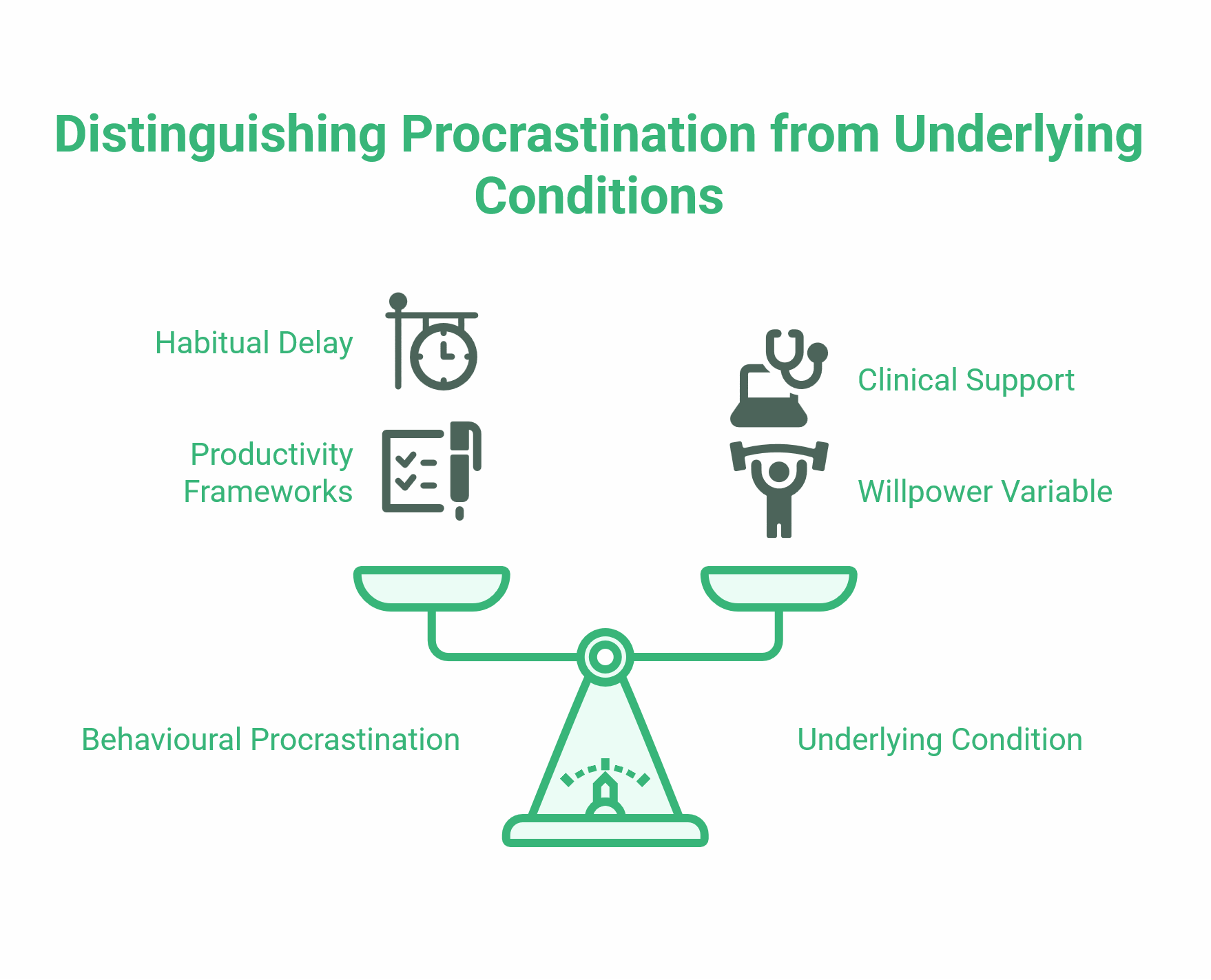
Not every persistent difficulty with starting or completing tasks is behavioural procrastination. For many people, the pattern reflects an underlying condition rather than a habit — and the appropriate response is clinical support rather than productivity frameworks. This section is worth reading before concluding that willpower is the only variable in play.
ADHD and Executive Dysfunction
For some people, persistent difficulty initiating tasks is not procrastination in the behavioural sense — it is a symptom of ADHD or another executive dysfunction condition. ADHD affects the brain’s dopamine regulation system, which makes initiating and sustaining tasks on non-stimulating work genuinely neurologically difficult rather than a matter of willpower.
If you consistently experience procrastination across all areas of life, struggle to complete tasks even when you want to, and find that standard productivity advice has no effect, it is worth discussing this with a GP. The NHS provides access to ADHD assessment and management support, and the distinction between habitual procrastination and executive dysfunction matters considerably for how you approach the problem.
Anxiety and Chronic Avoidance
Anxiety disorders frequently present with procrastination as a symptom. When avoidance is not selective but pervasive and accompanied by significant distress, it warrants professional support rather than self-help alone. NHS resources through the Every Mind Matters programme, and CBT-based interventions are worth exploring if this resonates.
Building Better Work Habits for the Long Term
Overcoming procrastination is not a one-time fix. It is a set of habits built over time, and the most durable approach combines three things: awareness of your personal triggers, structure that reduces reliance on willpower, and the skills or support that remove uncertainty as a barrier to starting.
For business owners, that third element is often the most overlooked. Developing strong communication and leadership qualities within a team reduces the number of decisions that pile up on any one person’s desk. Investing in personal and professional development builds the confidence and capability that makes starting difficult tasks feel less threatening.
If your business is consistently delaying its digital work — website improvements, content creation, SEO, video production — it is worth asking whether the barrier is time, capability, or emotional avoidance. In many cases, the most efficient solution is not building the skill yourself but working with a team that removes the task from your plate entirely.
As Ciaran Connolly, founder of ProfileTree, puts it: “The businesses we see making the most consistent digital progress are rarely the ones doing everything in-house. They are the ones who have been honest about where their time is best spent and who have brought in support for everything else.”
Conclusion
Procrastination is not a character flaw — it is a pattern with identifiable causes and practical solutions. Once you understand your triggers, whether that is perfectionism, anxiety, a skills gap, or digital distraction, the path forward becomes much clearer. Small steps, external accountability, and the right structure make a measurable difference. If the tasks piling up on your list are digital ones, talk to ProfileTree about how our training and digital services help businesses across Northern Ireland, Ireland, and the UK move forward.
FAQs
What is the main cause of procrastination?
The most consistent cause is emotional discomfort. The task generates anxiety, boredom, or self-doubt, and the brain seeks relief through avoidance. It is an emotional regulation problem, not a time management failure.
How do I stop procrastinating and start working?
Identify the smallest possible next action and do only that. Reduce the commitment to something the brain cannot reasonably resist — five minutes, one paragraph, a single phone call. Starting is consistently the hardest part; momentum builds quickly once you are in motion.
Is procrastination a symptom of ADHD?
It can be. ADHD affects executive function and dopamine regulation, which makes initiating and sustaining tasks genuinely difficult. If procrastination is pervasive and unresponsive to standard strategies, it is worth speaking with a GP about whether an ADHD assessment is appropriate.
What are the 4 types of procrastinators?
The most widely used framework identifies four types: the Perfectionist, the Worrier, the Defier, and the Crisis-Maker. Most people identify primarily with one type and secondarily with another. Knowing your type helps you choose the right counter-strategy.