
Digital Wellbeing and Mental Health in the Workplace: A UK Guide
Table of Contents
Mental health at work is shaped by how teams use technology. Most now run on screens from the first message of the morning to the last notification at night, and that shift has handed businesses real gains in flexibility and output. It has also blurred the line between work and rest in ways that quietly erode focus, sleep and staff retention. For employers across Northern Ireland, Ireland and the UK, digital wellbeing has moved from a soft perk to an operational and, increasingly, a legal concern.
This guide explains what digital wellbeing at work means, the costs of getting it wrong, the frameworks that help, and where UK and Irish law now sits on the right to switch off.
What is digital wellbeing in the workplace?
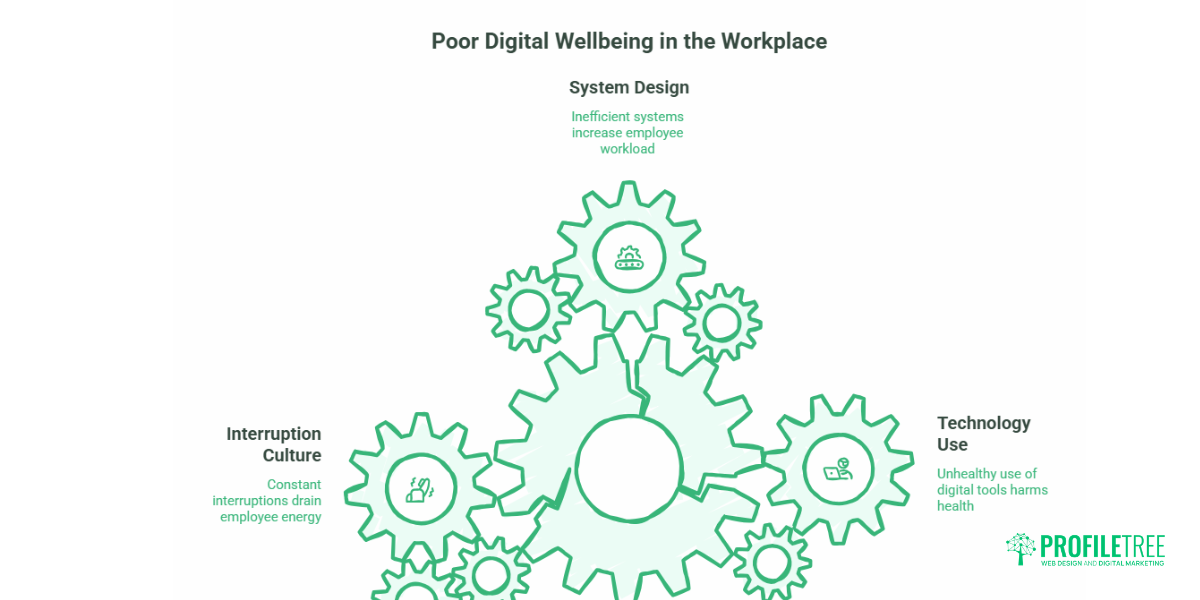
Digital wellbeing in the workplace is the healthy, intentional use of technology so that digital tools support productivity without harming an employee’s mental or physical health. It covers how people use email, messaging apps, video calls and devices during and outside working hours, and how an organisation designs its tools, policies and culture around that use.
The Chartered Institute of Personnel and Development (CIPD) frames digital wellbeing as part of broader employee wellbeing rather than a standalone IT issue. The point is balance: technology should reduce friction and free people for higher-value work, not generate a constant low hum of interruption that leaves staff drained by Wednesday.
Getting the basics right starts with the systems people use every day. A slow, badly structured intranet or website forces staff to work harder than they should, and clear internal tooling does the opposite. This is one reason businesses look at how their website development and internal platforms are built before blaming the team for poor focus.
The cost of digital fatigue on Mental health: technostress and burnout
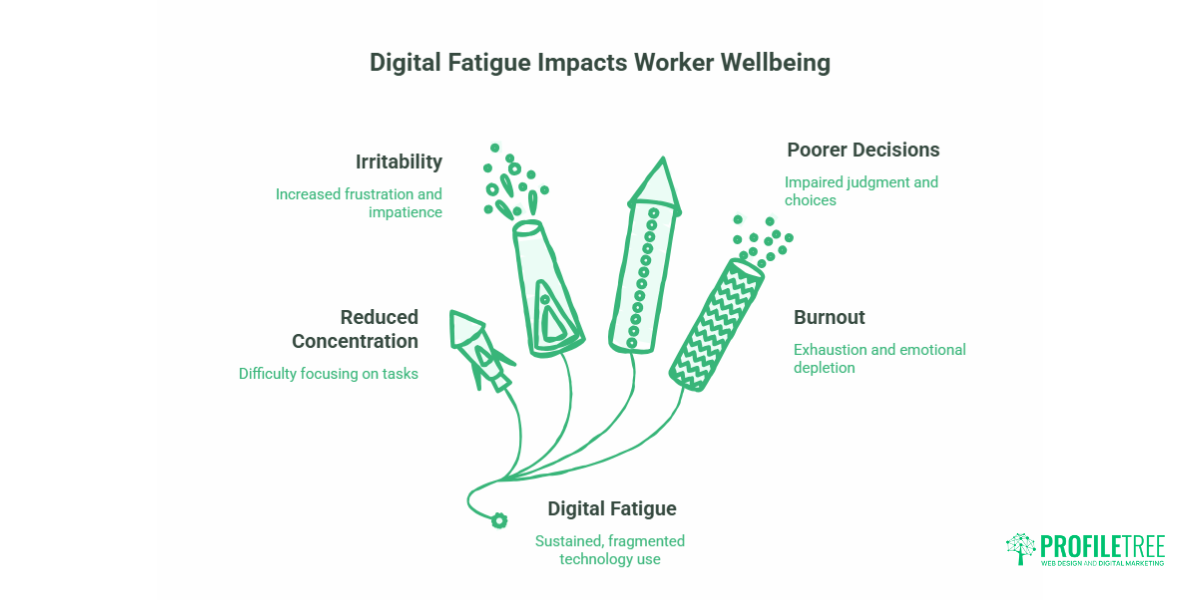
Digital fatigue is the exhaustion that builds from sustained, fragmented technology use. Left unmanaged, it shows up as reduced concentration, irritability, poorer decision-making and, eventually, burnout. The Health and Safety Executive treats work-related stress as a recognised hazard that employers have a duty to manage, and digital overload is now a meaningful contributor to it.
The “always-on” culture and digital burnout
Smartphones and remote-work tools have created an expectation that people are reachable around the clock. When a manager fires off an email at 9 pm, even without meaning to demand an instant reply, the signal lands. Staff feel pressure to respond, personal time gets interrupted, and recovery never fully happens. Over months, this is a direct path to burnout and higher turnover.
The fix is rarely a single policy. It usually involves resetting expectations around response times, auditing which notifications actually matter, and giving managers the skills to lead without leaning on constant availability. Practical workplace development and clearer communication habits do more here than any app. Unmanaged pressure also tends to surface as friction between colleagues, so it is worth understanding how digital overload feeds workplace conflict before it takes hold.
The frontline and deskless worker disconnect
Almost every guide on this topic assumes the reader manages a hybrid, desk-based staff drowning in Slack or Teams. That misses a large share of the UK and Irish workforce. Retail staff, hospitality teams, care workers and shift workers increasingly access rotas, group chats and manager messages on their own phones, often during unpaid hours.
For these workers, the problem is not meeting overload but intrusion: a WhatsApp group that pings on a day off, or a shift change demanded by message at 11 pm. Digital wellbeing policies need to name this group explicitly, set rules about which channels carry work instructions, and protect frontline staff from off-hours contact on personal devices.
Frameworks for a healthier digital workplace
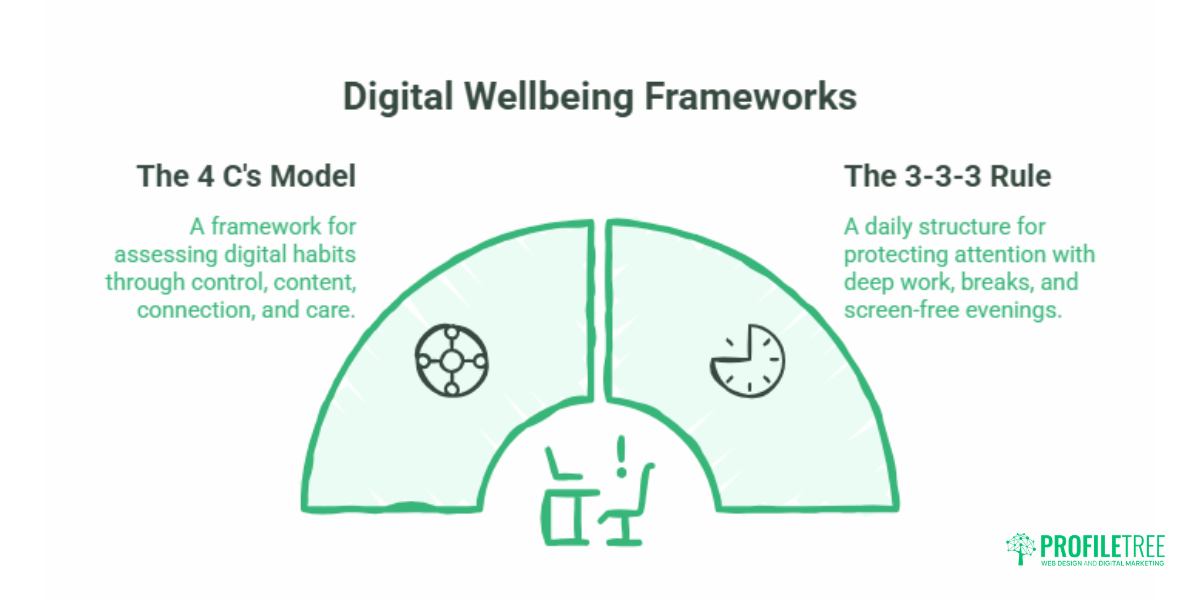
Two practical frameworks help move a business from good intentions to consistent habits. Both are simple enough to explain to a team in a single session.
The 4 C’s model: Control, Content, Connection, Care
The 4 C’s model, developed through the UK Government Digital Service, gives organisations four lenses for assessing digital habits.
- Control: Whether people feel they decide when and how they engage with technology, rather than being driven by it. In practice, this means default-off notifications outside hours and the ability to mute non-urgent channels.
- Content: The quality and relevance of what lands in someone’s inbox or feed. Batched, well-written updates beat a scattergun of half-formed messages.
- Connection: Using technology to strengthen working relationships instead of replacing them. A quick call can resolve in two minutes what a thread drags out over an afternoon.
- Care: Whether the organisation actively looks after people’s digital health, through training, check-ins and visible leadership behaviour.
The 3-3-3 rule for daily focus
The 3-3-3 rule is a daily structure for protecting attention. It splits the working and evening hours into three blocks: roughly three hours of uninterrupted deep work, three short movement or screen-free breaks during the day, and three hours free of work screens before sleep.
The deep-work block is where real output happens, so it should be protected from meetings and messages. The breaks reset attention and reduce physical strain. The evening wind-down matters because screen light close to bedtime suppresses melatonin and disrupts sleep, which then feeds straight back into next-day focus. The rule is a guideline, not a stopwatch, but it gives teams a shared language for healthy habits. Pairing it with light project management training helps teams plan work around those focus blocks rather than reacting all day.
Policy and compliance: the right to disconnect in the UK and Ireland
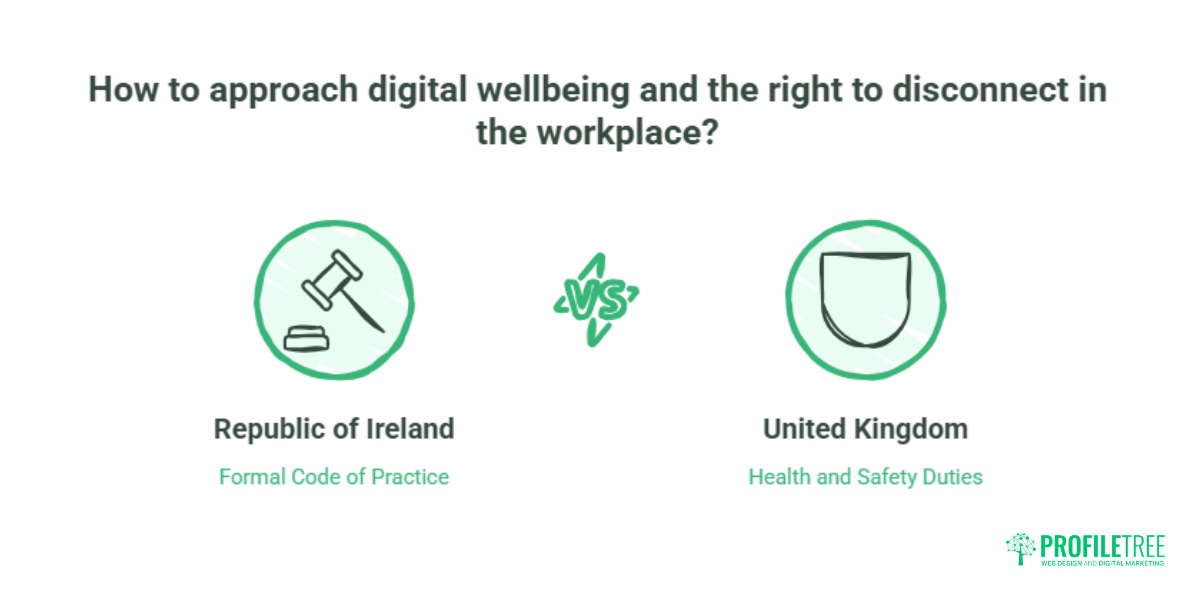
This is where digital wellbeing stops being optional. The legal picture differs across these markets, and employers operating in both the UK and Ireland need to know the distinction.
In the Republic of Ireland, there is a formal Code of Practice on the Right to Disconnect, overseen by the Workplace Relations Commission. It sets out an employee’s right not to routinely work outside normal hours, a right not to be penalised for declining out-of-hours work, and a duty on employers to respect colleagues’ right to switch off. While the Code itself is not standalone primary legislation, it is admissible in evidence in proceedings, which gives it real weight.
The UK has no statutory equivalent at the time of writing, though switching-off provisions have featured in worker-rights policy debates and proposed reforms. UK employers still carry duties under health and safety law to manage work-related stress, so a documented approach to out-of-hours contact is sensible risk management rather than mere goodwill.
| Jurisdiction | Status | What it means for employers |
|---|---|---|
| Republic of Ireland | Code of Practice on the Right to Disconnect (WRC) | Admissible in evidence; expectation of a written policy and respected switch-off times |
| France | Statutory right to disconnect | Larger employers must negotiate out-of-hours contact rules |
| United Kingdom | No standalone statute; covered indirectly by health and safety duties | Manage stress as a workplace hazard; switching-off rules under policy discussion |
Practical best practices for HR and leadership
Policy on paper changes little until daily behaviour shifts. The strongest results come from leaders modelling the habits they want, backed by a few clear rules.
Communication etiquette and notification auditing
Start by auditing how your team actually communicates. A short review usually surfaces obvious wins: messages that should have been emails, channels nobody needs, and an unwritten rule that everything deserves an instant reply.
- Set expected response windows by channel, so email is not treated like an emergency line.
- Use delay-send for messages composed outside hours, so a 9 pm draft lands at 8 am.
- Default meetings to 25 minutes to build in recovery between calls.
- Name the channels that carry urgent work instructions, and keep everything else off personal devices.
- Schedule no-meeting blocks to protect deep work.
Many of these habits are simply communication skills applied to digital tools. Teams that invest in the communication fundamentals and a clearer communication cycle tend to generate far less digital noise in the first place. The same applies to baseline digital confidence, since staff who are comfortable with their tools waste less energy fighting them, which is where general internet training earns its place.
Toxic versus healthy digital behaviours
| Toxic behaviour | Healthy alternative |
|---|---|
| Late-night emails with an expected instant reply | Delay-send so messages arrive in working hours |
| Constant, unstructured notifications | Batched updates at set points in the day |
| Back-to-back video meetings | Default 25-minute meetings with breaks between |
| Work group chats on personal phones at all hours | Clear channels and respected off-hours boundaries |
| Praising people for being “always on” | Recognising focused output and proper rest |
Using automation and AI to cut the load
A large slice of digital fatigue comes from repetitive admin: data entry, scheduling, chasing updates, and copying information between systems. This is exactly the work that sensible automation and AI tools can absorb, freeing people for the parts of the job that need human judgment.
The caution is to adopt deliberately. Bolting on tools without training tends to add complexity rather than remove it. Businesses that think carefully about which tasks to automate, and bring staff along through proper team training on AI tools, see the cognitive load drop. There is a growing body of practical experience on AI adoption for SMEs worth reading before committing to a platform, and AI also has a direct part to play in employee development when used to support people rather than just monitor them.
Ciaran Connolly, founder of ProfileTree, puts it this way: “The goal of workplace technology is not to keep people busier. It is to take the repetitive weight off their shoulders so they can do the work only a person can do, and then switch off at the end of the day.” [Flagged for Ciaran’s approval before publication.]
Building digital wellbeing into how your team works
Digital wellbeing is not a poster in the break room. It is a set of decisions about the tools you choose, the systems you build, and the habits leaders model. Start small: audit your communication, set a couple of clear boundaries, and protect deep-work time. Then formalise it into a written policy, especially if you operate in Ireland where the right to disconnect already carries legal weight.
For many businesses, the next step is structured help, whether that is digital training for the team, sensible AI training to introduce automation properly, or rethinking the internal systems staff rely on every day. The businesses that treat digital wellbeing as part of how they operate, rather than a one-off campaign, are the ones that hold on to good people.
Frequently asked questions
What is digital wellbeing in the workplace?
Digital wellbeing in the workplace is an employee’s ability to maintain a healthy, balanced and intentional relationship with technology at work. It means digital tools support productivity and communication without compromising mental or physical health.
What are the 5 pillars of workplace wellbeing?
The five pillars are usually given as physical, mental, financial, social and digital wellbeing. Digital wellbeing is often called the fifth pillar because, in modern hybrid and remote work, how people use technology influences all of the others, from sleep and stress to how connected they feel to colleagues.
What is the 3-3-3 rule for digital wellness?
The 3-3-3 rule is a daily structure for protecting attention. It suggests around three hours of uninterrupted deep work, three short movement or screen-free breaks across the day, and three hours free of work screens before sleep. The aim is sustained focus during the day and proper cognitive recovery at night.
Does the UK have a legal right to disconnect?
The UK does not currently have a standalone statutory right to disconnect like France or the Republic of Ireland’s official Code of Practice. However, switching-off rules have featured in worker-rights policy discussions, and UK employers still have duties under health and safety law to manage work-related stress, which covers digital overload.
How do you measure digital wellbeing among employees?
It is best measured through anonymous engagement surveys focused on perceived work-life balance, by reviewing message and email traffic outside core hours, and by tracking absence or turnover linked to stress. Patterns matter more than single data points.
What are some examples of digital wellbeing initiatives?
Common examples include no-meeting Fridays, agreed response-time expectations so there is no pressure to reply after a set hour, email delay-send as standard for out-of-hours messages, digital detox challenges, and protected deep-work blocks. The most effective initiatives are modelled by leadership rather than just announced.