
Faceless Digital Marketing: A Professional UK Guide
Table of Contents
Faceless digital marketing means building a brand that earns attention through what it publishes, not through a founder’s face on camera. It has a reputation problem. Search the term, and you will mostly find side-hustle courses promising fast money from stock footage reels.
That noise hides a serious point. Plenty of established UK and Irish businesses, from accountants to software firms, now grow audiences without putting a single person on screen. The strategy is sound. The hype around it is not.
This guide separates the two. You will see what faceless marketing actually is, why professional firms are adopting it, the content types that work, the UK setup details most articles skip, and a practical way to launch without buying a course.
What Faceless Digital Marketing Really Means
Faceless digital marketing is a brand strategy where the company, not an individual personality, carries the message. The brand still has a voice, a point of view, and a recognisable style. What it lacks is a human figurehead doing pieces to the camera. Before looking at tactics, it helps to pin down the definition and clear away the confusion that surrounds it.
The Definition Behind the Term
At its core, a faceless brand replaces the personal spokesperson with consistent assets: writing, design, audio, and data. Think of a finance newsletter you trust without knowing the editor’s name, or a software tutorial channel you follow for the clarity rather than the host. The brand becomes the entity people remember.
This is why a sharp digital strategy matters more here than in personality-led marketing. With no charismatic founder to paper over gaps, the planning and the content have to do all the work.
Some of the best-known faceless brands prove the point. Buffer built a following on careful writing rather than its founders’ profiles, Morning Brew grew a newsletter audience on the quality of its briefings, and Gymshark scaled early on product and community before any founder became a public figure. None relied on a face to carry the brand in its formative years.
Faceless Branding Versus Anonymous Posting
There is a difference between faceless branding and simply posting anonymously. Faceless branding is deliberate. It has guidelines, a tone, and a visual system. Anonymous posting is just hiding. One builds recognition over time; the other builds nothing.
A real faceless brand is identifiable within seconds, even with the logo cropped out. That recognition comes from repeated choices: the same colour palette, the same sentence rhythm, the same way of framing problems.
Why People Confuse It With a Scam
The term took a hit because of Master Resell Rights schemes. These repackage a generic course and sell the right to resell it, dressed up as “faceless digital marketing”. The product is often the course itself, sold to the next buyer in a chain. That model deserves its bad name. A genuine faceless brand sells real services or original products and answers for its quality in public. For businesses building this kind of brand, digital strategy support can help turn those principles into a consistent approach across content, channels, messaging, and audience engagement.
Why Professional Firms Are Adopting Faceless Marketing
The faceless trend started with B2C creators, but the more interesting shift is happening among service businesses. Accountants, solicitors, consultants, and agencies are realising they can build authority without anyone going on camera. A few reasons explain the move, and each one matters more for an established firm than for a hobbyist.
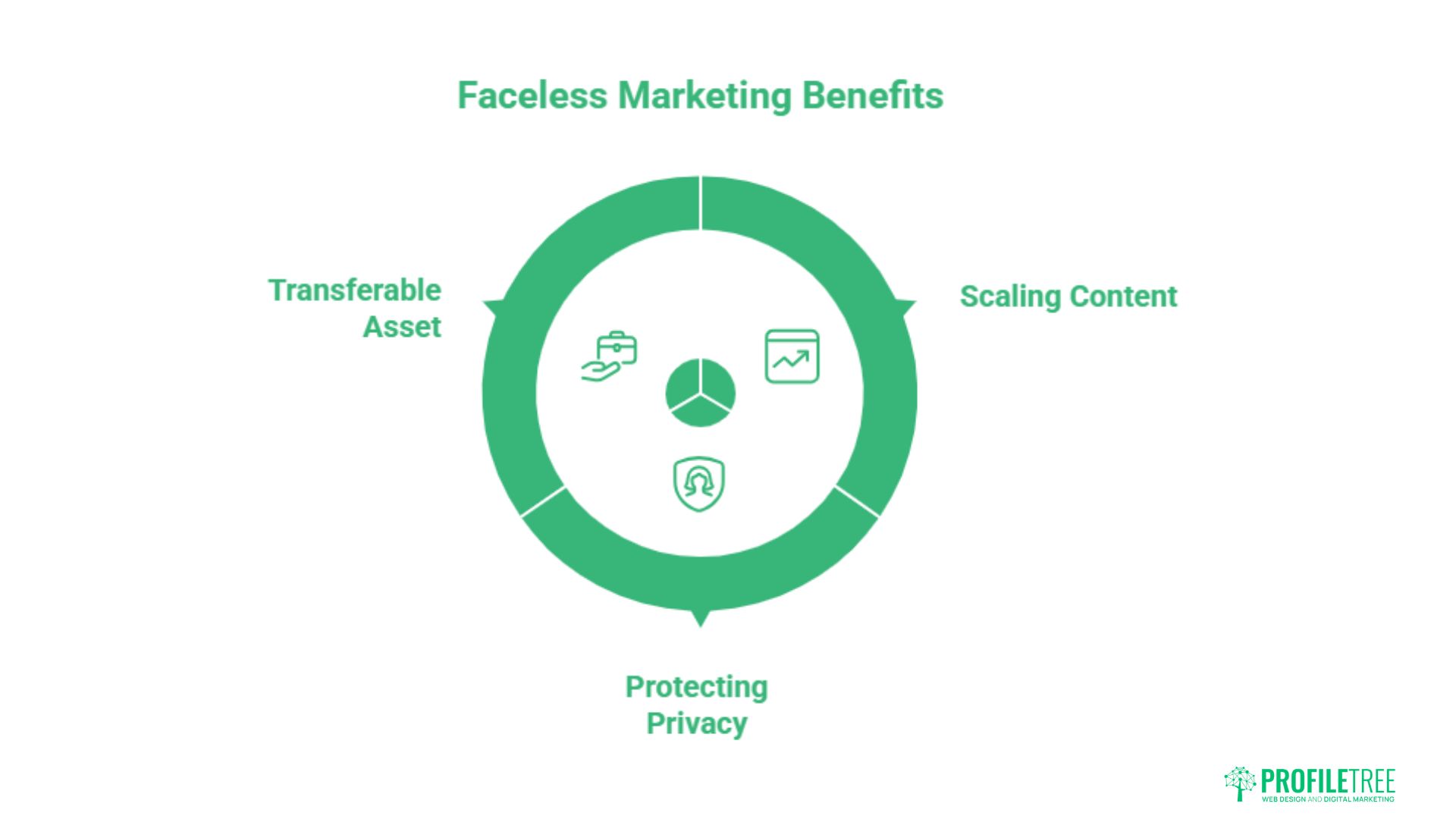
Scaling Content Without a Single Voice
When a brand depends on one person, that person becomes the bottleneck. Holidays, illness, or a simple bad week all stall the output. A faceless system spreads creation across a team working to shared guidelines, so production keeps moving regardless of who is at the desk that day. Strong content marketing built on documented standards is what makes that handover possible.
Protecting Privacy and Reducing Personal Risk
Many business owners simply do not want their personal life tied to their commercial brand. A faceless approach keeps that line clear. It also insulates the business from the reputational fallout that can follow when a public figure says something divisive. The brand carries on; no single reputation puts the whole operation at risk.
Building a Transferable Business Asset
A brand built around one founder is hard to sell. The value walks out the door with the person. A faceless brand, by contrast, is an asset in its own right: the audience, the content library, and the systems transfer cleanly to a new owner. For firms with an eye on eventual exit, that distinction is worth real money. You can see the same logic play out in the way major media brands operate, much like the destination coverage in this guide to cities to visit in Northern Ireland, where the publication, not any presenter, holds the trust.
That transferability also changes how you should document the work from day one. Written guidelines, a tidy asset library, and repeatable processes are not just tidy housekeeping; they are the very things that turn a content habit into a saleable business. A faceless brand that lives only in the founder’s head is no more transferable than a personality-led one.
The Four Faceless Content Types That Actually Work
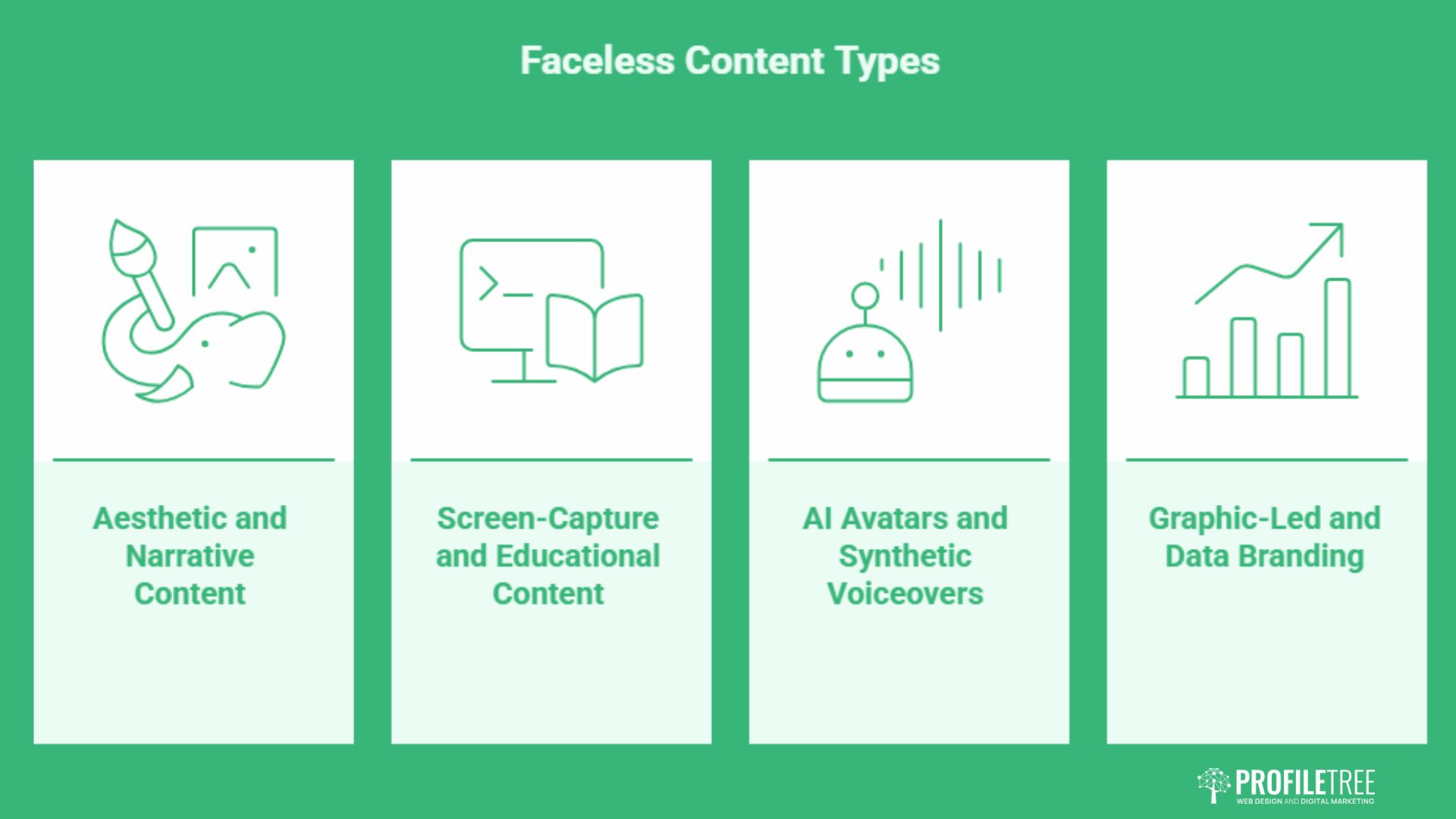
Not all faceless content is equal. The aesthetic reel that suits a lifestyle product would sink a professional services firm. Picking the right format for your audience is the decision that separates a faceless brand that grows from one that quietly stalls. These four types cover almost every practical case, and most strong brands blend two or three.
Aesthetic and Narrative Content for B2C
This is the style most people picture: clean stock or original footage, on-screen text, a calm voiceover. It works for products with a strong visual or emotional pull, such as homeware, food, or travel. Done well, it feels editorial. Done badly,y it feels like every other reel in the feed, which is why original footage beats library clips every time. For brands leaning on this format, the shift toward short-form video has made the bar both lower to clear and harder to stand out on.
Screen-Capture and Educational Content for B2B
For software firms and consultants, the screen is the star. Walkthroughs, tutorials, and recorded demos teach the audience something useful without anyone appearing on camera. This format builds authority fast because it shows competence directly. A SaaS company explaining a tricky workflow earns more trust than one talking about how trustworthy it is.
The format also ages well. A clear tutorial on a common problem keeps drawing search traffic long after a personality-led clip would have scrolled out of sight. That durability is what makes screen-capture content such a good match for B2B firms that sell on expertise rather than reach.
AI Avatars and Synthetic Voiceovers
AI tools now generate convincing voiceovers and presenter-style avatars, which let a small team produce video at a pace that used to need a studio. The quality has improved enough for routine explainer content, though audiences still spot the seams on emotional or high-stakes messages. Used sensibly, it is a production aid, not a replacement for judgement. If you are weighing these tools, structured AI training helps a team adopt them without producing obviously generic output, and tools like Canva AI sit at the accessible end of that toolkit.
Graphic-Led and Data Branding
Some of the strongest faceless brands lead with design and original data. Carousels, infographics, and charts travel well on LinkedIn and turn a firm’s own numbers into shareable proof. This suits research-led businesses and any company sitting on data nobody else has published. One caveat worth heeding: as AI content detection improves, audiences and platforms increasingly reward original analysis over recycled summaries.
A Reality Check on the Pros and Cons
Faceless marketing is a strong fit for some businesses and a poor one for others. Going in with clear eyes about the trade-offs saves wasted effort. The honest picture is that the model trades a little short-term warmth for a lot of long-term durability, and whether that bargain suits you depends on what you sell and how you want to grow.
Where the Approach Genuinely Wins
The strengths are real. Output scales beyond one person, the brand becomes a sellable asset, privacy stays intact, and search-led content compounds quietly over months. For research-led firms and service businesses with deep expertise, these advantages stack up fast. The model also rewards discipline, which suits owners who would rather build systems than perform.
The Honest Drawbacks to Plan For
The weaknesses deserve equal billing. Trust takes longer to build without a human anchor, so early traction can feel slow. Standing out is harder in crowded visual niches where every account uses the same stock clips. And a faceless brand demands genuine consistency, because there is no charisma to fall back on when the content dips. Going in expecting fast results is the quickest route to disappointment.
Casual Versus Professional Faceless Marketing
The clearest way to see the difference is to compare the side-hustle version with the professional one. The table below sets the two side by side, and the gap between them explains why so much faceless content fails to convert,t while a smaller, serious slice performs well.
| Factor | Side-hustle faceless marketing | Professional faceless brand |
|---|---|---|
| Content base | Generic stock footage and reels | Original data, design, and expertise |
| Goal | Resell a course or template | Sell real services or products |
| Trust signal | Income screenshots | Case studies, reviews, and transparent pricing |
| Time horizon | Promised fast returns | Compounding results over months |
| Main channel | Short-form social only | Search, email, and owned media |
UK Business Setup and Practical Launch Steps
This is where most guides go quiet. They describe the content and skip the admin, yet the admin is what turns a faceless project into a real business in the UK or Ireland. Sorting the structure, the compliance, and the platform mix early saves a lot of unpicking later. The steps below are the ones professional operators actually take.
Legal Structure and Tax Basics
A faceless brand still has a legal owner. Most UK sole operators start as self-employed and register with HMRC, then move to a limited company as income grows and liability matters more. If you sell digital products to consumers, VAT rules on cross-border digital sales can apply sooner than you expect, so it is worth checking the thresholds before your first sale. The official guidance on working for yourself from HMRC is the right starting point.
All prices and figures in this guide are indicative UK examples and correct at the time of writing; use them as a benchmark rather than fixed quotations.
Data Protection and Brand Ownership
Collecting emails or running ads means handling personal data, which brings data protection duties even for an anonymous-looking brand. Registering with the regulator and publishing a clear privacy policy are non-negotiable. Securing your brand name across platforms and, where it matters, as a trade mark protects the asset you are building. The UK guidance on data protection for businesses sets out the baseline.
Choosing Your Channels and Tool Stack
Resist the urge to be everywhere. Two or three channels chosen for where your buyers actually spend time will outperform a thin presence on six. A practical faceless tool stack, design tool, scheduling tool, and an email platform commonly run in the region of £30 to £80 a month at the start. Email deserves particular attention because it is the one channel you own outright, and this primer on using email well covers the fundamentals. A coordinated social media marketing approach then ties the channels together rather than treating each as a silo.
Building Trust and Driving Results Without a Face
The hardest question facing any faceless brand is simple: why should anyone trust a business with no visible human behind it? The answer is that trust comes from evidence, not from eye contact. Several mechanisms do the job a friendly founder would otherwise do, and search visibility turns that trust into measurable results.
Replacing Personal Rapport With Proof
Social proof carries the weight here. Reviews with real numbers, named case studies, third-party mentions, and transparent pricing all signal reliability. A consistent brand voice does the rest, because familiarity itself builds comfort over time. People come to trust the pattern even when they never learn a name.
Ciaran Connolly, founder of ProfileTree, puts it this way: “For our clients running a faceless marketing strategy, search becomes the engine. The content has to answer the question better than anyone else, because there is no personality carrying it. When it does, the traffic is steadier than anything a single spokesperson could sustain.”
Why SEO Is the Faceless Brand’s Best Friend
Search engines do not care who is on camera. They reward content that answers the query well, which makes search engine optimisation the natural home for a faceless brand. Ranking pages keep working long after publication, delivering qualified visitors without the constant pressure of feeding a personal feed. For most service firms, this is the channel that justifies the whole approach.
Using AI and Automation to Stay Personal at Scale
Faceless does not mean impersonal. Automated email sequences, smart segmentation, and well-built AI chatbots let a small brand respond quickly and relevantly to thousands of people. The trick is to use automation for speed and consistency while keeping a human reviewing the edge cases, so the brand feels responsive rather than robotic.
The video below from ProfileTree covers content and SEO fundamentals that sit at the centre of any faceless strategy.
Conclusion
Faceless digital marketing is a sound, scalable strategy once you strip away the get-rich-quick noise around it. For UK and Irish firms, the win comes from treating it professionally: real value, original content, proper legal setup, and search visibility doing the heavy lifting. Build the system, protect the brand as an asset, and let consistent quality earn the trust a face would otherwise provide.
Thinking about a faceless approach for your business? Talk to ProfileTree about a strategy built around your goals.
FAQs
Is faceless digital marketing a scam?
No, the strategy itself is legitimate. The confusion comes from Master Resell Rights courses that use the term as a sales hook. A real faceless brand sells genuine products or services and stands behind their quality in public. Judge any opportunity by whether it creates real value or simply resells the same course down a chain.
Do I need to be tech-savvy to start?
Not especially. Modern design, scheduling, and AI tools have lowered the barrier considerably. If you can use a word processor and follow a tutorial, you can produce a basic faceless content pipeline and improve from there.
How do I make a faceless brand feel human?
Lead with a clear brand voice and genuine engagement. Reply to comments, answer questions properly, and write the way a knowledgeable colleague would speak. Humanity in a faceless brand comes from how it communicates and how it treats its audience, not from a face. Consistency in tone does more for connection than any single personality could.
Can I use faceless marketing for B2B on LinkedIn?
Yes, and it works well. Document posts, data-led carousels, and clear infographics perform strongly with professional audiences and need no presenter. Many B2B firms build real authority this way.
What is the best niche for faceless marketing in the UK?
High-intent, information-hungry niches suit it best, such as personal finance, property, business software, and professional services. These audiences actively search for answers, which rewards the search-led content a faceless brand produces. The strongest niche is usually the one where you hold genuine expertise or original data.