
Marketing Automation for UK Businesses: Strategy and Statistics
Table of Contents
Most small and mid-sized firms do not lack marketing ideas. They lack the hours to run them. Marketing automation closes that gap by handling the repetitive work, the follow-up emails, the lead routing, and the social scheduling, so a two or three-person team can operate like a much larger one.
This guide is written for UK SMEs rather than global enterprises. It covers what the technology actually does, what the current adoption figures show, which trends matter in 2026, and how to start without a six-figure budget.
You will find practical benchmarks, realistic costs, and a phased plan you can begin this quarter. Where a figure comes from published research, the source is named so you can check it yourself.
What Marketing Automation Does for a Smaller Team
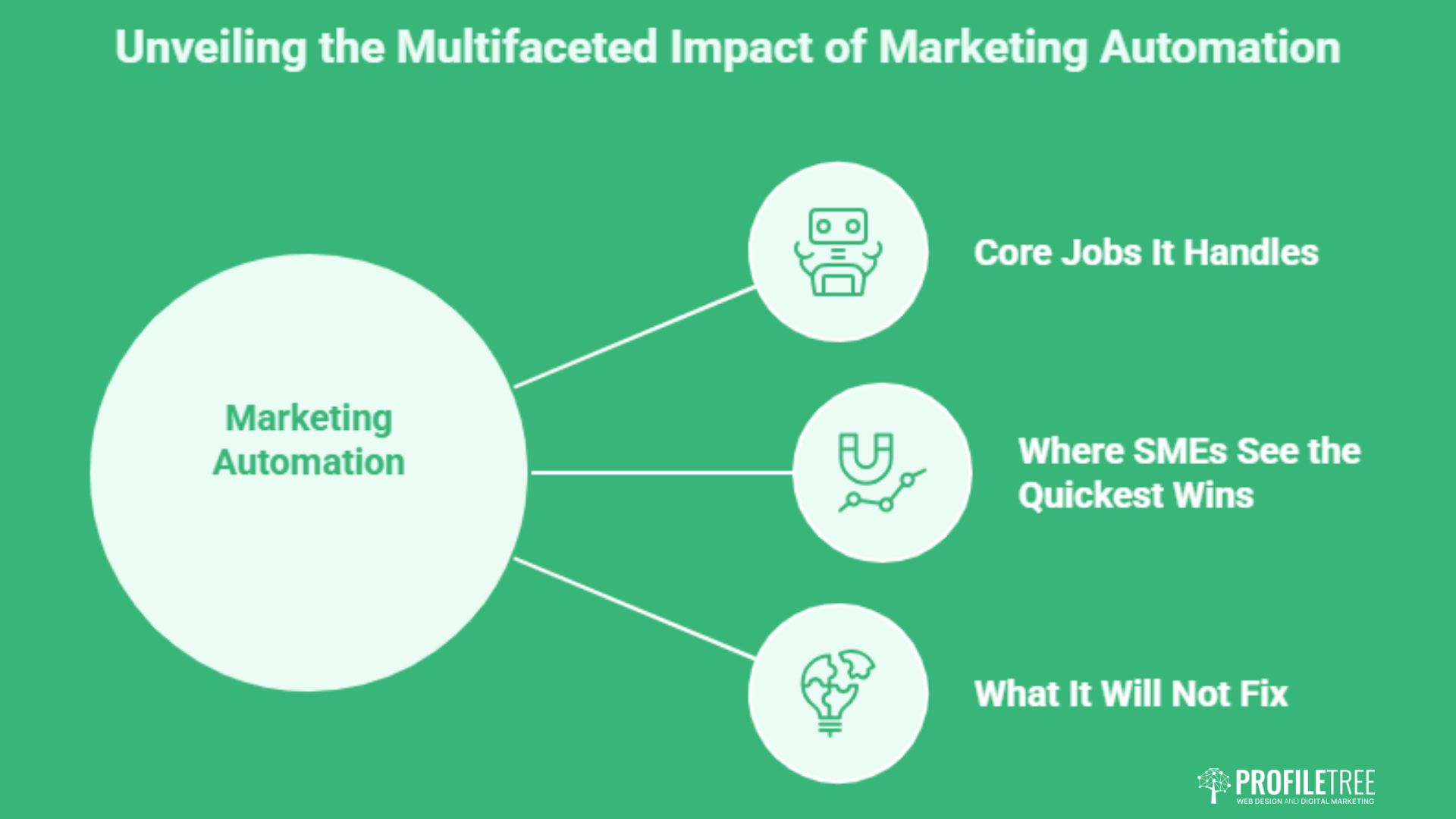
Marketing automation is software that runs marketing tasks for you once you set the rules. Think scheduled emails, lead scoring, social posting, and customer journeys that trigger from a person’s behaviour rather than a calendar. For a smaller business, the appeal is simple: fewer manual jobs, more consistent output, and a record of what worked. ProfileTree, the Belfast digital agency, sets this up for clients who want the output of a bigger team without the headcount.
The Core Jobs It Handles
At its most useful, automation takes the jobs you keep forgetting and makes them reliable. Welcome sequences send themselves. Abandoned baskets get a nudge. Quiet customers receive a re-engagement message before they drift away for good.
These tasks share one trait: they are rule-based and repetitive, which is exactly what software does well. Anything needing judgement, a tricky complaint, a bespoke proposal, stays with a person. If you are building these flows around email first, our guide on email marketing basics is a sensible starting point before you layer automation on top.
It helps to picture a single customer moving through one of these flows. Someone downloads a guide from your site, so the system tags them and sends a short welcome the same day. Three days later, if they have opened that email, a second message offers a relevant case study; if they have not, they get a gentler reminder instead. A week on, a member of your team gets an alert only for the contacts who clicked through, so the human attention lands where interest is real. None of that needs daily input once it is built, and every step is something a small team would struggle to do by hand at any scale.
Where SMEs See the Quickest Wins
The fastest return usually comes from email rather than anything more elaborate. It is cheap to run, it talks directly to people who already know you, and the results are easy to read. A weekly newsletter and two or three triggered sequences will often outperform a sprawling multi-channel setup that nobody has time to maintain.
Social scheduling is the second common win. Batching a fortnight of posts in one sitting frees up the daily scramble, and it keeps your feed active even during busy weeks. ProfileTree builds these foundations through its social media services, then expands once the basics are steady.
What It Will Not Fix
Automation amplifies whatever you feed it. Poor data, a weak offer, or a confusing website will simply be repeated faster and to more people. The tooling does not write your strategy or fix a broken sales process; it executes one that already works.
That is why the planning comes first. A short digital strategy review before you buy any platform tends to save far more than it costs, because it stops you from automating the wrong things.
The State of Marketing Automation in 2026
Adoption has moved from early-mover advantage to baseline expectation. The figures below give a sense of scale, though the more useful question for a smaller firm is not whether to adopt but where to start.
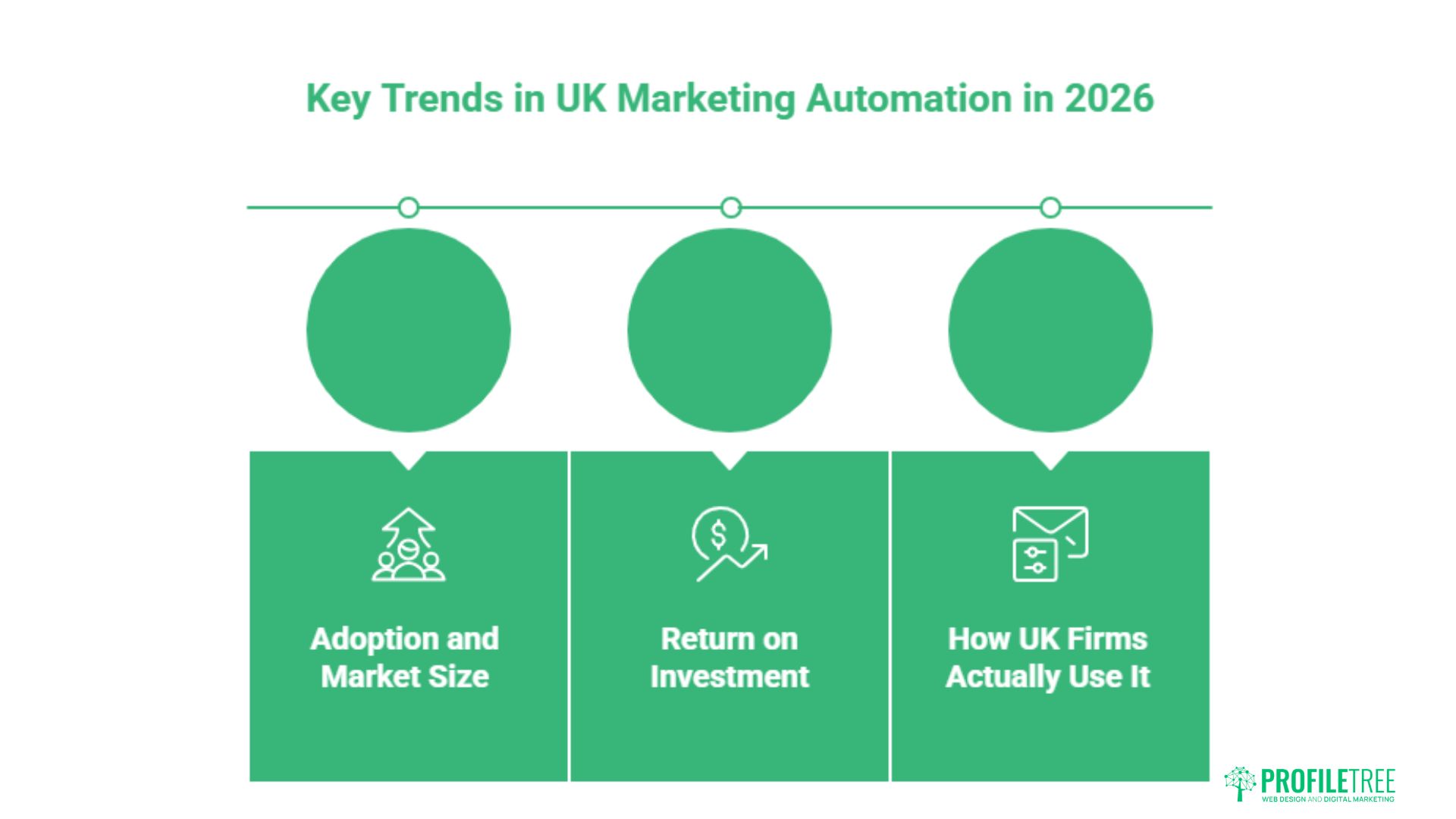
Adoption and Market Size
Marketing automation is now mainstream rather than niche. Industry surveys consistently place adoption among marketers at roughly three-quarters and rising, and analyst forecasts put the global market on a double-digit annual growth path through the end of the decade. The direction of travel is not in dispute, even where individual figures vary between sources.
For a UK SME, the practical reading is straightforward: your competitors are increasingly automating their follow-up, so a slow, manual sales process now stands out for the wrong reasons. A prospect who fills in a form on a Friday afternoon and hears nothing until Monday has often moved on by the time anyone replies. Automation removes that delay without anyone working the weekend.
Return on Investment
Return is the figure owners care about most, and it is also the one most often quoted without a source, so treat headline ROI claims with caution. What holds up across studies is the pattern rather than the precise multiple: automated nurture tends to lift qualified lead volume and shorten the time sales teams waste on cold prospects.
The honest version is this. Automation rarely creates demand on its own. It captures and converts demand you are already generating, which is why pairing it with active content marketing matters so much.
A worked example helps. Say you run a 200-person email list and convert 1% of enquiries by hand because follow-up is slow. A single automated nurture sequence that replies within minutes, rather than days, often lifts that conversion simply by reaching people while they are still interested. No new traffic, no bigger ad spend, just faster and more consistent follow-through on demand you already paid to create. That is the kind of return a small business can actually measure, and it shows up in revenue rather than vanity metrics.
How UK Firms Actually Use It
Usage has spread well beyond email. Social management, content distribution, and basic customer-service responses are now common automated functions, and most firms run several tools rather than one. That fragmentation is worth watching, because disconnected tools create more admin than they remove.
The sensible pattern for a smaller team is to pick one platform that covers email and basic CRM, get it working properly, then add channels only when each new one earns its keep.
The 2026 Trends That Matter for SMEs
Plenty of trend pieces chase features that only large enterprises can use. The four below are the ones a smaller UK business can act on this year without a specialist team.
AI-Assisted Content and Drafting
AI now sits inside most automation platforms, mainly as a drafting aid. It produces first drafts of emails, social captions, and subject-line variations, which a person then edits for accuracy and voice. The time saved is real; the risk is publishing the raw output, which readers increasingly recognise.
Ciaran Connolly, founder of ProfileTree, notes: “AI is changing how our clients produce content, but it works best as a starting point rather than a finished article. The teams getting value from it are the ones still applying judgment to what it writes.” Learning where the tooling helps and where it misleads is covered in our piece on AI content detection.
Personalisation Beyond First Names
Personalisation has moved past inserting a name at the top of an email. Modern tools adjust content based on what someone has bought, browsed, or clicked, so a returning customer sees something different from a first-time visitor. For SMEs, this was once out of reach; it is now built into mid-range platforms.
The catch is data. Useful personalisation needs clean, joined-up records, which is why tidying your contact list is the unglamorous first step that makes everything afterwards work.
The table below shows how personalisation typically scales as a small business matures its data, from a starting point most firms can reach in a week to the kind of behavioural targeting that once needed an enterprise budget.
| Stage | What it does | Data needed |
|---|---|---|
| Basic | Name and company merged into emails | A tidy contact list |
| Segmented | Different messages by customer type or location | Tagged or grouped contacts |
| Behavioural | Content adjusts to browsing and purchase history | Connected website and CRM data |
Chatbots and Conversational Tools
Chatbots have improved from clumsy FAQ boxes into tools that qualify leads, answer common questions out of hours, and hand over to a human with context attached. For a small team, that means enquiries get a response at 9 pm without anyone being on shift.
Set expectations honestly on the page so visitors know they are talking to software, and route anything sensitive to a person quickly. ProfileTree builds these through its AI chatbot work, tuned to the questions a specific business actually receives.
Joined-Up Channels
The shift worth noting is from single-channel campaigns to connected journeys, where an email, a social touch, and a website message all reference the same customer action. You do not need every channel to benefit. Two channels that talk to each other beat five that do not.
Start with the two where your customers already are, usually email and one social platform, and connect those before adding more. A focused digital marketing plan keeps that expansion deliberate rather than scattered.
Getting Started Without Overspending
This is where most SME projects succeed or stall. The technology is rarely the problem; the order of operations is. A clear sequence keeps costs down and adoption high.
All prices and figures in this guide are indicative UK examples and correct at the time of writing; use them as a benchmark rather than fixed quotations.
What It Realistically Costs
Entry-level automation suited to a small business commonly runs from a modest monthly subscription into the low hundreds of pounds, scaling with contact volume and features. The licence is rarely the whole cost, though setup time, data cleaning, and the hours to build and maintain flows all add up, and these hidden costs catch out firms that budget only for the software.
Plan for the full picture: subscription, initial configuration, and a few hours a month to keep things running. Budgeting for that maintenance is what separates a tool that earns its keep from a subscription nobody touches.
Watch for two costs in particular that vendors rarely advertise. The first is contact-tier creep: pricing usually steps up as your list grows, so a tool that looked cheap at 500 contacts can double once you pass a threshold. The second is integration. Connecting your automation tool to your website, your booking system, or your accounts package sometimes needs a paid connector or a developer’s time. Neither is a reason to avoid automation, but both belong in the budget from day one rather than as a surprise three months in.
The Skills Question
Most platforms are marketed as easy to use, and the basics genuinely are. The gap tends to appear in configuration and integration, where a small mistake quietly sends the wrong email to the wrong list. Many smaller teams lack the in-house experience to set this up cleanly the first time.
You can close that gap in two ways: bring in help for the initial build, or invest in digital training so someone on the team owns it properly. The second route costs more upfront and pays back through independence.
A Phased Plan You Can Start Now
Skip the big-bang launch. Begin with one high-value flow, a welcome sequence or an abandoned-enquiry follow-up, and prove it works before adding anything. This keeps the early effort small and the early results visible, which is what wins internal buy-in.
Once that first flow runs reliably, add a second, then connect a channel. A staged rollout over a few months almost always beats an ambitious launch that collapses under its own complexity. The same patient approach underpins lasting results in search engine optimisation, where steady compounding beats short bursts.
A simple three-month shape works for most small teams. Month one is foundations: clean the contact list, pick a platform, and build one flow. Month two adds a second flow and basic reporting, so you can see open rates, clicks, and which messages drive enquiries. Month three connects a channel, usually social or your website forms, and reviews what the first two months actually produced. By the end, you have evidence rather than assumptions, which makes the next decision, whether to expand or refine, far easier to justify to whoever holds the budget.
Keeping the Human Element
Automation should free your time for the work that needs a person, not remove people from the conversation. Customers can usually tell when every message is machine-made, and the firms that get the most from automation are the ones that still pick up the phone when it matters. A practical rule works well here: automate the routine and the high-volume, but route anything emotional, expensive, or unusual straight to a human.
A booking confirmation can be automatic; a complaint about a late order should not be. For a sense of how channels like social and search keep working together, see how social marketing supports the wider effort.
Conclusion
For an SME in the United Kingdom, marketing automation is less about chasing every feature and more about reclaiming time. Start with email, keep your data clean, add channels only as each one earns its place, and keep a person involved where judgment counts. Done in that order, a small team can run marketing that looks far bigger than its headcount, without the budget of one.
Ready to put this in place? Talk to ProfileTree about setting up a match for your team and budget.
FAQs
What is the difference between a CRM and marketing automation?
A CRM is the database that stores your customer and prospect records and tracks sales activity. Marketing automation is the engine that acts on that database, sending the emails, scoring the leads, and triggering the journeys. Many SME platforms now bundle a light CRM with automation, so smaller firms often buy both in one tool rather than running them separately.
How much does marketing automation cost for a small business?
Entry-level tools start at a low monthly subscription and rise into the low hundreds of pounds as your contact list and feature needs grow. The subscription is only part of it. Budget also for initialisation, setup, data cleaning, and a few hours each month to maintain your flows. Figures here are indicative UK benchmarks rather than fixed quotes.
Does marketing automation replace marketing staff?
No. It removes repetitive manual tasks, so your team can spend time on strategy, creative work, and the conversations that need a human. The role shifts rather than disappears, moving from sending individual emails towards designing and improving the systems that send them.
What should an SME automate first?
Email is almost always the best starting point. It is inexpensive, it reaches people who already know your business, and the results are easy to measure. Begin with one welcome sequence and one follow-up flow, prove they work, then expand.
Do I need technical skills to run it?
The day-to-day basics are designed to be manageable without a developer. The harder part is the initial configuration and connecting tools together, where mistakes are easy to make. Many SMEs get the first build done with outside help, then train a team member to run it day to day.